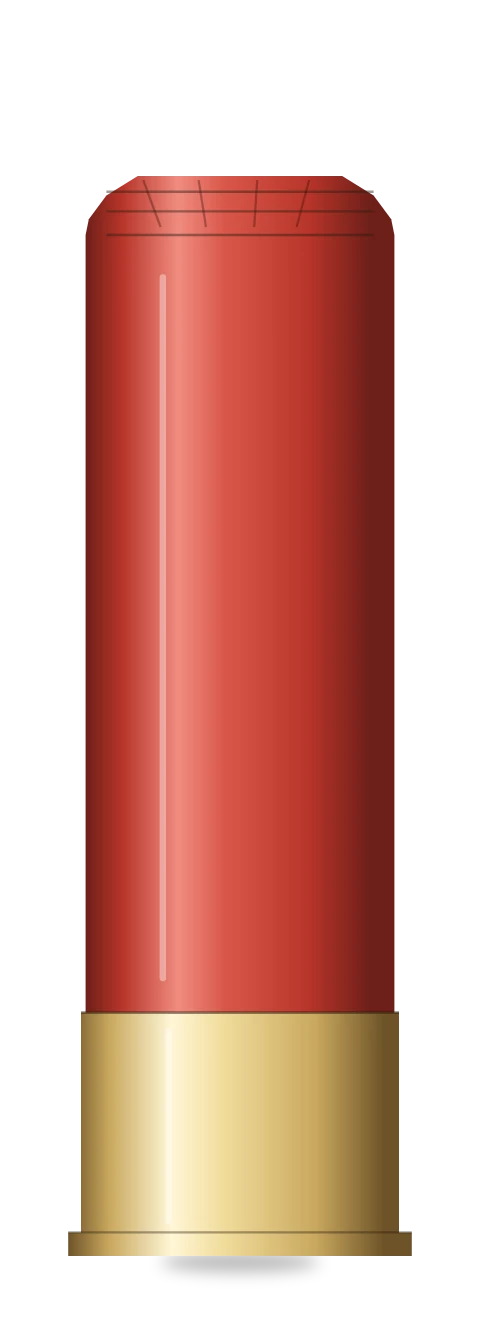
01 / At a glance
The basics
- Origin
- Traditional bore system
- Introduced
- Long-standing
- Ignition
- Centerfire
- Case form
- Rimmed shotshell
- Diameter
- Gauge
- Case length
- 70 / 76 / 89 mm
Rounded values to help you identify the cartridge, not manufacturing drawings. See the cited standard for exact dimensions and tolerances.
Do not mix it up
12/70, 12/76 and 12/89 are three different shell lengths. A shell must never be longer than your chamber. Shell length is measured after firing, with the hull opened flat, so check the chamber length marked on your barrel.
The 12 gauge is the most widely used shotgun cartridge in the world. It is the standard for waterfowl, upland birds, clay target shooting, turkey, deer with slugs, and home defense. If you are buying your first shotgun, there is a good chance it will be a 12.
Unlike a rifle cartridge, a shotshell has many variables: shell length, shot size, shot material, load weight and choke. This guide walks through each one so you can match the shell to the job. It is a reference, not a loading manual, and it contains no handloading data.
A short history
The word "gauge" comes from an old system. A 12 gauge bore is the diameter of a lead ball that weighs one-twelfth of a pound, so twelve such balls make a pound. The system is much older than modern shotshells and was used for muzzle-loading guns.
The modern 12 gauge developed with the paper and then plastic shotshell in the late 1800s and 1900s. Smokeless powder, plastic wads and better shot cups made patterns tighter and more consistent. Today the 12 gauge is made in many shell lengths and hundreds of loads.
Its popularity grew because it hits a sweet spot. It carries enough shot for larger birds and game, it is available in every style of shotgun, and its ammunition is sold everywhere.
Why it is so popular
The 12 gauge does a lot of jobs with one gun. Change the shell and choke and the same shotgun can hunt ducks, break clay targets and take a deer with a slug. That flexibility is the main reason it outsells every other gauge.
Another reason is supply. Shells, chokes, barrels and accessories are available in nearly every store that sells ammunition, and the choice of loads is far wider than for 20 gauge or .410 bore.
Specifications at a glance
| Specification | Value |
|---|---|
| Nominal bore diameter | About .729 in (18.5 mm) |
| Common shell lengths | 2¾ in (70 mm), 3 in (76 mm), 3½ in (89 mm) |
| Maximum average pressure, 2¾ and 3 in (SAAMI) | 11,500 psi |
| Maximum average pressure, 3½ in (SAAMI) | 14,000 psi |
| Common shot loads | 7/8 oz to 2 oz; most game loads are 1 to 1⅜ oz |
| Typical velocity | About 1,150 to 1,600 ft/s depending on load |
| Common shot sizes | #9 to BB and larger buckshot |
| Slug weight | Usually 1 oz (437 grains); some heavier |
Values are rounded for reference. Exact dimensions and tolerances are in the SAAMI and C.I.P. standards cited at the end of this page.
Strengths and limits
The 12 gauge is a flexible all-rounder. It also has real trade-offs.
| Advantage | Limitation |
|---|---|
| Huge range of loads for every purpose | Heavier loads recoil hard, especially in light guns |
| Shotguns are available in every price range | Some game loads are overkill for small birds |
| Ammunition is common and easy to find | Heavy shotguns can be tiring to carry on long hunts |
| Interchangeable chokes tune the pattern | Rules on shot material vary by place and species |
Shot size and what it does
A rifle bullet is one projectile, so we plot a trajectory. A shotshell fires many pellets, so pellet size and count matter more. Smaller shot gives more pellets and denser patterns but less energy per pellet. Larger shot gives fewer pellets with more punch.
The chart shows lead shot. Steel, bismuth and tungsten alloys have different densities, so the pellet count per ounce is different. Check the box for the actual numbers.
| Use | Common shot sizes | Notes |
|---|---|---|
| Skeet and clay targets | #8 and #9 | Dense patterns at short range |
| Trap and sporting clays | #7½ and #8 | More reach for longer targets |
| Dove and quail | #7½ to #8 | Small, fast birds |
| Pheasant | #4 to #6 | Larger and tougher birds |
| Ducks (steel) | #2 to #4 | Steel is lighter, so larger sizes are used |
| Geese | #2 to BB | Large birds, longer range |
| Turkey | #4 to #6 | Tight chokes and dense patterns |
Pellet counts are approximate for lead shot and vary slightly by maker. Always read the box and pattern your shotgun, because every barrel and choke combination shoots a little differently.
Recoil and shooter comfort
Recoil comes from the weight of the shot charge, the velocity and the weight of the gun. A light 7/8 oz target load in a heavy semi-automatic is mild. A 3½ inch magnum load in a light pump gun is punishing. Gas-operated semi-automatics soak up recoil better than pumps or fixed-breech guns.
A good stock fit, a recoil pad and a lighter load help. Lower-recoil loads exist for most uses, and they are a good choice for beginners and for long days at the range. A flinch costs more targets than a lighter load ever will.
How to choose a shell
Start with the job, then pick the shell length, the shot or slug, and the load weight.
Shell length
| Length | Typical use | Notes |
|---|---|---|
| 2¾ in (70 mm) | Targets, upland birds, home defense, slugs | The standard; fits every 12 gauge |
| 3 in (76 mm) | Waterfowl, turkey, heavy slugs | Needs a 3 inch chamber or longer |
| 3½ in (89 mm) | Large geese, turkey | Needs a 3½ inch chamber; heavy recoil |
Shot, slug and buckshot
Birdshot is for birds and targets. Buckshot uses a few large pellets and is used for larger game and defense where legal. A slug is a single heavy projectile for deer and similar game, and it needs the right barrel and choke.
Lead and non-toxic shot
Many wetlands and some other areas require non-toxic shot such as steel, bismuth or tungsten alloys. Steel is harder and lighter than lead, so it patterns differently and may need a more open choke. Check the rules where you hunt.
How to choose a shotgun
The right shotgun depends on what you plan to shoot. These are the points that matter most.
- Action. Pump-action shotguns are reliable and affordable. Semi-automatics soften recoil and offer fast follow-up shots. Break-action over-and-under guns are classic for clay targets and upland birds.
- Chamber length. Check the barrel. A 3 inch chamber fires 2¾ and 3 inch shells. A 2¾ inch chamber must only fire 2¾ inch shells.
- Barrel length. Longer barrels, 28 to 30 inches, give a smooth swing for target work. Shorter barrels, 18 to 24 inches, are handier for slugs, turkey in brush and defense.
- Interchangeable chokes. Screw-in tubes let you change the pattern for each use. Check that steel shot is approved for your tubes.
- Fit and weight. A gun that fits you shoots better and hurts less. Try several before you buy.
Chokes and patterning
A choke is a narrowing at the muzzle that controls how tightly the shot spreads. A tighter choke holds the pattern together for longer shots. A more open choke gives a wider pattern for close targets.
| Choke | Constriction | Typical use |
|---|---|---|
| Cylinder | None | Close range, slugs, defense |
| Improved cylinder | Light | Upland birds, skeet |
| Modified | Medium | All-around, 30 to 35 yards |
| Improved modified | Medium-heavy | Longer upland and waterfowl shots |
| Full | Tight | Turkey, long-range birds, trap |
Patterning means firing at a large sheet of paper at a set distance, usually 40 yards, and counting the pellets inside a 30 inch circle. It shows how your gun, load and choke work together. Pattern before the season, not during it.
Practical uses
Waterfowl
Ducks and geese call for non-toxic shot, usually steel, and often 3 inch shells. Pick the shot size for the bird and keep shots within a range your pattern can handle.
Upland birds and small game
Pheasant, grouse, quail and rabbit are classic uses. Lighter 2¾ inch loads and open to modified chokes give a good balance of carry and comfort.
Clay target shooting
Trap, skeet and sporting clays are the main reason many people own a 12 gauge. Light target loads keep recoil low over hundreds of shells.
Turkey, deer and home defense
Turkey hunting uses dense patterns from tight chokes. Deer hunting with slugs is limited to short ranges. For home defense, many people choose a short-barreled shotgun, but training, safe storage and local law matter more than the gun.
12 gauge vs similar gauges
The table lists the gauges most often compared with the 12. Figures are rounded and apply to common 2¾ and 3 inch shells.
| Gauge | Bore diameter | Common shell lengths | Typical shot load | Typical use |
|---|---|---|---|---|
| 12 gauge | .729 in | 2¾, 3, 3½ in | 1 to 1⅜ oz | All-purpose |
| 16 gauge | .662 in | 2¾ in | ⅞ to 1⅛ oz | Upland birds |
| 20 gauge | .615 in | 2¾, 3 in | ¾ to 1 oz | Upland birds, youth, light guns |
| 28 gauge | .550 in | 2¾ in | ¾ oz | Light upland, skeet |
| .410 bore | .410 in | 2½, 3 in | ½ to ¾ oz | Small game, skeet, first guns |
Against the 20 gauge, the 12 carries more shot and has more choices of loads, but it recoils more in a gun of the same weight. A 20 is often a better choice for youth and smaller shooters, and a modern 20 handles most upland work well. The .410 is small and light but its low shot count makes it harder for beginners to hit with.
Care and storage
Clean the barrel and action after use, and wipe down the gun after wet hunts to prevent rust. Remove choke tubes occasionally, clean the threads and apply a little grease so they do not seize. Store shells in a cool, dry place and keep guns and ammunition locked away from children.
Safety and common mistakes
- Never load a shell longer than the chamber. A 3 inch shell in a 2¾ inch chamber can raise pressure dangerously. Read the barrel marking.
- Never mix gauges. A 20 gauge shell can slip into a 12 gauge chamber and lodge in the barrel, and a 12 gauge shell fired behind it can burst the barrel. Keep different gauges separate.
- Match the choke to the shot. Steel shot through a tight choke can damage a barrel unless the choke is rated for steel. Slugs need the right choke and barrel.
- Check the barrel before you shoot. A bore blocked by snow, mud or a stuck wad is dangerous.
- Keep the muzzle pointed in a safe direction, and keep your finger off the trigger until you are ready to fire.
- Know your target and what is beyond it. Shot can travel far, and birdshot can carry hundreds of yards.
- Wear eye and ear protection every time.
Frequently asked questions
What does 12 gauge mean?
The gauge number comes from how many lead balls the size of the bore it takes to make one pound. For a 12 gauge, twelve balls weigh a pound. Smaller numbers mean larger bores.
Can I shoot 3 inch shells in a 2¾ inch chamber?
No. A shell longer than the chamber can raise pressure dangerously. Check the chamber length stamped on the barrel and only use shells at or below that length.
Which shot size should I use?
It depends on the target. Use #8 or #9 for skeet, #7½ to #8 for trap and doves, #4 to #6 for pheasant and turkey, and #2 to BB for geese.
What choke is best for general use?
Modified is the classic all-rounder. Improved cylinder is better for close birds and skeet, and full is better for turkey and long shots. Pattern your own gun to be sure.
Is steel shot safe in any shotgun?
No. Check the manufacturer's instructions and the choke rating. Many modern barrels and chokes are rated for steel, but older guns with tight chokes may not be.
How much recoil does a 12 gauge have?
It depends on the load and the gun. A light target load in a heavy semi-automatic is mild. A 3½ inch magnum in a light gun is heavy. Lower-recoil loads and good gun fit help a lot.
What is the effective range of a 12 gauge?
With birdshot, effective range is typically 30 to 50 yards, depending on shot size and choke. With slugs, it is generally limited to about 100 yards, and less with smoothbore barrels and open sights.
Is a 12 gauge good for home defense?
Many people use it for that purpose. It is powerful at close range, but it needs training, safe storage and attention to what lies beyond the target. Follow your local laws.
Sources
Sources reviewed · 29 October 2026