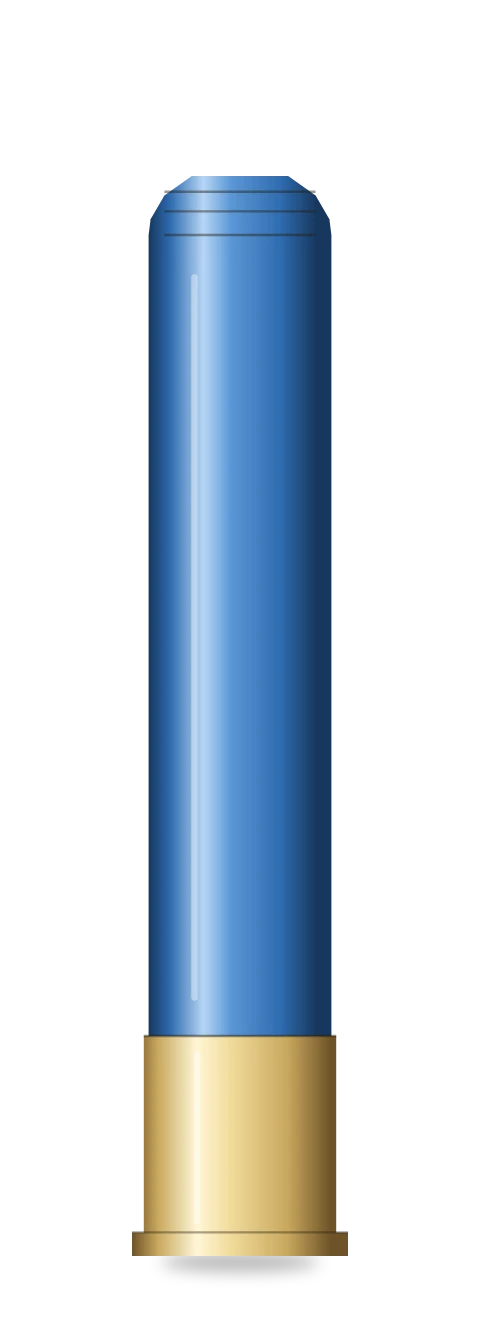
01 / At a glance
The basics
- Origin
- Bore diameter in inches
- Introduced
- Long-standing
- Ignition
- Centerfire
- Case form
- Rimmed shotshell
- Diameter
- .410 in
- Case length
- 64 / 76 mm
Rounded values to help you identify the cartridge, not manufacturing drawings. See the cited standard for exact dimensions and tolerances.
Do not mix it up
A .410 shell can slip into a 12 or 20 gauge chamber and lodge in the barrel. Never keep different gauges together. Do not use a 3 inch shell in a 2 1/2 inch chamber.
The .410 bore is the smallest shotgun size in common use. The bore is .410 inch across, the shells carry only 1/2 to 3/4 ounce of shot, and the guns are light and gentle to shoot. It is a traditional first shotgun for young shooters, a favorite of small game hunters and pest controllers, and one of the four gauges in skeet competition.
Like any shotshell, the .410 has several variables: shell length, shot size, load weight and choke. This guide explains each one, shows how to choose a shell and a shotgun, and compares the .410 with the 28 gauge, the 20 gauge and other sizes. It is a reference page, not a loading manual, and it contains no handloading data.
A short history
Most shotguns are named by gauge, an old British system based on the number of lead balls of the bore diameter that weigh a pound. The .410 is the exception. It is named for the diameter of its bore in inches, .410, which is 10.4 mm. If it followed the gauge system, it would be about a 67 gauge.
Small-bore shotguns appeared in the 19th century, and the .410 became a standard size in the early 20th century. It was sold as a light gun for small game, for boys and for shooters who wanted a quiet gun for pest control. Single-shot .410 guns were among the cheapest shotguns made, and generations of hunters learned on them.
The .410 has stayed in production because it is useful. It is also now sold in pump guns, lever-action guns, doubles and even revolvers designed to fire .410 shells, although many of those are controversial. It is not a gun for beginners who want an easy time hitting flying targets, but it is a good gun for learning safe handling.
Why it is so popular
The first reason is recoil. A 1/2 ounce load in a five pound gun has very little kick, and young shooters can fire it without being afraid. The sound is also lower than larger gauges, which helps new shooters stay relaxed.
The second reason is size and weight. Single-shot and pump .410 guns are small, light and cheap. They fit in a vehicle, a closet or a farm shop, and they are easy for a young person to carry.
The third reason is the work it can do. For rabbits, squirrels and similar small game at close range, and for pest control around the farm, the .410 does the job without a lot of noise or damage. It also has the kind of challenge that some experienced shooters enjoy.
Specifications at a glance
| Specification | Value |
|---|---|
| Bore diameter | .410 in (10.4 mm) |
| Common shell lengths | 2½ in (64 mm) and 3 in (76 mm) |
| Maximum average pressure (SAAMI) | 12,500 psi (2½ in); 13,500 psi (3 in) |
| Common shot loads | 1/2 oz in 2½ in shells; 11/16 oz in 3 in shells |
| Typical velocity | About 1,135 to 1,300 ft/s for shot loads |
| Common shot sizes | #9 to #4; #8 and #7½ are most common |
| Slug weight | About 1/5 to 1/4 oz |
| Typical gun weight | About 4½ to 6½ lb |
Values are rounded for reference. Exact dimensions and tolerances are in the SAAMI and C.I.P. standards cited at the end of this page.
Strengths and limits
The .410 is the lightest-kicking shotgun, and it pays for that. Know the trade-offs.
| Advantage | Limitation |
|---|---|
| Very light recoil and low noise | A very small shot charge, so thin patterns |
| Light, cheap, easy-to-carry guns | Short effective range, usually under 25 to 30 yards |
| Good for small game and pest control | Hard to hit moving targets; not a beginner's clay gun |
| Useful for teaching safe gun handling | Shells cost more than 12 or 20 gauge for what they do |
The .410 is often sold as the right first gun for a child. That is true for recoil, but not for hitting moving targets. A small pellet count makes it harder to hit a bird or a clay target, and a frustrated beginner can lose interest. For many young shooters, a light 20 gauge or a 28 gauge with a small load is a better choice for flying targets. The .410 is excellent for a standing target or small game at close range.
Slugs and buckshot
Slug and buckshot loads exist for the .410, but they are low in energy. They are sometimes used for pest control, for a quick, close shot, or in states that restrict deer rifles. The energy is far below that of larger gauges and deer cartridges, so check local rules before you use a .410 on deer.
Shot size and what it does
A shotshell fires many pellets rather than one bullet, so pellet size and count matter more than a single trajectory. Smaller shot gives more pellets and denser patterns but less energy per pellet. Larger shot gives fewer pellets with more punch.
A typical .410 load carries only 1/2 to 11/16 ounce of shot. That means a 1/2 ounce load of #8 holds about 205 pellets, a load of #7½ about 175, and a load of #6 about 110. An 11/16 ounce load of #7½ holds about 240. The chart shows lead shot. Steel, bismuth and tungsten alloys have different densities, so the numbers per ounce are different. Check the box.
| Use | Common shot sizes | Notes |
|---|---|---|
| Skeet | #9 | 1/2 oz target loads are standard |
| Rabbit and squirrel | #6 to #4 | Close shots, small targets, 3 inch shells |
| Dove and quail | #8 to #7½ | Short range only, open chokes |
| Pest control | #6 to #4 | Birds, rats and similar animals at close range |
| Snakes and small vermin | #9 to #7½ | Very close range |
Pellet counts are approximate for lead shot and vary slightly by maker. Always read the box and pattern your shotgun, because every barrel and choke combination shoots a little differently. With a .410, patterning is more important than with larger gauges.
Recoil and shooter comfort
Recoil comes from the weight of the shot charge, the velocity and the weight of the gun. A 1/2 ounce load in a five pound .410 is very mild, softer than any common shotgun load. A 3 inch shell with a heavier load in a very light single-shot can surprise a young shooter, because a light gun moves more.
The gun matters. A cheap single-shot with a hard plastic or metal butt can be unpleasant, even with a mild shell. A pad, a good fit and a firm hold make a lot of difference. Teach a young shooter to hold the gun tightly into the shoulder, to keep the cheek on the stock and to wear ear and eye protection.
How to choose a shell
Start with the job. Then choose the shell length, the shot or slug, and the load weight.
Shell length
| Length | Typical use | Notes |
|---|---|---|
| 2½ in (64 mm) | Skeet, light hunting, youth | Fits every .410 made today; carries about 1/2 oz |
| 3 in (76 mm) | Hunting, pest control, slugs | Needs a 3 inch chamber; carries 11/16 oz or more |
Load weight
A 1/2 ounce load is standard for skeet and light work. A 11/16 ounce load in a 3 inch shell has about a third more shot and is the usual hunting load. Because the shot charge is so small, a bigger charge helps more than in larger gauges.
Lead and non-toxic shot
Many wetlands and some other areas require non-toxic shot such as steel, bismuth or tungsten alloys. A .410 has too little shot to be an effective load on waterfowl. For upland game, the choice is usually lead, where lead is allowed. Check the rules where you hunt.
Slugs and buckshot
A .410 slug weighs about 1/5 to 1/4 ounce. Some makers load three or five pellets of buckshot in a 2½ or 3 inch shell, mainly for use in revolvers and small shotguns for defense. Patterns are small, energy is limited, and range is short. Choose the load to suit your barrel, rifled or smoothbore.
How to choose a shotgun
The right shotgun depends on what you plan to shoot. These are the points that matter most.
- Action. Single-shot guns are cheap, simple and safe for beginners, because the shooter has to reload by hand. Pumps and lever-actions hold more shells. Over-and-under and side-by-side guns are used for skeet and for fine hunting.
- Chamber length. Check the barrel. A 3 inch chamber fires 2½ and 3 inch shells. A 2½ inch chamber must only fire 2½ inch shells.
- Barrel length. Barrels of 24 to 28 inches are common. Shorter barrels are handier but make less difference to the pattern than with larger gauges.
- Choke. A full choke gives the best pattern for small game. Many .410 guns have a fixed choke, and some have screw-in tubes. For skeet, an open choke is better.
- Fit and weight. A gun that fits you shoots better and hurts less. For youth, look for a short length of pull or an adjustable stock. Very light guns kick more than a heavier gun with the same shell.
Revolvers that fire .410
A few revolvers can fire .410 shells as well as .45 Colt. They are sold for defense and for snakes, but they are not shotguns. The rifled barrel spreads the shot into a ring, and the short barrel keeps the speed down, so effective range is just a few yards. Treat them as specialist tools.
Chokes and patterning
A choke is a narrowing at the muzzle that controls how tightly the shot spreads. A tighter choke holds the pattern together for longer shots. A more open choke gives a wider pattern for close targets. Because a .410 carries so few pellets, the pattern is thin, and a tighter choke helps keep enough pellets on the target. A full choke is often best for hunting.
| Choke | Constriction | Typical use |
|---|---|---|
| Cylinder | None | Very close range, slugs |
| Skeet | Very light | Skeet and close targets |
| Improved cylinder | Light | Close small game |
| Modified | Medium | Small game to 25 yards |
| Full | Tight | Hunting; best for small game at 25 to 30 yards |
Patterning means firing at a large sheet of paper at 25 yards and counting the pellets inside a 30 inch circle. Because the .410 has fewer pellets, a pattern test shows how many are hitting where. Pattern before the season, not during it.
Practical uses
Small game
For rabbits, squirrels and similar game at close range, a .410 with a 3 inch shell and a full choke works well. The shot is small and the noise is low. Keep shots inside 25 yards and aim carefully, because the pattern is small.
Pest control
A .410 is common on farms for starlings, rats and other pests at close range. The low recoil and light weight make it handy. Check local laws on where you can shoot, and on the species you can take.
Skeet
The .410 is the smallest gauge in skeet competition, with the 12, 20 and 28. A good .410 shooter is a real expert, because the pattern is thin. The event is fun and demanding.
Youth and training
The .410 is a good gun for teaching safe handling and for shooting at standing targets. For flying targets, many young shooters do better with a 20 or 28 gauge at a light load, because the pattern is bigger.
.410 vs similar gauges
The table lists the gauges most often compared with the .410. Figures are rounded.
| Gauge | Bore diameter | Common shot load | Typical use |
|---|---|---|---|
| 12 gauge | .729 in | 1 to 1⅜ oz | All-round hunting and clays |
| 20 gauge | .615 in | 3/4 to 1 oz | Upland birds, light hunting and clays |
| 28 gauge | .550 in | 3/4 oz | Quail, doves and skeet |
| .410 bore | .410 in | 1/2 to 11/16 oz | Small game, pest control, youth and skeet |
Against the 28 gauge, the .410 carries about a third less shot and patterns thinner. Against the 20 gauge, it is a much lighter, quieter gun and a far less forgiving one. Against the 12 gauge, it is a different tool altogether, suited to close range and light work.
Care and storage
Clean the barrel after each session, pushing a brush and patch through the bore. Wipe the action and apply a light oil. Store shells in a cool, dry place, away from other gauges. Keep firearms and ammunition locked and out of reach of children and unauthorized users. This matters most with youth guns, which are often kept where children can reach them.
Safety and common mistakes
- Never keep .410 shells with 12 or 20 gauge shells. A .410 shell can slip into the chamber of a larger gauge and lodge in the barrel, where it blocks the next shell. Firing a larger shell behind it can burst the barrel.
- Check the gauge marked on the barrel before you load. Match the shell to the gun every time.
- Do not fire a 3 inch shell in a gun with a 2½ inch chamber.
- Treat every firearm as loaded. Keep your finger off the trigger until your sights are on the target.
- Know your target and what is beyond it. Shot can travel a long way, and slugs travel farther.
- Wear eye and ear protection. Shot can bounce back from hard targets.
- Supervise young shooters closely. A small gun is still a firearm. Teach the rules before you hand over a gun.
- If you reload, use only published data from a current manual and start low. This page does not contain loading data.
Frequently asked questions
Is a .410 a good first shotgun for a child?
It is good for learning safe handling and for shooting at standing targets, because the recoil is light. It is harder for hitting flying targets, because the pattern is thin. A light 20 or 28 gauge is often easier.
Is .410 a gauge or a caliber?
It is a bore diameter in inches, not a gauge. The bore is .410 inch across. By the gauge system it would be about a 67 gauge. People often call it a 410 gauge.
What is the effective range of a .410?
For shot loads, about 25 to 30 yards with a full choke. Past that, the pattern is too thin for reliable hits. Slugs can reach farther, but they carry little energy.
Can I hunt deer with a .410?
Slug loads exist, but the energy is low, and many places do not allow it for deer. Check local regulations. A larger gauge or a rifle is a better tool.
Can I shoot .410 in a 12 gauge shotgun?
No. A .410 shell can fall into the barrel of a larger shotgun and lodge there, where it blocks the next shell. Firing a larger shell behind it can burst the barrel. Never keep different gauges together.
What shot size should I use?
#9 for skeet, #8 or #7½ for light birds at close range, and #6 or #4 for rabbit, squirrel and pests. Check local rules for non-toxic shot.
What is the difference between 2½ inch and 3 inch .410 shells?
The 3 inch shell is longer and carries more shot, about 11/16 ounce against 1/2 ounce. It needs a chamber of 3 inches or more. A 2½ inch chamber must only fire 2½ inch shells.
Can I reload .410 shells?
Yes. Hulls, wads and powders for .410 are available. Use only published data from a current loading manual and follow its safety instructions.
Sources
Sources reviewed · 29 October 2026