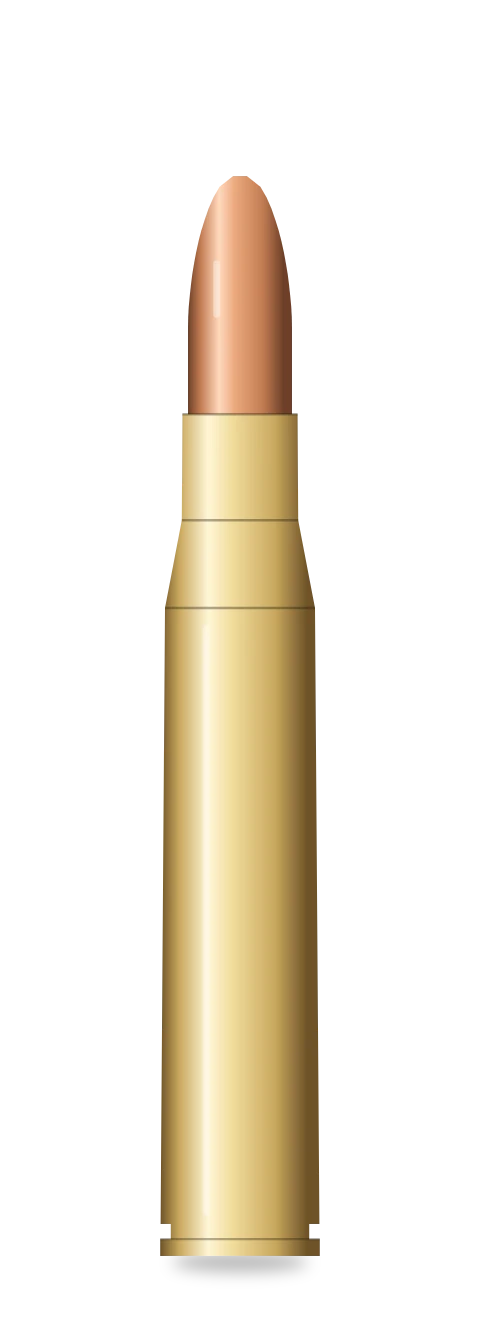
01 / At a glance
The basics
- Origin
- United States
- Introduced
- 1906
- Ignition
- Centerfire
- Case form
- Rimless, bottleneck
- Diameter
- 7.8 mm
- Case length
- 63.3 mm
Rounded values to help you identify the cartridge, not manufacturing drawings. See the cited standard for exact dimensions and tolerances.
Do not mix it up
The .25-06 Remington and .270 Winchester are made on the same case, and they can be chambered in a .30-06 rifle. Firing them there is dangerous. Always check the marking on your rifle and the ammunition.
The .30-06 Springfield, often spoken "thirty-aught-six", is a full-size American rifle cartridge. The U.S. Army adopted it in 1906, and it served through two world wars. Since then it has been one of the most popular hunting cartridges in North America, for deer, elk, bear and nearly everything in between.
This guide explains what the cartridge is, how it performs, how to choose ammunition and a rifle, and how it compares with the .308 Winchester, the .270 Winchester and other big-game cartridges. It is a reference page, not a loading manual, and it contains no handloading data.
A short history
The story starts with the .30-03, adopted by the U.S. Army in 1903 for the new Springfield rifle. It fired a heavy 220 grain round-nose bullet. A few years later, armies around the world moved to lighter, pointed bullets, and the Army followed. In 1906 it shortened the case slightly, loaded a 150 grain spitzer bullet and called the result Cartridge, Ball, Caliber .30, Model of 1906. The "06" in the name is the year.
The cartridge served in the M1903 Springfield and the M1917 Enfield, and later in the M1 Garand, the Browning Automatic Rifle and several machine guns. It was the main American service cartridge in both world wars and Korea. In the 1950s the military moved to the shorter 7.62x51 NATO, which has a civilian twin in the .308 Winchester.
Hunters took up the cartridge in the 1920s and never put it down. Rifle makers have offered it in nearly every model for over a century, and it remains in production today.
Why it is so popular
The first reason is versatility. The .30-06 can be loaded with bullets from 110 to 220 grains, so one rifle can hunt deer with a light bullet and elk or moose with a heavy one. Few other cartridges cover such a range.
The second is availability. Ammunition is sold nearly everywhere, from big-box stores to small-town hardware shops. In a pinch you can find it in a place that does not stock many other rifle cartridges.
The third is history and tradition. Many hunters inherited a .30-06 from a father or grandfather, and there are millions of old rifles still in use. It is also a cartridge that handloaders enjoy, because of the huge selection of bullets and powders.
Specifications at a glance
| Specification | Value |
|---|---|
| Bullet diameter | .308 in (7.82 mm) |
| Case length | 2.494 in (63.3 mm) |
| Maximum overall length (SAAMI) | 3.340 in (84.8 mm) |
| Case type | Rimless, bottleneck |
| Primer | Large rifle |
| Maximum average pressure (SAAMI) | 60,000 psi |
| Typical bullet weights | 110 to 220 grains; 150, 165 and 180 grains are most common |
| Typical muzzle velocity | About 2,400 to 3,000 ft/s depending on bullet weight |
| Common barrel twist | 1 in 10 inches |
Values are rounded for reference. Exact dimensions and tolerances are in the SAAMI standards cited at the end of this page.
Strengths and limits
The .30-06 is a proven, flexible cartridge. It also has competition now, and it is not the easiest to shoot.
| Advantage | Limitation |
|---|---|
| Wide range of bullet weights, from deer to moose | More recoil than a .308 or a 6.5 Creedmoor |
| Ammunition is easy to find | Requires a long action, so rifles are a little longer and heavier |
| Millions of rifles in use, new and used | Drops more at long range than modern flat-shooting cartridges |
| Plenty of handloading components | A small risk of confusing it with the .270 Winchester or .25-06 |
Ballistics
The tables and charts below show the Hornady American Whitetail 180 grain InterLock load, which leaves the muzzle at 2,700 ft/s. It is a very common deer and elk hunting load, and a good picture of what the cartridge does.
| Range (yd) | Velocity (ft/s) | Energy (ft-lb) | Drop (in) | Wind drift, 10 mph (in) |
|---|---|---|---|---|
| 100 | 2500 | 2498 | 0 | 0.8 |
| 200 | 2309 | 2131 | -4.1 | 3.2 |
| 300 | 2127 | 1807 | -14.7 | 7.5 |
| 400 | 1952 | 1523 | -33 | 13.8 |
| 500 | 1787 | 1277 | -60.4 | 22.5 |
Reading the numbers
From a 100 yard zero, the bullet drops about 4 inches at 200 yards, 15 inches at 300 yards, 33 inches at 400 yards and 60 inches at 500 yards. A 10 mph crosswind moves it about 3 inches at 200 yards, 7.5 inches at 300 yards and 22 inches at 500 yards.
Energy is the point. The bullet carries about 2,900 foot-pounds at the muzzle, 1,800 at 300 yards and about 1,280 at 500 yards. Many hunters use 1,000 foot-pounds for deer and 1,500 foot-pounds for elk as a guide, although the bullet and shot placement matter more than a number. That is why the .30-06 is a good choice out to 300 or 400 yards on big game.
How these figures were made: muzzle velocity (2,700 ft/s), weight (180 grains) and ballistic coefficient (G1 0.452) come from published retailer data for the Hornady American Whitetail 180 grain InterLock load. Drop, velocity, energy and wind drift are computed with a standard point-mass model, a 100 yard zero, a 1.5 inch sight height and standard atmosphere. They are estimates. Your rifle, barrel length and lot of ammunition will differ, so confirm with a chronograph and a range session.
Recoil and shooter comfort
Recoil is moderate to stout. In an 8 to 8.5 pound rifle with a 180 grain load, free recoil is roughly 18 to 22 foot-pounds. That is more than a .308 Winchester or a 6.5 Creedmoor, and less than a .300 Winchester Magnum. Most adults handle it with practice, but beginners should start with lighter 125 to 150 grain loads.
A good recoil pad, a rifle that fits you and a muzzle brake or suppressor where legal all make it easier to shoot well. Heavier rifles recoil less, but they are harder to carry. The best rifle is the one you shoot confidently.
How to choose ammunition
The .30-06 has a bigger choice of bullets than almost any cartridge. Pick the bullet for the job first, then the weight.
| Bullet weight | Typical velocity | Best for |
|---|---|---|
| 125 to 150 grains | About 2,900 to 3,100 ft/s | Deer, antelope and light recoil |
| 165 to 168 grains | About 2,750 to 2,800 ft/s | All-around hunting and target |
| 180 grains | About 2,700 ft/s | Elk, mule deer and general big game |
| 200 to 220 grains | About 2,400 to 2,600 ft/s | Elk, moose and bear at moderate range |
| Bullet type | Best for | Notes |
|---|---|---|
| Soft point (InterLock, Core-Lokt, Power-Shok) | General hunting | Reliable and affordable |
| Polymer tip (SST, Ballistic Tip) | Long-range deer and antelope | Flatter flight and quick expansion |
| Bonded or monolithic (Partition, Barnes TSX) | Elk, moose and bear | Deep penetration and weight retention |
| Full metal jacket and military ball | Practice and historic rifles | Not suited to hunting |
Surplus ammunition
Military surplus .30-06 is often sold at low prices. Some of it has corrosive primers. After shooting it, clean the bore and gas parts thoroughly the same day, or rust can form. Also inspect each round, because old ammunition can be unreliable.
How to choose a rifle
The .30-06 requires a long action. These are the points that matter most.
- Action type. Bolt-actions such as the Remington 700, Winchester Model 70 and Tikka T3x are the usual hunting choice. Semi-automatics such as the Browning BAR and the M1 Garand are also popular. Lever and pump guns exist but are less common.
- Barrel length. A 22 to 24 inch barrel is standard. A shorter barrel loses some velocity and makes the report louder.
- Weight. A light rifle of 7 to 7.5 pounds is easy to carry but recoils more. A medium rifle of 8 to 9 pounds is a good balance.
- Twist rate. Most rifles use 1 in 10 inches, which stabilizes bullets from 110 to 220 grains.
- New or used. Because of its age, there are many used .30-06 rifles on the market. Have a gunsmith inspect an older rifle before you shoot it.
- Optics. A 3-9x or 4-12x scope is a common hunting choice. Iron sights suit historic rifles.
Zeroing and range practice
A 100 yard zero is common, and it is easy to confirm. Some hunters zero 2.5 to 3 inches high at 100 yards, which puts the bullet roughly on target out to about 250 or 275 yards without holdover.
Shoot from a rest, allow the barrel to cool between groups, and shoot a group of three to five shots to confirm. Then check the drop at 200, 300 and 400 yards with your own load, and keep the data on a card. Practice from field positions too, because that is how most hunting shots are taken.
Practical uses
Deer and antelope
A 150 to 165 grain polymer tip or soft point is a classic choice for whitetail, mule deer, blacktail and pronghorn. It shoots flat enough for most shots, and it kills cleanly with good placement.
Elk, moose and bear
A 180 to 220 grain bonded or monolithic bullet gives the penetration these animals need. This is where the .30-06 is strongest. Take the shot at a distance where the bullet still has enough energy and speed.
Target shooting and historic rifles
The M1 Garand and M1903 Springfield are popular at vintage military rifle matches, and the .30-06 is used there with ball or match loads.
Handloading
The cartridge has been handloaded for over a century, with one of the widest selections of bullets and powders of any cartridge. If you reload, always use data from a current published manual.
.30-06 Springfield vs similar cartridges
The table lists the cartridges most often compared with the .30-06. Figures are rounded and use the SAAMI maximum average pressure where one exists.
| Cartridge | Bullet diameter | Case length | Max pressure | Typical use |
|---|---|---|---|---|
| .30-06 Springfield | .308 in | 2.494 in | 60,000 psi | All-round big game |
| .308 Winchester | .308 in | 2.015 in | 62,000 psi | Hunting and target |
| .270 Winchester | .277 in | 2.540 in | 65,000 psi | Deer and antelope |
| .25-06 Remington | .257 in | 2.494 in | 63,000 psi | Deer and varmints |
| .300 Winchester Magnum | .308 in | 2.620 in | 64,000 psi | Long-range big game |
| 6.5 Creedmoor | .264 in | 1.920 in | 62,000 psi | Target and hunting |
Against the .308 Winchester, the .30-06 holds about 100 to 150 ft/s more velocity with the same bullet, and is better with heavy bullets. The .308 fits a shorter action and recoils less. Against the .270 Winchester, the .270 is flatter with its lighter bullets, while the .30-06 has more bullet choices for larger game. Against the .300 Winchester Magnum, the Magnum shoots flatter and harder, but it kicks more and costs more.
Care and storage
Clean the bore regularly with a proper rod and bore guide, and follow the rifle maker's instructions. If you shoot corrosive surplus ammunition, clean the bore, chamber and gas system the same day. Old rifles may have worn bores or loose parts, so have them checked. Store ammunition in a cool, dry place, and keep guns and ammunition locked away from children.
Safety and common mistakes
- The .25-06 Remington and .270 Winchester are made on the same case as the .30-06, with a smaller bullet. Their cartridges can chamber in a .30-06 rifle, and firing them there is dangerous. Read the barrel marking and the headstamp every time.
- Match the load to the rifle. An M1 Garand needs ammunition with the right pressure curve. Use ammunition marked for the Garand, or military-type loads, and avoid heavy hunting loads with slow powders, which can bend the operating rod.
- Inspect old rifles and old ammunition. Do not fire cartridges with dents, corrosion or loose bullets, and have an older rifle checked before use.
- Know the signs of high pressure: flattened or pierced primers, a sticky bolt lift and bright marks on the case head. Stop firing and have the rifle checked.
- Treat every firearm as loaded, and know your target and what is behind it.
- Wear eye and ear protection every time. If you reload, use only published data from a current manual.
Frequently asked questions
What does .30-06 mean?
The ".30" is the approximate bullet diameter in hundredths of an inch (.308 in). The "06" is 1906, the year the U.S. Army adopted the cartridge.
Is the .30-06 still a good hunting cartridge?
Yes. With the right bullet it handles deer, elk, moose and bear. Modern cartridges may shoot flatter, but the .30-06 remains accurate, versatile and easy to find.
How far can a .30-06 shoot accurately?
Most hunting shots are inside 300 yards. With a good bullet and a skilled shooter, ethical shots on big game are possible to 400 yards or so. It also performs at 1,000 yards in target shooting, but it is not a long-range specialist.
What is the difference between .30-06 and .308?
They use the same .308 inch bullet. The .30-06 has a longer case and holds more powder, so it can push the same bullet about 100 to 150 ft/s faster. It needs a long action and recoils more.
How much recoil does a .30-06 have?
Moderate to stout. In an 8 to 8.5 pound rifle with a 180 grain load it is roughly 18 to 22 foot-pounds of free recoil. Lighter loads of 125 to 150 grains are easier on beginners.
What bullet weight is best for deer?
150 to 165 grains is a classic choice. For elk and larger game, 180 to 220 grains is better.
Can I fire .270 Winchester ammunition in a .30-06 rifle?
No. The .270 case can fit in a .30-06 chamber, but firing it there is dangerous. Always check the marking on the barrel and the headstamp of the cartridge.
Can I reload .30-06 brass?
Yes. The brass is widely reloaded. Use only published data from a current loading manual, and follow its safety instructions.
Sources
Sources reviewed · 29 October 2026