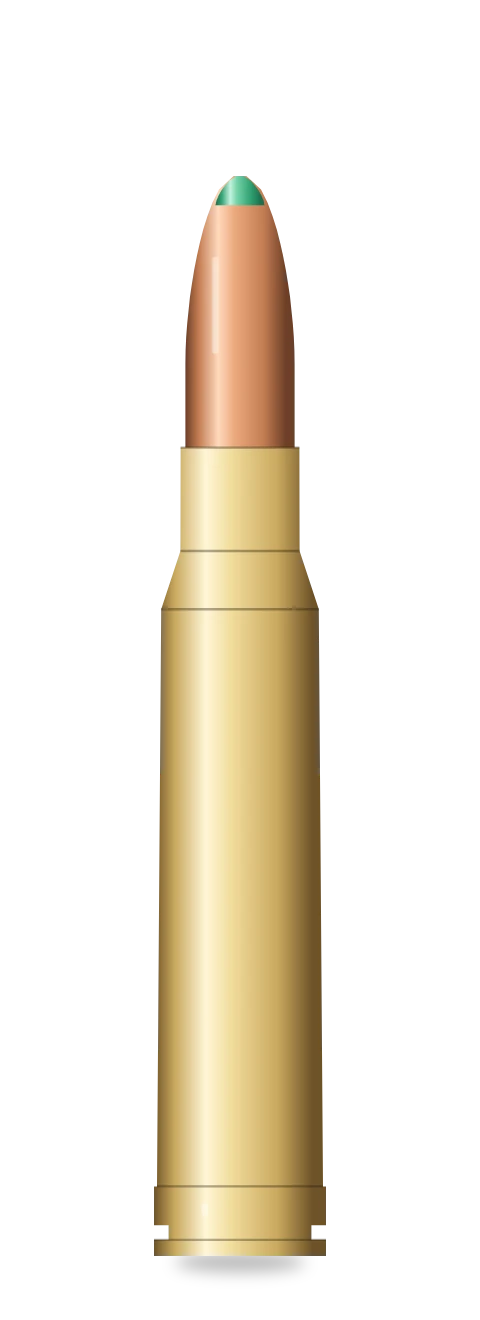
01 / At a glance
The basics
- Origin
- United States
- Introduced
- 1958
- Ignition
- Centerfire
- Case form
- Belted, bottleneck
- Diameter
- 8.6 mm
- Case length
- 63.5 mm
Rounded values to help you identify the cartridge, not manufacturing drawings. See the cited standard for exact dimensions and tolerances.
Do not mix it up
The .338 Winchester Magnum is not the same as the .338 Lapua Magnum or the .338 Federal. The cartridges are not interchangeable. Check the marking on the barrel.
The .338 Winchester Magnum is a belted magnum rifle cartridge that fires a .338 inch bullet, usually 200 to 300 grains, at about 2,600 to 3,000 ft/s. It was introduced in 1958 and became the standard medium-bore magnum for hunters who wanted more than a .30 caliber. It is known for deep penetration, a lot of energy and heavy recoil, and it is a favorite for elk, moose and large bears.
This guide explains what the cartridge is, how it performs out to 500 yards, how to choose ammunition and a rifle, and how it compares with the .300 Winchester Magnum, the 7mm Remington Magnum, the .30-06 Springfield and other cartridges people weigh it against. It is a reference page, not a loading manual, and it contains no handloading data.
A short history
The .338 grew out of experiments in the late 1940s. Riflemen including Charles O'Neil, Elmer Keith and Don Hopkins tried .333 inch bullets in big cases, and the wildcats they built, the .333 OKH and the .334 OKH, showed what a heavy .33 bullet could do on big game.
Winchester put the idea into production in 1958. The .338 Winchester Magnum uses a .375 H&H Magnum case, blown out, shortened and necked down. It was introduced with the .264 Winchester Magnum and the .458 Winchester Magnum, which share the same case family. Winchester offered it in the Model 70, including the Alaskan version built for big bears and moose.
It built its reputation in Alaska and the Rockies, and later in Africa. Many hunters chose it because it had more energy than any .30 magnum and heavier bullets, with recoil that was still manageable for a practiced shooter. It has never been the most popular magnum, but it has never gone away.
Why people choose it
The first reason is bullet weight. A .338 bullet of 225 to 250 grains is heavy, long and strong, and it keeps its energy and goes deep into an animal. That is what hunters want when they face a large elk, a moose or a bear.
The second reason is range. The bullets have good ballistic coefficients, so they hold their speed. A 225 grain bullet at 2,840 ft/s still carries about 2,000 foot-pounds at 500 yards, more than some cartridges used on deer have at the muzzle.
The third reason is the choice. Rifles from every major maker are chambered for it, and the factory loads range from 180 to 300 grains. Hunters can choose a bullet for the animal they are after.
Specifications at a glance
| Specification | Value |
|---|---|
| Bullet diameter | .338 in (8.6 mm) |
| Case length | 2.500 in (63.5 mm) |
| Overall length (SAAMI) | 3.340 in (84.8 mm) |
| Case type | Belted, bottleneck |
| Primer | Large rifle magnum |
| Maximum average pressure (SAAMI) | 64,000 psi |
| Typical bullet weights | 180 to 300 grains; 210, 225 and 250 grains are the most common |
| Typical muzzle velocity | About 2,840 ft/s with a 225 grain bullet from a 24 inch barrel |
| Typical rifling twist | 1 in 9 to 1 in 10 inches |
Values are rounded for reference. Exact dimensions and tolerances are in the SAAMI and C.I.P. standards cited at the end of this page.
Strengths and limits
The .338 Winchester Magnum is a powerful, versatile big game cartridge. It is also a magnum, with the costs that come with that.
| Advantage | Limitation |
|---|---|
| Heavy bullets and deep penetration | Heavy recoil and a loud blast |
| High energy at long range | Barrel life is shorter than in non-magnum cartridges |
| Suits elk, moose and large bears | Too much for deer-sized game for most hunters |
| Rifles and ammunition are easy to find | Ammunition costs more than for .30-06 or .308 |
The cartridge does what it was made to do. A hunter who needs a bullet that will break heavy bone and still reach the vitals will find one in a .338. A hunter who mostly shoots deer will find that a smaller cartridge is easier to shoot and just as effective.
Barrel life
Magnum cartridges burn more powder and wear the barrel faster. A .338 barrel can keep its best accuracy for a couple of thousand rounds with careful shooting. For hunters who fire a few boxes a year, that is not a concern.
Ballistics
The tables and charts below show one common factory load, a 225 grain SST bullet at 2,840 ft/s from a 24 inch barrel, with the rifle zeroed at 200 yards.
| Range (yd) | Velocity (ft/s) | Energy (ft-lb) | Drop (in) | Wind drift, 10 mph (in) |
|---|---|---|---|---|
| 100 | 2662 | 3540 | 1.7 | 0.6 |
| 200 | 2491 | 3100 | 0 | 2.5 |
| 300 | 2326 | 2704 | -7.3 | 5.9 |
| 400 | 2168 | 2348 | -21.1 | 10.8 |
| 500 | 2016 | 2030 | -42.2 | 17.5 |
Reading the numbers
With a 200-yard zero the bullet rises about 1.7 inches above the line of sight at 100 yards, returns to the line at 200 and falls about 7 inches at 300 yards, 21 inches at 400 and 42 inches at 500. A 10 mph crosswind moves it about 6 inches at 300 yards and about 17 at 500. Velocity drops from 2,840 ft/s at the muzzle to about 2,016 ft/s at 500 yards, and energy from about 4,030 to about 2,030 foot-pounds.
The path is similar to other magnums, with a slightly steeper drop than a 7mm Remington Magnum, and the bullet is much heavier. At 300 yards a .338 bullet still carries about 2,700 foot-pounds. That is real big game power.
How these figures were made: the muzzle velocity (2,840 ft/s), weight (225 grains) and the published velocities at 100 to 500 yards (2,662, 2,491, 2,326, 2,168 and 2,016 ft/s) are Hornady figures for its 338 Win Mag 225 grain SST Superformance load from a 24 inch test barrel. The ballistic coefficient (G1 0.525) was fitted to match those published velocities. Drop, velocity, energy and wind drift are computed with a standard point-mass model, a 200-yard zero, a 1.5 inch sight height and standard atmosphere. They are estimates. Different bullets and barrel lengths change the results.
Recoil and shooter comfort
The .338 Winchester Magnum has heavy recoil. It kicks harder than a .300 Winchester Magnum, a 7mm Remington Magnum or a .30-06 Springfield. In a light rifle the push is sharp and the muzzle jumps. Most shooters need practice to shoot it well, and some never get comfortable with it.
A heavier rifle, a good recoil pad and a stock that fits you help a great deal. A muzzle brake reduces the push but makes the blast loud for people nearby, so use one with care. Hearing protection is a must. Practice from a bench in small amounts, and spend more time on field positions with fewer shots.
How to choose ammunition
Choose by animal first. The same name covers a wide range of loads.
| Bullet type | Best for | Notes |
|---|---|---|
| Bonded or partition soft point, 210 to 250 grains | Elk, moose, bear | Holds together; deep penetration |
| Polymer tip bullets (SST, ELD-X, Ballistic Tip) | Elk and long-range hunting | High BC and controlled expansion |
| Copper solid bullets (TSX, CX) | Large bears and tough game | Deep penetration; keeps weight |
| Match bullets (BTHP, ELD Match) | Long-range target shooting | Best accuracy; not for hunting |
| Lighter soft point, 180 to 200 grains | Deer and pronghorn | Flatter path, less recoil |
Bullet weight
A 210 to 225 grain bullet is a good all-round weight for elk and moose. A 250 grain bullet is the choice for large bears and for hunters who want the most penetration. A 180 to 200 grain bullet is flatter and lighter-kicking, and it suits deer and pronghorn at long range.
Check the box
The .338 Winchester Magnum is not the same as the .338 Lapua Magnum, the .338 Federal or the .338 Norma Magnum. The cartridges are not interchangeable. Check the marking on the barrel and the headstamp every time.
How to choose a rifle
The right rifle depends on where and how you hunt. These are the points that matter most.
- Weight. A light mountain rifle of 7 pounds is easy to carry and hard to shoot. A rifle of 8 to 9 pounds is steadier and kicks less.
- Barrel length. 24 to 26 inches gives full velocity. A 22 inch barrel is handier and loses about 100 ft/s.
- Twist rate. A 1 in 10 twist handles most bullets up to 250 grains. A 1 in 9 twist suits the heaviest ones.
- Action. Bolt-action rifles from Winchester, Remington, Browning, Ruger, Tikka and others are the norm. Check that the magazine is long enough for the cartridge.
- Recoil pad and fit. A good pad and a stock that fits you cut felt recoil more than almost any other change.
- Optics. A 3-9x or 4-12x scope is plenty for hunting. Check eye relief, because a rifle that kicks hard can hit your brow.
Quality counts
A magnum rifle needs a strong action and a good trigger. A rifle that groups well with several bullet weights is worth more than a powerful one that shoots wide. Look for groups under an inch and a half at 100 yards with the factory loads you plan to use.
Zeroing and practice
A 200-yard zero is common, and it keeps the bullet within a few inches of the line of sight out to about 250 yards. A 100-yard zero is easier to check on a short range and leaves the bullet several inches low at 250 yards. Check your own load.
Shoot from field positions. Sit, kneel and use a bipod or a pack. Practice at 200, 300 and 400 yards if you plan to take long shots, and learn your drop. Because recoil is heavy, short, regular sessions beat one long one, and a few well-aimed shots beat many fast ones.
Practical uses
Elk and moose
This is the cartridge's core use. A 225 to 250 grain bonded or partition bullet is a proven elk and moose load at 300 to 400 yards or more, with enough energy for a clean kill on a large animal.
Large bears
Many hunters in Alaska and Canada use it for brown and grizzly bears. A heavy, tough bullet and good shot placement matter more than anything else. Some hunters prefer a larger caliber for dangerous game, and local rules may set a minimum.
African plains game
It is used on larger plains game in Africa, such as eland, kudu and wildebeest, and is a popular all-round rifle for a safari. For the biggest dangerous game, many countries require a larger caliber.
Long-range hunting
The heavy bullets keep their energy well, so the .338 is used for long shots on large animals. A good bullet, a rangefinder and practice are what make long shots ethical.
Deer
It will take deer, but it is more than most hunters need. The recoil is harder to shoot well, and the damage to meat is greater with a fast, heavy bullet. A smaller cartridge is usually the better choice.
.338 Winchester Magnum vs similar cartridges
The table lists the cartridges most often compared with the .338 Winchester Magnum. Figures are rounded and use SAAMI maximum average pressures.
| Cartridge | Bullet diameter | Case length | Max pressure | Typical use |
|---|---|---|---|---|
| .338 Winchester Magnum | .338 in | 2.500 in | 64,000 psi | Elk, moose and large bears |
| .300 Winchester Magnum | .308 in | 2.620 in | 64,000 psi | Big game and long range |
| 7mm Remington Magnum | .284 in | 2.500 in | 61,000 psi | Big game and long range |
| .30-06 Springfield | .308 in | 2.494 in | 60,000 psi | All-round big game |
| .270 Winchester | .277 in | 2.540 in | 65,000 psi | Deer, pronghorn and elk |
Against the .300 Winchester Magnum, the .338 has a heavier bullet and more penetration, with more recoil and a slightly steeper path. Against the 7mm Remington Magnum, it has more energy and a bullet suited to larger game, and the 7mm is flatter and easier to shoot. Against the .30-06 Springfield, it has far more energy at range, with much more recoil.
Care and storage
Clean the bore after a shooting session and after a hunt in rain or snow. Magnum rifles can build up copper fouling, so an occasional copper solvent may be needed. Check the stock screws, the recoil lug bedding and the scope mounts from time to time, because heavy recoil can loosen them. Store the rifle unloaded in a dry place. Keep firearms and ammunition locked and out of reach of children and unauthorized users.
Safety and common mistakes
- Do not confuse the .338 Winchester Magnum with the .338 Lapua Magnum, the .338 Federal or the .338 Norma Magnum. Read the marking on the barrel and the headstamp before loading.
- Treat every firearm as loaded. Keep your finger off the trigger until your sights are on the target.
- Know your target and what is beyond it. A magnum rifle bullet can travel several miles.
- Wear eye and ear protection at the range, and keep enough eye relief on the scope to avoid a cut brow.
- Hold the rifle firmly against your shoulder. A loose rifle kicks harder.
- Do not use hot handloads to chase speed. Pressures rise fast.
- If you reload, use only published data from a current manual and start low. This page does not contain loading data.
- Store firearms unloaded and locked, and keep the ammunition apart.
Frequently asked questions
What is the .338 Winchester Magnum good for?
Large game such as elk, moose and brown bears, and some African plains game. It has heavy bullets, deep penetration and high energy at range.
How much recoil does the .338 Win Mag have?
A lot. It kicks harder than a .300 Winchester Magnum, a 7mm Remington Magnum or a .30-06. A heavy rifle with a good pad helps, and practice matters.
What is the effective range of the .338 Win Mag?
Most hunters shoot within 400 yards. With a good bullet, skilled shooters take elk at 500 yards or more. The limit is the shooter, not the cartridge.
Is the .338 Win Mag better than the .300 Win Mag?
It has a heavier bullet and more energy on large animals, but more recoil. The .300 Winchester Magnum is flatter and easier to shoot. For most big game, either works.
What bullet weight is best?
A 210 to 225 grain bullet is a good all-round weight for elk. Use 250 grains for large bears and the most penetration, and 180 to 200 grains for deer and flatter shooting.
Is the .338 Win Mag good for deer?
It will do the job, but it is more than most hunters need. A smaller cartridge is easier to shoot and spoils less meat.
Is the .338 Win Mag the same as the .338 Lapua?
No. The .338 Lapua Magnum is a longer, more powerful cartridge made for long-range military and target use. The cartridges are not interchangeable.
Can I reload .338 Winchester Magnum?
Yes. The brass is widely reloaded. Use only published data from a current loading manual and follow its safety instructions.
Sources
Sources reviewed · 29 October 2026