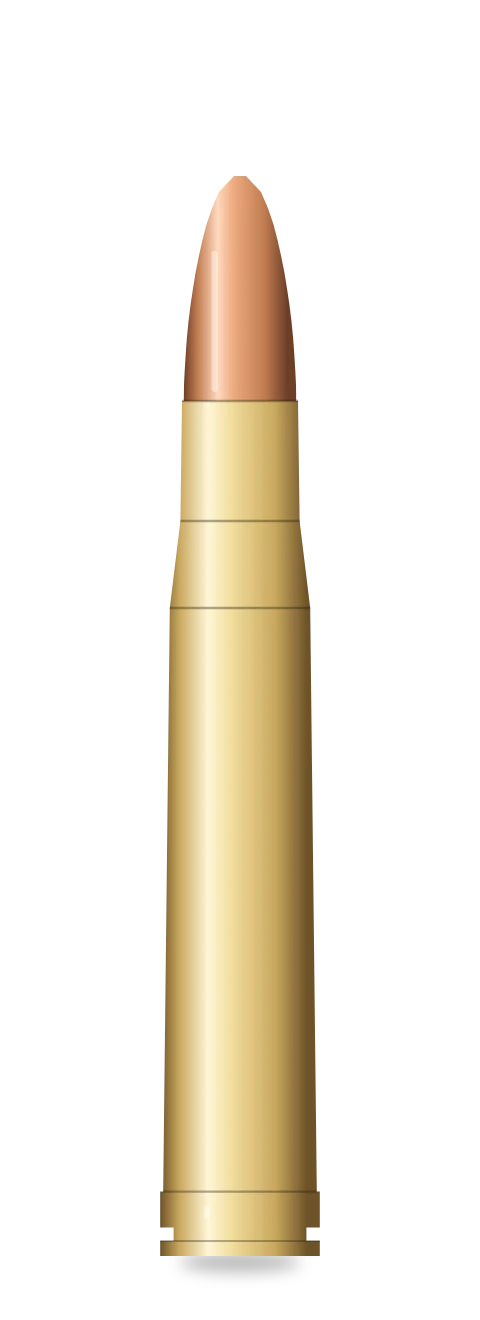
01 / At a glance
The basics
- Origin
- United Kingdom
- Introduced
- 1912
- Ignition
- Centerfire
- Case form
- Belted, bottleneck
- Diameter
- 9.5 mm
- Case length
- 72.4 mm
Rounded values to help you identify the cartridge, not manufacturing drawings. See the cited standard for exact dimensions and tolerances.
Do not mix it up
The .375 Flanged Magnum is a rimmed version for double rifles and is not the same cartridge. Use the cartridge the rifle is marked for.
The .375 H&H Magnum is a belted British cartridge from 1912 that became the standard rifle for dangerous game. A 300 grain bullet leaves at about 2,400 to 2,550 ft/s and carries nearly 4,000 foot-pounds at the muzzle. In many places, mostly in Africa, it is also the legal minimum for hunting thick-skinned dangerous game.
This guide explains what the .375 H&H is, how it performs out to 300 yards, how to choose ammunition and a rifle, and how it compares with the .338 Winchester Magnum, the .300 Winchester Magnum and the .30-06 Springfield. It is a reference page, not a loading manual, and it contains no loading data.
A short history
Holland & Holland, the London gunmaker, introduced the .375 H&H Magnum in 1912, together with the .275 H&H Magnum. Both shared the belted case design. The belt was added to ensure correct headspacing, and the case was designed with a taper for cordite.
The cartridge came out of British competition for African hunting. The 9.5x57mm Mannlicher-Schonauer and the 9.3x62mm Mauser had strongly shaped the market, and Holland & Holland wanted a cartridge that matched them. The original loads were a 235 grain bullet at 2,800 ft/s, a 270 grain at 2,650 and a 300 grain at 2,500. The original pressure limit was 47,000 psi, set with cordite in mind.
The company released it to the general public after World War I. Winchester began making rifles for it in 1925, which gave it a footing in the United States. After World War II, its popularity grew, and colonial and later African laws set minimum bullet diameters for dangerous game at 9.3 mm (.366 inch) or .375 inch, which fit the cartridge. More than a century on, it is still the cartridge people think of first when they think of a safari rifle.
Why it has lasted
The first reason is the balance. The .375 H&H carries enough energy and bullet weight for the largest game on the continent, with recoil that a trained shooter can manage. It is a rifle you can learn to shoot well, which is not true of the larger bores.
The second reason is versatility. With a 270 grain bullet it flattens out enough for plains game at a few hundred yards, and with a heavy 300 or 350 grain bullet it drives deep into thick-skinned animals. Many hunters use one rifle for everything on a safari.
The third reason is the law and the tradition. In many places the .375 H&H is the legal minimum for hunting dangerous game, and outfitters expect it. Rifles, bullets and loads are made for it all over the world, and that support makes it easy to buy ammunition in nearly any country that hosts hunters.
Specifications at a glance
| Specification | Value |
|---|---|
| Bullet diameter | .375 in (9.5 mm) |
| Case length | 2.850 in (72.4 mm) |
| Overall length | 3.600 in (91.4 mm) |
| Case type | Belted, bottleneck |
| Maximum pressure (C.I.P.) | 62,366 psi (430 MPa) |
| Typical bullet weights | 235 to 350 grains; 300 grains is the most common |
| Typical muzzle velocity | About 2,300 to 2,625 ft/s, depending on bullet weight |
| Typical muzzle energy | About 4,100 to 4,400 ft-lbf with 270 to 350 grain bullets |
Values are rounded for reference. The C.I.P. figure is cited because published sources give it directly. Exact dimensions and tolerances are in the standards cited at the end of this page. A separate rimmed version, the .375 Flanged Magnum, exists for double rifles and is not interchangeable.
Strengths and limits
The .375 H&H is built for large, heavy and dangerous animals. It is not a light-recoil cartridge for general use.
| Strength | Limit |
|---|---|
| Heavy bullets and over 3,800 ft-lbf at the muzzle | Heavy recoil that needs practice |
| Legal minimum for dangerous game in many places | Ammunition and rifles cost more than a .30-06 |
| Works with a wide range of bullet weights | Trajectory is less flat than a flat-shooting magnum |
| A long record and rifles made for it worldwide | More rifle weight and a long action than most hunters need |
Honest advice: for deer, elk or sheep, the .375 H&H is more than you need, and a .30-06 or .300 Winchester Magnum is a better and cheaper tool. It earns its place on dangerous game, large bear and for hunters who want one rifle that handles anything in range.
Belted case and headspace
A belt is a raised ring of brass near the base of the case. The case headspaces on the belt, not on the shoulder. Handloaders should follow the instructions in a current manual for sizing belted cases. This page contains no loading data.
Ballistics
The table and charts below show one factory load, a 300 grain Trophy Bonded Bear Claw bullet at 2,400 ft/s, with the rifle zeroed at 100 yards. This is the way many dangerous-game rifles are sighted, since most shots are close.
| Range (yd) | Velocity (ft/s) | Energy (ft-lb) | Drop (in) | Wind drift, 10 mph (in) |
|---|---|---|---|---|
| 50 | 2278 | 3455 | 0.1 | 0.3 |
| 100 | 2159 | 3103 | 0 | 1.2 |
| 150 | 2043 | 2780 | -2 | 2.8 |
| 200 | 1931 | 2484 | -6 | 5.1 |
| 250 | 1823 | 2215 | -12.4 | 8.1 |
| 300 | 1720 | 1970 | -21.4 | 12 |
Reading the numbers
With a 100 yard zero the bullet falls about 2 inches at 150 yards, 6 at 200, 12 at 250 and 21 at 300. A 10 mph crosswind moves it about 1 inch at 100 yards, 5 at 200 and 12 at 300. Velocity drops from 2,400 ft/s at the muzzle to about 1,930 ft/s at 200 yards and 1,720 ft/s at 300, and energy from about 3,840 to 2,480 and 1,970 foot-pounds.
The bullet is heavy and blunt compared with a long-range design, so it slows and drops faster than a flat-shooting magnum. That is a fair trade for its purpose. Dangerous-game shots are often inside 100 yards, and at 300 yards the bullet still carries about 1,970 foot-pounds.
How these figures were made: the muzzle velocity (2,400 ft/s), weight (300 grains) and the published velocities at 100, 200 and 300 yards (2,159, 1,932 and 1,721 ft/s) are Federal figures for its Trophy Bonded Bear Claw 300 grain load, which Federal lists with a ballistic coefficient of 0.342. The coefficient used here (G1 0.347) was fitted to match those published velocities. Drop, velocity, energy and wind drift are computed with a standard point-mass model, a 100 yard zero, a 1.5 inch sight height and standard atmosphere. They are estimates. Federal publishes two trajectory tables that disagree with each other at 300 yards, so the drop figures here are model estimates and not published values.
Recoil and shooter comfort
Recoil is heavy. In a rifle of 9 to 10 pounds, the .375 H&H kicks much harder than a .30-06 or a .300 Winchester Magnum. A well-fitted stock, a good recoil pad and a firm shoulder position help. Many shooters learn it with a lighter load first and then move up.
A flinch ruins a shot at close range with a dangerous animal. Practice with the loads you will hunt with, and shoot them from the positions you will use. Wear hearing protection, and consider a muzzle brake only if your guides and the people near you can accept the noise.
How to choose ammunition
Federal, Hornady, Barnes, Norma, Swift and others load the .375 H&H. For dangerous game, choose the bullet for the animal, not for the cartridge.
| Load | Muzzle velocity | Best for | Notes |
|---|---|---|---|
| 270 grain Barnes TSX | About 2,625 ft/s | Plains game and lighter dangerous game | All-copper expanding bullet |
| 300 grain Trophy Bonded Bear Claw | About 2,400 ft/s | General dangerous game | Bonded bullet; the load in this guide |
| 300 grain Swift A-Frame or Norma Oryx | About 2,560 ft/s | Dangerous game | Premium expanding bullet |
| 350 grain Woodleigh | About 2,300 ft/s | Thick-skinned game | Heavy bullet, soft nose and full metal jacket versions |
Most dangerous-game hunters carry two kinds of bullet: a soft or expanding bullet for the first shot, and a solid (full metal jacket) bullet for follow-up shots and for penetration on thick-skinned animals. Ask your professional hunter what is required, since the rules and customs differ by country.
Buy premium bullets
A cheap soft-point bullet can break up on heavy bone. For dangerous game, premium bonded or solid copper bullets are worth the extra price. Test the load for accuracy, and confirm that it feeds smoothly in your rifle before you travel.
Ammunition when you travel
Airline and customs rules for rifles and ammunition are strict and differ between countries. Plan in advance with your outfitter, and carry the paperwork. This is part of the cost of the cartridge.
How to choose a rifle
Rifles for the .375 H&H are built for hard use. These are the points that matter most.
- Action. A controlled-feed bolt-action rifle or a double rifle is the usual recommendation for dangerous game. Controlled feed means the extractor holds the case from the magazine to the chamber.
- Magazine. A magazine that feeds a belted magnum cartridge smoothly, with a reliable follower.
- Weight. A rifle of 8.5 to 10 pounds is common. More weight softens recoil, and less weight is easier to carry.
- Stock. A solid stock that fits you and has a good recoil pad. Synthetic stocks resist weather and bedding changes.
- Sights. Open sights or a low-power scope suit close shots. Many dangerous-game rifles have both.
- Safety. A safety that works silently and quickly when you shoulder the rifle.
- Reliability. Test the rifle for feeding, extraction and accuracy before you hunt. Buy from a maker with a record for it.
Winchester, Ruger, CZ and other makers have made bolt-action rifles in .375 H&H, and the cartridge is also chambered in double rifles and single-shots. Check the catalogs, since models come and go.
Zeroing and range practice
A 100 yard zero suits most dangerous-game use. With a 300 grain bullet at 2,400 ft/s the drop is small out to 150 yards, and most shots are much closer. Many hunters sight in a little high at 100 yards for the longer shots of plains game.
Zero on paper at 100 yards, then confirm your drops at 200 and 300. The numbers in this guide are estimates from a model, and your rifle and load will differ. Practice from field positions, and shoot with the same bullets you will hunt with, including the solids.
Practice working the bolt quickly without taking the rifle off your shoulder. Close-range shots at dangerous animals leave little time, and a smooth follow-up shot is a skill that needs practice.
Practical uses
Dangerous game
This is the reason for the cartridge. It is a common choice for buffalo and other big dangerous game, and in many places the legal minimum for thick-skinned game. For the largest animals, some hunters prefer a bigger cartridge, so check the rules and ask your professional hunter.
Large bear and moose
Its energy and bullet weight suit large bear and moose. Many hunters in bear country carry a rifle in this class for protection and for hunting.
Plains game
It handles plains game easily, and a lighter bullet gives a flatter path. It is more cartridge than most hunters need for this, but a hunter with one rifle for a safari often uses it for everything.
Target and collecting
Some shooters keep a .375 H&H for its history. The cartridge is accurate and fun to shoot for those who handle recoil well.
.375 H&H vs similar cartridges
The table compares the .375 H&H with the large-game cartridges it is usually weighed against. Figures are rounded. Pressures are SAAMI, except the .375 H&H, which is the C.I.P. figure.
| Cartridge | Bullet diameter | Case length | Max pressure | Typical use |
|---|---|---|---|---|
| .375 H&H Magnum | .375 in | 2.850 in | 62,366 psi (C.I.P.) | Dangerous game and large bear |
| .338 Winchester Magnum | .338 in | 2.500 in | 64,000 psi | Elk and large game |
| .300 Winchester Magnum | .308 in | 2.620 in | 64,000 psi | Long-range big game |
| .30-06 Springfield | .308 in | 2.494 in | 60,000 psi | All-round big game |
Against the .338 Winchester Magnum, the .375 H&H carries a heavier, wider bullet and is the accepted minimum for dangerous game, while the .338 has a flatter path and less recoil. Against the .300 Winchester Magnum, it is a different tool, made for big animals at short range. Against the .30-06, it hits much harder and kicks much harder.
Care and storage
Clean the bore and action after each trip, and wipe the metal against humidity and salt. Rifles taken to Africa face heat, dust and rain, so check them on return. Check the stock screws and scope mounts, since heavy recoil can loosen them. Store the rifle unloaded and locked, with the ammunition separate and away from children.
Safety and common mistakes
- Do not confuse the .375 H&H with the .375 Ruger, .375 Flanged Magnum or other .375 cartridges. Read the barrel marking and the headstamp.
- Treat every rifle as loaded. Keep your finger off the trigger until the sights are on the target.
- Know your target and what lies beyond it. A rifle bullet can travel several miles.
- Wear eye and ear protection, and brace for recoil with a firm shoulder position.
- Check the bore for obstructions before you load.
- Follow the laws and customs of the country where you hunt, including the minimum caliber and bullet rules.
- If you reload, use only published data from a current manual and start low. This page does not contain loading data.
- Store firearms and ammunition locked and apart, away from children.
Frequently asked questions
What is the .375 H&H used for?
Mainly dangerous game such as buffalo, and also large bear and moose. In many places it is the legal minimum for thick-skinned dangerous game.
When was the .375 H&H introduced?
Holland & Holland introduced it in 1912, together with the .275 H&H Magnum. It was released to the general public after World War I.
Why does the .375 H&H have a belt?
The belt was added to ensure correct headspacing.
How much energy does the .375 H&H have?
A 300 grain bullet carries about 3,800 to 4,400 foot-pounds at the muzzle, depending on the load.
Is the .375 H&H too much for deer?
It is more than you need. A .30-06 or .300 Winchester Magnum does the job with less recoil and cost.
What is the maximum pressure of the .375 H&H?
The C.I.P. maximum is 62,366 psi. The original 1912 design was limited to 47,000 psi.
Can I shoot a .375 Flanged Magnum in my .375 H&H rifle?
No. The .375 Flanged Magnum is a rimmed version made for double rifles. It is not interchangeable.
What bullets should I use for dangerous game?
Premium bonded or solid copper bullets for the first shot, and solid bullets for follow-up shots and thick-skinned animals. Ask your professional hunter for the rules.
Sources
Sources reviewed · 29 October 2026