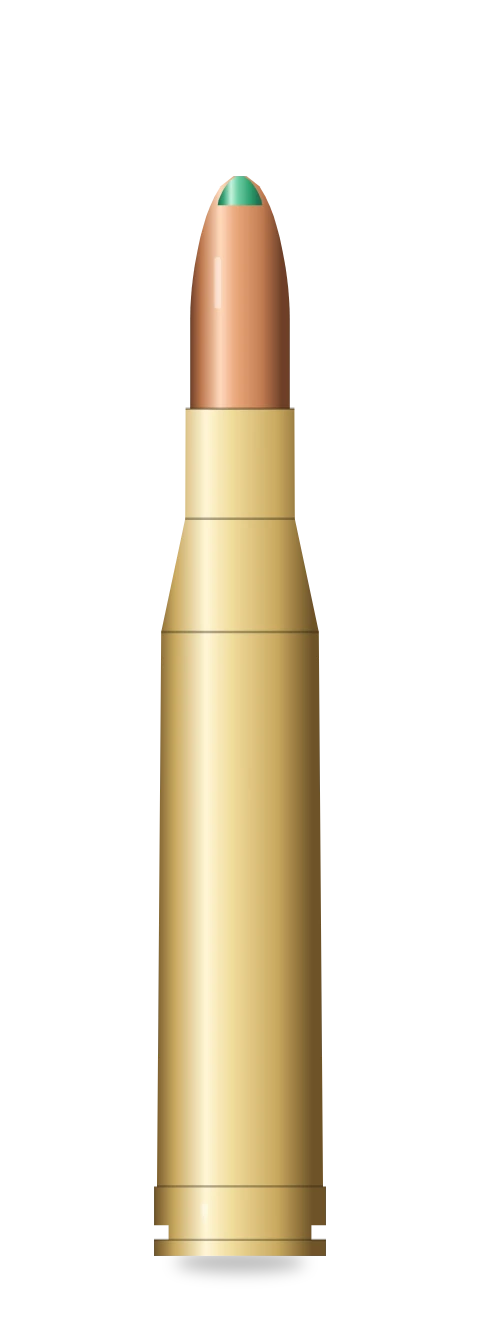
01 / At a glance
The basics
- Origin
- United States
- Introduced
- 1963
- Ignition
- Centerfire
- Case form
- Belted, bottleneck
- Diameter
- 7.8 mm
- Case length
- 66.5 mm
Rounded values to help you identify the cartridge, not manufacturing drawings. See the cited standard for exact dimensions and tolerances.
Do not mix it up
The .300 Winchester Magnum is not the .300 WSM, .300 Weatherby Magnum or .300 PRC. They look similar but are different cartridges. Read the barrel marking.
The .300 Winchester Magnum is a belted magnum cartridge that fires a .308 inch bullet at high speed. It is one of the most popular magnum cartridges in the world for hunting elk, moose and other large game at long range, and it is also used in long-range target shooting and in some military and police sniper rifles.
This guide explains what the cartridge is, how it performs, how to choose ammunition and a rifle, and how it compares with the .30-06 Springfield, .270 Winchester, 7mm Remington Magnum and other cartridges people weigh it against. It is a reference page, not a loading manual, and it contains no handloading data.
A short history
Winchester introduced the .300 Winchester Magnum in 1963, in the Model 70 rifle. It followed the .264 Winchester Magnum and .338 Winchester Magnum of 1958 as part of a family of belted magnum cartridges, and it was aimed at hunters who wanted a .30 caliber with more reach than the .30-06 Springfield.
The case descends from the .375 Holland & Holland Magnum, a long-established African big-game cartridge. Winchester shortened the case so that it would fit in a rifle action of standard .30-06 length. It kept the belt, a raised ring around the base of the case that controls how the case sits in the chamber.
The cartridge gave hunters the speed of a magnum in a rifle of ordinary size, and it became very successful. Many manufacturers chambered it, and it became the standard .30 caliber magnum in North America for decades.
Newer cartridges have since challenged it, including the short magnums of the 2000s and the .300 PRC. Some of them are efficient and accurate. Even so, the .300 Winchester Magnum has stayed in the top group because the rifles, ammunition and bullet choices are so numerous, and because hunters trust something they know.
Why it is so popular
The first reason is power. A 180 grain bullet leaves the muzzle at about 2,960 ft/s with more than 3,500 foot-pounds of energy. That is much more than a .308 Winchester or .30-06 Springfield, and it keeps a lot of energy at long range.
The second reason is choice. Bullets of .308 inch diameter are made in more types and weights than for any other caliber. A hunter can pick a light, fast bullet for open-country deer or a heavy, strong bullet for elk and moose.
The third reason is availability. Almost every maker of bolt-action rifles has offered it for decades. Ammunition and brass are easy to find, and they are available at most price levels.
Specifications at a glance
| Specification | Value |
|---|---|
| Bullet diameter | .308 in (7.82 mm) |
| Case length | 2.620 in (66.5 mm) |
| Maximum overall length (SAAMI) | 3.340 in (84.8 mm) |
| Case type | Belted, bottleneck |
| Primer | Large rifle magnum |
| Maximum average pressure (SAAMI) | 64,000 psi |
| Typical bullet weights | 150 to 220 grains; 165, 180 and 200 grains are most common |
| Typical muzzle velocity | About 2,960 ft/s with a 180 grain bullet |
| Common barrel twist | 1 in 10 inches |
Values are rounded for reference. Exact dimensions and tolerances are in the SAAMI standard cited at the end of this page.
Strengths and limits
The .300 Winchester Magnum is a very capable cartridge, but it is not right for every hunter or every rifle. The power has a cost.
| Advantage | Limitation |
|---|---|
| High energy and flat path at long range | Heavy recoil and loud muzzle blast |
| Suits elk, moose and other large game | More power than needed for deer and smaller game |
| Huge choice of .308 inch bullets | Ammunition costs more than non-magnum cartridges |
| Fits a standard-length action | Shortens barrel life with heavy use |
It is a very good cartridge in the right hands. For deer and similar animals within 300 yards, a smaller cartridge does the same job with much less recoil. For elk, moose and long shots, the extra power is useful.
Barrel life
The .300 Winchester Magnum burns a lot of powder, and the high pressure and heat wear the barrel throat faster than a smaller cartridge. A hunting rifle fired a few dozen times a year will last a very long time. A rifle fired hundreds of times a season in practice or competition will lose accuracy sooner, and the barrel may need to be replaced.
Ballistics
The tables and charts below show one common factory load, a 180 grain Fusion bullet at 2,960 ft/s, fired from a rifle zeroed at 100 yards.
| Range (yd) | Velocity (ft/s) | Energy (ft-lb) | Drop (in) | Wind drift, 10 mph (in) |
|---|---|---|---|---|
| 100 | 2762 | 3050 | 0 | 0.6 |
| 200 | 2574 | 2647 | -3.1 | 2.6 |
| 300 | 2392 | 2287 | -11.4 | 6 |
| 400 | 2218 | 1967 | -25.8 | 11.1 |
| 500 | 2052 | 1682 | -47.3 | 18 |
Reading the numbers
With a 100 yard zero, the bullet drops about 3 inches at 200 yards and about 11 inches at 300 yards. At 400 yards it has dropped about 26 inches, and at 500 yards about 47 inches. A 10 mph crosswind moves it about 11 inches at 400 yards. Energy falls from about 3,500 foot-pounds at the muzzle to about 2,290 at 300 yards, and still about 1,680 at 500 yards, which is plenty for elk.
For comparison, the same .308 inch bullet from a .30-06 Springfield loses velocity faster. The extra speed of the magnum helps most past 300 yards, where a lower drop and less wind drift make a difference.
How these figures were made: the muzzle velocity (2,960 ft/s), weight (180 grains) and ballistic coefficient (G1 0.485) are the figures published by Federal for its Fusion 180 grain .300 Winchester Magnum load. Drop, velocity, energy and wind drift are computed with a standard point-mass model, a 100-yard zero, a 1.5 inch sight height and standard atmosphere. The computed velocities agree with Federal's published table within about 15 ft/s. They are estimates, so confirm your own drop at the range.
Recoil and shooter comfort
The .300 Winchester Magnum has heavy recoil. In a rifle of typical hunting weight, it is a sharp, hard push that many shooters find unpleasant after a few rounds. Flinching is the most common cause of poor accuracy with this cartridge.
You can reduce the effect. A heavier rifle, a good recoil pad and a properly fitted stock all help. A muzzle brake cuts recoil a lot but makes the rifle much louder for people nearby, so use hearing protection and think about the people next to you. If the recoil is more than you enjoy, a .30-06 Springfield or .270 Winchester will let you shoot more and shoot better.
How to choose ammunition
Pick the bullet for the game and the distance. The same .300 Winchester Magnum name covers a wide range of loads.
| Bullet type | Best for | Notes |
|---|---|---|
| Cup-and-core soft point, 165 to 180 grains | Deer, elk and general hunting | Affordable and widely available |
| Polymer tip, 165 to 180 grains | Deer and elk at longer range | Flatter flight and quick expansion |
| Bonded or partition, 180 to 200 grains | Elk, moose and tough game | Holds together for deep penetration |
| Lead-free copper, 150 to 190 grains | Hunting where lead is restricted | Check the twist rate for the bullet length |
| Match bullet, 190 to 230 grains | Long-range target shooting | High ballistic coefficient; not usually for hunting |
Bullet weight
A 165 or 180 grain bullet is the usual all-round weight. A 150 grain bullet shoots flatter and recoils a little less, and it is a good choice for deer and pronghorn. A 190 to 220 grain bullet is for long range and large game, and it needs a faster twist for the heavier match bullets.
Cost and practice ammunition
Magnum ammunition costs more per round than .308 Winchester or .30-06 Springfield, and the recoil limits how much most people shoot. A common approach is to practice with a few good rounds of the hunting load, and to do most training with dry fire or a milder rifle that has the same controls.
Do not confuse it with other .30 magnums
The .300 Winchester Magnum is not the .300 WSM, .300 Weatherby Magnum, .300 Remington Ultra Magnum or .300 PRC. They have similar names but different case sizes, and they are not interchangeable. Read the barrel marking and the headstamp before you buy ammunition.
How to choose a rifle
A rifle for the .300 Winchester Magnum should be built to handle the recoil and the heat. These are the points that matter most.
- Weight. A rifle of 8 to 9 pounds tames the recoil much better than an ultralight rifle. Lightweight mountain rifles kick harder.
- Barrel length. 24 to 26 inches is common for this cartridge and gives the best velocity. A shorter barrel loses speed and adds muzzle blast.
- Action. A bolt action is the standard choice, with a magazine that holds three or four rounds.
- Stock and recoil pad. A well-fitted stock and a good recoil pad matter more here than with most cartridges.
- Scope and mounts. Choose a strong scope that handles recoil, with a clear, bright image for low light.
Zeroing and practice
Zero the rifle at 100 yards, from a steady rest, using your hunting load. Take your time and let the barrel cool between shots. The recoil is heavy, so keep range sessions short and stop when you notice you are flinching.
Many hunters then confirm the drop at 200 and 300 yards and write the figures on a card. If you plan to shoot beyond 400 yards, practice at those distances with the same load, and learn to read wind. Dry-fire practice at home costs nothing and builds trigger control without the recoil.
Practical uses
Elk and moose hunting
This is the main use of the cartridge. A 180 to 200 grain bonded or partition bullet drives deep through bone and muscle, and it delivers plenty of energy at 400 yards. Shot placement still matters most.
Long-range hunting and target shooting
With a heavy, high-ballistic-coefficient bullet, the .300 Winchester Magnum is used in long-range matches and by hunters shooting across open country. Practice and a rangefinder are more important than the cartridge.
Backcountry and mountain hunting
In wide-open mountain country, a flat-shooting cartridge helps when the animal is across a canyon. The trade-off is weight and recoil. A lightweight rifle chambered for this cartridge kicks hard, so many mountain hunters prefer a .30-06 Springfield or a lighter-recoiling cartridge for the same job.
Military and police use
It has been used in some military and police sniper rifles because of its accuracy and its range. Those rifles are built to a higher standard than most hunting rifles.
.300 Winchester Magnum vs similar rifle cartridges
The table lists the cartridges most often compared with the .300 Winchester Magnum. Figures are rounded and use the SAAMI maximum average pressure.
| Cartridge | Bullet diameter | Case length | Max pressure | Typical use |
|---|---|---|---|---|
| .300 Winchester Magnum | .308 in | 2.620 in | 64,000 psi | Elk, moose and long range |
| .30-06 Springfield | .308 in | 2.494 in | 60,000 psi | All-round big game |
| .308 Winchester | .308 in | 2.015 in | 62,000 psi | Deer and target shooting |
| .270 Winchester | .277 in | 2.540 in | 65,000 psi | Deer, pronghorn and elk |
| 7mm Remington Magnum | .284 in | 2.500 in | 61,000 psi | Long-range big game |
| .300 WSM | .308 in | 2.100 in | 65,000 psi | Short-action magnum |
| .338 Winchester Magnum | .338 in | 2.500 in | 64,000 psi | Elk, moose and large bears |
Against the .30-06 Springfield, the .300 Winchester Magnum shoots flatter and hits harder, with more recoil and a higher price. Against the .270 Winchester, it has more power and a heavier bullet. Against the 7mm Remington Magnum, it is a very close match, with the 7mm often a little flatter and the .300 a little heavier. The .338 Winchester Magnum is stronger still on the largest game.
Care and storage
Clean the bore after each trip, using a rod and a bore guide, and watch for copper fouling. Keep the action lightly oiled and check the scope mounts and stock screws for tightness, because recoil loosens them. Store ammunition in a cool, dry place. Keep firearms and ammunition locked and out of reach of children and unauthorized users.
Safety and common mistakes
- Match the cartridge to the rifle. .300 Winchester Magnum, .300 WSM and .300 Weatherby Magnum are different cartridges. Read the barrel marking and the headstamp.
- Treat every rifle as loaded. Keep your finger off the trigger until the sights are on the target.
- Identify your target and what is behind it. A .300 magnum bullet can travel several miles.
- Wear eye and ear protection, and use a well-fitted stock to avoid scope bite from recoil. Keep your eye back from the scope.
- Do not shoot beyond the distance at which you can place the bullet reliably.
- If you reload, use only published data from a current manual and start low. This page does not contain loading data.
Frequently asked questions
What is the .300 Winchester Magnum best for?
Elk, moose and other large game, especially at long range. It is also used in long-range target shooting. For deer within 300 yards, a smaller cartridge does the job with less recoil.
How far can a .300 Winchester Magnum shoot?
Hunters typically keep shots within about 400 to 500 yards. Skilled shooters can hit much farther. The bullet can travel several miles if it misses, so always know your backstop.
What is the difference between .300 Winchester Magnum and .30-06 Springfield?
Both fire a .308 inch bullet. The .300 Winchester Magnum has a larger, belted case and higher velocity, so it shoots flatter and hits harder, with more recoil. The .30-06 is gentler and has a longer history.
Is the .300 Winchester Magnum too much for deer?
It is more than most deer hunts need, but it works. A lighter bullet in the 150 to 165 grain range is a better choice for deer. Many hunters prefer a milder cartridge for comfort.
How much recoil does a .300 Winchester Magnum have?
It has heavy recoil, much more than a .308 Winchester or .30-06 Springfield. A heavier rifle, a good recoil pad and a fitted stock make it easier to shoot well.
What is a belted magnum?
A belted case has a raised band around the base, just ahead of the extractor groove. The belt was used to position the case in the chamber, and it is a feature of many older magnum cartridges, including this one.
Can I reload .300 Winchester Magnum brass?
Yes. The brass is widely reloaded. Use only published data from a current loading manual and follow its safety instructions.
What distance should I zero a .300 Winchester Magnum?
A 100 yard zero is simple and common. Some hunters zero at 200 yards for a flatter path. Check your own rifle with the ammunition you use.
Sources
Sources reviewed · 29 October 2026