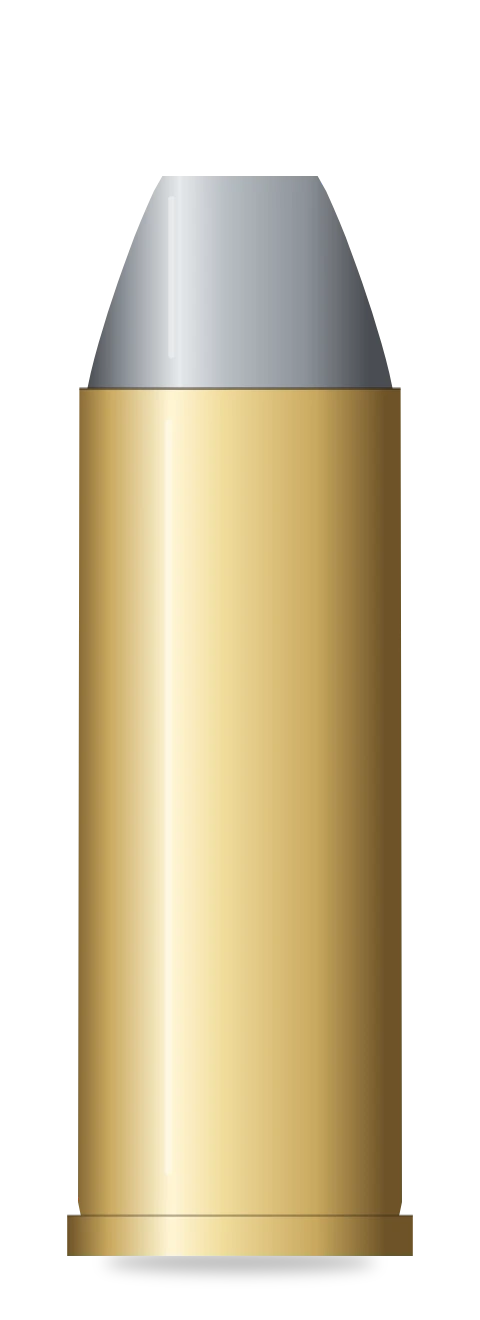
01 / At a glance
The basics
- Origin
- United States
- Introduced
- 1873
- Ignition
- Centerfire
- Case form
- Rimmed, straight-walled
- Diameter
- 11.5 mm
- Case length
- 32.6 mm
Rounded values to help you identify the cartridge, not manufacturing drawings. See the cited standard for exact dimensions and tolerances.
Do not mix it up
Only fire hot .45 Colt loads in guns that are built for them. Old revolvers and many modern ones were made for black-powder-era pressures, and strong loads can damage them. Read the maker's manual.
The .45 Colt is a large-bore revolver cartridge that fires a .452 inch bullet, usually 200 to 300 grains. It was introduced in 1873 with the Colt Single Action Army, and it has been in continuous use ever since. It is the standard cartridge of cowboy action shooting, a common hunting round in strong modern revolvers and lever-action carbines, and a favorite of shooters who like classic guns.
This guide explains what the cartridge is, how it performs, how to choose ammunition and a revolver, and how it compares with the .45 ACP, .44 Magnum, .357 Magnum and other cartridges people weigh it against. It is a reference page, not a loading manual, and it contains no handloading data.
A short history
Colt introduced the .45 Colt in 1873, together with the Single Action Army revolver, and the U.S. Army adopted the pair. The first loads used black powder and a 250 grain lead bullet at around 900 ft/s. The revolver, nicknamed the Peacemaker, became the gun of the American West, and the cartridge was loaded for it by several makers.
People often call the cartridge the .45 Long Colt. That name came about to tell it from the shorter .45 Schofield, which fits in a Colt revolver but not the other way round. Colt itself called it simply the .45 Colt, and that is the name SAAMI uses.
The cartridge never went away. Winchester and Marlin offered lever-action rifles in .45 Colt, and in the 20th century Ruger built revolvers strong enough to handle much higher pressure loads. The rise of cowboy action shooting in the 1980s gave it a new following, and today it is made by every major ammunition company.
Why it is so popular
The first reason is history. The .45 Colt is tied to the Single Action Army, the cavalry and the cowboy. For many shooters, a revolver in this cartridge is part of the pleasure of the hobby.
The second reason is range of use. Standard loads are gentle, with the recoil of a push rather than a snap, and they are accurate. Strong loads in a strong gun reach near .44 Magnum power. One cartridge covers target shooting, small game and deer.
The third reason is the guns. Revolvers from Colt, Ruger, Uberti and Taurus, and lever-action carbines from Marlin, Henry, Winchester and Rossi, all use it. A rifle and a revolver can share the same ammunition.
Specifications at a glance
| Specification | Value |
|---|---|
| Bullet diameter | .452 in (11.5 mm) |
| Case length | 1.285 in (32.6 mm) |
| Maximum overall length (SAAMI) | 1.600 in (40.6 mm) |
| Case type | Rimmed, straight-walled |
| Primer | Large pistol |
| Maximum average pressure (SAAMI) | 14,000 psi |
| Maximum pressure (C.I.P.) | 130 MPa (1,300 bar) |
| Typical bullet weights | 200 to 335 grains; 225 and 250 grains are most common |
| Typical muzzle velocity | About 750 to 900 ft/s for standard loads |
| Common barrel twist | 1 in 16 inches |
Values are rounded for reference. Exact dimensions and tolerances are in the SAAMI and C.I.P. standards cited at the end of this page. Some strong loads are made to higher pressures that are not part of the SAAMI standard, for use only in guns built for them.
Strengths and limits
The .45 Colt is a gentle cartridge with a heavy bullet, and it has a split personality. Know the trade-offs.
| Advantage | Limitation |
|---|---|
| Large, heavy bullet with good penetration | Slow bullet; the path is steep at distance |
| Mild standard loads that are easy to shoot | Revolvers hold six rounds or fewer and reload slowly |
| Strong loads in strong guns approach .44 Magnum power | Strong loads are only for guns built for them |
| Works in both revolvers and lever-action carbines | Ammunition costs more than .38 Special or 9mm |
The key issue is pressure. SAAMI sets a modest maximum for the .45 Colt, in line with the 1870s. A few strong guns can take more, and some companies sell loads built for them. Those loads can wreck a gun that was not made for them, so match the load to the revolver.
Standard loads and strong loads
A standard 250 grain load at about 750 to 800 ft/s has the same gentle character the cartridge had in 1873. A strong load of 300 grains or more at 1,200 ft/s or higher is a different animal. The case is the same, and the gun is not. Never put a strong load in an old revolver, an Italian replica or a lightweight gun.
Ballistics
Pistol ballistics are compressed into short distances. The tables and charts below show one common factory load, a 225 grain jacketed hollow point at 860 ft/s, fired from a revolver zeroed at 25 yards.
| Range (yd) | Velocity (ft/s) | Energy (ft-lb) | Drop (in) | Wind drift, 10 mph (in) |
|---|---|---|---|---|
| 25 | 844 | 356 | 0 | 0.1 |
| 50 | 828 | 342 | -2.2 | 0.6 |
| 75 | 813 | 330 | -7.5 | 1.3 |
| 100 | 799 | 319 | -16.1 | 2.4 |
Reading the numbers
From a 25-yard zero the bullet falls about 2 inches at 50 yards and about 16 inches at 100 yards. A 10 mph crosswind moves it about 2.4 inches at 100 yards. Energy falls from about 369 foot-pounds at the muzzle to about 319 at 100 yards. It is a slow, heavy bullet, so the path is steep, and the cartridge is best inside 50 yards.
These figures are for a standard-pressure load. A strong 300 grain hunting load from a Ruger at 1,250 ft/s has about 1,000 foot-pounds at the muzzle, which is real hunting power for deer and hogs at close range. Lever-action carbines add speed with the same load.
How these figures were made: the muzzle velocity (860 ft/s), weight (225 grains) and the published velocities at 50 and 100 yards (828 and 799 ft/s) are Federal figures for its American Eagle 225 grain JHP load. The ballistic coefficient (G1 0.193) was fitted to match those published velocities. Drop, velocity, energy and wind drift are computed with a standard point-mass model, a 25-yard zero, a 0.9 inch sight height and standard atmosphere. They are estimates. Velocity depends heavily on barrel length.
Recoil and shooter comfort
Standard .45 Colt loads have mild recoil. In a full-size single-action revolver, the push is slow and easy to manage, and many shooters find it pleasanter than a .357 Magnum. Strong loads are very different, with recoil comparable to a .44 Magnum.
The grip shape of a single-action revolver rolls the gun up in the hand, which is part of the feel of the cartridge. Use a firm grip, wear hearing protection and eye protection, and move to strong loads only in a strong gun and only when you are comfortable with the standard loads.
How to choose ammunition
Choose by purpose first, then pressure. The same .45 Colt name covers very different products.
| Bullet type | Best for | Notes |
|---|---|---|
| Lead round nose flat point, 250 grains | Cowboy action shooting and practice | Mild and accurate; low velocity |
| Jacketed hollow point (JHP), 200 to 255 grains | Defense and general use | Designed to expand; standard pressure |
| Hard-cast lead flat point, 255 to 335 grains | Hunting and field use | Deep penetration; check that your gun allows lead |
| Jacketed soft point, 250 to 300 grains | Hunting | Controlled expansion |
| Strong loads (not SAAMI) | Hunting in strong revolvers and carbines only | Much higher pressure; use only in guns marked for it |
Bullet weight
A 250 grain bullet is the classic weight. A 225 grain bullet is common for defense. Heavier hard-cast bullets of 300 grains or more are for deep penetration in strong guns. Choose a weight that your revolver shoots accurately.
Match the load to the gun
Read the markings on the ammunition box. A label such as "Ruger and T/C only" means the load is too strong for other guns. If you do not know whether your revolver can take it, use standard-pressure ammunition. Older guns and replicas should only fire standard loads.
How to choose a revolver
The best revolver is the one you can shoot accurately and use for the job you have in mind. These are the points that matter most.
- Strength. A Ruger Blackhawk or Redhawk, or a Freedom Arms revolver, can take the strongest loads. A Colt Single Action Army or an Italian replica is for standard loads. Know which you have.
- Barrel length. 4¾ and 5½ inches are the classic single-action sizes. A 7½ inch barrel gives more velocity and a longer sight radius.
- Action. Single-action revolvers are the traditional choice for cowboy action shooting. Double-action guns such as the Ruger Redhawk and Taurus are faster to use.
- Grip. A grip that fits your hand reduces felt recoil and improves control.
- Sights. Adjustable sights suit hunting and target work. Fixed sights are traditional on single-action revolvers.
Lever-action carbines
A carbine in .45 Colt is handy, light and gentle, and the longer barrel adds speed. It is a popular pairing with a single-action revolver in cowboy action shooting. A carbine can also fire strong loads that would be a risk in an old revolver, if the carbine is rated for them.
Zeroing and practice
Many revolvers are set to hit the point of aim at about 25 yards. Test your revolver at that distance, shoot a group from a rest and adjust the sights if the group is off. Many single-action revolvers have fixed sights, so choose a load that hits where you aim.
Practice with standard loads for most of your sessions. Dry-fire at home with an unloaded revolver and a safe direction to build smooth handling. Cowboy action shooters train for smooth gun handling, and it is good practice for anyone.
Practical uses
Cowboy action shooting
The .45 Colt is a staple of cowboy action shooting, a timed sport with revolvers, lever-action rifles and shotguns in Old West costume. Shooters use mild lead loads for accuracy and speed, and the cartridge is perfect for the sport.
Handgun and carbine hunting
With a strong load in a strong gun, the .45 Colt takes deer, hogs and similar game at close range, usually inside 75 yards. It is a mild-looking cartridge that can do real work with the right gun and bullet. Check local regulations for minimum caliber, energy and barrel length.
Personal and home defense
A .45 Colt revolver is used by some people for home defense or in the field. Laws about carrying and using firearms for protection vary, so follow local laws and get proper training.
Target shooting
It is a pleasant, accurate cartridge on the range, and the big, slow bullet is easy to watch hit steel at 25 to 50 yards.
.45 Colt vs similar handgun cartridges
The table lists the handgun cartridges most often compared with the .45 Colt. Figures are rounded and use the SAAMI maximum average pressure.
| Cartridge | Bullet diameter | Case length | Max pressure | Typical use |
|---|---|---|---|---|
| .45 Colt | .452 in | 1.285 in | 14,000 psi | Revolvers and lever-action carbines |
| .45 ACP | .452 in | 0.898 in | 21,000 psi | Large-bore pistols and competition |
| .44 Magnum | .429 in | 1.285 in | 36,000 psi | Hunting revolvers |
| .44 Special | .429 in | 1.160 in | 15,500 psi | Mild revolvers |
| .357 Magnum | .357 in | 1.290 in | 35,000 psi | Revolvers and carbines |
| .454 Casull | .452 in | 1.383 in | 65,000 psi | Hunting revolvers |
Against the .45 ACP, the two use the same bullet diameter, and standard .45 Colt loads are slightly slower with a longer case. Against the .44 Magnum, a standard .45 Colt is far milder, and a strong one is close. Against the .357 Magnum, it has a heavier bullet and a slower one.
Care and storage
Clean the barrel and the cylinder after each range session, paying attention to the chambers and the face of the cylinder where powder residue and lead build up. Lightly oil the moving parts. Store ammunition in a cool, dry place. Keep firearms and ammunition locked and out of reach of children and unauthorized users.
Safety and common mistakes
- Never fire strong loads, those not made to SAAMI pressure, in a gun not built and marked for them. Old revolvers and replicas can be wrecked.
- Do not confuse .45 Colt with .45 ACP. The cartridges share a bullet diameter but have different cases and pressures, and they are not interchangeable.
- A .45 Schofield cartridge will fire in a .45 Colt chamber, but a .45 Colt will not fit in a Schofield chamber. Read the barrel marking.
- Treat every firearm as loaded. Keep your finger off the trigger until your sights are on the target.
- Know your target and what is beyond it. A .45 bullet can pass through a target and travel far.
- Wear eye and ear protection at the range.
- If you reload, use only published data from a current manual and start low. This page does not contain loading data.
Frequently asked questions
Is .45 Colt the same as .45 Long Colt?
Yes. People use the name .45 Long Colt to tell it from the shorter .45 Schofield. The official name is .45 Colt.
What is the difference between .45 Colt and .45 ACP?
They use the same bullet diameter, but the .45 Colt is a longer, rimmed revolver cartridge at lower pressure. The .45 ACP is a shorter, rimless pistol cartridge. They are not interchangeable.
Can I shoot strong .45 Colt loads in any revolver?
No. Strong loads that go beyond SAAMI pressure are only for guns built for them, such as modern Ruger and Freedom Arms revolvers. Old revolvers and Italian replicas should only fire standard loads.
Is .45 Colt good for deer hunting?
With a strong load in a strong gun, and a well-built hard-cast or soft-point bullet, yes, at close range. A lever-action carbine is a better choice than a short revolver. Check local regulations.
Is .45 Colt good for self-defense?
It has a large bullet and is easy to shoot with standard loads, and some people use it for defense. A revolver holds fewer rounds than a pistol and is slower to reload. Practice and training matter more than the cartridge.
How far can a .45 Colt shoot?
Most practical shooting is inside 50 yards. The bullet travels much farther, so always know your backstop.
What bullet weight is best for .45 Colt?
250 grains is the classic weight. 225 grains is common for defense. 300 grains and heavier hard-cast bullets are for hunting in strong guns.
Can I reload .45 Colt brass?
Yes. The brass is widely reloaded. Use only published data from a current loading manual and follow its safety instructions.
Sources
Sources reviewed · 29 October 2026