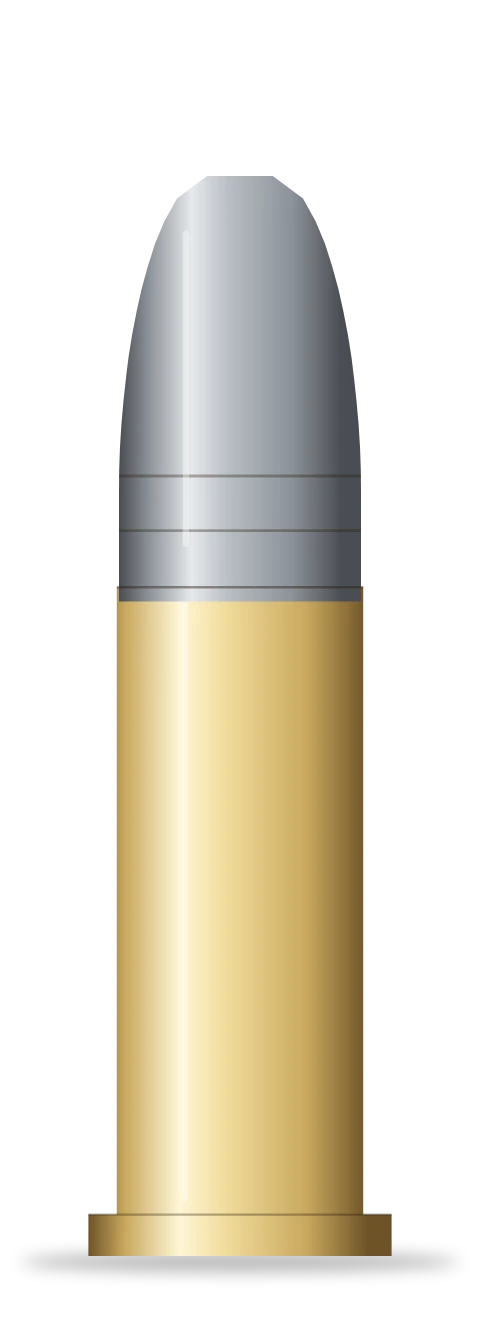
01 / At a glance
The basics
- Origin
- United States
- Introduced
- 1887
- Ignition
- Rimfire
- Case form
- Rimmed, straight-sided
- Diameter
- 5.6 mm
- Case length
- 15.6 mm
Rounded values to help you identify the cartridge, not manufacturing drawings. See the cited standard for exact dimensions and tolerances.
Do not mix it up
.22 Short, .22 Long, .22 LR and .22 WMR are different cartridges. They share the .22 name, but they are not interchangeable. Check the marking on your firearm before you buy ammunition.
The .22 Long Rifle, usually written .22 LR, is the most widely shot rimfire cartridge in the world. It is small, mild and inexpensive to shoot, and it has been in production since 1887. Millions of shooters learned on it, and many never leave it, because it does so many jobs well: plinking, small-game hunting, pest control, training and organized competition.
This guide explains what the cartridge is, how its different velocity classes behave, how to choose ammunition and a firearm, and how it compares with the other .22 and .17 rimfire rounds. It is a reference page. It does not contain loading data, because rimfire ammunition cannot be reloaded.
A short history
The .22 Long Rifle was introduced in 1887 by Stevens. It paired the case of the earlier .22 Long with a heavier bullet, and it added power without changing the basic rimfire design. The first .22 rimfire, the .22 Short, dates to the 1850s and was one of the earliest self-contained metallic cartridges.
The long production run explains the huge range of firearms. Single-shot rifles, bolt-action rifles, semi-automatic rifles, revolvers and pistols have all been built for it, along with dedicated match rifles for Olympic and smallbore competition. Nearly every maker of ammunition lists several .22 LR products, and nearly every gun maker lists at least one firearm.
Why it is still popular
Cost is the first reason. A box of .22 LR costs a fraction of centerfire ammunition, so you can shoot far more and learn faster. Low recoil is the second reason, because a beginner can learn good habits without flinching. The report is mild compared with centerfire, and rifles are light and easy to carry.
Availability is the third. Almost every store that sells ammunition stocks it, and the choice of bullet and velocity covers everything from quiet backyard shooting to competition.
Specifications at a glance
| Specification | Value |
|---|---|
| Bullet diameter | .222 in (5.6 mm) |
| Case length | 0.613 in (15.6 mm) |
| Maximum overall length (SAAMI) | 1.000 in (25.4 mm) |
| Case type | Rimmed, straight-sided |
| Ignition | Rimfire, priming compound in the rim |
| Maximum average pressure (SAAMI) | 24,000 psi |
| Common barrel twist | 1:16 inch |
| Typical bullet weights | 30 to 40 grains for most loads, with some 60 grain subsonic loads |
Values are rounded for reference. Exact dimensions and tolerances are in the SAAMI standards cited at the end of this page.
Strengths and limits
The .22 LR is a specialist at being small. The table shows what that gives you and what it costs.
| Advantage | Limitation |
|---|---|
| Low cost per shot | Rimfire ammunition cannot be reloaded |
| Very mild recoil and noise | Short effective range for hunting, usually inside 50 yards |
| Huge choice of rifles, pistols and ammunition | Wind moves the bullet a lot, even at 100 yards |
| Light, compact firearms | Not suited to animals larger than small game |
How to choose ammunition
Most of the performance differences come from velocity class and bullet type. Pick the velocity first, then the bullet.
| Class | Typical speed | Best for | Notes |
|---|---|---|---|
| Subsonic | Below about 1,125 ft/s | Quiet shooting, suppressed rifles, backyard pest control | Stays under the speed of sound, which removes the crack; may not cycle some semi-autos |
| Standard velocity | About 1,070 ft/s | Target shooting and training | Often the most accurate in match and target rifles |
| High velocity | About 1,250 ft/s | Plinking and small-game hunting | The most common type; cycles most semi-autos |
| Hyper velocity | 1,400 ft/s and up | Small game and pest control | Lighter bullets, flatter path, louder, usually more expensive |
| Bullet type | Best for | Notes |
|---|---|---|
| Lead round nose | Target and general use | Accurate and inexpensive; leaves lead fouling in the bore |
| Plated round nose | Plinking and practice | Cleaner than bare lead and widely available |
| Hollow point | Small-game hunting | Expands on impact for faster results on small animals |
| Segmenting hollow point | Small game and pests | Breaks into pieces for a lighter, shallower wound |
Every rifle has its own favorite. Buy a few different boxes and shoot groups at 50 yards before you stock up. Many rifles are far more accurate with one brand than another.
Ballistics
The tables and charts below show a common factory load, the CCI Target Mini-Mag with a 40 grain plated round nose bullet. At the muzzle it moves at 1,235 ft/s, but it slows quickly because a small, light round nose bullet has a low ballistic coefficient.
| Range (yd) | Velocity (ft/s) | Energy (ft-lb) | Drop (in) | Wind drift, 10 mph (in) |
|---|---|---|---|---|
| 25 | 1154 | 118 | 1.5 | 0.4 |
| 50 | 1089 | 105 | 2.9 | 1.5 |
| 75 | 1036 | 95 | 2.5 | 3.3 |
| 100 | 993 | 88 | 0 | 5.8 |
| 125 | 956 | 81 | -4.7 | 8.7 |
| 150 | 924 | 76 | -11.7 | 12.2 |
Reading the numbers
With a 100-yard zero, the bullet rises about 3 inches above the line of sight at 50 yards and falls about 12 inches below it at 150 yards. A 10 mph crosswind pushes it about 6 inches at 100 yards. These numbers explain why most .22 LR shooting happens inside 75 yards, and why wind reading is the main skill at longer range.
Many rimfire shooters zero at 50 yards instead, which keeps the bullet close to the line of sight at the distances where most .22 LR shooting happens. Pick the zero that fits the distances you actually shoot.
How these figures were made: muzzle velocity (1,235 ft/s), bullet weight (40 grains) and ballistic coefficient (G1 0.130) are the published figures for the CCI Target Mini-Mag. Drop, velocity, energy and wind drift are computed with a standard point-mass model, a 100-yard zero, a 1.5 inch sight height and standard atmosphere. The computed velocity, energy and trajectory at 25 to 100 yards agree closely with CCI's own table. Treat them as estimates and confirm with your own rifle.
How to choose a firearm
There is a .22 LR firearm for almost every taste. These are the points that matter most.
- Action type. A bolt action or single shot is the most accurate for the price and the safest for a first rifle. A semi-automatic is faster and more fun for plinking, but needs ammunition it likes to cycle reliably.
- Barrel and twist. A 1:16 twist is standard. Longer barrels give a longer sight radius and slightly more velocity; shorter barrels are easier to carry and handle.
- Sights and optics. Good iron sights are enough for a beginner. A 3-9 or 4-12 scope helps for small-game hunting and precision shooting.
- Trigger. A clean, light trigger matters more than any other feature for accuracy.
- Pistols and revolvers. A .22 LR handgun is a low-cost way to learn handgun fundamentals, but short barrels reduce velocity and accuracy.
Accuracy and practice
Start at 25 yards with a rest, then move out to 50. Shoot five-round groups and change only one thing at a time: ammunition, sight setting or position. A rimfire usually shows its true accuracy only with ammunition it likes, so a few test boxes are money well spent.
Practice builds more skill than any equipment change. Dry-fire at home to learn trigger control. Shoot from a rest, then from a sling, then from a field position. Add a spinning target or a plate rack for fun, and keep notes of every session so you can see what is improving.
Practical uses
Plinking and training
This is the main use. Cans, paper targets and reactive steel make it enjoyable, and the low cost lets you shoot often. It is also the usual cartridge for teaching safe habits to new shooters of all ages.
Small-game hunting
The .22 LR is used on squirrels, rabbits and similar small game, and for controlling pests. Keep shots close, aim for the head or the chest, and use hollow-point ammunition. Check local rules about seasons, bullet types and legal species before you hunt.
Target and competition
Smallbore rifle events, silhouette matches, rimfire benchrest, biathlon and many club events use the .22 LR. Match ammunition and a match-grade rifle are capable of remarkable precision at 50 yards and beyond.
.22 LR vs similar rimfire cartridges
The table lists the rimfire and small centerfire cartridges most often compared with the .22 LR. Speeds are approximate figures for common factory loads.
| Cartridge | Bullet diameter | Case length | Typical load | Typical use |
|---|---|---|---|---|
| .22 Short | .222 in | 0.423 in | 29 gr at about 1,080 ft/s | Quiet plinking, some pistols |
| .22 Long Rifle | .222 in | 0.613 in | 40 gr at 1,070 to 1,250 ft/s | Plinking, small game, target |
| .22 WMR (Magnum) | .224 in | 1.055 in | 40 gr at about 1,900 ft/s | Small game to coyote-size pests |
| .17 HMR | .172 in | 1.06 in | 17 gr at about 2,500 ft/s | Flat-shooting varmint and small game |
| .223 Remington | .224 in | 1.760 in | 55 gr at about 3,200 ft/s | Varmint and target (centerfire) |
The .22 WMR and .17 HMR shoot flatter and farther, but their ammunition costs several times more per round and they are louder. For a first rifle, or for any job inside 75 yards, the .22 LR is hard to beat.
Care and storage
Rimfire rifles stay accurate when kept clean, but the barrel needs far less cleaning than a centerfire. Wipe the bore after each session and give the action a light oil. Store ammunition in a cool, dry place, locked away from children. Old rimfire ammunition can misfire, and a failed round must be handled with the muzzle pointed in a safe direction for at least thirty seconds.
Safety and common mistakes
- Do not underestimate the bullet. A .22 LR can travel more than a mile. Always know what is beyond your target and shoot only with a safe backstop.
- Match the cartridge to the chamber. .22 Short, .22 Long Rifle and .22 WMR are different cartridges. Check the barrel marking.
- Treat every firearm as loaded. Keep your finger off the trigger until your sights are on the target.
- Wear eye and ear protection. A .22 LR is quieter than centerfire, but it can still damage hearing.
- Use only fresh, clean ammunition from a reliable maker, and avoid ammunition that looks corroded or damaged.
- Supervise young shooters directly, and teach rules before the first shot.
Frequently asked questions
What does .22 LR mean?
.22 refers to the nominal bullet diameter in inches, and LR stands for Long Rifle, the name of this specific cartridge. It does not mean it can only be used in rifles. Many pistols and revolvers also use it.
How far can a .22 LR shoot accurately?
Most shooters stay inside 100 yards. With a good rifle and match ammunition, accuracy is excellent at 50 yards and workable beyond, but wind affects the bullet strongly. For hunting, stay inside 50 yards.
Can I use .22 Short or .22 Long in a .22 LR rifle?
Often they chamber, but they may not cycle a semi-automatic, and mixed use is not recommended. Use the cartridge marked on your barrel. .22 WMR is a different cartridge and will not chamber.
Is subsonic ammunition quieter?
Yes. Subsonic loads stay below the speed of sound, so they have no supersonic crack. They are quieter, especially with a suppressor, but they may not cycle every semi-automatic.
Can I reload .22 LR?
No. Rimfire cases have the priming compound inside the rim and are not designed to be reloaded.
What is the best .22 LR ammunition for my rifle?
There is no single best. Every rifle prefers certain brands and bullets. Buy several different boxes and compare groups at 50 yards.
What distance should I zero a .22 LR?
Many shooters zero at 50 yards for general use and small-game hunting. Others zero at 100 yards. The ballistics table above shows both trajectories.
Is the .22 LR suitable for self-defense?
It is low in power and is generally not recommended. Cartridges designed for defense, such as 9mm Luger, offer much better performance. Follow local laws and professional training if you need an answer for a specific situation.
Sources
Sources reviewed · 29 October 2026