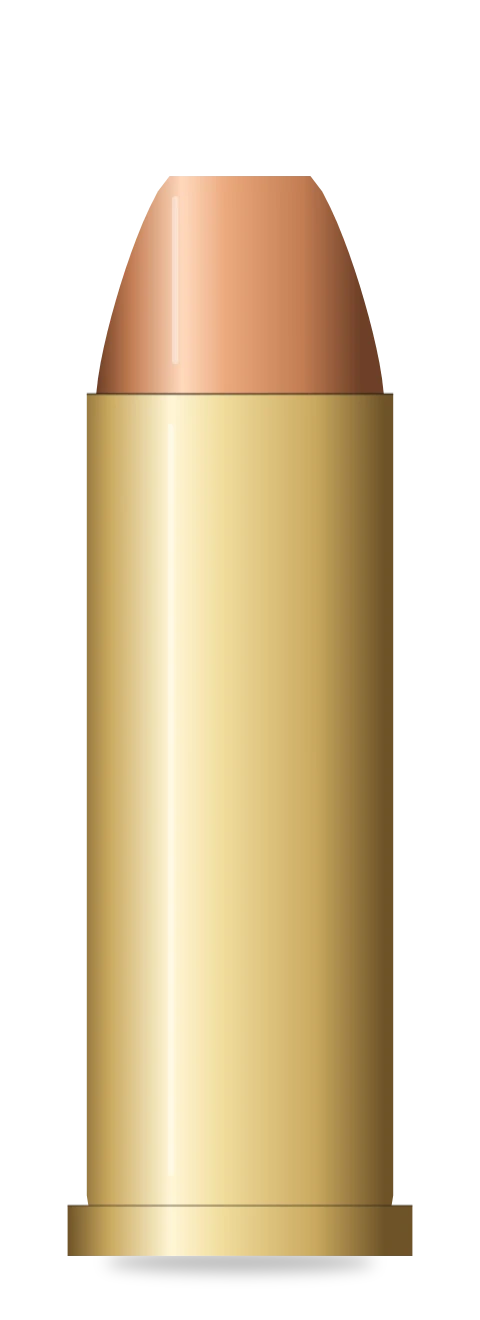
01 / At a glance
The basics
- Origin
- United States
- Introduced
- 1955
- Ignition
- Centerfire
- Case form
- Rimmed, straight-walled
- Diameter
- 10.9 mm
- Case length
- 32.6 mm
Rounded values to help you identify the cartridge, not manufacturing drawings. See the cited standard for exact dimensions and tolerances.
Do not mix it up
A .44 Magnum revolver can fire .44 Special, but a .44 Special revolver must never be loaded with .44 Magnum. Check the marking on the barrel or cylinder.
The .44 Magnum is a large-bore revolver cartridge that fires a .429 inch bullet, usually 240 to 300 grains, at around 1,200 to 1,500 ft/s. It was introduced in 1955 and became the standard for handgun hunting and for protection against large animals. It is also used in lever-action carbines, where it gains speed and becomes much easier to shoot.
This guide explains what the cartridge is, how it performs, how to choose ammunition and a revolver, and how it compares with the .357 Magnum, .45 Colt, 10mm Auto and other cartridges people weigh it against. It is a reference page, not a loading manual, and it contains no handloading data.
A short history
The .44 Magnum grew out of the .44 Special, a revolver cartridge from 1907. Elmer Keith, a rancher, hunter and writer, spent years loading the .44 Special to much higher pressures in heavy revolvers, and he pushed the ammunition and gun industries to build a stronger factory cartridge.
Remington developed the cartridge and Smith & Wesson built the revolver, the Model 29, and both were introduced in 1955. The case is the .44 Special lengthened by about an eighth of an inch. Like the .357 Magnum before it, the longer case keeps the powerful loads out of older guns that cannot handle them.
Sales were slow at first. The Model 29 became a cultural icon after the 1971 film Dirty Harry, where it was called the most powerful handgun in the world, and demand rose sharply. Ruger, Colt, Taurus, Magnum Research and others followed with their own revolvers, and Marlin, Henry and Rossi built lever-action carbines for it.
Why it is so popular
The first reason is power. A 240 grain bullet at about 1,230 ft/s carries over 800 foot-pounds at the muzzle, and heavier hunting loads carry more. That is far beyond the .357 Magnum and the 9mm, and it is enough for deer, hogs and black bear at close range with a good bullet.
The second reason is the .44 Special. A .44 Magnum revolver can also fire the milder .44 Special. A shooter can practice with a gentle load and hunt with the full-power one, all in the same revolver.
The third reason is the guns. Heavy double-action revolvers, single-action revolvers and lever-action carbines are built for it, and they are well made and long-lived. Many shooters own one, because it is one of the simplest ways to carry a lot of energy in a handgun.
Specifications at a glance
| Specification | Value |
|---|---|
| Bullet diameter | .429 in (10.9 mm) |
| Case length | 1.285 in (32.6 mm) |
| Maximum overall length (SAAMI) | 1.610 in (40.9 mm) |
| Case type | Rimmed, straight-walled |
| Primer | Large pistol (a magnum primer is common) |
| Maximum average pressure (SAAMI) | 36,000 psi |
| Maximum pressure (C.I.P.) | 300 MPa (3,000 bar) |
| Typical bullet weights | 180 to 330 grains; 240 and 300 grains are most common |
| Typical muzzle velocity | About 1,230 to 1,450 ft/s with a 240 grain bullet from a revolver |
| Common barrel twist | 1 in 18.75 to 1 in 20 inches |
Values are rounded for reference. Exact dimensions and tolerances are in the SAAMI and C.I.P. standards cited at the end of this page.
Strengths and limits
The .44 Magnum is a heavy-hitting cartridge, and it has the costs that come with that.
| Advantage | Limitation |
|---|---|
| Large, heavy bullets with deep penetration | Heavy recoil and a loud blast |
| Also fires the milder .44 Special | Revolvers are large and heavy, with six rounds or fewer |
| Works in revolvers and lever-action carbines | Ammunition costs more than .357 Magnum or 9mm |
| Enough energy for medium game at short range | Short barrels give up a lot of velocity and make a big flash |
| Very strong, durable guns | Not a long-range handgun cartridge |
The .44 Magnum is a cartridge for people who accept its recoil. It is not hard to shoot well, but it is hard to shoot fast. A hunter at 25 to 75 yards gets everything the cartridge offers. A beginner who wants a first handgun is better served by a smaller cartridge.
Muzzle blast and flash
A full-power load burns a large amount of slow powder. In a short barrel, a lot of it is still burning when the bullet leaves, which gives a loud blast and a long flash. Hearing protection is needed every time, and two types at once (plugs and muffs) are sensible at an indoor range.
Ballistics
The tables and charts below show one common factory load, a 240 grain jacketed hollow point at 1,230 ft/s, fired from a revolver zeroed at 25 yards.
| Range (yd) | Velocity (ft/s) | Energy (ft-lb) | Drop (in) | Wind drift, 10 mph (in) |
|---|---|---|---|---|
| 25 | 1170 | 729 | 0 | 0.3 |
| 50 | 1117 | 665 | -0.7 | 1.1 |
| 75 | 1073 | 614 | -3.1 | 2.4 |
| 100 | 1036 | 572 | -7.4 | 4.2 |
Reading the numbers
From a 25-yard zero the bullet is within an inch of the point of aim at 50 yards and falls about 7 inches at 100 yards. A 10 mph crosswind moves it about 4 inches at 100 yards. Energy falls from about 806 foot-pounds at the muzzle to about 572 at 100 yards, which is still more than most handgun loads have at the muzzle. The heavy bullet holds its speed better than a lighter one.
These figures are for a revolver. A lever-action carbine with a 16 to 20 inch barrel adds several hundred ft/s with the same load, which flattens the path and increases the energy a great deal. Hunting loads from a revolver may start at 1,350 to 1,450 ft/s with a 240 grain bullet.
How these figures were made: the muzzle velocity (1,230 ft/s) and weight (240 grains) are published figures for the Federal American Eagle 240 grain JHP load. The ballistic coefficient (G1 0.176) was fitted to match the published downrange velocities. Drop, velocity, energy and wind drift are computed with a standard point-mass model, a 25-yard zero, a 0.9 inch sight height and standard atmosphere. They are estimates. Velocity depends heavily on barrel length, and a short barrel will be slower.
Recoil and shooter comfort
The .44 Magnum has heavy recoil. In a large revolver with a long barrel, it feels like a firm, slow push. In a short or light revolver, the same load snaps the gun upward and hurts the hand. Weight is the main fix. A revolver of 45 to 55 ounces soaks up much of the recoil.
Start with .44 Special, which is gentle and accurate, and move up to magnum loads when your grip, trigger control and confidence are good. Do not try heavy loads in a light gun. A flinch ruins accuracy, and an honest session of ten careful shots is worth more than a hundred bad ones. Always use hearing protection.
How to choose ammunition
Choose by purpose first, then bullet weight. The same .44 Magnum name covers very different products.
| Bullet type | Best for | Notes |
|---|---|---|
| Jacketed hollow point (JHP), 200 to 240 grains | Defense, deer and general hunting | Designed to expand; wide range of makers |
| Jacketed soft point, 240 to 300 grains | Hunting | Controlled expansion and deep penetration |
| Hard-cast lead flat point, 265 to 330 grains | Large or dangerous game, defense in bear country | Very deep penetration; check that your gun allows lead |
| Lead semi-wadcutter or round nose | Practice and target shooting | Cheaper; often milder |
| Lighter bullets, 180 to 200 grains | Fast loads for small and medium game | More velocity, less penetration |
Bullet weight
A 240 grain bullet is the classic all-round weight. A 180 or 200 grain bullet is faster and flatter. A 300 grain or heavier bullet is slower and made for deep penetration on large animals. Choose the weight your revolver shoots accurately, and then choose the bullet design for the job.
.44 Special in a .44 Magnum revolver
A .44 Magnum revolver safely fires .44 Special. It is a good way to practice with less recoil and lower cost. The reverse is not safe. A revolver chambered only for .44 Special must never be loaded with .44 Magnum, because the longer case will not fit and the pressure is much higher. Always check the marking on the barrel or cylinder.
How to choose a revolver
The best revolver is the one you can shoot accurately and use for the job you have in mind. These are the points that matter most.
- Weight and frame. Large frames such as the Ruger Redhawk and Super Blackhawk or the Smith & Wesson Model 29 and 629 are built for it. Heavier is easier to shoot.
- Barrel length. A 6 or 6.5 inch barrel is a good balance for hunting and general use. Eight inches gives more velocity and a longer sight radius. A short 3 or 4 inch barrel is for carry in the field and is loud and harsh.
- Action. Double-action revolvers are fast to shoot and common. Single-action revolvers are slower to reload but very strong and accurate.
- Grip. A grip that fits your hand and absorbs shock matters more than almost any other feature.
- Sights and optics. Adjustable sights suit hunting and target work. A handgun scope or red dot on a sturdy mount extends the practical range.
Lever-action carbines
A carbine in .44 Magnum is lighter and handier than most deer rifles and has gentle recoil. The longer barrel adds speed, so the same ammunition hits harder and flatter. Magazine capacity is usually more than a revolver. A carbine is the best choice for a hunter who wants .44 Magnum power with less punishment.
Zeroing and practice
Many revolvers are set to hit the point of aim at about 25 yards. For hunting, many shooters zero at 50 yards, because the path stays within a few inches out to 75 yards. Test your revolver at the distance you plan to use, shoot a group from a rest, and adjust the sights if the group is off. Different bullet weights hit at different points, so zero with the ammunition you plan to hunt with.
Practice with .44 Special or light magnum loads for most of your sessions, and finish with a few full-power rounds to stay familiar with the recoil. Dry-fire at home with an unloaded revolver and a safe direction to build smooth trigger control.
Practical uses
Handgun hunting
The .44 Magnum is a classic handgun hunting cartridge. With a well-built 240 to 300 grain bullet, hunters take deer, hogs and black bear at close range, usually inside 75 yards, and need to be good with the gun. Check local regulations for minimum caliber, energy and barrel length.
Protection against large animals
Hikers, anglers and guides in bear country carry .44 Magnum revolvers with hard-cast bullets. Bear spray is the first line of protection for most people, and it has a good record. A revolver is a last resort, and the shooter needs enough practice to hit under stress.
Lever-action carbines
A .44 Magnum carbine is a fun, handy rifle for deer in thick cover, for hogs and for ranch work. Many hunters like that the same ammunition can go in a carbine and a revolver.
Target and silhouette shooting
Handgun silhouette is one of the sports where the .44 Magnum has a long history. Many shooters use it in a long-barreled revolver, and some use .44 Special loads for fun and comfort.
.44 Magnum vs similar handgun cartridges
The table lists the handgun cartridges most often compared with the .44 Magnum. Figures are rounded and use the SAAMI maximum average pressure.
| Cartridge | Bullet diameter | Case length | Max pressure | Typical use |
|---|---|---|---|---|
| .44 Magnum | .429 in | 1.285 in | 36,000 psi | Hunting revolvers and lever-action carbines |
| .44 Special | .429 in | 1.160 in | 15,500 psi | Mild revolvers and practice |
| .357 Magnum | .357 in | 1.290 in | 35,000 psi | Revolvers and carbines |
| .41 Magnum | .410 in | 1.290 in | 36,000 psi | Hunting revolvers |
| .45 Colt | .452 in | 1.285 in | 14,000 psi | Revolvers and lever-action carbines |
| 10mm Auto | .400 in | 0.992 in | 37,500 psi | Semi-automatic pistols |
Against the .357 Magnum, the .44 Magnum has a much heavier bullet and more energy, and a good deal more recoil. Against the .45 Colt, standard loads are similar in size, and the .44 Magnum is faster. Against the 10mm Auto, the .44 Magnum is more powerful, but the 10mm fits an autoloader and holds more rounds.
Care and storage
Clean the barrel and the cylinder after each range session, paying attention to the chambers and the face of the cylinder where powder residue and lead build up. Check the screws, since heavy recoil can loosen them. Lightly oil the moving parts. Store ammunition in a cool, dry place. Keep firearms and ammunition locked and out of reach of children and unauthorized users.
Safety and common mistakes
- Never load .44 Magnum into a revolver marked only for .44 Special. The case is longer, and the pressure is much higher.
- Do not confuse .44 Magnum with .44-40 (.44 WCF) or other .44 caliber cartridges. Read the barrel marking and the headstamp.
- Treat every firearm as loaded. Keep your finger off the trigger until your sights are on the target.
- Know your target and what is beyond it. A .44 bullet can pass through a target and travel far.
- Wear eye and ear protection at the range. Magnum blast is very loud, and indoor ranges amplify it.
- Hold the gun firmly. A loose grip with heavy loads can cause injury to the hand or face from the scope.
- If you reload, use only published data from a current manual and start low. This page does not contain loading data.
Frequently asked questions
Can a .44 Magnum revolver shoot .44 Special?
Yes. The .44 Magnum case is slightly longer, so a .44 Magnum revolver safely accepts .44 Special. A .44 Special revolver must never be loaded with .44 Magnum.
Is .44 Magnum too powerful for a beginner?
For most beginners, yes. The recoil is heavy and the blast is loud. A better path is to start with a .22 LR or a .38 Special, then move to .44 Special, and only then to magnum loads in a heavy revolver.
Can I hunt deer with a .44 Magnum?
Yes. With a well-built bullet of 240 grains or more, it is a proven deer cartridge at close range, usually inside about 75 yards from a revolver and farther from a carbine. Check local regulations for minimum caliber and energy.
Is .44 Magnum good for bear defense?
Many people carry it for that reason, with hard-cast bullets that penetrate deeply. Bear spray is the first choice for most people, and a revolver needs a lot of practice to be useful under stress.
How far can a .44 Magnum shoot?
Most practical handgun shooting is inside 75 yards. Skilled shooters hit at 100 yards from a rest, and silhouette shooters go farther. A carbine reaches farther with the same ammunition. Always know your backstop.
What is the difference between .44 Magnum and .44 Special?
They use the same bullet diameter, but the .44 Magnum case is longer and the pressure is more than twice as high. The Magnum is much more powerful, and the Special is gentler and more pleasant to shoot.
What bullet weight is best for .44 Magnum?
240 grains is the classic all-round weight. 180 to 200 grains is faster for small and medium game. 270 to 330 grains is for large or dangerous game and deep penetration.
Can I reload .44 Magnum brass?
Yes. The brass is widely reloaded. Use only published data from a current loading manual and follow its safety instructions.
Sources
Sources reviewed · 29 October 2026