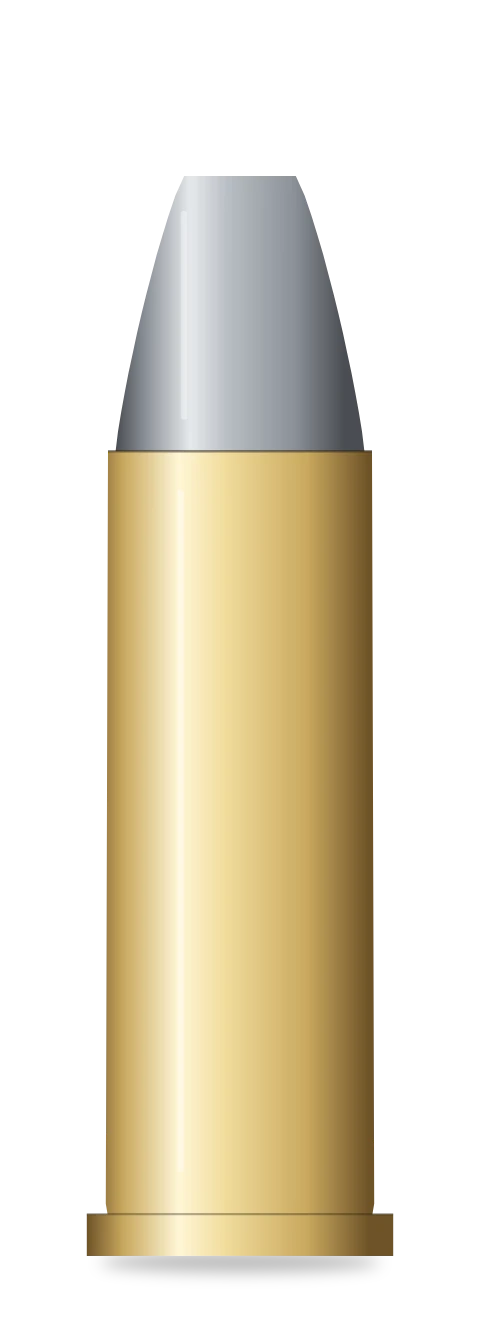
01 / At a glance
The basics
- Origin
- United States
- Introduced
- 1898
- Ignition
- Centerfire
- Case form
- Rimmed, straight-walled
- Diameter
- 9.1 mm
- Case length
- 29.3 mm
Rounded values to help you identify the cartridge, not manufacturing drawings. See the cited standard for exact dimensions and tolerances.
Do not mix it up
A .357 Magnum revolver can fire .38 Special, but a .38 Special revolver must never be loaded with .357 Magnum. Check the marking on the barrel or cylinder.
The .38 Special is a mild, accurate revolver cartridge that fires a .357 inch bullet, usually 125 to 158 grains, at about 750 to 950 ft/s. It was introduced in 1898 and became the standard American police and personal defense revolver cartridge for most of the 20th century. It is still sold in huge numbers, and it is the cartridge many people learn to shoot on.
This guide explains what the cartridge is, how it performs, how to choose ammunition and a revolver, and how it compares with the .357 Magnum, 9mm Luger, .380 ACP and other cartridges people weigh it against. It is a reference page, not a loading manual, and it contains no handloading data.
A short history
Smith & Wesson introduced the .38 Special in 1898, together with its Military & Police revolver. The U.S. Army had been using the .38 Long Colt, and in the fighting in the Philippines soldiers felt it was too weak. The .38 Special was a longer, stronger case with the same .357 inch bullet diameter, and it was first loaded with black powder.
The cartridge was adopted by police departments across the United States, and by the middle of the century it was the standard law enforcement revolver round. Small-frame revolvers such as the Smith & Wesson Model 36 became the classic concealed carry gun. In 1972 a version known as the FBI load, a 158 grain lead semi-wadcutter hollow point at higher pressure, became a standard police load.
The .38 Special also gave birth to the .357 Magnum. In 1935 the case was lengthened slightly, and loaded to much higher pressure. That is why a .357 Magnum revolver can fire .38 Special, and why the two cartridges are so often discussed together. Police moved to 9mm pistols in the late 20th century, but the .38 Special is still a common revolver cartridge.
Why it is so popular
The first reason is comfort. The recoil is mild, even in a small revolver. A beginner can learn the fundamentals of sights, trigger and grip without fighting the gun, and an experienced shooter can fire many rounds without fatigue.
The second reason is accuracy. The cartridge is very accurate in a good revolver, and wadcutter target loads have been used in bullseye and revolver competition for generations. It is the standard cartridge for an enormous number of target and training guns.
The third reason is availability. Revolvers in .38 Special have been made for over a century by almost every maker, new and used guns are common, and the ammunition is easy to find. A .357 Magnum revolver also shoots it, so a shooter gets two cartridges in one gun.
Specifications at a glance
| Specification | Value |
|---|---|
| Bullet diameter | .357 in (9.07 mm) |
| Case length | 1.155 in (29.3 mm) |
| Maximum overall length (SAAMI) | 1.550 in (39.4 mm) |
| Case type | Rimmed, straight-walled |
| Primer | Small pistol |
| Maximum average pressure (SAAMI) | 17,000 psi (+P: 18,500 psi) |
| Maximum pressure (C.I.P.) | 117 MPa (1,170 bar) |
| Typical bullet weights | 110 to 158 grains; 130 and 158 grains are most common |
| Typical muzzle velocity | About 750 to 900 ft/s with a 158 grain bullet |
| Common barrel twist | 1 in 18.75 inches |
Values are rounded for reference. Exact dimensions and tolerances are in the SAAMI and C.I.P. standards cited at the end of this page.
Strengths and limits
Every handgun cartridge is a compromise. The table shows where the .38 Special sits.
| Advantage | Limitation |
|---|---|
| Mild recoil and easy to shoot well | Modest energy; a +P load helps, but it is still below a 9mm +P |
| Accurate, with many target loads | Revolver capacity is usually five or six rounds |
| Fires in .357 Magnum revolvers as well | Slow to reload compared with a pistol magazine |
| Many guns, new and used, at fair prices | Short barrels lose velocity, and bullets may not expand |
The .38 Special has an honest reputation. It is not powerful, but it is controllable, and a shooter who hits with it is better off than one who misses with a stronger cartridge. Bullet design matters a great deal, because the speed is low.
Short barrels and expansion
A two inch snub-nose revolver gives up a lot of velocity, 100 ft/s or more, compared with a four inch barrel. Some bullets do not expand at that speed. If you carry a snub-nose for defense, choose a load designed for short barrels, and read what the maker says about performance.
Ballistics
Pistol ballistics are compressed into short distances. The tables and charts below show one common factory load, a 158 grain lead round nose at 770 ft/s, fired from a revolver zeroed at 25 yards.
| Range (yd) | Velocity (ft/s) | Energy (ft-lb) | Drop (in) | Wind drift, 10 mph (in) |
|---|---|---|---|---|
| 25 | 757 | 201 | 0 | 0.1 |
| 50 | 745 | 195 | -2.9 | 0.6 |
| 75 | 733 | 189 | -9.7 | 1.3 |
| 100 | 722 | 183 | -20.5 | 2.3 |
Reading the numbers
From a 25-yard zero the bullet falls about 3 inches at 50 yards and about 20 inches at 100 yards. A 10 mph crosswind moves it about 2 inches at 100 yards. Energy falls from about 208 foot-pounds at the muzzle to about 183 at 100 yards. The bullet is slow, so the path is steep, and the cartridge is a close-range tool, with most practical shooting inside 25 yards.
These figures are for a standard-pressure load. A +P load adds roughly 100 ft/s with the same bullet weight, and a lighter 110 to 130 grain bullet is faster still. Target wadcutters are slower, around 700 ft/s with a 148 grain bullet.
How these figures were made: the muzzle velocity (770 ft/s), weight (158 grains) and the published velocities at 50 and 100 yards (745 and 722 ft/s) are Federal figures for its American Eagle 158 grain lead round nose load. The ballistic coefficient (G1 0.203) was fitted to match those published velocities. Drop, velocity, energy and wind drift are computed with a standard point-mass model, a 25-yard zero, a 0.9 inch sight height and standard atmosphere. They are estimates. Velocity depends heavily on barrel length.
Recoil and shooter comfort
The .38 Special has mild recoil in a medium or large revolver. In a light snub-nose, it is livelier, and a +P load is noticeably sharper. A heavier gun softens it. For a new shooter, a revolver with a four inch barrel and a rubber grip is a very comfortable place to start.
Wadcutter target loads are the gentlest of all, and they are used by many instructors. Always use hearing protection, even with mild loads, and eye protection, because revolvers can spit small bits of lead and powder from the gap between cylinder and barrel.
How to choose ammunition
Choose by purpose first, then bullet weight. The same .38 Special name covers very different products.
| Bullet type | Best for | Notes |
|---|---|---|
| Lead round nose, 130 to 158 grains | Practice and general shooting | Cheapest; low velocity |
| Lead wadcutter, 148 grains | Target shooting and training | Flat nose cuts clean holes; very mild |
| Lead semi-wadcutter, 158 grains | Target and field use | Accurate and a little harder-hitting |
| Jacketed hollow point (JHP), 110 to 158 grains | Personal defense | Designed to expand; choose short-barrel loads for snubs |
| +P loads, 125 to 158 grains | Defense and field use | Higher pressure; only for guns rated for +P |
Bullet weight
A 158 grain bullet is the classic weight, and a 130 grain bullet is common for lower recoil and good velocity. A 110 grain bullet is light and fast, and is made for defense in short barrels. Pick a weight your revolver shoots accurately.
.38 Special +P
A +P load runs at a higher pressure than standard ammunition. It is safe in a revolver that is rated for it, which means most modern steel-frame revolvers, but not in old, light or alloy-frame guns that are not marked for it. Check the maker's manual. When in doubt, use standard-pressure loads.
.38 Special in a .357 Magnum revolver
A .357 Magnum revolver safely fires .38 Special. It is a good way to practice at low cost and low recoil. The reverse is not safe. A revolver chambered only for .38 Special must never be loaded with .357 Magnum.
How to choose a revolver
The best revolver is the one you can shoot accurately and use for the job you have in mind. These are the points that matter most.
- Frame size. A medium frame such as the Smith & Wesson Model 10 or Ruger GP100 is a good all-round choice for home use and range work. Small frames carry easily but are harder to shoot well.
- Barrel length. Four inches is a good balance. Two inches is for carry, with more recoil and less velocity. Six inches suits target shooting.
- Action. Double-action revolvers are the most common. A smooth trigger matters more than a long list of features.
- Material. Steel frames take +P and last for generations. Alloy frames are light, and may carry limits on +P. Read the markings.
- Grip and sights. A grip that fits your hand and sights you can see well improve accuracy more than almost any other change.
Buying a used revolver
Used revolvers are a good value, and many have been well cared for. Check the lockup, the timing and the gap between the cylinder and the barrel. Look inside the chambers for pitting. Have a gunsmith look at any old revolver before you shoot it, especially if it is a black powder era design.
Zeroing and practice
Many revolvers are set to hit the point of aim at about 25 yards. Test your revolver at that distance, shoot a group from a rest and adjust the sights if the group is off. Many snub-nose revolvers have fixed sights, so choose a load that hits the point of aim at the distance you expect to use.
Practice often with mild loads. Dry-fire at home with an unloaded revolver and a safe direction to build smooth trigger control. A short, focused session once or twice a week beats a long session once a month. Rotate in the load you carry, so you know where it hits.
Practical uses
Personal defense
A .38 Special revolver is simple, reliable and easy to use, and it has been a home defense and concealed carry choice for generations. Laws about carrying and using firearms for protection vary, so follow local laws and get proper training.
Target and bullseye shooting
Wadcutter loads are the traditional bullseye and revolver league cartridge. They cut clean paper holes and are accurate and gentle. It remains one of the best cartridges for learning precision.
Plinking and training
It is a pleasant cartridge to shoot on a day at the range. Low recoil and moderate cost make it a good choice for teaching new shooters, under supervision.
Small game
With a hard-cast or semi-wadcutter bullet and a carefully placed shot, it can take small game at short range. For anything larger, use a .357 Magnum or a stronger cartridge.
.38 Special vs similar handgun cartridges
The table lists the handgun cartridges most often compared with the .38 Special. Figures are rounded and use the SAAMI maximum average pressure.
| Cartridge | Bullet diameter | Case length | Max pressure | Typical use |
|---|---|---|---|---|
| .38 Special | .357 in | 1.155 in | 17,000 psi | Revolvers |
| .357 Magnum | .357 in | 1.290 in | 35,000 psi | Revolvers and lever-action carbines |
| 9mm Luger | .355 in | 0.754 in | 35,000 psi | All-round pistol and carbine |
| .380 ACP | .355 in | 0.680 in | 21,500 psi | Pocket pistols |
| .38 S&W | .361 in | 0.775 in | 14,500 psi | Old revolvers |
| .45 ACP | .452 in | 0.898 in | 21,000 psi | Large-bore pistols and competition |
Against the .357 Magnum, the .38 Special uses the same bullet with far less speed and recoil. Against the 9mm Luger, a standard .38 Special has less energy, and the 9mm +P is well above a .38 +P. Against the .380 ACP, it carries more energy and is easier to shoot in a medium revolver.
Care and storage
Clean the barrel and the cylinder after each range session, paying attention to the chambers and the face of the cylinder where powder residue builds up. Lightly oil the moving parts. Store ammunition in a cool, dry place. Keep firearms and ammunition locked and out of reach of children and unauthorized users.
Safety and common mistakes
- Never load .357 Magnum into a revolver marked only for .38 Special. The case is longer, and it is dangerous.
- Do not use +P ammunition in guns that are not rated for it, including many older and light alloy revolvers.
- The .38 S&W is a different cartridge from the .38 Special. It has a slightly larger bullet and a shorter case. Do not mix them. Check the barrel marking.
- Treat every firearm as loaded. Keep your finger off the trigger until your sights are on the target.
- Know your target and what is beyond it. A .38 bullet can pass through a target and travel far.
- Wear eye and ear protection at the range.
- If you reload, use only published data from a current manual and start low. This page does not contain loading data.
Frequently asked questions
Can a .357 Magnum revolver shoot .38 Special?
Yes. The .357 Magnum case is slightly longer, so a .357 Magnum revolver safely accepts .38 Special. A .38 Special revolver must never be loaded with .357 Magnum.
What does +P mean on .38 Special ammunition?
+P means the load runs at a higher pressure than the standard specification. Use it only in revolvers that are rated for it, typically modern steel-frame guns. Check your manual.
Is .38 Special good for self-defense?
It is a long-standing choice, with mild recoil and good reliability in a revolver. The energy is modest, so bullet choice matters. Many people use it with +P hollow points. Practice and training matter more than the cartridge.
What is the difference between .38 Special and 9mm?
The bullets are nearly the same diameter, but the cartridges are not interchangeable. The .38 Special is a rimmed revolver cartridge. The 9mm Luger is a rimless pistol cartridge with higher pressure, higher capacity and more energy.
What bullet weight is best for .38 Special?
158 grains is the classic all-round weight. 130 grains is common for lower recoil. 148 grain wadcutters are for target work. Pick one your revolver shoots accurately.
How far can a .38 Special shoot?
Most practical shooting is inside 25 yards. Good shooters hit at 50 yards. The bullet travels much farther, so always know your backstop.
Can I hunt with a .38 Special?
It is suitable for small game at short range. It is not enough for deer in most places. A .357 Magnum or larger is a better choice, and local rules may set a minimum.
Can I reload .38 Special brass?
Yes. The brass is widely reloaded. Use only published data from a current loading manual and follow its safety instructions.
Sources
Sources reviewed · 29 October 2026