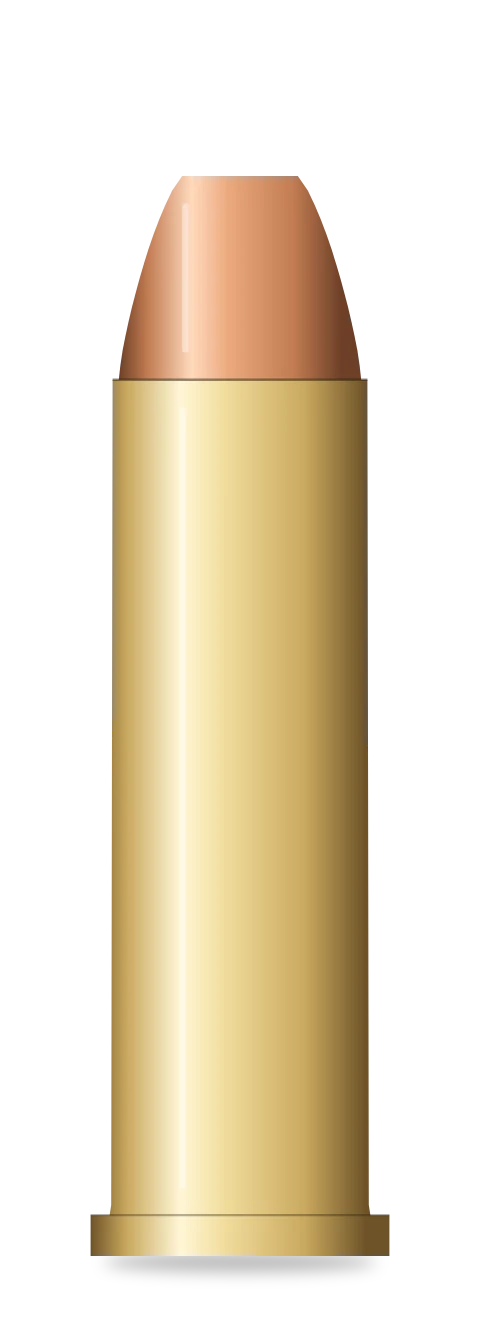
01 / At a glance
The basics
- Origin
- United States
- Introduced
- 1935
- Ignition
- Centerfire
- Case form
- Rimmed, straight-walled
- Diameter
- 9.1 mm
- Case length
- 32.8 mm
Rounded values to help you identify the cartridge, not manufacturing drawings. See the cited standard for exact dimensions and tolerances.
Do not mix it up
.357 Magnum revolvers can shoot .38 Special, but a .38 Special revolver must never be loaded with .357 Magnum. The longer magnum case will not fit, and trying it is dangerous.
The .357 Magnum is a high-pressure revolver cartridge that fires a .357 inch bullet at speeds well above the .38 Special it was built from. It was introduced in 1935 and has been one of the most respected revolver cartridges ever since. It is used for personal defense, hunting at short range, silhouette and target shooting, and in lever-action carbines.
This guide explains what the cartridge is, how it performs, how to choose ammunition and a revolver, and how it compares with the .38 Special, 9mm Luger, .44 Magnum and other cartridges people weigh it against. It is a reference page, not a loading manual, and it contains no handloading data.
A short history
Smith & Wesson introduced the .357 Magnum in 1935, together with a revolver called the Registered Magnum. The company worked with ammunition maker Winchester and with gun writers and shooters of the time, including Elmer Keith, who had been pushing for stronger handgun loads for years. Douglas Wesson of Smith & Wesson led the project.
The idea was simple. The .38 Special case was lengthened slightly, from 1.155 to 1.290 inches, so that a much stronger load could be used. The longer case would not fit in an older .38 Special revolver, which prevented the high-pressure loads from being used in guns not built for them. The new revolver was built stronger to handle the pressure.
It was a sensation. It was promoted as a handgun cartridge that could penetrate car doors and other cover that stopped older loads, and it was seen as the most powerful handgun load in the world until the .44 Magnum arrived in 1955. Police departments adopted it and it became a standard sidearm cartridge for decades.
Why it is so popular
The first reason is flexibility. A .357 Magnum revolver also shoots the milder .38 Special. A shooter can practice with cheap, soft-recoiling .38 Special loads, and carry or hunt with full-power magnums, all in one revolver.
The second reason is performance. A 158 grain bullet at about 1,250 ft/s carries over 500 foot-pounds of energy in a revolver, and a carbine barrel adds more speed. It is a serious cartridge for defense and for short-range hunting.
The third reason is the range of guns. Revolvers from Smith & Wesson, Ruger, Colt and others, single-action and double-action, small and large, and lever-action carbines are all made for it. The same ammunition works in all of them.
Specifications at a glance
| Specification | Value |
|---|---|
| Bullet diameter | .357 in (9.07 mm) |
| Case length | 1.290 in (32.8 mm) |
| Maximum overall length (SAAMI) | 1.590 in (40.4 mm) |
| Case type | Rimmed, straight-walled |
| Primer | Small pistol (a large pistol primer is used in some loads) |
| Maximum average pressure (SAAMI) | 35,000 psi |
| Maximum pressure (C.I.P.) | 300 MPa (3,000 bar) |
| Typical bullet weights | 110 to 200 grains; 125, 140 and 158 grains are most common |
| Typical muzzle velocity | About 1,250 ft/s with a 158 grain bullet from a revolver |
| Common barrel twist | 1 in 18.75 inches |
Values are rounded for reference. Exact dimensions and tolerances are in the SAAMI and C.I.P. standards cited at the end of this page.
Strengths and limits
Every handgun cartridge is a compromise. The table shows where the .357 Magnum sits.
| Advantage | Limitation |
|---|---|
| High velocity and energy for a handgun | Sharp recoil, muzzle blast and flash in short barrels |
| Also fires the mild .38 Special | Revolver capacity is usually six rounds or fewer |
| Works in revolvers and lever-action carbines | Heavier and larger guns than 9mm pistols |
| Good penetration with hard-cast and premium bullets | Short barrels lose much of the velocity advantage |
The .357 Magnum is loud and can kick hard in a small revolver. In a carbine it is much easier to shoot and noticeably faster. The cartridge is at its best in a medium or large revolver with a barrel of four inches or longer.
Muzzle blast and flash
Full-power magnum loads burn a lot of powder, and in a short barrel some of it is still burning when it leaves the muzzle. That produces a large flash and a loud blast, especially in low light. Anyone who plans to use a .357 Magnum for defense should practice with the loads they will carry, and in the conditions they expect.
Ballistics
Pistol ballistics are compressed into short distances. The tables and charts below show one common factory load, a 158 grain XTP jacketed hollow point at 1,250 ft/s, fired from a revolver zeroed at 25 yards.
| Range (yd) | Velocity (ft/s) | Energy (ft-lb) | Drop (in) | Wind drift, 10 mph (in) |
|---|---|---|---|---|
| 25 | 1197 | 502 | 0 | 0.2 |
| 50 | 1149 | 463 | -0.6 | 0.9 |
| 75 | 1108 | 430 | -2.9 | 2.1 |
| 100 | 1071 | 403 | -6.9 | 3.6 |
Reading the numbers
From a 25-yard zero the bullet is within an inch of the point of aim at 50 yards and falls about 7 inches at 100 yards. A 10 mph crosswind moves it about 3.6 inches at 100 yards. Energy falls from about 548 foot-pounds at the muzzle to about 403 at 100 yards. The bullet is fast but light for its caliber, so it loses speed more quickly than a heavier, longer bullet would.
These figures are for a revolver. A 16 to 20 inch carbine barrel adds a few hundred ft/s with the same load, which flattens the path and increases energy.
How these figures were made: the muzzle velocity (1,250 ft/s), weight (158 grains) and the published velocities at 50 and 100 yards (1,149 and 1,072 ft/s, from an 8 inch test barrel) are Hornady figures for its 158 grain XTP load. The ballistic coefficient (G1 0.210) was fitted to match those published velocities. Drop, velocity, energy and wind drift are computed with a standard point-mass model, a 25-yard zero, a 0.9 inch sight height and standard atmosphere. They are estimates. Velocity depends heavily on barrel length, and revolvers with shorter barrels will be slower.
Recoil and shooter comfort
The .357 Magnum has stout recoil. In a light, small revolver, full-power loads are sharp and hard on the hand. In a medium or large revolver of 35 ounces or more, the recoil is a firm push that most shooters can learn to manage.
The big advantage of the cartridge is that it can fire .38 Special. Beginners should begin with .38 Special, and move to magnum loads only when they have good trigger control and a steady grip. A large rubber grip helps. Always use hearing protection, because the blast is very loud.
How to choose ammunition
Choose by purpose first, then bullet weight. The same .357 Magnum name covers very different products.
| Bullet type | Best for | Notes |
|---|---|---|
| Jacketed soft point or flat point | Target, practice and field use | Common, affordable, flat nose |
| Jacketed hollow point (JHP) | Personal defense | Designed to expand; costs more |
| Hard-cast lead flat point, 158 to 180 grains | Hunting and field use | Deep penetration; check that your gun allows lead |
| Lead semi-wadcutter | Target practice | Mild and accurate; can also be used in .38 Special |
| Lighter bullets, 110 to 125 grains | Defense and fast loads | Very fast, with more muzzle flash |
Bullet weight
A 158 grain bullet is the classic weight and a good all-round choice. A 125 grain bullet is faster and common in defense loads. A 180 grain bullet is heavier and used for hunting and field protection. Choose a weight that your revolver shoots accurately.
.38 Special in a .357 Magnum revolver
A .357 Magnum revolver safely fires .38 Special. It is a good way to practice at low cost and with low recoil. The reverse is not safe. A revolver chambered only for .38 Special must never be loaded with .357 Magnum, because the longer case will not fit and the pressure is much higher. Always check the marking on the barrel or cylinder.
How to choose a revolver
The best revolver is the one you can shoot accurately and use for the job you have in mind. These are the points that matter most.
- Weight and frame size. A medium frame such as the Smith & Wesson Model 66 or Ruger GP100 is a good all-round choice. Small, light revolvers are painful with magnum loads.
- Barrel length. Four inches is a good balance for general use. Six inches gives more velocity and a longer sight radius. A two inch barrel is for concealed carry and recoil is harsh.
- Action. Double-action revolvers are the most common. Single-action revolvers are slower to load but are very accurate.
- Grip. A grip that fits your hand reduces felt recoil and improves control.
- Sights. Adjustable sights are useful for hunting and for target shooting. Fixed sights are simpler for carry.
Zeroing and practice
Many revolvers are set to hit the point of aim at about 25 yards. Test your revolver at that distance, shoot a group from a rest and adjust the sights if the group is off. Different bullet weights hit at different points, so zero with the ammunition you plan to use.
Practice with .38 Special for most of your sessions and finish with a few magnum rounds to stay familiar with the recoil. Dry-fire at home with an unloaded revolver and a safe direction to build smooth trigger control. A short, focused session once or twice a week beats a long session once a month.
Practical uses
Personal defense
A revolver chambered for .357 Magnum has long been a popular choice for home defense and carry. Laws about carrying and using firearms for protection vary, so follow local laws and get proper training.
Handgun hunting
With a heavy, well-built bullet, some hunters use the .357 Magnum for deer and hogs at short range, normally under 50 yards. It is a limited cartridge for the purpose, and many hunters prefer .44 Magnum. Check local rules for minimum energy and caliber.
Lever-action carbines
A lever-action carbine shooting .357 Magnum gains a lot of velocity from the longer barrel, has less recoil and is easier to shoot accurately. It is a fun, handy rifle for hunting small and medium game at close range and for ranch use.
Target and silhouette shooting
The .357 Magnum has a long record in handgun silhouette and in revolver matches. Many shooters use .38 Special loads for the match and keep the magnums for the field.
.357 Magnum vs similar handgun cartridges
The table lists the handgun cartridges most often compared with the .357 Magnum. Figures are rounded and use the SAAMI maximum average pressure.
| Cartridge | Bullet diameter | Case length | Max pressure | Typical use |
|---|---|---|---|---|
| .357 Magnum | .357 in | 1.290 in | 35,000 psi | Revolvers and lever-action carbines |
| .38 Special | .357 in | 1.155 in | 17,000 psi | Revolvers |
| 9mm Luger | .355 in | 0.754 in | 35,000 psi | All-round pistol and carbine |
| .45 ACP | .452 in | 0.898 in | 21,000 psi | Large-bore pistols and competition |
| .41 Magnum | .410 in | 1.290 in | 36,000 psi | Hunting revolvers |
| .44 Magnum | .429 in | 1.285 in | 36,000 psi | Hunting revolvers |
Against the .38 Special, the .357 Magnum has far more speed and energy and the same bullet size. Against the 9mm Luger, a .357 Magnum revolver has more power in a long barrel but holds fewer rounds and is bigger. Against the .44 Magnum, it recoils less and is easier to use, but it has less energy for hunting.
Care and storage
Clean the barrel and the cylinder after each range session, paying attention to the chambers and the face of the cylinder where powder residue builds up. Lightly oil the moving parts. Store ammunition in a cool, dry place. Keep firearms and ammunition locked and out of reach of children and unauthorized users.
Safety and common mistakes
- Never load .357 Magnum into a revolver marked only for .38 Special. The case is longer, and it is dangerous.
- Match the cartridge to the revolver. .357 Magnum, .357 SIG and 9mm are different cartridges, even though the bullets are almost the same size. Read the barrel marking and the headstamp.
- Treat every firearm as loaded. Keep your finger off the trigger until your sights are on the target.
- Know your target and what is beyond it. A .357 bullet can pass through a target and travel far.
- Wear eye and ear protection at the range. Magnum blast is loud, and indoor ranges amplify it.
- If you reload, use only published data from a current manual and start low. This page does not contain loading data.
Frequently asked questions
Can a .357 Magnum revolver shoot .38 Special?
Yes. The .357 Magnum case is slightly longer, so a .357 Magnum revolver safely accepts .38 Special. A .38 Special revolver must never be loaded with .357 Magnum.
What is the difference between .357 Magnum and 9mm?
The bullets are almost the same diameter, but the cartridges are completely different. The .357 Magnum is a longer, rimmed revolver cartridge that has more energy in a revolver, while the 9mm Luger is a rimless pistol cartridge with higher capacity.
Is .357 Magnum good for self-defense?
It is powerful and widely used, but it recoils hard and is loud, especially from a short barrel. Many shooters use a .357 Magnum revolver with .38 Special +P or mild magnum loads for defense. Practice and training matter more than the cartridge.
Can I hunt deer with a .357 Magnum?
Some hunters do, with heavy, well-built bullets and careful shots under about 50 yards. It is a limited cartridge for deer, and a lever-action carbine is a better choice than a short-barreled revolver. Check local regulations.
How far can a .357 Magnum shoot?
Most practical shooting is inside 50 yards. Good shooters hit at 100 yards from a rest, and the bullet travels much farther. Always know your backstop.
What bullet weight is best for .357 Magnum?
158 grains is the classic all-round weight. 125 grains is faster and popular for defense. 180 grains is for hunting and field use. Pick one that your revolver shoots accurately.
Can I reload .357 Magnum brass?
Yes. The brass is widely reloaded. Use only published data from a current loading manual and follow its safety instructions.
What distance should I zero a .357 Magnum revolver?
Many revolvers are set to hit the point of aim at about 25 yards. Check your own revolver with the ammunition you use and adjust if needed.
Sources
Sources reviewed · 29 October 2026