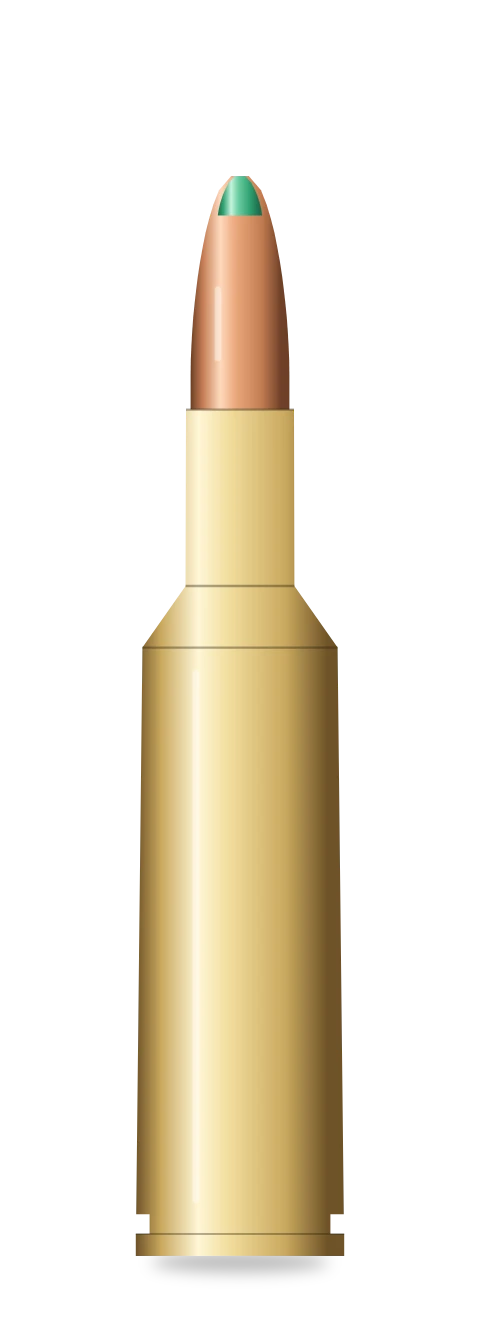
01 / At a glance
The basics
- Origin
- United States
- Introduced
- 2024
- Ignition
- Centerfire
- Case form
- Rimless, bottleneck
- Diameter
- 5.7 mm
- Case length
- 48.8 mm
Rounded values to help you identify the cartridge, not manufacturing drawings. See the cited standard for exact dimensions and tolerances.
Do not mix it up
The .22 Creedmoor uses the same case head as the 6.5 Creedmoor but a much smaller bullet. Do not confuse the two. Use only the cartridge the rifle is marked for.
The .22 Creedmoor is a .224 caliber rifle cartridge from Hornady. It takes the 6.5 Creedmoor case and necks it down to hold a .224 inch bullet, which gives a short-action cartridge that fires 65 to 80 grain bullets at more than 3,000 ft/s. The bullets are long and sleek for the caliber, so they hold their speed and resist wind better than the bullets in a .223 Remington or a .22-250 Remington.
This guide explains what the .22 Creedmoor is, how it performs out to 500 yards, how to choose ammunition and a rifle, and how it compares with the .22-250 Remington, the .223 Remington, the 6.5 Creedmoor and the .22 ARC. It is a reference page, not a loading manual, and it contains no loading data.
A short history
Hornady designed the .22 Creedmoor in 2023 and began production of ammunition in 2024. It is a necked-down 6.5 Creedmoor case, with a case length of 1.92 inches (49 mm) and an overall length of 2.45 inches (62.23 mm). SAAMI has standardized the cartridge with a maximum average pressure of 62,000 psi, which is the same figure as the 6.5 Creedmoor. Hornady lists a twist rate of 1 in 8 inches.
It sits in a line of Hornady cartridges that use the Creedmoor idea with a different bullet diameter. The parent, the 6.5 Creedmoor, made a case that works well with long, high-BC bullets. Necking it to .224 produces a cartridge with a large powder capacity for its bore size, which gives high velocity, and a case that can take a long magazine length for long bullets.
It is a new cartridge, so the rifle and ammunition choices are narrower than for the older .22 centerfires. It targets shooters who want a flat-shooting varmint round, and those who want a quiet-to-medium recoil round for long-range target shooting with a light bullet.
Why people shoot it
The first reason is speed with a good bullet. An 80 grain ELD-X leaves a 24 inch test barrel at 3,285 ft/s, and a 65 grain CX bullet leaves at 3,660 ft/s. That is fast for a bullet of that weight, and the bullet has a high ballistic coefficient, so it keeps that speed.
The second reason is wind. A long bullet with a high BC drifts less than a short one at the same speed. Out at 400 and 500 yards, where wind decides the shot, an 80 grain .224 bullet holds up well. The drift in this guide for a 10 mph crosswind is about 9 inches at 400 yards and 15 inches at 500, which is modest for a bullet of this size.
The third reason is recoil. A .22 caliber bullet kicks little, so a long-range varmint shooter can see the impact through the scope and follow the shot. That helps with spotting and with correcting. It also means long practice sessions are less tiring than with a .243 Winchester or a 6.5 Creedmoor.
Specifications at a glance
| Specification | Value |
|---|---|
| Bullet diameter | .224 in (5.7 mm) |
| Case length | 1.92 in (49 mm) |
| Overall length | 2.45 in (62.23 mm) |
| Case type | Rimless, bottleneck |
| Parent case | 6.5 Creedmoor |
| Maximum average pressure (SAAMI) | 62,000 psi |
| Rifling twist | 1 in 8 in (Hornady) |
| Typical bullet weights | 65 to 88 grains |
| Typical muzzle velocity | About 3,285 ft/s with an 80 grain bullet |
Values are rounded for reference. Exact dimensions and tolerances are in the SAAMI standard. The velocities are Hornady figures from a 24 inch test barrel.
Strengths and limits
The .22 Creedmoor is a long-range varmint and target cartridge. These are the trade-offs to understand.
| Strength | Limit |
|---|---|
| High velocity with a high-BC bullet | Fewer rifles and less ammunition than older .22 centerfires |
| Flat trajectory and low wind drift for a .22 | More barrel wear than a .223 Remington at high round counts |
| Light recoil, easy to spot hits | Ammunition costs more than for common .22 centerfires |
| Short action with a familiar case head | Light bullets may not suit larger game |
Honest advice: for most varmint work inside 300 yards, a .223 Remington or a .22-250 Remington does the job at a lower cost with more rifle and ammunition choices. The .22 Creedmoor earns its place for shooters who push to 400 yards and beyond on small targets and who want the wind advantage.
Barrel life
A cartridge with a large case and a small bullet burns a lot of powder through a small bore, and that wears a barrel. Shooters who fire many rounds in a day should plan for it, let the barrel cool, and expect a shorter barrel life than with a .223 Remington.
Ballistics
The table and charts below show one factory load, an 80 grain ELD-X Precision Hunter bullet at 3,285 ft/s from a 24 inch test barrel, with the rifle zeroed at 200 yards. It is a hunting bullet with a high ballistic coefficient.
| Range (yd) | Velocity (ft/s) | Energy (ft-lb) | Drop (in) | Wind drift, 10 mph (in) |
|---|---|---|---|---|
| 100 | 3076 | 1681 | 1.1 | 0.5 |
| 200 | 2877 | 1470 | 0 | 2.2 |
| 300 | 2686 | 1282 | -5.3 | 5.1 |
| 400 | 2504 | 1114 | -15.4 | 9.4 |
| 500 | 2329 | 963 | -31.1 | 15.2 |
Reading the numbers
With a 200 yard zero the bullet rises about 1 inch above the line of sight at 100 yards, returns to the line at 200 and falls about 5 inches at 300, 15 at 400 and 31 at 500. A 10 mph crosswind moves it about 5 inches at 300 yards, 9 at 400 and 15 at 500. Velocity drops from 3,285 ft/s at the muzzle to about 2,330 ft/s at 500 yards, and energy from about 1,920 to about 960 foot-pounds.
The bullet stays supersonic well past 500 yards, and it keeps a flat arc. The energy at long range is modest, as with any light bullet, so the cartridge suits small targets and varmints, and it is not made for large game at long range.
How these figures were made: the muzzle velocity (3,285 ft/s), weight (80 grains) and the published velocities at 100 to 500 yards (3,076, 2,877, 2,687, 2,504 and 2,329 ft/s) are Hornady figures for its Precision Hunter 80 grain ELD-X load from a 24 inch test barrel, as listed by a retailer. The ballistic coefficient (G1 0.494) was fitted to match those velocities. Drop, velocity, energy and wind drift are calculated with a standard point-mass model, a 200 yard zero, a sight height of 1.5 inches and standard atmosphere. The published table appears to assume a 500 yard zero, so the drop figures here differ. They are estimates. Your rifle and conditions will differ.
Recoil and shooter comfort
Recoil is light. In a rifle of 8 to 10 pounds, the .22 Creedmoor kicks less than a .243 Winchester and a 6.5 Creedmoor, and a bit more than a .223 Remington because of the larger powder charge. Most shooters can watch the bullet strike through the scope.
The muzzle blast is sharp, since a large charge burns in a small bore. Use good hearing protection, and consider both plugs and muffs. A muzzle brake cuts recoil further while raising the noise for people nearby.
How to choose ammunition
Hornady makes the factory ammunition. Match the bullet to the job, and test the load in your own rifle.
| Load | Muzzle velocity | Best for | Notes |
|---|---|---|---|
| 65 grain CX | About 3,660 ft/s | Varmints and predators | Copper bullet at the highest speed |
| 69 grain ELD-VT V-Match | About 3,560 ft/s | Varmints and target use | Match bullet with a high BC |
| 80 grain ELD Match | About 3,285 ft/s | Target and long-range practice | Match bullet; the heavy weight |
| 80 grain ELD-X Precision Hunter | About 3,285 ft/s | Varmints and predators at long range | Polymer-tip hunting bullet |
For varmints, choose a bullet made to expand reliably at the speeds the cartridge produces. Fast, light bullets can break up on impact at close range, so check what the maker says about the intended use. For target work, a match bullet shoots with less variation. Try more than one load, since a rifle often prefers one.
Check the headstamp and the rifle
The .22 Creedmoor case is the same size as a 6.5 Creedmoor case at the head, and a mix-up is possible. Do not put .22 Creedmoor ammunition in a 6.5 Creedmoor rifle or the reverse. Always read the barrel marking and the headstamp.
Cost
Factory ammunition costs more than for a .223 Remington, and stores stock fewer choices. Many shooters practice with a cheaper cartridge and use the .22 Creedmoor for the shots that need it.
How to choose a rifle
The right rifle depends on how you shoot. These are the points that matter most.
- Chambering and magazine. Buy a rifle made for the .22 Creedmoor. Its overall length of 2.45 inches needs a magazine made for it.
- Barrel length. 22 to 26 inches is common. Longer barrels give more velocity, and heavier barrels hold zero better in long strings.
- Twist rate. Long, high-BC .224 bullets need a fast twist. Hornady lists 1 in 8 inches. Check the rate the maker uses and match it to the bullets you plan to shoot.
- Weight. A heavier varmint rifle is steadier and kicks less. A lighter rifle is easier to carry.
- Trigger. A clean, crisp trigger improves accuracy at long range.
- Optic. A good variable-power scope with reliable adjustments suits the cartridge. A high-magnification scope helps with small targets.
- Barrel life. High velocity wears a barrel faster than a .223 Remington does.
Short-action bolt-action rifles are made for the cartridge. Not every model is still in production, and the choice is narrower than for older cartridges, so check current catalogs.
Zeroing and range practice
A 200 yard zero is a good starting point for varmints. With an 80 grain ELD-X the bullet stays within about 1 inch of the line of sight out to 150 yards, and drops about 5 inches at 300 yards. That lets you hold on a small target out to about 250 yards, and hold over beyond that.
Zero at 100 yards on paper first, then confirm at 200. Shoot at 300, 400 and 500 to learn your own drops, and write them on a card. The numbers in this guide are estimates from a model, and your barrel, load and air density will move them. Wind is the main problem past 400 yards, and with a light bullet it matters a lot, so practice judging it.
Shoot from field positions as well as a bench. A varmint shooter often shoots from a bipod or a pack, and the best group from a bench is not the group you will shoot in the field. Practice at the distances you plan to take.
Practical uses
Prairie dogs and ground squirrels
This is the home use of a fast .224. The flat trajectory and the ability to see the hit make it effective on small targets at long range. Heat and barrel temperature matter in a long session.
Coyotes and other predators
It is used on coyotes with a bullet made for it. Fast, light bullets can fail to penetrate on a bad angle, so shot placement matters. Check what the bullet maker says.
Long-range target shooting
Match bullets with a high BC let a shooter reach 500 yards and beyond with low recoil. Light bullets drift more than heavy ones at long range, so the .22 Creedmoor is a target cartridge for those who like to read the wind.
Not for large game
A light bullet does not carry the energy or the penetration for elk or larger animals. Check local rules for deer, since many places set a minimum caliber or energy, and use a cartridge that is legal and suitable for the animal.
.22 Creedmoor vs similar cartridges
The table compares the .22 Creedmoor with the cartridges it is usually weighed against. Figures are rounded and use SAAMI pressures, except where noted.
| Cartridge | Bullet diameter | Case length | Max pressure | Typical use |
|---|---|---|---|---|
| .22 Creedmoor | .224 in | 1.92 in | 62,000 psi | Long-range varmint and target |
| .22-250 Remington | .224 in | 1.912 in | 65,000 psi | Varmints and predators |
| .223 Remington | .224 in | 1.760 in | 55,000 psi | Varmints, target and sporting |
| .22 ARC | .224 in | 1.525 in | 52,000 psi | Varmints and target in an AR-15 |
| 6.5 Creedmoor | .264 in | 1.920 in | 62,000 psi | Target and hunting |
Against the .22-250 Remington, the .22 Creedmoor offers similar speed with newer, longer high-BC bullets, while the .22-250 has far more rifles and ammunition. Against the .223 Remington, it is faster and flatter and costs more. Against the .22 ARC, it is faster with a bigger case, and the .22 ARC fits an AR-15. Against the 6.5 Creedmoor, it shares the case and kicks less, and it is made for a different job.
Care and storage
Clean the bore after a day of shooting, and follow the barrel maker's advice on copper and carbon. High-velocity cartridges leave fouling, and a clean bore helps accuracy. Let the barrel cool during a long session. Inspect the action, the magazine and the scope mounts for tightness. Store the rifle unloaded and locked, with the ammunition separate and away from children.
Safety and common mistakes
- Do not confuse the .22 Creedmoor with the 6.5 Creedmoor. Read the barrel marking and the headstamp.
- Treat every rifle as loaded. Keep your finger off the trigger until the sights are on the target.
- Know your target and what lies beyond it. A .22 bullet at this speed can travel a mile or more, and it ricochets off rocks and hard ground.
- Wear eye and ear protection. A fast cartridge has a sharp report.
- Check the bore for obstructions before you load.
- Watch the barrel temperature in a long session, and let the rifle cool.
- If you reload, use only published data from a current manual and start low. This page does not contain loading data.
- Store firearms and ammunition locked and apart, away from children.
Frequently asked questions
What is the .22 Creedmoor?
It is a .224 caliber rifle cartridge from Hornady, made by necking the 6.5 Creedmoor case down. Hornady designed it in 2023 and released ammunition in 2024.
What is the maximum pressure of the .22 Creedmoor?
The SAAMI maximum average pressure is 62,000 psi, the same as the 6.5 Creedmoor.
How fast is the .22 Creedmoor?
An 80 grain ELD-X leaves a 24 inch test barrel at about 3,285 ft/s. A 65 grain CX leaves at about 3,660 ft/s.
What twist rate does the .22 Creedmoor use?
Hornady lists a twist of 1 in 8 inches.
Is the .22 Creedmoor better than the .22-250 Remington?
It offers similar speed with newer, long, high-BC bullets. The .22-250 has far more rifles and ammunition, so the choice depends on what you shoot and how far.
Can I use .22 Creedmoor ammunition in a 6.5 Creedmoor rifle?
No. The bullet diameters differ, and the cartridges are not interchangeable. Use only the cartridge the rifle is marked for.
Is the .22 Creedmoor good for deer?
It is a varmint cartridge. Many places set a minimum caliber or energy for deer, so check local rules, and use a cartridge that is legal and suitable for the animal.
Does the .22 Creedmoor wear barrels fast?
It wears a barrel faster than a .223 Remington, because it burns a large charge in a small bore. Let the barrel cool and plan for a shorter barrel life.
Sources
Sources reviewed · 29 October 2026