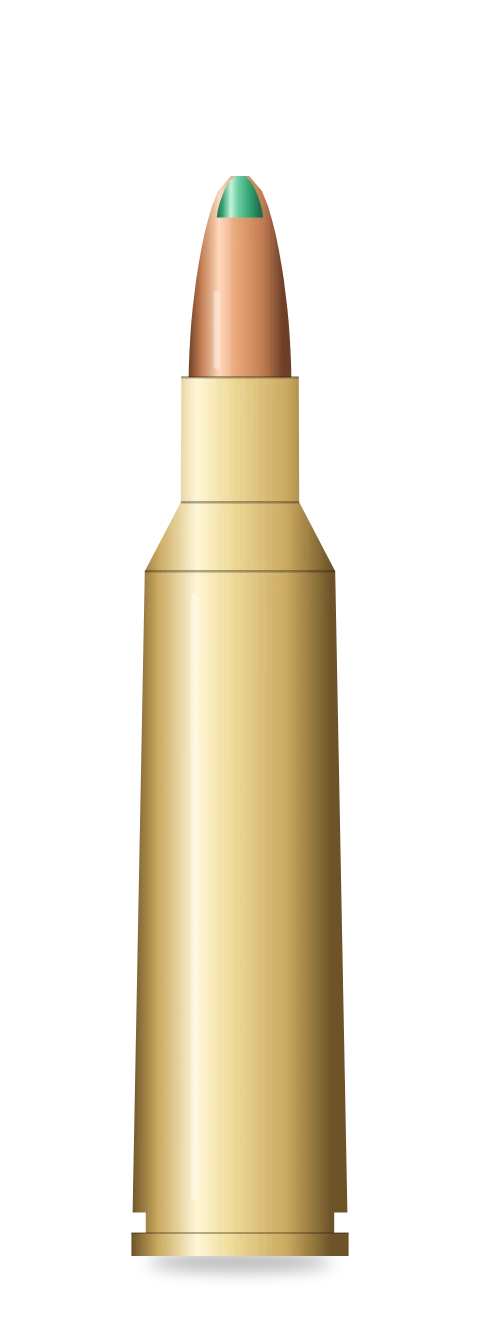
01 / At a glance
The basics
- Origin
- United States
- Introduced
- 1965
- Ignition
- Centerfire
- Case form
- Rimless, bottleneck
- Diameter
- 5.7 mm
- Case length
- 48.6 mm
Rounded values to help you identify the cartridge, not manufacturing drawings. See the cited standard for exact dimensions and tolerances.
Do not mix it up
The .22-250 Remington is not the same as the .220 Swift or the .223 Remington, and the cartridges are not interchangeable. Check the marking on the barrel.
The .22-250 Remington is a fast, flat-shooting varmint cartridge that fires a .224 inch bullet, usually 40 to 55 grains, at about 3,600 to 4,000 ft/s. It began as a wildcat in the 1930s, became a factory cartridge in 1965, and has been one of the top choices for prairie dogs, ground squirrels and coyotes ever since.
This guide explains what the cartridge is, how it performs out to 500 yards, how to choose ammunition and a rifle, and how it compares with the .223 Remington, the .243 Winchester, the 6mm Creedmoor and other cartridges people weigh it against. It is a reference page, not a loading manual, and it contains no handloading data.
A short history
The .22-250 began as a hobby of experimenters. In the 1930s, riflemen discovered that the .250 Savage case, necked down to hold a .224 inch bullet, gave very high velocity from a short, strong case. Gunmakers and handloaders built rifles for it, and the cartridge was known as the Varminter.
For about thirty years it stayed a wildcat. Shooters made their own brass and reamed their own chambers, and the cartridge gained a reputation for accuracy. Remington adopted it as a factory cartridge in 1965 and chambered its Model 700 for it. Other makers followed, and ammunition became easy to buy.
It has held its position for sixty years. Newer cartridges have come along, some of them faster, but the .22-250 remains a standard choice for serious varmint shooters. Its brass is widely available, and its rifles are among the most accurate sold.
Why it is so popular
The first reason is speed. A 55 grain bullet leaves the muzzle at about 3,680 ft/s, and a 40 grain bullet can top 4,000. That gives a very flat path and a short flight time, which makes range estimation less critical on small targets.
The second reason is accuracy. The case is stout and efficient, and good rifles shoot half-inch groups or better at 100 yards with quality ammunition. Many bench and varmint rifles are built on it for that reason.
The third reason is effect. Light, fast .224 bullets are designed to expand violently on small animals. A hit on a prairie dog or a ground squirrel at 300 yards is usually decisive, and the same load works on coyotes inside a reasonable range.
Specifications at a glance
| Specification | Value |
|---|---|
| Bullet diameter | .224 in (5.7 mm) |
| Case length | 1.912 in (48.6 mm) |
| Overall length (SAAMI) | 2.350 in (59.7 mm) |
| Case type | Rimless, bottleneck |
| Primer | Large rifle |
| Maximum average pressure (SAAMI) | 65,000 psi |
| Typical bullet weights | 40 to 70 grains; 50 to 55 grains are the most common |
| Typical muzzle velocity | About 3,680 ft/s with a 55 grain bullet from a 24 inch barrel |
| Typical rifling twist | 1 in 12 to 1 in 14 inches; faster for heavy bullets |
Values are rounded for reference. Exact dimensions and tolerances are in the SAAMI standard cited at the end of this page.
Strengths and limits
The .22-250 is one of the best varmint cartridges. It also has limits that come with its speed.
| Advantage | Limitation |
|---|---|
| Very high velocity and a flat path | Barrel wear is fast with heavy shooting |
| Excellent accuracy | Bullets are light, so wind moves them more than heavier bullets |
| Mild recoil for its power | Not a deer cartridge in many states |
| Brass and ammunition are widely available | Loud muzzle blast and a hot barrel after a few shots |
The cartridge is made for varmints. It does that job extremely well, and it is not meant to do much else. A hunter who wants one rifle for coyotes and deer should look at a .243 Winchester or a 6mm Creedmoor.
Barrel life
A fast case with a large powder charge in a small bore wears the throat of the barrel quickly. A .22-250 barrel often keeps its best accuracy for a couple of thousand rounds, and less if the shooter fires fast strings without letting the barrel cool. A varmint shooter who fires a few hundred rounds in a day will notice it. A hunter who fires a few boxes a year will not.
Ballistics
The tables and charts below show one common factory load, a 55 grain V-MAX bullet at 3,680 ft/s from a 24 inch barrel, with the rifle zeroed at 200 yards.
| Range (yd) | Velocity (ft/s) | Energy (ft-lb) | Drop (in) | Wind drift, 10 mph (in) |
|---|---|---|---|---|
| 100 | 3254 | 1293 | 0.9 | 0.9 |
| 200 | 2868 | 1005 | 0 | 3.9 |
| 300 | 2514 | 772 | -5.2 | 9.2 |
| 400 | 2186 | 584 | -15.8 | 17.3 |
| 500 | 1884 | 434 | -33.9 | 29 |
Reading the numbers
With a 200-yard zero the bullet rises about 1 inch above the line of sight at 100 yards, returns to the line at 200 and falls about 5 inches at 300, 16 inches at 400 and 34 inches at 500. A 10 mph crosswind moves it about 9 inches at 300 yards, 17 at 400 and 29 at 500. Velocity drops from 3,680 ft/s at the muzzle to about 1,884 ft/s at 500 yards, and energy from about 1,650 to about 430 foot-pounds.
These numbers explain the cartridge. The path is flat to about 300 yards, and the bullet hits very hard up close. Beyond 400 yards the light bullet slows, drifts and loses energy quickly, so long shots at small targets need good wind calls.
Wind and light bullets
Light bullets are pushed around by the wind more than heavy ones, even when they start fast. At 500 yards, the drift in a 10 mph wind is nearly twice what a 6mm Creedmoor bullet shows over the same distance. Varmint shooters handle this by watching mirage, using flags and keeping shots to 300 to 400 yards when the wind is up. A small miss on a prairie dog is a lost shot, not a lost animal, and most shooters accept that.
How these figures were made: the muzzle velocity (3,680 ft/s), weight (55 grains) and the published velocities at 100 to 500 yards (3,253, 2,868, 2,514, 2,186 and 1,884 ft/s) are Hornady figures for its 22-250 Remington 55 grain V-MAX load from a 24 inch test barrel. The ballistic coefficient (G1 0.260) was fitted to match those published velocities. Drop, velocity, energy and wind drift are computed with a standard point-mass model, a 200-yard zero, a 1.5 inch sight height and standard atmosphere. They are estimates. Different bullets and barrel lengths change the results.
Recoil and shooter comfort
The .22-250 has light recoil. It is a little more than a .223 Remington and much less than a .308 Winchester. In a rifle of 8 to 10 pounds, most shooters see the bullet strike, which is a big part of why varmint shooters like it.
The muzzle blast is louder than the recoil would suggest. Wear ear protection, and let others know before you fire when you shoot in a group. A suppressor, where legal, makes a real difference with this cartridge.
How to choose ammunition
Choose by use first. Varmint ammunition and match ammunition use different bullets.
| Bullet type | Best for | Notes |
|---|---|---|
| Polymer tip varmint (V-MAX, Ballistic Tip) | Prairie dogs, squirrels, coyotes | Fast, flat and explosive; the standard choice |
| Hollow point | Target and small game | Accurate and often cheaper |
| Soft point | Coyotes and larger varmints | More penetration than a varmint tip |
| Match hollow point | Benchrest and target | Best accuracy; not for hunting |
| Copper bullets | Areas that require non-lead ammunition | Deeper penetration; check twist rate |
Bullet weight
A 40 to 50 grain bullet is the fastest and flattest and best for small varmints. A 55 grain bullet is the standard choice and a good all-round weight. A 60 to 70 grain bullet is a better choice for the wind and for coyotes, but it needs a faster twist to be stable. Check your rifle's twist rate before you buy heavy bullets.
Check the box
The .22-250 Remington is not the same as the .220 Swift or the .223 Remington, and the cartridges are not interchangeable. A .223 Remington cartridge will drop into a .22-250 chamber, and firing it is unsafe. Read the headstamp and the barrel marking every time.
How to choose a rifle
The right rifle depends on what you shoot. These are the points that matter most.
- Barrel. A heavy barrel stays steadier and cools slowly. A medium or light barrel is easier to carry. For long prairie dog sessions, heavy is better.
- Twist rate. A 1 in 14 or 1 in 12 twist works for bullets up to 55 grains. A 1 in 9 or 1 in 10 twist handles heavier bullets.
- Barrel length. 24 inches is the usual length. A 26 inch barrel adds a little speed.
- Action. Bolt-action rifles from Remington, Ruger, Savage, Tikka and others are the norm. Single-shot rifles are also made for it.
- Trigger and stock. A crisp trigger and a stable, well-fitting stock make a bigger difference to accuracy than the cartridge.
- Optics. A variable scope of 6-24x with a fine reticle suits varmint work. A 4-12x scope is enough for coyote hunting.
Zeroing and practice
A 200-yard zero is a popular choice. The bullet stays within an inch or so of the line of sight out to about 250 yards, so the shooter can hold on the target for most shots. A 100-yard zero is also common and easier to check at a short range.
Practice from a rest, then from a bipod and a field position. Learn your drop at 300 and 400 yards, and learn the wind. Because the barrel heats quickly, shoot a few rounds and let it cool. Watch the grouping, and clean the bore when accuracy falls off.
Practical uses
Prairie dogs and ground squirrels
This is the cartridge's home ground. The flat path and quick bullet let a shooter hit small targets at 300 to 400 yards, and the varmint bullets give quick, clean kills. It is a standard rifle at prairie dog shoots for good reason.
Coyotes and foxes
It is an effective predator cartridge out to about 300 yards. Choose a bullet that holds together, such as a bonded or heavier soft point, rather than the lightest varmint bullet, to reduce the chance of a bullet breaking up on the surface.
Target and benchrest
The cartridge's accuracy has made it a favorite in some varmint benchrest classes. It is also used for plinking at long range with steel targets.
Small game and pest control
It is used on woodchucks, jackrabbits and similar pests. Whatever the target, use a clear, safe backstop for every shot, because a fast .22 bullet can still ricochet.
Deer
Some hunters have taken deer with the .22-250, but it is not a good choice. Many states do not allow .22 caliber centerfire rifles on deer, and the bullet is light for the job. Check local law, and choose a larger cartridge such as the .243 Winchester or 6mm Creedmoor.
.22-250 Remington vs similar cartridges
The table lists the cartridges most often compared with the .22-250 Remington. Figures are rounded and use SAAMI maximum average pressures.
| Cartridge | Bullet diameter | Case length | Max pressure | Typical use |
|---|---|---|---|---|
| .22-250 Remington | .224 in | 1.912 in | 65,000 psi | Varmints and predators |
| .223 Remington | .224 in | 1.760 in | 55,000 psi | Varmints, target and defense |
| .243 Winchester | .243 in | 2.045 in | 60,000 psi | Deer and varmints |
| 6mm Creedmoor | .243 in | 1.920 in | 62,000 psi | Target, deer and varmints |
| .308 Winchester | .308 in | 2.015 in | 62,000 psi | Hunting and target |
Against the .223 Remington, the .22-250 is faster, flatter and harder hitting at long range, and the .223 has cheaper ammunition and less barrel wear. Against the .243 Winchester, it is faster with light bullets and has less recoil, and the .243 has heavier bullets and works on deer. Against the 6mm Creedmoor, it has a flatter path with a light bullet, and the 6mm Creedmoor has better wind resistance and wider uses.
Care and storage
Clean the bore after a long shooting session, because a fast .22 bullet leaves copper in the barrel and accuracy falls off as it builds up. Use a bore guide and a good rod, and do not drag a dirty brush back through the bore. Let the barrel cool between strings. Check the stock screws and the scope mounts from time to time. Store the rifle unloaded in a dry place. Keep firearms and ammunition locked and out of reach of children and unauthorized users.
Safety and common mistakes
- Do not confuse the .22-250 Remington with the .223 Remington, the .220 Swift or the .250 Savage. Read the marking on the barrel and the headstamp before loading.
- Treat every firearm as loaded. Keep your finger off the trigger until your sights are on the target.
- Know your target and what is beyond it. A fast .22 bullet can ricochet and travel a long way, especially off rocks and hard ground.
- Wear eye and ear protection at the range.
- Do not shoot at hard surfaces or water. Varmint bullets break up and can fragment back.
- Let a hot barrel cool before you continue. Do not leave a round in a hot chamber for long.
- If you reload, use only published data from a current manual and start low. This page does not contain loading data.
- Store firearms unloaded and locked, and keep the ammunition apart.
Frequently asked questions
What is the .22-250 used for?
Mostly varmints, such as prairie dogs, ground squirrels and coyotes. It is also used for benchrest and long-range plinking.
Is the .22-250 good for deer?
It is not a good choice. Many states do not allow .22 caliber centerfire rifles on deer, and the bullet is light. A .243 Winchester or 6mm Creedmoor is a better tool.
What is the difference between the .22-250 and the .223?
The .22-250 has a larger case, a higher pressure and roughly 400 to 600 ft/s more velocity with the same bullet weight. The .223 has less barrel wear and cheaper ammunition.
How far can the .22-250 shoot?
Varmint shooters take targets at 300 to 400 yards. Beyond that the light bullet drifts in the wind and loses energy fast.
How long does a .22-250 barrel last?
Often a couple of thousand rounds of best accuracy. Shooting fast strings without cooling the barrel shortens it.
What bullet weight is best?
A 55 grain bullet is the standard. Use 40 to 50 grain bullets for small varmints and 60 to 70 grain bullets for coyotes and wind, if your twist rate allows.
Can I shoot .223 in a .22-250 rifle?
No. A .223 Remington cartridge can fit in a .22-250 chamber, and firing it is unsafe. Only fire the cartridge marked on the barrel.
Can I reload .22-250 Remington?
Yes. The brass is widely reloaded. Use only published data from a current loading manual and follow its safety instructions.
Sources
Sources reviewed · 29 October 2026