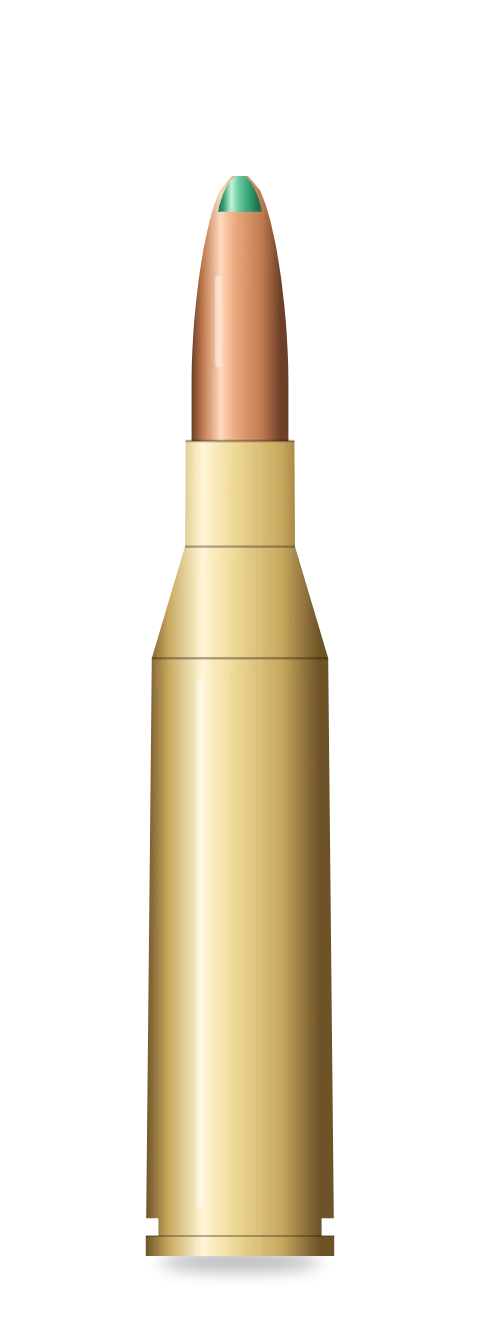
01 / At a glance
The basics
- Origin
- United States
- Introduced
- 1955
- Ignition
- Centerfire
- Case form
- Rimless, bottleneck
- Diameter
- 6.2 mm
- Case length
- 51.9 mm
Rounded values to help you identify the cartridge, not manufacturing drawings. See the cited standard for exact dimensions and tolerances.
Do not mix it up
The .243 Winchester is not the same as the 6mm Remington or the 6mm Creedmoor. They use the same bullet diameter but different cases, so they are not interchangeable.
The .243 Winchester is a mid-size rifle cartridge that fires a 6 mm bullet. It was designed in the 1950s to do two jobs with one rifle: shoot small, fast targets like coyotes and prairie dogs at long range, and take deer-size game cleanly. It has done both for seventy years, and it is still one of the most common first big-game rifles for new hunters and young shooters.
This guide explains what the cartridge is, how it performs, how to choose ammunition and a rifle, and how it compares with the .308 Winchester, 6.5 Creedmoor, .270 Winchester and other cartridges people weigh it against. It is a reference page, not a loading manual, and it contains no handloading data.
A short history
The .243 Winchester was introduced by Winchester in 1955. It is the .308 Winchester case necked down so that it holds a 6 mm bullet, which measures .243 inches across. Hunters and experimenters had been making similar wildcat cartridges on the .308 case for years, and Winchester turned the idea into a factory product.
The first rifles were the Winchester Model 70 and the Savage Model 99. Winchester sold it as a cartridge for varmints and deer, and the combination was an immediate success. Within a few years almost every maker offered a rifle for it.
It was not alone for long. Remington brought out the .244 Remington, later renamed the 6mm Remington, in 1955 too. Winchester had a better marketing story and rifles with faster twist rates for heavier bullets, and the .243 became the winner. The 6mm Remington survives as a smaller niche cartridge.
In the early years some hunters doubted that a 6 mm bullet was big enough for deer, and others thought it was too much gun for varmints. Seventy years of field use have settled the matter. Modern bullets are better built than the ones available in 1955, and the .243 Winchester is now accepted as a capable deer cartridge when it is used with a proper hunting bullet.
Why it is so popular
The first reason is recoil. In a normal hunting rifle the .243 Winchester kicks very little, so a new shooter can learn good habits without flinching. That is why it is so often chosen as a first deer rifle, and as a rifle for youth hunters.
The second reason is range of use. A light 55 to 70 grain bullet turns the same rifle into a flat-shooting varmint gun. A 90 to 100 grain bullet makes it a deer rifle. One rifle and one cartridge can cover coyotes in winter and whitetails in autumn.
The third reason is availability. The .243 Winchester is stocked almost everywhere ammunition is sold, in many bullet weights and price levels. Used rifles are common and cheap, so it is easy to get started.
Specifications at a glance
| Specification | Value |
|---|---|
| Bullet diameter | .243 in (6.17 mm) |
| Case length | 2.045 in (51.9 mm) |
| Maximum overall length (SAAMI) | 2.710 in (68.8 mm) |
| Case type | Rimless, bottleneck |
| Primer | Large rifle |
| Maximum average pressure (SAAMI) | 60,000 psi |
| Typical bullet weights | 55 to 108 grains; 80, 95 and 100 grains are most common |
| Typical muzzle velocity | About 2,960 ft/s with a 100 grain bullet |
| Common barrel twist | 1 in 9 to 1 in 10 inches |
Values are rounded for reference. Exact dimensions and tolerances are in the SAAMI standard cited at the end of this page.
Strengths and limits
The .243 Winchester is a gentle, flexible cartridge. It is not a magic one, and its limits are worth knowing before you hunt with it.
| Advantage | Limitation |
|---|---|
| Mild recoil, easy to shoot accurately | Small bullet, so shot placement matters a lot on deer |
| Flat trajectory out to about 300 yards | Not suited to elk, moose or other large game |
| Works for both varmints and deer | Light bullets can be pushed by wind at long range |
| Wide choice of rifles and ammunition | Some states and provinces have rules on minimum caliber or energy for deer |
Used with a well-built bullet and good shot placement, the .243 Winchester kills deer cleanly. The key is to pick a bullet made for hunting, not a thin-jacketed varmint bullet, and to take only broadside or quartering shots at sensible distances.
Barrel heat and wear
The .243 Winchester burns a fair amount of powder in a small bore, and fast, high-volume shooting at varmints heats the barrel. A hot barrel loses accuracy and wears faster. Let the rifle cool between strings of shots, and expect a barrel that sees thousands of rounds to wear out sooner than one used only for an annual deer hunt.
Ballistics
The tables and charts below show one common factory load, a 100 grain InterLock soft point at 2,960 ft/s, fired from a rifle zeroed at 100 yards.
| Range (yd) | Velocity (ft/s) | Energy (ft-lb) | Drop (in) | Wind drift, 10 mph (in) |
|---|---|---|---|---|
| 100 | 2725 | 1648 | 0 | 0.8 |
| 200 | 2501 | 1389 | -3.2 | 3.1 |
| 300 | 2288 | 1163 | -12 | 7.4 |
| 400 | 2086 | 966 | -27.4 | 13.7 |
| 500 | 1895 | 797 | -50.8 | 22.4 |
Reading the numbers
With a 100 yard zero, the bullet drops about 3 inches at 200 yards and about 12 inches at 300 yards. That is easy to hold for at hunting distances. At 400 yards it has dropped about 27 inches, and a 10 mph crosswind moves it roughly 14 inches. Energy falls from about 1,945 foot-pounds at the muzzle to about 1,160 at 300 yards, which is still enough for deer when the shot is placed well.
These numbers are for one bullet. A lighter 58 or 75 grain varmint bullet starts faster and drops less in the first 300 yards, but it slows down sooner and is pushed around more by wind. A heavier 100 grain or longer bullet starts slower but holds its speed better at distance.
How these figures were made: the muzzle velocity (2,960 ft/s), weight (100 grains) and ballistic coefficient (G1 0.405) are the figures published for Hornady American Whitetail 100 grain InterLock ammunition. Drop, velocity, energy and wind drift are computed with a standard point-mass model, a 100-yard zero, a 1.5 inch sight height and standard atmosphere. They are estimates. Real rifles, barrels and conditions vary, so confirm your own drop at the range.
Recoil and shooter comfort
The .243 Winchester has some of the lowest recoil of any common deer cartridge. In a rifle of normal weight it feels like a firm push, not a kick. Most new shooters can practice with it for a full session and still shoot well.
Even so, recoil depends on the rifle. A light rifle with a hard plastic butt plate recoils more than a heavier rifle with a recoil pad. For a young or small shooter, make sure the stock is the right length so the rifle fits, and use hearing protection, because the muzzle blast is louder than the recoil suggests.
How to choose ammunition
Choose the bullet for the job. The same .243 Winchester name covers loads for very different purposes.
| Bullet type | Best for | Notes |
|---|---|---|
| Light varmint bullet, 55 to 70 grains | Coyotes, prairie dogs, groundhogs | Fast and flat; thin jackets that break apart quickly |
| Soft point, 95 to 100 grains | Deer and pronghorn | Built to expand and hold together; the common hunting choice |
| Bonded or premium, 90 to 100 grains | Deer, including larger bucks | Higher cost, deeper penetration |
| Match bullet, 95 to 108 grains | Target shooting | Very consistent, often not meant for hunting |
| Lead-free copper, 80 to 90 grains | Hunting where lead is restricted | Check the rifle twist rate for the bullet length |
Regulations and lead-free ammunition
Some areas restrict lead ammunition for hunting, and some set a minimum bullet weight or energy for deer. Check the current rules where you hunt before you buy ammunition. Lead-free copper bullets are made for the .243 Winchester, and they are usually longer for their weight, so the twist rate of the rifle matters.
Bullet weight
A 95 or 100 grain bullet is the usual choice for deer. Lighter bullets, such as 58 or 75 grains, are for varmints only. Do not use a very light varmint bullet on deer.
Twist rate
Older .243 rifles often have a 1 in 10 inch twist, which handles bullets up to about 100 grains. Some rifles have a faster twist, which can stabilize longer, heavier bullets. If you buy a long, heavy bullet, check that your rifle can stabilize it.
How to choose a rifle
The .243 Winchester is chambered in so many rifles that the choice is mostly about fit and purpose. These are the points that matter most.
- Weight. A lighter rifle of 6 to 7 pounds is easy to carry on a hunt. A heavier rifle is steadier for varmint shooting from a bench.
- Barrel length and twist. A 22 inch barrel is a good all-round length. A faster twist allows heavier bullets.
- Action. A bolt action gives the best accuracy for the price. Lever and semi-automatic rifles are also made for it.
- Stock fit. Choose a rifle with an adjustable or correctly sized stock, especially for younger shooters.
- Optics. A scope in the 3-9x or 4-12x range suits both deer and varmint work.
Zeroing and practice
Zero the rifle at 100 yards from a stable rest, with the ammunition you plan to hunt with. A 100 yard zero keeps the bullet within about 3 inches of the line of sight to 200 yards, and a zero at 200 yards, which many hunters choose, flattens the path further.
Once zeroed, check the rifle from the field positions you will use, such as sitting with sticks or kneeling. Practice at the distances you expect to shoot, and set a personal maximum range you will not exceed. Confirm the zero again at the start of every season.
Practical uses
Deer and pronghorn hunting
With a 95 or 100 grain soft point, the .243 Winchester is a very effective deer cartridge at normal hunting distances. Choose your shots carefully, aim for the vitals and give the animal time to expire.
Varmint and predator control
With a light bullet, it is flat and accurate on coyotes, foxes, groundhogs and prairie dogs out to 300 yards or more. It is louder and recoils more than a .223 Remington, so use it where the extra power is needed.
Target and varmint competition
The 6 mm bullet diameter has a long record in target and varmint shooting. The .243 Winchester is used in some benchrest-style and field matches, and it is a low-cost way to learn long-range shooting before moving to a dedicated match cartridge.
Youth and beginner rifle
Because of its mild recoil, the .243 Winchester is a very good first big-game cartridge. Always supervise and teach firearm safety before the first shot.
.243 Winchester vs similar rifle cartridges
The table lists the cartridges most often compared with the .243 Winchester. Figures are rounded and use the SAAMI maximum average pressure.
| Cartridge | Bullet diameter | Case length | Max pressure | Typical use |
|---|---|---|---|---|
| .243 Winchester | .243 in | 2.045 in | 60,000 psi | Deer and varmints |
| .223 Remington | .224 in | 1.760 in | 55,000 psi | Varmints and small game |
| 6mm Creedmoor | .243 in | 1.920 in | 62,000 psi | Target shooting and deer |
| 6.5 Creedmoor | .264 in | 1.920 in | 62,000 psi | Target shooting and deer |
| .308 Winchester | .308 in | 2.015 in | 62,000 psi | All-round deer rifle |
| .270 Winchester | .277 in | 2.540 in | 65,000 psi | Deer and elk |
| .30-06 Springfield | .308 in | 2.494 in | 60,000 psi | All-round big game |
Against the .223 Remington, the .243 Winchester is much better for deer and has heavier bullets. Against the .308 Winchester, it recoils less and shoots flatter with light bullets, but it carries less energy. The 6mm Creedmoor and 6.5 Creedmoor are modern target-oriented cartridges, and the .243 Winchester is generally more available and cheaper. The .270 Winchester is flatter and stronger on elk, with more recoil.
Care and storage
Clean the bore after a range session, and use a quality rod and bore guide. Keep the action lightly oiled, and wipe down the exterior after wet weather. Store ammunition in a cool, dry place and check the rounds for dents or corrosion before a hunt. Keep firearms and ammunition locked and out of reach of children and unauthorized users.
Safety and common mistakes
- Match the cartridge to the rifle. .243 Winchester, 6mm Remington and 6mm Creedmoor are different cartridges. Read the barrel marking and the headstamp.
- Do not use light varmint bullets on deer. Use a bullet made for hunting.
- Do not shoot beyond the range at which you can place a bullet reliably. Wind and a small bullet make long shots less forgiving than they look.
- Treat every rifle as loaded. Keep your finger off the trigger until the sights are on the target.
- Know your target and what is beyond it. A rifle bullet can travel more than a mile.
- Wear eye and ear protection. Muzzle blast is loud.
- If you reload, use only published data from a current manual and start low. This page does not contain loading data.
Frequently asked questions
Is .243 Winchester good for deer?
Yes, with a well-built 95 to 100 grain hunting bullet and good shot placement. It is one of the most widely used deer cartridges, especially for new and young hunters. Check your local regulations for minimum caliber or energy rules.
Is the .243 Winchester a 6mm?
Yes. The bullet is 6 mm, or .243 inches, across. The name .243 Winchester is the cartridge, and 6mm is the bullet size shared with other cartridges such as the 6mm Remington and 6mm Creedmoor.
How far can a .243 Winchester shoot?
For deer, most hunters keep shots within about 300 yards. Target shooters hit accurately much farther. The bullet will travel more than a mile if it misses, so always know your backstop.
What is the best bullet weight for .243 Winchester?
For deer, 95 to 100 grains. For varmints, 55 to 80 grains. If you want one load for both, a 90 to 95 grain bullet is a compromise.
What is the difference between .243 Winchester and .308 Winchester?
The .243 Winchester is made from the .308 Winchester case, but it holds a smaller 6 mm bullet. It recoils less and shoots flatter with light bullets. The .308 is stronger on larger game.
Is the .243 Winchester good for beginners?
Yes. It has mild recoil, ammunition is easy to find, and it can be used for varmints and deer. Beginners should still get proper safety instruction.
Can I reload .243 Winchester brass?
Yes. The brass is widely reloaded. Use only published data from a current loading manual and follow its safety instructions.
What distance should I zero a .243 Winchester?
A 100 yard zero is a simple, common choice. Many hunters use 200 yards. Check your own rifle with the ammunition you use.
Sources
Sources reviewed · 29 October 2026