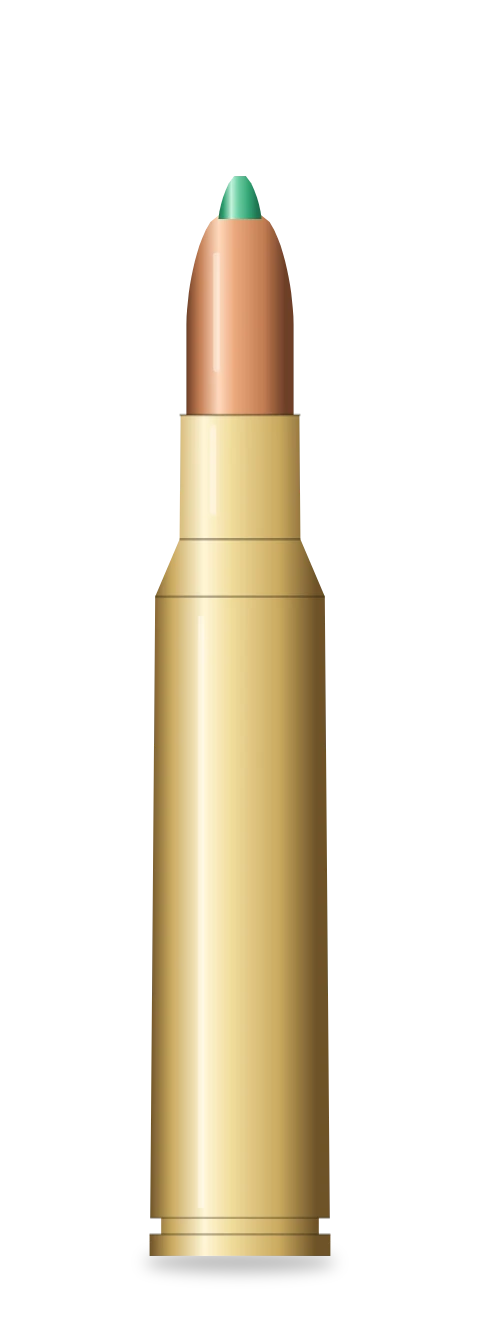
01 / At a glance
The basics
- Origin
- United States
- Introduced
- 1960s
- Ignition
- Centerfire
- Case form
- Rimless, bottleneck
- Diameter
- 5.7 mm
- Case length
- 44.7 mm
Rounded values to help you identify the cartridge, not manufacturing drawings. See the cited standard for exact dimensions and tolerances.
Do not mix it up
.223 Remington and 5.56×45 NATO look almost the same, but they are not identical, and 5.56 loads can run at higher pressure. A rifle marked only .223 Remington is not designed for 5.56 NATO ammunition. Always follow the rifle maker's instructions.
The .223 Remington is a small, fast, lightweight centerfire rifle cartridge. It is one of the most common rifle cartridges in America, used for varmint hunting, target shooting, training and general-purpose rifles. It shares its roots with the 5.56×45 mm NATO military cartridge, and the two are often confused.
This guide explains what the cartridge is, how it performs, how to choose ammunition and a rifle, and how it differs from 5.56 NATO and other small-bore rifle cartridges. It is a reference, not a loading manual, and it contains no handloading data.
A short history
The .223 Remington was developed in the late 1950s and introduced commercially in the early 1960s. It grew out of work on a small, light, high-velocity rifle round, and it was designed around the lightweight rifle that became the AR-15 and then the military M16.
The military adopted a version of the cartridge as the 5.56×45 mm. The two share a case design and bullet diameter, but the military round was loaded to higher pressures and its chamber dimensions differ. That difference is the source of most of the confusion between the names, and it is explained in the safety section below.
Since then the .223 Remington has become a standard sporting cartridge. Bolt-action, semi-automatic and single-shot rifles are made for it, and nearly every ammunition maker loads it.
Why it is so popular
The .223 is easy to shoot. Recoil is light, so beginners and smaller shooters can shoot it comfortably and learn good habits. Ammunition is made in huge quantities, which keeps practice affordable. The cartridge is accurate in good rifles, and its flat trajectory over typical varmint distances is a real advantage.
Another reason is the rifle platform. The AR-15 pattern is the best-selling rifle design in America, and it is chambered in .223 Remington or 5.56 NATO. That brings a huge market in parts, accessories and training, and keeps the cartridge in constant demand.
Specifications at a glance
| Specification | Value |
|---|---|
| Bullet diameter | .224 in (5.69 mm) |
| Case length | 1.760 in (44.7 mm) |
| Maximum overall length (SAAMI) | 2.260 in (57.4 mm) |
| Case type | Rimless, bottleneck |
| Primer | Small rifle |
| Maximum average pressure (SAAMI) | 55,000 psi |
| Maximum pressure (C.I.P.) | 430 MPa (4,300 bar) |
| Common barrel twist | 1:12 to 1:7 inch; 1:9 and 1:8 are common |
| Typical bullet weights | 35 to 77 grains; most factory loads are 50 to 69 grains |
Values are rounded for reference. Exact dimensions and tolerances are in the SAAMI and C.I.P. standards cited at the end of this page.
Strengths and limits
The .223 is a light, fast cartridge with clear strengths and limits.
| Advantage | Limitation |
|---|---|
| Light recoil and mild report | Light bullets are pushed by the wind more than heavy ones |
| Flat trajectory at short and medium range | Not suited to large game such as elk |
| Wide choice of rifles and ammunition | Confusion with 5.56 NATO can lead to wrong ammunition choices |
| Affordable practice and training | Light bullets lose energy quickly past about 300 yards |
Ballistics
The tables and charts below show a common factory load, a 55 grain V-MAX polymer-tip bullet at 3,240 ft/s. It is a popular varmint load and a good picture of what the .223 does at its best.
| Range (yd) | Velocity (ft/s) | Energy (ft-lb) | Drop (in) | Wind drift, 10 mph (in) |
|---|---|---|---|---|
| 100 | 2848 | 991 | 0 | 1.1 |
| 200 | 2489 | 757 | -2.8 | 4.8 |
| 300 | 2157 | 568 | -11.3 | 11.5 |
| 400 | 1852 | 419 | -27.3 | 21.9 |
| 500 | 1577 | 304 | -53.5 | 37.1 |
Reading the numbers
From a 100-yard zero, the bullet drops about 3 inches at 200 yards, 11 inches at 300 yards and 27 inches at 400 yards. A 10 mph crosswind moves it about 5 inches at 200 yards and 22 inches at 400. Energy falls from about 1,280 foot-pounds at the muzzle to about 420 at 400 yards, which is why the .223 is best kept inside 300 yards on small game and varmints.
Heavier bullets in the 62 to 77 grain range keep their speed and fight the wind better, and they are the usual choice for longer-range target work.
How these figures were made: muzzle velocity (3,240 ft/s), weight (55 grains) and ballistic coefficient (G1 0.255) are the published figures for the Hornady Varmint Express 55 grain V-MAX. Drop, velocity, energy and wind drift are computed with a standard point-mass model, a 100-yard zero, a 1.5 inch sight height and standard atmosphere. They are estimates. Your rifle, barrel length and lot of ammunition will differ, so confirm with a chronograph and a range session.
Recoil and shooter comfort
Recoil is one of the .223 strengths. It is light enough for new shooters, youth and smaller adults to practice for long sessions without fatigue. Rifle weight matters less than in larger cartridges, so light carbines remain comfortable.
Because the muzzle blast is sharp, hearing protection is important. A muzzle device can cut felt recoil and muzzle rise, but it will increase blast and noise for people standing nearby.
How to choose ammunition
Pick the bullet for the job first, then the weight. The .223 name covers a huge range of products.
| Bullet type | Best for | Notes |
|---|---|---|
| Full metal jacket (FMJ) | Practice and training | Most affordable; not suited to hunting |
| Polymer-tip varmint (V-MAX type) | Varmint and predator hunting | Fast, flat and designed to expand quickly |
| Soft point | General hunting and varmints | Reliable expansion at moderate cost |
| Hollow-point boat-tail match | Target and precision shooting | Built for accuracy; heavier bullets resist wind |
| Bonded or copper | Hunting where lead is restricted | Controlled expansion, usually higher cost |
Bullet weight
A 40 to 55 grain bullet is fast and flat and suits varmints inside 300 yards. A 62 to 69 grain bullet is a common all-around choice for target and general use. A 75 to 77 grain match bullet is slower but holds its energy and resists wind, which helps in longer-range competition.
Twist rate and bullet length
Barrel twist decides which bullets stabilize. A 1:12 twist handles light bullets. A 1:9 twist handles up to about 69 grains. A 1:7 or 1:8 twist stabilizes heavier 75 to 77 grain match bullets. Match your bullet weight to your barrel twist for the best accuracy.
How to choose a rifle
The right rifle depends on how you plan to use it. These are the points that matter most.
- Action type. Bolt-action rifles are accurate, light and affordable. Semi-automatic rifles in the AR-15 pattern offer fast follow-up shots and huge parts support.
- Chambering. Check the barrel marking. A rifle marked .223 Remington is made for .223 ammunition. A rifle marked 5.56 NATO can generally fire both. A rifle marked .223 Wylde accepts both.
- Barrel length and twist. A 16 inch barrel is compact; 20 to 24 inch barrels give a little more velocity and a longer sight radius.
- Weight and fit. A lighter rifle is easier to carry. A heavier barrel holds accuracy over a long session.
- Optics. A variable scope in the 3-9 or 4-14 range suits most uses. Red-dot optics suit close-range carbine work.
Zeroing and range practice
A 100-yard zero is the usual choice and is easy to confirm. Some AR-15 shooters zero at 50 yards, which gives a second crossing near 200 yards for short-range use. Whichever you choose, shoot a group, adjust the optic and confirm with a second group.
Record your actual drop at 200, 300 and 400 yards with the ammunition you plan to use, and keep the data on a card. Light bullets are sensitive to wind, so practice reading flags and mirage as well as pulling the trigger.
Practical uses
Varmint and predator hunting
The .223 is a standard cartridge for prairie dogs, coyotes and other varmints and predators. Flat trajectory, light recoil and fast expansion make it effective inside its range. Always check local regulations on legal species, seasons and ammunition.
Target and training
It is a favorite for target shooting, from bench rests to practical-style matches. Low recoil keeps shooters fresh over long sessions, and affordable ammunition supports high-volume practice.
Home and general use
Many people choose a .223 AR-15 or bolt rifle as a general-purpose rifle. Laws on rifles and carrying vary, so follow local law and get proper training.
.223 Remington vs similar cartridges
The table lists the cartridges most often compared with the .223 Remington. Figures are rounded and use the SAAMI maximum average pressure where one exists.
| Cartridge | Bullet diameter | Case length | Max pressure | Typical use |
|---|---|---|---|---|
| .223 Remington | .224 in | 1.760 in | 55,000 psi | Varmint, target, general use |
| 5.56×45 mm NATO | .224 in | 1.760 in | Different system, higher working pressure | Military rifles |
| .222 Remington | .224 in | 1.700 in | 46,000 psi | Varmint (older) |
| .204 Ruger | .204 in | 1.850 in | 60,000 psi | Flat-shooting varmint |
| .243 Winchester | .243 in | 2.045 in | 60,000 psi | Deer and varmints |
| .308 Winchester | .308 in | 2.015 in | 62,000 psi | Hunting and target |
| 6.5 Grendel | .264 in | 1.520 in | 52,000 psi | Hunting and target in AR rifles |
Against the .308 Winchester, the .223 recoils far less and costs less to shoot but has much less energy at range. Against the .204 Ruger, it has a heavier bullet and more energy. Against the 6.5 Grendel, it is lighter and cheaper to feed, but has more wind drift past 300 yards.
Care and storage
Clean the bore and chamber regularly, and lubricate a semi-automatic as directed in the manual. Check magazines and springs for wear. Store ammunition in a cool, dry place away from heat and solvents, and keep firearms and ammunition locked away from children.
Safety and common mistakes
- .223 Remington and 5.56×45 NATO are not identical. 5.56 loads can run at higher pressure and use a longer leade. A rifle marked only .223 Remington is not designed for 5.56 NATO ammunition. Always follow the rifle maker's instructions.
- Read the barrel marking and the headstamp. Do not guess.
- Inspect ammunition. Do not fire cartridges with dents, corrosion or loose bullets.
- Know the signs of high pressure: flattened or pierced primers, a sticky bolt lift and bright marks on the case head. Stop firing and have the rifle checked.
- Treat every firearm as loaded, and know your target and what is behind it.
- Wear eye and ear protection every time. If you reload, use only published data from a current manual.
Frequently asked questions
What is the difference between .223 Remington and 5.56×45 NATO?
They share a case and a bullet diameter, but 5.56 NATO loads run at higher pressure and the chamber is cut slightly differently. A rifle marked only .223 Remington is not designed for 5.56 ammunition. A rifle marked 5.56 NATO or .223 Wylde can generally fire both. Follow the rifle maker's instructions.
Is the .223 Remington good for deer?
In some places it is legal for deer, but many hunters prefer a larger cartridge. Check local rules on minimum caliber and energy, and use a bullet designed for game.
How far can a .223 shoot accurately?
Most hunting shots are inside 300 yards. Target shooters use it at 500 yards and beyond with heavier match bullets, but wind and drop need careful handling.
What twist rate is best for .223?
A 1:9 twist is a versatile choice for most bullets up to 69 grains. A 1:7 or 1:8 twist is better for heavy 75 to 77 grain match bullets. A 1:12 twist suits light bullets.
How much recoil does a .223 have?
Very little. It is one of the mildest centerfire rifle cartridges, which makes it popular with new shooters and youth.
What is .223 Wylde?
It is a chamber design that accepts both .223 Remington and 5.56 NATO ammunition safely, with good accuracy from either. It is a popular choice for AR-15 barrels.
What distance should I zero a .223 at?
A 100-yard zero is the most common. Some AR-15 shooters zero at 50 yards. Check your drop at longer distances with your own load.
Can I reload .223 Remington brass?
Yes. The brass is widely reloaded. Use only published data from a current loading manual, and follow its safety instructions.
Sources
Sources reviewed · 29 October 2026