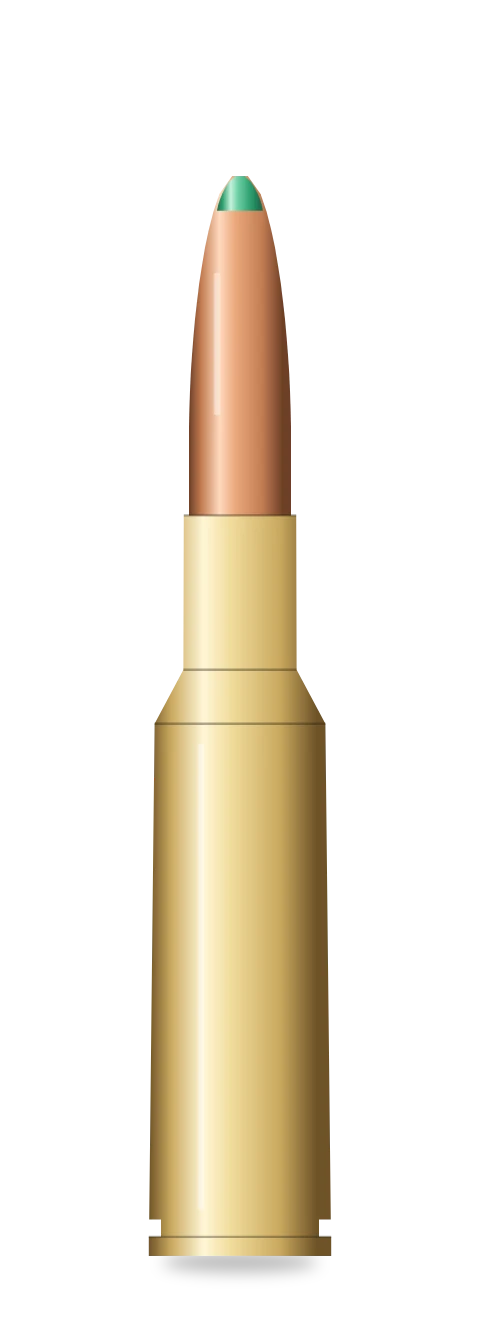
01 / At a glance
The basics
- Origin
- United States
- Introduced
- 2007
- Ignition
- Centerfire
- Case form
- Rimless, bottleneck
- Diameter
- 6.7 mm
- Case length
- 48.8 mm
Rounded values to help you identify the cartridge, not manufacturing drawings. See the cited standard for exact dimensions and tolerances.
Do not mix it up
The 6.5 Creedmoor is not the same as the 6.5 PRC, the 6.5 Grendel or the .260 Remington. They look similar but are not interchangeable. Check the marking on your rifle.
The 6.5 Creedmoor is a mid-size rifle cartridge that fires a long, slim 6.5 mm bullet. It was designed in 2007 for target shooting, and it has since become one of the most popular cartridges in North America for competition and for hunting deer-size game. Shooters like it because it is accurate, it handles wind well and the recoil is moderate.
This guide explains what the cartridge is, how it performs, how to choose ammunition and a rifle, and how it compares with the .308 Winchester and other 6.5 mm cartridges. It is a reference page, not a loading manual, and it contains no handloading data.
A short history
The 6.5 Creedmoor was developed by Dave Emary of Hornady and Dennis DeMille of Creedmoor Sports, and it was introduced in 2007. The idea was a cartridge for target rifles that would shoot very efficient 6.5 mm bullets, and still fit in a standard short action, the same size used by the .308 Winchester.
The case is based on the .30 T/C, necked down to 6.5 mm. The design gave the cartridge a case shape that feeds smoothly from the magazine and works with long bullets seated out toward the lands. It was built for accuracy, not for the largest possible velocity.
It started as a competition cartridge. After 2010 it spread quickly into precision rifle matches, and from there into hunting rifles and factory ammunition lines. Today almost every major rifle maker offers it.
Why it is so popular
The main reason is the bullet. A 6.5 mm bullet is narrow for its weight, so a 140 grain bullet has a high ballistic coefficient. It holds its speed, drops less and is pushed less by wind than a typical .308 bullet of similar weight.
The second reason is comfort. In a typical rifle the 6.5 Creedmoor recoils noticeably less than a .308 Winchester with a heavy bullet. That makes it easier to shoot well, and easier to shoot a lot.
The third reason is the market. Rifles, barrels, magazines and ammunition are available in every price range, and match-grade factory loads are common. It is easy to find a good rifle for it.
Specifications at a glance
| Specification | Value |
|---|---|
| Bullet diameter | .264 in (6.7 mm) |
| Case length | 1.920 in (48.8 mm) |
| Maximum overall length (SAAMI) | 2.825 in (71.8 mm) |
| Case type | Rimless, bottleneck |
| Primer | Large rifle |
| Maximum average pressure (SAAMI) | 62,000 psi |
| Typical bullet weights | 95 to 147 grains; 120 to 143 grains is most common |
| Typical muzzle velocity | About 2,600 to 2,950 ft/s depending on bullet |
| Common barrel twist | 1 in 8 inches |
Values are rounded for reference. Exact dimensions and tolerances are in the SAAMI standards cited at the end of this page.
Strengths and limits
The 6.5 Creedmoor is a very good all-round precision cartridge. It has limits, though, and some of the hype is more than the numbers show.
| Advantage | Limitation |
|---|---|
| High-BC bullets resist wind and keep energy at range | Not a big-game cartridge for the largest animals |
| Moderate recoil and good accuracy | Barrels can lose accuracy sooner than a milder cartridge when fired hard |
| Wide choice of rifles and factory ammunition | Works best with a fast twist, so older slow-twist rifles are not ideal |
| Fits standard short-action rifles | Holds less powder than the .308, so heavy hunting bullets are slower |
Ballistics
The tables and charts below show the Hornady Match 140 grain ELD Match load, which leaves the muzzle at 2,710 ft/s. It is a popular target load and a good picture of what the cartridge does.
| Range (yd) | Velocity (ft/s) | Energy (ft-lb) | Drop (in) | Wind drift, 10 mph (in) |
|---|---|---|---|---|
| 100 | 2569 | 2051 | 0 | 0.5 |
| 200 | 2432 | 1839 | -3.8 | 2.2 |
| 300 | 2300 | 1644 | -13.4 | 5 |
| 400 | 2172 | 1466 | -29.7 | 9.2 |
| 500 | 2047 | 1303 | -53.3 | 14.7 |
| 600 | 1927 | 1154 | -85.2 | 21.8 |
Reading the numbers
From a 100 yard zero, the bullet drops about 4 inches at 200 yards, 13 inches at 300 yards, 30 inches at 400 yards, 53 inches at 500 yards and 85 inches at 600 yards. A 10 mph crosswind moves it about 5 inches at 300 yards, 15 inches at 500 yards and 22 inches at 600 yards.
The important point is energy and speed at distance. At 500 yards the bullet is still moving at about 2,050 ft/s and carries about 1,300 foot-pounds. At 600 yards it is still above 1,900 ft/s. That is what makes the cartridge so good for long-range target shooting, and for ethical hunting shots at deer at 300 to 400 yards.
How these figures were made: muzzle velocity (2,710 ft/s), weight (140 grains) and ballistic coefficient (G1 0.646) are the published figures for the Hornady Match 140 grain ELD Match load. Drop, velocity, energy and wind drift are computed with a standard point-mass model, a 100 yard zero, a 1.5 inch sight height and standard atmosphere. They are estimates. Your rifle, barrel length and lot of ammunition will differ, so confirm with a chronograph and a range session.
Recoil and shooter comfort
Recoil is moderate. In a typical rifle that weighs 8 to 9 pounds, free recoil is roughly 10 to 15 foot-pounds, which is a bit more than a .243 Winchester and noticeably less than a .30-06. Most adults shoot it comfortably, and many teenagers can handle it in a heavier rifle.
A muzzle brake cuts recoil and makes it easy to see impacts, but it makes the blast louder for people nearby. A good recoil pad and a well-fitted stock matter more than most people think.
How to choose ammunition
Pick the bullet for the job first, then the weight. The 6.5 Creedmoor is loaded for target shooting and hunting.
| Bullet type | Best for | Notes |
|---|---|---|
| Match hollow point, boat-tail (ELD-M, SMK, Berger) | Target and long-range shooting | Built for accuracy and high BC |
| Polymer tip, bonded or monolithic (ELD-X, SST, Nosler Partition) | Hunting deer and similar game | Controlled expansion and weight retention |
| Soft point | General hunting | Reliable and affordable |
| Full metal jacket | Practice and training | Most affordable; not suited to hunting |
Bullet weight
A 120 to 129 grain bullet is fast and flat, and suits deer and light recoil. A 140 to 143 grain bullet is the best all-round choice for target and hunting use. A 147 grain match bullet holds its speed and resists wind best, but it needs the right twist and magazine length.
Match ammunition to your rifle
Factory rifles shoot best with certain bullets. Try a few boxes of different weights and brands, and shoot groups from a rest. Buy more of the load that shoots best. Rifles are different even when they are the same model.
How to choose a rifle
The 6.5 Creedmoor is available in many styles. The right one depends on how you plan to use it.
- Action type. Bolt-action rifles are the usual choice for accuracy. Semi-automatic AR-10 style rifles are also available, although they are heavier and cost more.
- Barrel and twist. A 1 in 8 inch twist is standard and stabilizes the common 120 to 147 grain bullets. Barrel lengths of 20 to 24 inches are common for hunting, and 24 to 26 inches for target rifles.
- Weight. A lightweight hunting rifle of 6 to 7 pounds is easy to carry but recoils more. A heavier target rifle of 10 to 12 pounds shoots softly.
- Trigger. A crisp, light trigger helps at distance. Many modern rifles offer adjustable triggers.
- Optics. For hunting, a 3-9x or 4-12x scope is common. For long-range target shooting, a 5-25x scope with a mil or MOA turret is usual.
- Magazine. Check that the magazine feeds the bullets you intend to use. Long bullets may need a longer magazine.
Zeroing and range practice
A 100 yard zero is the common starting point, and it works well for target shooting and hunting out to about 250 yards. Some hunters zero 2 or 3 inches high at 100 yards, which puts the bullet on target out to about 250 yards without holdover.
For long-range shooting, confirm your zero at 100 yards. Then record the elevation needed at 200, 300, 400, 500 and 600 yards, and keep the data on a card. Measure your muzzle velocity with a chronograph if you can, because small changes affect drop at distance. Practice reading wind, because it is the main source of misses past 300 yards.
Practical uses
Long-range target shooting
This is the cartridge's home. It is a standard choice in precision rifle matches and in steel target shooting at 300 to 1,000 yards. A good rifle shoots groups under an inch at 100 yards.
Deer and similar game
With a proper hunting bullet, the 6.5 Creedmoor is excellent on whitetail, mule deer, antelope and hogs. It suits open country, where shots can be long. Place the shot well, and keep the range within what the bullet's energy allows.
Elk and larger animals
Some hunters use it on elk with a premium bullet at close to moderate range, but many prefer a bigger cartridge. Many states set minimum caliber or energy rules, so check local law.
General rifle use
Because it is accurate and mild, it makes a good one-rifle choice for a hunter who also likes to shoot targets.
6.5 Creedmoor vs similar cartridges
The table lists the cartridges most often compared with the 6.5 Creedmoor. Figures are rounded and use the SAAMI maximum average pressure where one exists.
| Cartridge | Bullet diameter | Case length | Max pressure | Typical use |
|---|---|---|---|---|
| 6.5 Creedmoor | .264 in | 1.920 in | 62,000 psi | Target and hunting |
| .308 Winchester | .308 in | 2.015 in | 62,000 psi | Hunting and target |
| .260 Remington | .264 in | 2.035 in | 60,000 psi | Hunting and target |
| 7mm-08 Remington | .284 in | 2.035 in | 61,000 psi | Hunting |
| .243 Winchester | .243 in | 2.045 in | 60,000 psi | Deer and varmints |
| 6.5 PRC | .264 in | 2.030 in | 65,000 psi | Long-range hunting |
Against the .308 Winchester, the 6.5 Creedmoor has less recoil and less wind drift, while the .308 has more bullet weight and more choices of loads. Against the .260 Remington, the two are very close in performance. The Creedmoor wins on the number of factory rifles and ammunition. Against the 6.5 PRC, the PRC is faster and flatter, but it recoils more and has a smaller selection. The 6.5 Creedmoor remains the easier cartridge to shoot and to find.
Care and storage
Clean the bore regularly with a proper rod and bore guide, and follow the rifle maker's instructions. Hard shooting, with many rounds in a short time, heats the barrel and wears it faster, so allow it to cool. Barrels used for long-range matches may lose accuracy after a few thousand rounds. Store ammunition in a cool, dry place, and keep guns and ammunition locked away from children.
Safety and common mistakes
- Do not mix up 6.5 cartridges. The 6.5 Creedmoor, 6.5 PRC, 6.5 Grendel, .260 Remington and 6.5x55 Swedish all use 6.5 mm bullets, but they are different cartridges. Read the barrel marking and the headstamp.
- Check the twist. A slower twist may not stabilize the heaviest bullets and can cause poor accuracy.
- Inspect ammunition. Do not fire cartridges with dents, corrosion or loose bullets.
- Know the signs of high pressure: flattened or pierced primers, a sticky bolt lift and bright marks on the case head. Stop firing and have the rifle checked.
- Treat every firearm as loaded, and know your target and what is behind it.
- Wear eye and ear protection every time. If you reload, use only published data from a current manual.
Frequently asked questions
What is the 6.5 Creedmoor good for?
It is excellent for long-range target shooting, and for hunting deer, antelope and hogs. It is accurate, has moderate recoil and handles wind well.
How far can a 6.5 Creedmoor shoot?
Target shooters use it to 1,000 yards and beyond. For hunting, most ethical shots are inside 400 yards, depending on the bullet, the animal and the shooter.
Is the 6.5 Creedmoor better than the .308?
For wind resistance, recoil and long-range accuracy, usually yes. The .308 has more bullet weight and a wider range of factory loads, and it is better when you want heavy bullets for large game at close range.
Is the 6.5 Creedmoor good for elk?
It can work with a premium bullet at close to moderate range, but it is marginal. Many hunters prefer a bigger cartridge. Check local rules on minimum caliber and energy.
What twist rate is best for the 6.5 Creedmoor?
A 1 in 8 inch twist is standard and works with most bullets from 120 to 147 grains. Some rifles use 1 in 7.5 or 1 in 7 for the heaviest bullets.
How much recoil does a 6.5 Creedmoor have?
Moderate. In an 8 to 9 pound rifle it is roughly 10 to 15 foot-pounds of free recoil, a bit more than a .243 and noticeably less than a .30-06.
What zero distance should I use?
A 100 yard zero is the common choice. For hunting, some shooters zero 2 to 3 inches high at 100 yards. For long-range shooting, confirm at 100 yards and record the drop at longer distances.
Can I reload 6.5 Creedmoor brass?
Yes. The brass is widely reloaded. Use only published data from a current loading manual, and follow its safety instructions.
Sources
Sources reviewed · 29 October 2026