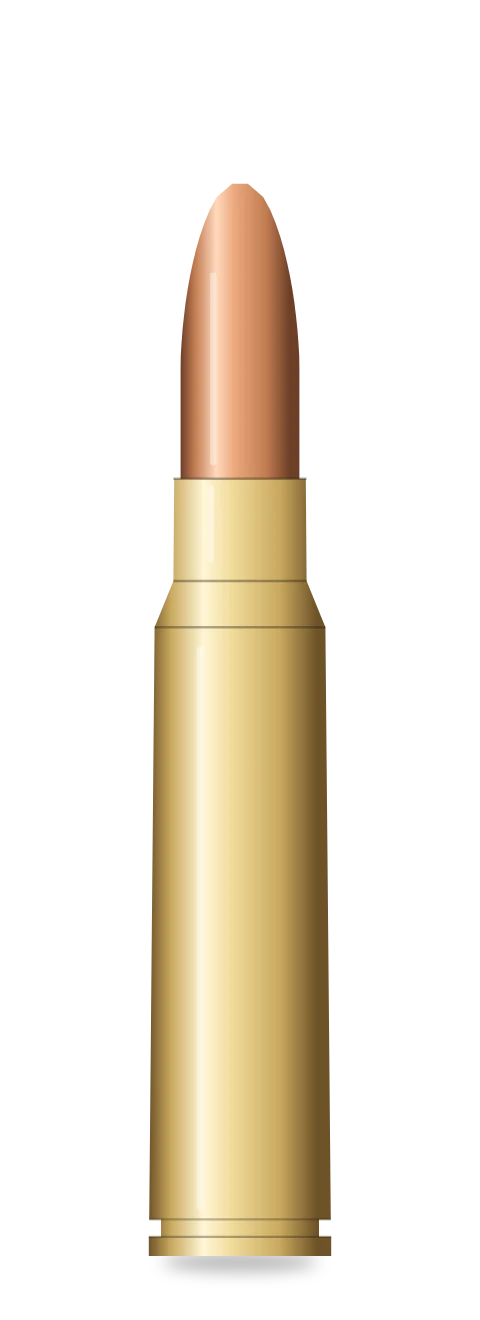
01 / At a glance
The basics
- Origin
- United States
- Introduced
- 1952
- Ignition
- Centerfire
- Case form
- Rimless, bottleneck
- Diameter
- 7.82 mm
- Case length
- 51.18 mm
Rounded values to help you identify the cartridge, not manufacturing drawings. See the cited standard for exact dimensions and tolerances.
Do not mix it up
.308 Winchester and 7.62×51 NATO are very close in size and share a history, but they are not the same specification. Use only what your rifle maker says is approved for your firearm.
The .308 Winchester is a mid-size, rimless bottleneck rifle cartridge that has been in continuous production since 1952. It sits in a useful middle spot: enough power for deer-size game, accuracy that has won match after match, and recoil that most shooters manage after a short learning curve. Almost every major rifle maker lists at least one model chambered for it, and almost every ammunition maker loads it.
This guide explains what the cartridge is, how it performs, how to choose ammunition and a rifle, and how it compares with the cartridges people most often weigh it against. It is a reference, not a loading manual, and it contains no handloading data.
A short history
Winchester introduced the .308 Winchester in 1952. It was the commercial version of an experimental military cartridge called the T65, developed in the early 1950s to deliver the performance of the older .30-06 in a shorter, lighter case. A shorter cartridge allows a shorter action, a lighter rifle and a more compact automatic weapon.
The military adopted the 7.62×51 mm NATO cartridge in 1954, built on the same idea, while Winchester offered its own version to hunters and target shooters in rifles including the Model 70 Featherweight. Other makers followed quickly.
That shared origin explains the long list of rifles and the wide choice of ammunition. It also explains why the case became a platform. The .243 Winchester, 7mm-08 Remington and .338 Federal are all built on the .308 case, necked down or up. Each is its own cartridge, and they are compared further down this page.
Why it is still popular
Newer cartridges have appeared, some with flatter trajectories and lighter recoil. The .308 stays popular for practical reasons. Rifles are easy to find in every price range. Factory ammunition is stocked almost everywhere, in dozens of bullet types. Brass, bullets and dies are plentiful for people who reload. Gunsmiths know the cartridge well, and parts and magazines are easy to source.
For a first centerfire rifle, or for a single rifle that has to do several jobs, that availability counts for as much as raw performance.
Specifications at a glance
| Specification | Value |
|---|---|
| Bullet diameter | .308 in (7.82 mm) |
| Case length | 2.015 in (51.18 mm) |
| Maximum overall length (SAAMI) | 2.800 in (71.1 mm) |
| Case type | Rimless, bottleneck |
| Primer | Large rifle |
| Maximum average pressure (SAAMI) | 62,000 psi |
| Maximum pressure (C.I.P.) | 415 MPa (4,150 bar) |
| Common barrel twist | 1:10 inch |
| Typical bullet weights | 110 to 220 grains; most hunting and match loads are 150 to 180 grains |
Values are rounded for reference. Exact dimensions and tolerances are in the SAAMI and C.I.P. standards cited at the end of this page.
Strengths and limits
No cartridge is best at everything. The table sets the .308 strengths next to the matching limits so you can judge whether it fits your use.
| Advantage | Limitation |
|---|---|
| Huge selection of rifles, ammunition and components | Recoil can be noticeably heavier than .223 Remington or 6.5 Creedmoor |
| Wide bullet range, from 110 to 220 grains | Trajectory is not as flat as newer long-range cartridges, so range estimation matters past 300 yards |
| Short action keeps rifles compact and light | Rifles and ammunition weigh more than those for .223 Remington |
| Proven accuracy in hunting and target rifles | More than needed for small game and varmints |
Ballistics
Ballistics depend on bullet, velocity, barrel length and conditions. To show the range of performance, the tables and chart below compare two common factory loads: a 150 grain soft point made for hunting and a 168 grain match bullet.
| Range (yd) | Velocity (ft/s) | Energy (ft-lb) | Drop (in) | Wind drift, 10 mph (in) |
|---|---|---|---|---|
| 100 | 2548 | 2163 | 0 | 1.1 |
| 200 | 2292 | 1750 | -3.9 | 4.4 |
| 300 | 2050 | 1401 | -14.4 | 10.5 |
| 400 | 1825 | 1109 | -33.2 | 19.7 |
| 500 | 1617 | 871 | -62.6 | 32.7 |
| Range (yd) | Velocity (ft/s) | Energy (ft-lb) | Drop (in) | Wind drift, 10 mph (in) |
|---|---|---|---|---|
| 100 | 2457 | 2252 | 0 | 0.9 |
| 200 | 2272 | 1925 | -4.3 | 3.6 |
| 300 | 2094 | 1637 | -15.3 | 8.3 |
| 400 | 1925 | 1383 | -34.3 | 15.3 |
| 500 | 1765 | 1163 | -62.6 | 25 |
Reading the numbers
Both loads land about 4 inches low at 200 yards and 14 to 15 inches low at 300 yards from a 100-yard zero. Past that, the heavier match bullet with the higher ballistic coefficient holds its speed better. At 500 yards it still carries about 1,160 foot-pounds of energy against about 870 for the soft point, and a 10 mph crosswind moves it about 25 inches against about 33.
In practice, a 100-yard zero works for most hunting inside 250 yards. Past 300 yards you need your own measured drop data, a reliable range estimate and a plan for wind.
How these figures were made: muzzle velocities and ballistic coefficients are the published factory figures (2,820 fps and G1 0.338 for the 150 grain load; 2,650 fps and G1 0.462 for the 168 grain load). Drop, velocity, energy and wind drift are computed with a standard point-mass model, a 100-yard zero, a 1.5 inch sight height and standard atmosphere. They are estimates. Your rifle, barrel length and ammunition lot will differ, so confirm with a chronograph and a range session.
Recoil and shooter comfort
The .308 kicks harder than a .223 Remington and is usually described as moderate. How much you feel depends less on the cartridge than on the setup. A heavier rifle absorbs more of the push. A well-fitted stock with a good recoil pad spreads it across the shoulder. A muzzle brake cuts felt recoil but adds noise and blast, which matters on a firing line and in the field.
New shooters improve fastest with lighter loads, a steady rest and short sessions. Flinching, caused by anticipating the shot, ruins accuracy faster than any other habit. If you notice it, stop, relax, dry-fire a few times and start again. Large hearing protection or plugs plus muffs also reduce the noise that makes people flinch.
How to choose ammunition
Pick the bullet for the job first, then the weight, then the brand. The same cartridge name covers very different products.
| Bullet type | Best for | Notes |
|---|---|---|
| Soft point | Deer-size game at typical hunting ranges | Reliable expansion at moderate cost |
| Polymer tip or bonded | Hunting with a flatter path or better weight retention | Usually costs more |
| Hollow-point boat-tail match | Target and precision shooting | Built for accuracy; check hunting rules before using it on game |
| Full metal jacket | Training and bulk practice | Not suited to hunting and not legal for it in many places |
| Solid copper | Hunting where lead is restricted; deep penetration | Longer for the same weight |
Bullet weight
A 150 grain bullet is fast and flat for its class and suits deer hunting at moderate distance. A 168 to 175 grain bullet is the long-standing match choice and holds wind better. A 180 grain bullet is a common step up for tougher game and deeper penetration. Heavier bullets drop more at a given distance and recoil more, so match the weight to the animal or target, not to the number on the box.
Barrel length
Published velocities usually come from a long test barrel, often 24 inches. A shorter barrel loses speed, roughly 20 to 30 feet per second for every inch removed. A 16 inch carbine will not reach the numbers printed on the box.
How to choose a rifle
The right rifle depends on how you will use it. These are the points that matter most.
- Action type. A bolt action gives the best accuracy for the money and the lightest weight. A semi-automatic AR-10 pattern rifle gives faster follow-up shots, but magazines and parts are not interchangeable between every maker, so check compatibility.
- Barrel and twist. A 1:10 twist handles most bullets from 150 to 180 grains. Very long match bullets may prefer a faster twist.
- Weight. A light rifle carries easily in the field but recoils more. A heavier rifle is steadier on the bench and kinder to the shoulder.
- Fit. Stock length and comb height decide how well you can see through the optic and how recoil feels. Try the rifle before you buy if you can.
- Optic and mounts. A variable scope in the 3-9 or 4-12 range suits most uses. Good mounts matter more than extra magnification.
Zeroing and range practice
Zero the rifle before every season and after any change to the optic, mounts or ammunition. A 100-yard zero is the usual starting point because it is easy to verify and shows small groups clearly. Some hunters zero at 200 yards for a flatter path in open country. Whichever distance you choose, shoot a group, adjust the optic and confirm with a second group.
Then record your actual drop at 200, 300 and 400 yards with the load you plan to use, and tape a small card to the stock or keep it in a pocket. Ballistic apps help, but a measured number at a real range is the one you can trust. Repeat the check whenever you change ammunition, because lots and brands differ.
Practical uses
Hunting
The .308 is used on deer, pronghorn and similar game. With a bonded or solid copper bullet and careful shot placement it is also used on larger animals such as elk, although many hunters choose a heavier cartridge for them. Regulations on minimum caliber, bullet type and lead differ by region, so check local rules before you buy ammunition.
Target and competition
Accurate rifles and match ammunition make the .308 a standard choice for medium-range target shooting and service-rifle style events. At 600 yards and beyond it works, but it needs more wind and drop work than newer long-range cartridges.
Training and general use
Because ammunition is easy to find, the cartridge suits shooters who want one rifle to hunt, practice and shoot targets. Bulk practice ammunition lowers the cost of regular training.
.308 Winchester vs similar cartridges
The table lists the cartridges most often compared with the .308. Figures are rounded and use the SAAMI maximum average pressure where a SAAMI figure exists.
| Cartridge | Bullet diameter | Case length | Max pressure | Typical use |
|---|---|---|---|---|
| .308 Winchester | .308 in | 2.015 in | 62,000 psi | All-round hunting and target |
| 7.62×51 mm NATO | .308 in | 2.015 in (51 mm) | Different test system, not SAAMI | Military and surplus |
| .30-06 Springfield | .308 in | 2.494 in | 60,000 psi | Larger game, more case capacity |
| 6.5 Creedmoor | .264 in | 1.920 in | 62,000 psi | Long-range target and hunting |
| .243 Winchester | .243 in | 2.045 in | 60,000 psi | Light-recoil deer and varmints |
| 7mm-08 Remington | .284 in | 2.035 in | 61,000 psi | Deer hunting with mild recoil |
| .223 Remington | .224 in | 1.760 in | 55,000 psi | Varmints, target, light recoil |
Against the 6.5 Creedmoor, the .308 gives up some trajectory and wind performance at long range and gains a larger bullet and more choice of rifles and ammunition. Against the .30-06, it delivers similar performance with typical bullets from a shorter action. The .243 Winchester and 7mm-08 Remington are necked-down relatives that recoil less and suit smaller shooters.
Care and storage
Store ammunition cool, dry and locked away from children, in its original box or a purpose-made case. Keep it away from solvents and heat. Clean the bore on a regular schedule, and always check that the chamber and barrel are clear before you shoot. Brass is reusable if you reload, but inspect every case for cracks and bulges before each use.
Safety and common mistakes
- Match the cartridge to the chamber. .308 Winchester and 7.62×51 mm NATO are close in size but are not the same specification. Use only what your rifle maker approves.
- Read the barrel marking and the headstamp. If the rifle does not say .308 Winchester or 7.62×51 mm, do not guess.
- Inspect ammunition. Do not fire cartridges with dents, corrosion or loose bullets.
- Know the signs of high pressure: flattened or pierced primers, sticky bolt lift and bright marks on the case head. Stop firing and have the rifle checked.
- Wear eye and ear protection every time. A .308 is loud without it.
- If you reload, use only published data from a current manual and start low. This page does not contain loading data.
Frequently asked questions
Is .308 Winchester the same as 7.62×51 mm NATO?
They are very close in size and share a history, but they are not the same specification. Pressure is measured differently, and chambers can differ. Use only the ammunition your rifle maker says is approved for your firearm.
Is the .308 Winchester good for deer?
Yes. With a quality soft point or bonded bullet and good shot placement it is a proven deer cartridge. Check local regulations on bullet type and minimum caliber.
How far can a .308 Winchester shoot accurately?
It depends on the rifle, the load and the shooter. Most hunting shots are taken inside about 300 yards. Target shooters use it at 600 yards and beyond, but wind and drop need careful handling.
How much recoil does a .308 Winchester have?
It is moderate. It is heavier than a .223 Remington and often a little heavier than a 6.5 Creedmoor, and it varies with rifle weight, stock fit and bullet weight.
What twist rate is best for .308 Winchester?
A 1:10 inch twist is the most common and works with most bullets from 150 to 180 grains. Very long match bullets may do better with a faster twist.
What is the difference between .308 Winchester and .30-06?
Both use a .308 inch bullet. The .30-06 has a longer case and more capacity, and needs a longer action. The .308 delivers similar performance with typical bullets from a shorter case.
What distance should I zero a .308 Winchester at?
A 100-yard zero is the most common and is easy to confirm. Some hunters prefer 200 yards for open country. Whichever you pick, record your measured drop at longer distances with the exact load you use.
Can I reload .308 Winchester brass?
Yes. The brass is widely reloaded. Use only published data from a current loading manual and follow its safety instructions.
Sources
Sources reviewed · 29 October 2026