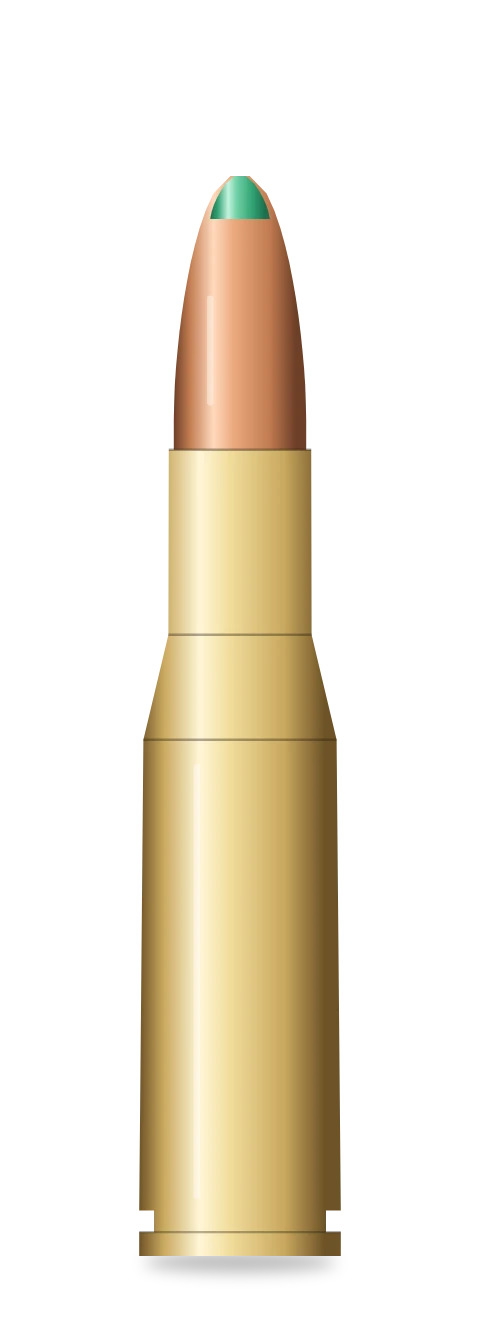
01 / At a glance
The basics
- Origin
- United States
- Introduced
- 2004
- Ignition
- Centerfire
- Case form
- Rimless, bottleneck
- Diameter
- 7.0 mm
- Case length
- 42.8 mm
Rounded values to help you identify the cartridge, not manufacturing drawings. See the cited standard for exact dimensions and tolerances.
Do not mix it up
The original chamber and the 6.8 SPC II chamber differ. Check which one a rifle has before you buy ammunition.
The 6.8mm Remington SPC, usually called the 6.8 SPC, is a rimless 7 mm (.277 inch) rifle cartridge made to give an AR-15 pattern rifle more power than a 5.56 NATO can. It was developed in the early 2000s with members of the US Army Marksmanship Unit and US Special Operations Command, and it never became a military standard. Today it is a hunting and sporting cartridge for people who want a hard-hitting round from a carbine-size rifle.
This guide explains what the 6.8 SPC is, how it performs out to 400 yards, how to choose ammunition and a rifle, and how it compares with the 5.56 NATO, the .300 Blackout, the 6.5 Grendel and the 7.62x39. It is a reference page, not a loading manual, and it contains no loading data.
A short history
Remington Arms developed the cartridge with members of the US Army Marksmanship Unit and USSOCOM between 2002 and 2004. The goal was a cartridge for short-barreled rifles and carbines that could take the place of the 5.56 NATO, which has less power from a short barrel. By late 2004 it was reported to be performing well with special operations users, though it was not issued to conventional troops.
The case is based on the .30 Remington. It is 1.687 inches (42.8 mm) long, with an overall length of 2.260 inches (57.4 mm), which fits an AR-15 magazine well, and it takes a large rifle primer. The SAAMI maximum pressure is 55,000 psi, and the C.I.P. figure is 58,700 psi. The bullet is .277 inch (7.0 mm) in diameter.
The military never adopted it. In 2007 both SOCOM and the US Marine Corps decided not to field weapons in 6.8 mm, citing logistics and cost. That left the cartridge as a civilian one, and a number of makers offered rifles, among them Barrett, Stag Arms, Rock River Arms and Robinson Armament. Several of those makers have since moved on, and ammunition choices are narrower than for the 5.56 and .300 Blackout.
Why people shoot it
The first reason is power from a small rifle. A 120 grain SST leaves a 16 inch barrel at about 2,460 ft/s with about 1,610 foot-pounds of energy, and a 115 grain FMJ leaves at about 2,575 ft/s. That is more bullet weight and energy than a 5.56 offers, and the bullet is wider, which helps it make a bigger wound channel on game.
The second reason is the platform. The cartridge works in an AR-15 pattern rifle with a different barrel, bolt and magazines, so a shooter can use the same controls, optics and accessories. That makes it handy and light, and it suits shooters who find a bolt-action hunting rifle heavier than they like.
The third reason is the hunting niche. Deer and hogs at moderate range fall within what the cartridge does well, and the AR-15 is a common rifle in places where hunters like the platform. It fills the space between a 5.56 and a .308 Winchester in a carbine.
Specifications at a glance
| Specification | Value |
|---|---|
| Bullet diameter | .277 in (7.0 mm) |
| Case length | 1.687 in (42.8 mm) |
| Overall length | 2.260 in (57.4 mm) |
| Case type | Rimless, bottleneck |
| Parent case | .30 Remington |
| Primer | Large rifle |
| Maximum pressure (SAAMI) | 55,000 psi |
| Maximum pressure (C.I.P.) | 58,700 psi |
| Typical bullet weights | 85 to 140 grains; 110 to 120 grains for most uses |
| Typical muzzle velocity | About 2,460 to 2,575 ft/s with 115 to 120 grain bullets |
Values are rounded for reference. Exact dimensions and tolerances are in the SAAMI standard. The cartridge was also updated as the 6.8 SPC II with a revised chamber, so check which chamber your rifle has.
Strengths and limits
The 6.8 SPC is a medium-power cartridge for the AR-15. These are the trade-offs to understand.
| Strength | Limit |
|---|---|
| More bullet weight and energy than a 5.56 | Fewer rifles, magazines and ammunition than 5.56 or .300 Blackout |
| Works in an AR-15 pattern rifle | Trajectory is not flat past 300 yards |
| Moderate recoil in a light rifle | A short case limits speed with heavy bullets |
| Suited to deer and hogs at moderate range | Two chamber versions can cause confusion |
Honest advice: if you want a hard-hitting AR-15 round for medium range, the 6.5 Grendel has a flatter trajectory, and the .300 Blackout has far more rifles and ammunition. The 6.8 SPC makes sense if you already own a rifle for it, if you like its bullet weight, or if you want a modest-recoil AR-15 for deer and hogs.
Two chambers
The original chamber and the 6.8 SPC II chamber differ. Check the marking on the barrel and the information from the rifle maker before you buy ammunition, since the two are not the same. If you are unsure, ask the maker of the rifle which chamber it has.
Ballistics
The table and charts below show one factory load, a Hornady Custom 120 grain SST at 2,460 ft/s from a 16 inch test barrel, with the rifle zeroed at 200 yards. It is a common hunting load for the cartridge.
| Range (yd) | Velocity (ft/s) | Energy (ft-lb) | Drop (in) | Wind drift, 10 mph (in) |
|---|---|---|---|---|
| 100 | 2250 | 1349 | 2.7 | 1 |
| 200 | 2051 | 1121 | 0 | 4.1 |
| 300 | 1862 | 924 | -11 | 9.7 |
| 400 | 1686 | 757 | -32 | 18 |
Reading the numbers
With a 200 yard zero the bullet rises about 3 inches above the line of sight at 100 yards, returns to the line at 200 and falls about 11 inches at 300 and 32 at 400. A 10 mph crosswind moves it about 10 inches at 300 yards and 18 at 400. Velocity drops from 2,460 ft/s at the muzzle to about 1,690 ft/s at 400 yards, and energy from about 1,610 to about 760 foot-pounds.
The energy at 300 yards is about 920 foot-pounds, which is a number many hunters watch for deer. Past that the bullet is slow and drops fast, so the cartridge is a 200 to 300 yard round for deer-size game, and it is not made for long range.
How these figures were made: the muzzle velocity (2,460 ft/s), weight (120 grains) and the published velocities at 100 to 400 yards (2,250, 2,051, 1,863 and 1,687 ft/s) are Hornady figures for its Custom 120 grain SST load from a 16 inch test barrel. The ballistic coefficient (G1 0.407) was fitted to match those velocities. Hornady does not publish a numeric BC for this load. Drop, velocity, energy and wind drift are calculated with a standard point-mass model, a 200 yard zero, a sight height of 1.5 inches and standard atmosphere. Hornady lists a slightly different sight height, so the drop differs by a small amount. They are estimates. Your rifle and conditions will differ.
Recoil and shooter comfort
Recoil is moderate. In an AR-15 of 6 to 8 pounds, the 6.8 SPC kicks more than a 5.56 and less than a .308 Winchester, and the gas action of a semi-automatic softens it. Most adults shoot it well, and young shooters can manage it with a proper fit.
The report from a short barrel is sharp. Use good hearing protection, and consider both plugs and muffs. A muzzle device can reduce recoil and flash while raising the noise for people nearby.
How to choose ammunition
Hornady and Federal load the cartridge. Match the bullet to the job, and test the load in your own rifle.
| Load | Muzzle velocity | Best for | Notes |
|---|---|---|---|
| 115 grain FMJ | About 2,575 ft/s | Practice | Full metal jacket for range use |
| 110 grain Sierra Pro Hunter | About 2,500 ft/s | Hunting | Soft point for deer and hogs |
| 120 grain SST | About 2,460 ft/s | Deer and hogs | Polymer-tip hunting bullet |
| 85 grain Barnes TSX | About 3,070 ft/s | Hunting and predators | Light copper bullet at high speed |
For hunting, choose a bullet made to expand reliably at the speeds the cartridge produces. The 120 grain weight is a common choice for deer. Try more than one load, since a rifle often prefers one.
Check the headstamp and the rifle
Do not put 6.8 SPC ammunition in a rifle of another chambering. A cartridge that chambers in the wrong rifle can be dangerous. Always read the barrel marking and the headstamp, and check which chamber your rifle has.
Cost
Factory ammunition costs more than for 5.56, and stores stock fewer choices. Plan your practice with that in mind.
How to choose a rifle
The right rifle depends on how you plan to use it. These are the points that matter most.
- Chambering. Buy a rifle made for the 6.8 SPC, and check whether it has the original chamber or the SPC II chamber.
- Barrel length. A 16 inch barrel is common. Longer barrels give more velocity, and the published numbers here use 16 inches.
- Twist rate. Check the rate the maker uses and match it to the bullets you plan to shoot. One rifle on the market uses 1 in 10 inches.
- Magazines. Use magazines made for the cartridge and test them for reliable feeding.
- Weight. An AR-15 pattern rifle is light, and a lighter rifle kicks more.
- Trigger. A clean, crisp trigger improves accuracy.
- Optic. A low-power variable scope suits a 6.8 SPC well, and a red dot suits short range.
Makers who have offered rifles in the chambering include Barrett, Stag Arms, Rock River Arms, Robinson Armament and LWRC, and Bushmaster sold a conversion kit in 2018. Ruger made a Mini-14 in 6.8 SPC that has been discontinued. Not every model is still in production, so check current catalogs.
Zeroing and range practice
A 200 yard zero is a good starting point for hunting with this cartridge. With a 120 grain SST the bullet rises about 3 inches at 100 yards and drops about 11 inches at 300, so you can hold on the vital area out to about 250 yards, and hold over beyond that.
Zero at 100 yards on paper first, then confirm at 200. Shoot at 300 and 400 to learn your own drops, and write them on a card. The numbers in this guide are estimates from a model, and your barrel, load and air density will move them. Wind matters past 300 yards, so practice judging it.
Shoot from field positions as well as a bench. A hunter rarely gets a bench, and the best group from a rest is not the group you will shoot from sticks. Practice at the distances you plan to take.
Practical uses
Deer
The 6.8 SPC is used on deer at moderate range with a good bullet. Keep shots inside 250 to 300 yards, where the energy and the trajectory are good.
Hogs
A 110 to 120 grain bullet works on hogs at moderate range. Shot placement matters more than any number.
Sporting use in an AR-15
It is a fun sporting cartridge in an AR-15 pattern rifle, with a mild kick and an effective bullet at moderate range.
Not for long range
It drops quickly past 300 yards and is not made for long range. A shooter who wants reach is better served by a cartridge with a flatter bullet.
6.8 SPC vs similar cartridges
The table compares the 6.8 SPC with the cartridges it is usually weighed against. Figures are rounded and use SAAMI pressures, except where noted.
| Cartridge | Bullet diameter | Case length | Max pressure | Typical use |
|---|---|---|---|---|
| 6.8 SPC | .277 in | 1.687 in | 55,000 psi | Deer and hogs in an AR-15 |
| 5.56x45 NATO | .224 in | 1.760 in | 62,400 psi (NATO) | Military and sporting |
| .300 Blackout | .308 in | 1.368 in | 55,000 psi | Suppressed use and short-range hunting |
| 6.5 Grendel | .264 in | 1.52 in | 52,000 psi | Long-range in an AR-15 |
| 7.62x39 | .311 in | 1.524 in | 45,010 psi | Short-range hunting and sporting |
Against the 5.56, the 6.8 SPC carries a heavier, wider bullet and more energy at medium range, while the 5.56 is cheaper and has far more rifles and ammunition. Against the .300 Blackout, it is faster and flatter at medium range, and the .300 Blackout suits suppressed use. Against the 6.5 Grendel, it is a heavier-hitting round with a less flat trajectory. Against the 7.62x39, the two have similar roles, and the 6.8 SPC has the more modern AR-15 platform.
Care and storage
Clean the bore after a day of shooting, and follow the barrel maker's advice on copper and carbon. Keep the bolt and the gas system clean, since a semi-automatic rifle needs it to cycle. Inspect the magazines, the action and the scope mounts for tightness. Store the rifle unloaded and locked, with the ammunition separate and away from children.
Safety and common mistakes
- Do not mix up the original chamber and the SPC II chamber. Check the marking and ask the maker if you are not sure.
- Do not shoot 6.8 SPC ammunition in a rifle of another chambering, or the reverse.
- Treat every rifle as loaded. Keep your finger off the trigger until the sights are on the target.
- Know your target and what lies beyond it. A rifle bullet can travel more than a mile.
- Wear eye and ear protection.
- Check the bore for obstructions before you load.
- If you reload, use only published data from a current manual and start low. This page does not contain loading data.
- Store firearms and ammunition locked and apart, away from children.
Frequently asked questions
What is the 6.8 SPC?
It is a 7 mm (.277 inch) rifle cartridge developed by Remington with the US Army Marksmanship Unit and USSOCOM between 2002 and 2004, to give an AR-15 more power than a 5.56.
What is the maximum pressure of the 6.8 SPC?
The SAAMI maximum pressure is 55,000 psi, and the C.I.P. figure is 58,700 psi.
Did the military adopt the 6.8 SPC?
No. It was not issued to conventional troops, and in 2007 SOCOM and the US Marine Corps decided not to field weapons in 6.8 mm because of logistics and cost.
What case is the 6.8 SPC based on?
It is based on the .30 Remington case.
How far can you shoot a 6.8 SPC?
For deer, most hunters keep shots inside 250 to 300 yards. The 120 grain SST in this guide drops about 32 inches at 400 yards from a 200 yard zero.
What is the difference between the 6.8 SPC and the 6.8 SPC II?
The 6.8 SPC II uses a revised chamber. Check the marking on the barrel and the maker information to see which one your rifle has.
Is the 6.8 SPC better than the 5.56?
It carries a heavier, wider bullet and more energy at medium range. The 5.56 is cheaper and has far more rifles and ammunition.
Is the 6.8 SPC good for deer?
Yes, at moderate range with a good bullet. Check local rules for caliber and energy.
Sources
Sources reviewed · 29 October 2026