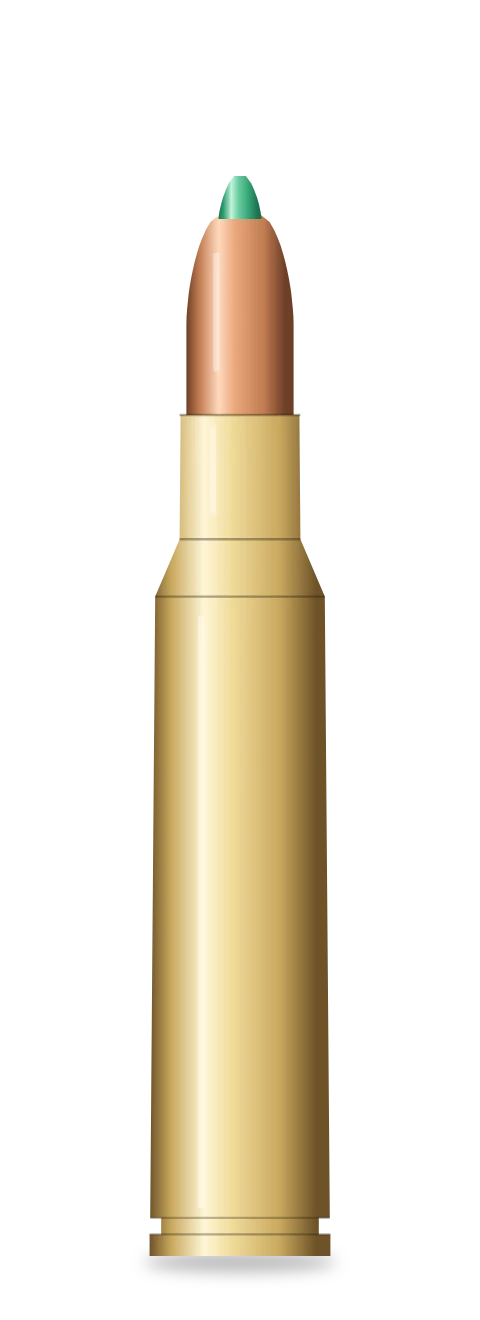
01 / At a glance
The basics
- Origin
- Belgium / NATO
- Introduced
- 1980
- Ignition
- Centerfire
- Case form
- Rimless, bottleneck
- Diameter
- 5.7 mm
- Case length
- 44.7 mm
Rounded values to help you identify the cartridge, not manufacturing drawings. See the cited standard for exact dimensions and tolerances.
Do not mix it up
5.56 NATO ammunition should not be fired in a rifle chambered only for .223 Remington. A .223 Remington round can be fired in a 5.56 NATO chamber. Check the marking on the barrel.
The 5.56x45mm NATO is a small-bore, high-velocity rifle cartridge that fires a .224 inch bullet, usually 55 to 77 grains, at about 2,700 to 3,200 ft/s. It is the standard rifle cartridge of NATO and the most common cartridge fired from AR-15 pattern rifles in the United States. It has light recoil, a flat path out to a few hundred yards and very wide availability.
This guide explains what the 5.56 NATO is, how it differs from the .223 Remington, how it performs out to 500 yards, how to choose ammunition and a rifle, and how it compares with the .300 AAC Blackout, the 7.62x39mm, the .22-250 Remington and others. It is a reference page, not a loading manual, and it contains no handloading data.
A short history
The 5.56 NATO descends from the .223 Remington, which Remington designed in the early 1960s for the AR-15 rifle. The military version of that rifle became the M16, and the cartridge became the standard round for American infantry.
NATO chose a second standard rifle cartridge after the 7.62x51mm NATO. FN Herstal in Belgium developed a new bullet and load in the late 1970s, and NATO tested candidates from 1977 to 1980. On 28 October 1980 it standardized the SS109 round under STANAG 4172. The United States calls its version the M855.
The SS109 bullet weighs 62 grains and has a steel penetrator in the nose. It is heavier than the earlier 55 grain M193 bullet, and it needs a faster rifling twist to stay stable. That change is the root of many of the differences between military and civilian ammunition and chambers.
Today the cartridge is used by NATO members and many other countries. In the United States the same case is sold to civilians in huge quantities, labeled either .223 Remington or 5.56x45mm NATO.
Why it is so common
The first reason is the rifle. The AR-15 pattern is the best-selling rifle design in the United States, and almost all of them are chambered in .223 Remington, 5.56 NATO or a hybrid chamber. That created a huge market for parts, accessories and training.
The second reason is recoil. A 5.56 rifle kicks very little. A new shooter can fire a long session without fatigue, and follow-up shots are fast. For training, that is a real advantage.
The third reason is supply. The cartridge is made in military and commercial plants around the world, and it is sold in nearly every store that sells ammunition. It is one of the most widely sold centerfire rifle cartridges in the country.
Specifications at a glance
| Specification | Value |
|---|---|
| Bullet diameter | .224 in (5.7 mm) |
| Case length | 1.760 in (44.7 mm) |
| Overall length | 2.260 in (57.4 mm) |
| Case type | Rimless, bottleneck |
| Primer | Small rifle |
| Maximum pressure (NATO EPVAT) | About 62,400 psi (430 MPa) |
| Maximum pressure (.223 Remington, SAAMI) | 55,000 psi |
| Typical bullet weights | 55 to 77 grains; 55 and 62 grains are the most common |
| Typical muzzle velocity | About 3,165 ft/s with a 55 grain bullet |
| Typical rifling twist | 1 in 7 to 1 in 12 inches |
Pressure figures from different standards use different measurement methods, so they cannot be compared directly. Exact dimensions and tolerances are in the standards cited at the end of this page.
5.56 NATO and .223 Remington
The two cartridges have the same case and bullet dimensions. The difference is mainly in the chamber and the pressure rating. A 5.56 NATO chamber has a longer leade, which is the distance from the case mouth to where the rifling starts. A .223 Remington chamber can have a shorter leade.
Because of this, 5.56 NATO ammunition should not be fired in a rifle chambered only for .223 Remington. The longer leade of the NATO chamber lowers peak pressure, and a short leade does not. A .223 Remington cartridge can be fired in a 5.56 NATO chamber, though accuracy may be a little lower.
Some rifles have a hybrid chamber, such as the .223 Wylde, that accepts both. If a rifle is marked 5.56 NATO, it is made for both. If it is marked only .223 Remington, use .223 ammunition. When in doubt, read the barrel marking and the manual.
Strengths and limits
The 5.56 NATO is a light, fast cartridge. It is excellent at what it is made for and limited outside that.
| Advantage | Limitation |
|---|---|
| Very light recoil and fast follow-up shots | Light bullets lose energy fast and drift in wind |
| Flat path out to 300 yards | Not a good choice for large game |
| Cheap, plentiful ammunition | Hunting rules for the caliber vary by state |
| Huge range of rifles and accessories | Military and civilian chambers can be confused |
It is a very good cartridge for varmints, predators and target work. It can be used on small deer in places where the law allows, but a larger cartridge is a better choice for deer. Always check your state rules before you hunt with it.
Barrel length and velocity
Barrel length changes velocity. A 20 inch barrel gives the speeds that ammunition makers publish. A 16 inch carbine gives somewhat less, and a very short barrel gives much less. The loss also changes how a bullet performs at long range.
Ballistics
The tables and charts below show one common factory load, a 55 grain FMJ boat-tail bullet at 3,165 ft/s, with the rifle zeroed at 100 yards. A 100-yard zero is common for AR-15 pattern rifles.
| Range (yd) | Velocity (ft/s) | Energy (ft-lb) | Drop (in) | Wind drift, 10 mph (in) |
|---|---|---|---|---|
| 100 | 2772 | 939 | 0 | 1.1 |
| 200 | 2412 | 710 | -3.1 | 4.9 |
| 300 | 2080 | 528 | -12.1 | 11.8 |
| 400 | 1776 | 385 | -29.3 | 22.6 |
| 500 | 1506 | 277 | -57.6 | 38.2 |
Reading the numbers
With a 100-yard zero the bullet falls about 3 inches at 200 yards, 12 at 300, 29 at 400 and 58 at 500. A 10 mph crosswind moves it about 5 inches at 200 yards, 12 at 300, 23 at 400 and 38 at 500. Velocity drops from 3,165 ft/s at the muzzle to about 1,500 ft/s at 500 yards, and energy from about 1,220 to about 280 foot-pounds.
The light bullet sheds speed quickly. Inside 300 yards the cartridge is accurate and flat, and past that the drop and wind drift grow fast. Heavier, higher-ballistic-coefficient bullets of 69 to 77 grains do better at long range, and they need a faster twist.
How these figures were made: the muzzle velocity (3,165 ft/s), weight (55 grains) and the published velocities at 100 to 500 yards (2,772, 2,412, 2,080, 1,776 and 1,506 ft/s) are Federal figures for its American Eagle 5.56x45mm 55 grain FMJ boat-tail load. The ballistic coefficient (G1 0.250) was fitted to match those published velocities. Drop, velocity, energy and wind drift are computed with a standard point-mass model, a 100-yard zero, a 1.5 inch sight height and standard atmosphere. They are estimates. Different bullets and barrel lengths change the results.
Recoil and shooter comfort
Recoil is very light. A 6 to 8 pound AR-15 pattern rifle pushes back gently, and the muzzle rises little. Children and new shooters can learn on it, and adults can shoot it all day. The report is sharp in a short barrel, so hearing protection matters.
Light recoil lets a shooter see the bullet strike and fire again quickly. That is why the cartridge is used so widely for training and for competition that rewards speed.
How to choose ammunition
Choose by purpose first, then by weight. Pay attention to the marking on the box and the rifle chamber.
| Bullet type | Best for | Notes |
|---|---|---|
| FMJ boat-tail, 55 grains (M193 type) | Practice and plinking | The cheapest and most common load |
| FMJ with steel penetrator, 62 grains (M855 type) | Practice and training | Needs a faster twist; some ranges do not allow steel-core ammunition |
| Soft point or hollow point, 55 to 62 grains | Varmints and small game | Expands on impact |
| Polymer tip, 55 to 60 grains | Varmints at longer range | Fast expansion and a flat path |
| Match hollow point, 69 to 77 grains | Target and long-range shooting | High ballistic coefficient; needs a 1 in 7 or 1 in 8 twist |
Check the twist
A slow twist, such as 1 in 12, stabilizes light bullets of 55 grains or less. A 1 in 9 twist stabilizes bullets up to about 65 grains. A fast twist, such as 1 in 7, stabilizes 77 grain bullets and long match bullets. Choose a bullet weight that suits your barrel.
Steel-case and range rules
Some ranges ban steel-core and steel-case ammunition, because steel can start fires and damage targets. Check the range rules before you buy ammunition in bulk.
How to choose a rifle
The right rifle depends on how you will use it. These are the points that matter most.
- Chambering. A rifle marked 5.56 NATO or .223 Wylde is the safe choice. Do not buy a rifle chambered only for .223 Remington if you plan to shoot 5.56 ammunition.
- Barrel length. 16 inches is the usual carbine length and handles well. 18 to 20 inches gives more velocity. A longer barrel suits target work.
- Twist rate. A 1 in 7 or 1 in 8 twist handles the widest range of bullets. A 1 in 12 twist suits only light bullets.
- Weight. A light rifle of 6 to 7 pounds is easy to carry. A heavier rifle is steadier on the bench.
- Optic. A red dot or a low-power variable scope of 1-6x suits most uses. A magnified scope of 4-16x suits varmint and target work.
- Quality. An AR-15 is a platform with many makers. Choose a maker with a good record and keep to standard parts.
Zeroing and practice
A 100-yard zero is the most common and the easiest to check. A 50 and 200 yard zero is popular on carbines. It puts the bullet on target at both distances, with only a small rise in between. Choose one and learn your own numbers.
Practice from field positions, and shoot at the distances you expect to use. A rifle that groups well at the bench but is never fired from a sling or a rest gives false confidence. Confirm your zero with the ammunition you plan to use, and check it again when you change loads.
Practical uses
Target shooting and training
This is the main use. The light recoil and low cost make it a good choice for practice, and it is used in many competitions.
Varmints and predators
With a soft point or polymer-tip bullet it is effective on prairie dogs, coyotes and fox to a few hundred yards. Matching the bullet to the twist matters for accuracy.
Home defense
Many people keep an AR-15 for home defense. The light recoil allows fast, accurate shooting, but the bullet can pass through walls, so the choice of load and the surroundings matter.
Small deer and hogs
It is used for these where the law allows it, with a bullet made for hunting and a careful shot. A larger cartridge is a better choice.
Plinking
It is fun to shoot, but ammunition costs more than for rimfire cartridges.
5.56 NATO vs similar cartridges
The table lists the cartridges most often compared with the 5.56 NATO. Figures are rounded, and pressures are from the standards named in each row.
| Cartridge | Bullet diameter | Case length | Max pressure | Typical use |
|---|---|---|---|---|
| 5.56x45mm NATO | .224 in | 1.760 in | 62,400 psi (NATO EPVAT) | Military, AR-15 rifles, varmints |
| .223 Remington | .224 in | 1.760 in | 55,000 psi (SAAMI) | Varmints, target, general use |
| .300 AAC Blackout | .308 in | 1.368 in | 55,000 psi | Short carbines and suppressed rifles |
| 7.62x39mm | .311 in | 1.524 in | 45,010 psi (SAAMI) | AK pattern rifles and deer at short range |
| .22-250 Remington | .224 in | 1.912 in | 65,000 psi | Varmints and predators |
Against the .223 Remington, the case is the same, and the chamber and pressure rating differ. Against the .300 AAC Blackout, it is faster and flatter with a lighter bullet. Against the 7.62x39, it has a flatter path and less recoil, and a lighter bullet. Against the .22-250 Remington, it is slower and kicks less.
Care and storage
Clean the bore, the chamber and the bolt carrier group after each session. A gas-operated rifle collects carbon in the action, and a light oil on the moving parts keeps it running. Check the screws and the optic mounts from time to time. Store the rifle unloaded in a dry place. Keep firearms and ammunition locked and out of reach of children and unauthorized users.
Safety and common mistakes
- Do not fire 5.56 NATO ammunition in a rifle chambered only for .223 Remington. Read the marking on the barrel.
- Treat every firearm as loaded. Keep your finger off the trigger until your sights are on the target.
- Know your target and what is beyond it. A rifle bullet can travel more than a mile.
- Check that the bore is clear before shooting.
- Wear eye and ear protection at the range.
- Follow range rules on steel-core and steel-case ammunition.
- If you reload, use only published data from a current manual and start low. This page does not contain loading data.
- Store firearms unloaded and locked, and keep the ammunition apart.
Frequently asked questions
What is the difference between 5.56 NATO and .223 Remington?
The cases and bullets are the same size. The 5.56 NATO chamber has a longer leade and a higher pressure rating. Do not fire 5.56 ammunition in a rifle marked only .223 Remington.
Can I fire .223 Remington in a 5.56 NATO rifle?
Yes. A 5.56 NATO chamber accepts .223 Remington ammunition. Accuracy may be a little lower.
What does 5.56x45mm mean?
It is the bullet diameter in millimeters and the case length in millimeters. The bullet is 5.56 mm (.224 inch) in diameter and the case is 45 mm (1.76 inches) long.
Is the 5.56 good for deer?
It is used on small deer where the law allows it, with a bullet made for hunting and a careful shot. Many states set a minimum caliber or energy, so check your rules. A larger cartridge is a better choice.
How far can a 5.56 shoot?
It is accurate and flat inside 300 yards. Past 400 yards the drop, the wind drift and the energy loss grow fast with a light bullet.
What twist rate do I need?
A 1 in 7 or 1 in 8 twist handles the widest range of bullets. A 1 in 9 twist suits bullets up to about 65 grains. A 1 in 12 twist suits only light bullets.
What is M855 ammunition?
It is the United States military version of the 62 grain SS109 bullet. It has a steel penetrator in the nose. Some ranges do not allow it.
Can I reload 5.56 NATO brass?
Yes, but military brass often has thicker walls and a crimped primer, so it needs extra care. Use only published data from a current loading manual and follow its safety instructions.
Sources
Sources reviewed · 29 October 2026