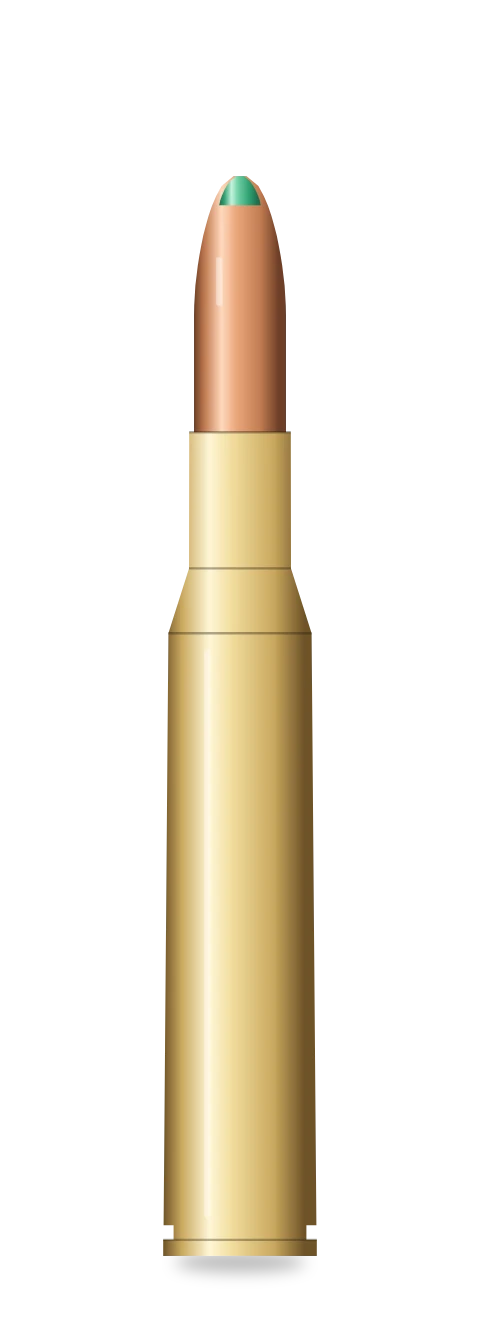
01 / At a glance
The basics
- Origin
- United States
- Introduced
- 1957
- Ignition
- Centerfire
- Case form
- Rimless, bottleneck
- Diameter
- 7.2 mm
- Case length
- 64.5 mm
Rounded values to help you identify the cartridge, not manufacturing drawings. See the cited standard for exact dimensions and tolerances.
Do not mix it up
Do not confuse it with the .280 Ackley Improved, which is a different cartridge with its own chamber. Read the barrel marking and the headstamp.
The .280 Remington is a 7mm (.284 inch) rifle cartridge built on the .30-06 Springfield case, necked down to hold a 7mm bullet. Remington introduced it in 1957. It has the same case length as the .270 Winchester and a heavier, higher-BC bullet, and it has lived for decades in the shadow of both the .270 and the 7mm Remington Magnum.
This guide explains what the .280 Remington is, how it performs out to 500 yards, how to choose ammunition and a rifle, and how it compares with the .270 Winchester, the 7mm-08 Remington, the .30-06 Springfield and the 7mm Remington Magnum. It is a reference page, not a loading manual, and it contains no loading data.
A short history
Remington introduced the cartridge in 1957, together with its Models 740, 760, 721 and 725 rifles. It is a .30-06 Springfield case necked down to .284 inch, with a case length of 2.540 inches and a maximum overall length of 3.330 inches.
The name is the odd part of the story. In late 1978 Remington renamed the cartridge 7mm-06 Remington, and shortly after that 7mm Express, in an attempt to boost sales. The new name was confused with the 7mm Remington Magnum, and Remington went back to .280 Remington in 1981. That muddle cost the cartridge momentum, and it has never reached the sales of the .270 Winchester or the .30-06.
It helps to place it beside its closest relative. The .270 Winchester uses the same case length of 2.540 inches and a .277 inch bullet, while the .280 Remington uses a .284 inch bullet. The difference is a few hundredths of an inch, but it opens a very large range of 7mm bullets, from light varmint-weight projectiles to long, heavy bullets for elk.
It has kept a loyal following. The Ruger M77 was chambered for it, and gun writer Jack O'Connor's last rifle was a restocked Ruger M77 in .280 Remington. Hornady discusses the cartridge together with the .280 Ackley Improved, a popular wildcat, and the two are often compared.
Why people shoot it
The first reason is the bullet. A 7mm bullet of a given weight is longer and slimmer than a .30 caliber bullet, so it keeps its speed and resists wind better. A 139 grain SST has a G1 ballistic coefficient of 0.486 and a sectional density of 0.246, which is a good combination for deer, pronghorn and elk.
The second reason is the balance. The .280 Remington uses a full-length case and runs at a moderate 60,000 psi. A 140 grain bullet leaves at about 2,840 ft/s in standard loads and a 154 grain bullet at about 2,825 ft/s, while hot factory loads push a 139 grain bullet to about 3,090 ft/s. That is a flat-shooting cartridge without the recoil and blast of a magnum.
The third reason is the rifle. Because it fits a standard .30-06 length action, the cartridge works in the same rifles as the .270 Winchester and the .30-06. A hunter who likes the .270 but wants a heavier bullet has a natural alternative here.
Sectional density shows the range of the cartridge. A 120 grain bullet in .284 inch has a sectional density of about 0.212, and a 175 grain bullet about 0.310. The heavy end of that range is the choice for elk, since a long, heavy bullet keeps its path and penetrates deeply.
Specifications at a glance
| Specification | Value |
|---|---|
| Bullet diameter | .284 in (7.2 mm) |
| Case length | 2.540 in (64.5 mm) |
| Overall length | 3.330 in (84.6 mm) |
| Case type | Rimless, bottleneck |
| Parent case | .30-06 Springfield, necked down |
| Maximum average pressure (SAAMI) | 60,000 psi |
| Maximum pressure (C.I.P.) | 58,740 psi |
| Typical bullet weights | 120 to 175 grains |
| Typical muzzle velocity | About 3,110 ft/s with 120 grains to 2,680 ft/s with 175 grains |
Values are rounded for reference. Velocities are typical factory or test figures and vary by load and barrel length.
Strengths and limits
The .280 Remington is a versatile hunting cartridge. These are the trade-offs to understand.
| Strength | Limit |
|---|---|
| Flat trajectory and good wind resistance with 7mm bullets | Fewer rifles and fewer ammunition choices than the .270 or .30-06 |
| Moderate recoil for the energy delivered | Name history confused buyers, and some stores stock little |
| Fits standard .30-06 length actions | Not a long-range match cartridge by modern standards |
| Wide choice of 7mm bullets | Can be mistaken for the .280 Ackley Improved |
Honest advice: the .270 Winchester is easier to buy ammunition for, and the 7mm-08 Remington gives similar bullet performance in a shorter, lighter rifle. The .280 Remington makes sense if you want a 7mm in a standard action, if you already own a rifle for it, or if you reload and enjoy its range of bullets.
Bullet and ammunition choice
Factory loads range from 120 grains to 175 grains. Lighter bullets at 3,100 ft/s suit pronghorn and varmint-sized game, and 150 to 175 grain bullets suit elk and larger deer. Choose a bullet made for the range and the game.
Ballistics
The table and charts below show one factory load, a Hornady Superformance 139 grain SST at 3,090 ft/s, with the rifle zeroed at 200 yards.
| Range (yd) | Velocity (ft/s) | Energy (ft-lb) | Drop (in) | Wind drift, 10 mph (in) |
|---|---|---|---|---|
| 100 | 2887 | 2572 | 1.3 | 0.6 |
| 200 | 2693 | 2238 | 0 | 2.4 |
| 300 | 2507 | 1940 | -6.1 | 5.7 |
| 400 | 2329 | 1674 | -17.8 | 10.4 |
| 500 | 2158 | 1437 | -35.9 | 16.9 |
Reading the numbers
With a 200 yard zero the bullet rises about 1 inch above the line of sight at 100 yards, returns to the line at 200 and falls about 6 inches at 300, 18 at 400 and 36 at 500. A 10 mph crosswind moves it about 6 inches at 300 yards, 10 at 400 and 17 at 500. Velocity drops from 3,090 ft/s at the muzzle to about 2,160 ft/s at 500 yards, and energy from about 2,950 to about 1,440 foot-pounds.
The trajectory is flat, and the bullet keeps more than 1,400 foot-pounds at 500 yards, which is enough for deer-size game with a bullet that expands at that speed. For elk, consider a heavier bullet and a shorter shot.
How these figures were made: the muzzle velocity (3,090 ft/s), the weight (139 grains) and the G1 ballistic coefficient (0.486) are Hornady figures for its Superformance 139 grain SST load, as listed by a retailer. The barrel length is not stated on that page. Drop, velocity, energy and wind drift are calculated with a standard point-mass model, a 200 yard zero, a sight height of 1.5 inches and standard atmosphere. They are estimates. Your rifle and conditions will differ.
Recoil and shooter comfort
Recoil is moderate. In a rifle of 7 to 8 pounds the .280 Remington kicks about like a .270 Winchester or a .30-06, and well below a magnum. Most adults shoot it well with a proper stock fit.
A new shooter will learn faster on a lighter cartridge such as the 7mm-08 or 6.5 Creedmoor. Use good hearing protection, and consider both plugs and muffs on the range. A muzzle brake cuts recoil while raising the noise for everyone nearby.
Rifle weight and stock fit matter as much as the cartridge. A good recoil pad, a properly fitted stock and a steady shooting position cut the felt kick more than any change of load. Shoot a few rounds at a time, and stop when you start to flinch.
How to choose ammunition
Match the bullet to the game and the distance, and test the load in your own rifle.
| Load | Muzzle velocity | Best for | Notes |
|---|---|---|---|
| 120 grain soft point | About 3,110 ft/s | Pronghorn and light deer loads | Flat shooting, lighter bullet |
| 139 grain SST Superformance | About 3,090 ft/s | Deer and pronghorn | Polymer-tip bullet, high BC |
| 140 grain | About 2,840 ft/s | All-round hunting | Standard velocity |
| 154 grain soft point | About 2,825 ft/s | Deer and elk | Heavier bullet |
| 175 grain soft point | About 2,680 ft/s | Elk | Deep penetration |
For hunting, choose a bullet made to expand reliably at the speeds the cartridge produces. For practice, a cheaper soft point or full metal jacket works. Try more than one load, since a rifle often prefers one.
Check the headstamp and the rifle
Do not confuse .280 Remington ammunition with .280 Ackley Improved ammunition, or with 7mm Remington Magnum or 7x57mm Mauser ammunition. Always read the barrel marking and the headstamp.
Cost and supply
The cartridge is less common than the .270 Winchester or the .30-06, so factory choices are fewer and stores stock less. Reloading helps, since 7mm bullets and brass are easy to find.
How to choose a rifle
The right rifle depends on how you hunt. These are the points that matter most.
- Chambering. Buy a rifle made for the .280 Remington, not for the .280 Ackley Improved.
- Action length. A standard action, long enough for the .30-06 family, is needed.
- Barrel length. 22 to 24 inches is common. Longer barrels give more velocity.
- Weight. A lighter rifle is easier to carry in the mountains and kicks harder. A heavier rifle is steadier.
- Trigger. A clean, crisp trigger improves accuracy at long range.
- Optic. A good variable-power scope with reliable adjustments suits the cartridge.
- Models. Choice is narrower than for the .270 Winchester, so check current catalogs and the used market.
Several makers have offered bolt-action rifles in .280 Remington, and the Ruger M77 and the old Remington Models 740, 760, 721 and 725 are known examples. Check that a used rifle is in good condition and that it is marked for the cartridge.
Zeroing and range practice
A 200 yard zero is a good starting point for hunting. With a 139 grain SST the bullet stays within about 1.5 inches of the line of sight out to 150 yards and drops about 6 inches at 300 yards. That lets you hold on the vital area out to about 300 yards.
Zero at 100 yards on paper first, then confirm at 200. Shoot at 300, 400 and 500 to learn your own drops, and write them on a card. The numbers in this guide are estimates from a model, and your barrel, load and air density will move them. Wind is the main problem past 400 yards, so practice judging it.
Shoot from field positions as well as a bench. Practice at the distances you plan to take.
Beyond 300 yards, either hold over by the amount in your drop card or use a scope with a ballistic reticle or turrets. Test the correction at the range before you trust it in the field, and record the temperature and altitude, since both change the drop. Treat any figure for shots past 400 yards as a guide and not a promise.
Practical uses
Deer
The .280 Remington is a fine deer cartridge. It shoots flat, hits hard and is easy to carry in a standard rifle.
Pronghorn and open-country hunting
Light, fast bullets suit long shots across open ground, and the flat trajectory helps when you must judge range.
Elk
With a 154 to 175 grain bullet built for penetration, it works on elk at moderate range. Many hunters prefer a larger cartridge. Check local rules.
Mountain hunting
A light rifle in this cartridge is a good mountain tool. It gives a flat trajectory without the weight of a magnum rifle.
.280 Remington vs similar cartridges
The table compares the .280 Remington with the cartridges it is usually weighed against. Figures are rounded and use SAAMI pressures.
| Cartridge | Bullet diameter | Case length | Max pressure | Typical use |
|---|---|---|---|---|
| .280 Remington | .284 in | 2.540 in | 60,000 psi | All-round big game |
| .270 Winchester | .277 in | 2.540 in | 65,000 psi | Deer, pronghorn and elk |
| 7mm-08 Remington | .284 in | 2.035 in | 61,000 psi | All-round deer and pronghorn |
| .30-06 Springfield | .308 in | 2.494 in | 60,000 psi | All-round big game |
| 7mm Remington Magnum | .284 in | 2.500 in | 61,000 psi | Long-range big game |
Against the .270 Winchester, the .280 uses a heavier, larger bullet at similar speed, but the .270 is easier to buy. Against the 7mm-08, it has more case capacity and more speed with the same bullet. Against the .30-06, it offers a flatter path and less recoil. Against the 7mm Remington Magnum, it is gentler and slower.
Care and storage
Clean the bore after a day of shooting, and follow the barrel maker's advice on copper and carbon. Inspect the action and the scope mounts for tightness. Store the rifle unloaded and locked, with the ammunition separate and away from children.
Safety and common mistakes
- Do not confuse the .280 Remington with the .280 Ackley Improved or the 7mm Remington Magnum. Read the barrel marking and the headstamp.
- Treat every rifle as loaded. Keep your finger off the trigger until the sights are on the target.
- Know your target and what lies beyond it. A rifle bullet can travel several miles.
- Wear eye and ear protection.
- Check the bore for obstructions before you load.
- Do not take shots beyond the range at which you can place bullets reliably.
- If you reload, use only published data from a current manual and start low. This page does not contain loading data.
- Store firearms and ammunition locked and apart, away from children.
Frequently asked questions
What is the .280 Remington?
It is a 7mm (.284 inch) rifle cartridge from Remington, introduced in 1957 and based on the .30-06 Springfield case.
What is the maximum pressure of the .280 Remington?
The SAAMI maximum average pressure is 60,000 psi, and the C.I.P. figure is 58,740 psi.
Why was the .280 Remington renamed?
Remington renamed it 7mm-06 Remington in late 1978, then 7mm Express shortly after, to try to boost sales. The name was confused with the 7mm Remington Magnum, and Remington went back to .280 Remington in 1981.
How fast is the .280 Remington?
A 140 grain bullet leaves at about 2,840 ft/s, a 154 grain bullet at about 2,825 ft/s, and a Hornady Superformance 139 grain SST at about 3,090 ft/s.
Is the .280 Remington the same as the .280 Ackley Improved?
No. The Ackley Improved is a different cartridge with its own chamber. Read the barrel marking and the headstamp.
Is the .280 Remington better than the .270 Winchester?
It is similar in use. The .280 shoots a heavier, larger bullet, and the .270 is easier to buy and has more rifles.
Is the .280 Remington good for elk?
It works with a 154 to 175 grain bullet built for penetration at moderate range. Many hunters prefer a larger cartridge, and local rules may set minimums.
Can I reload the .280 Remington?
Yes. Brass, 7mm bullets, powder and primers are available. Use only published data from a current manual.
Sources
Sources reviewed · 29 October 2026