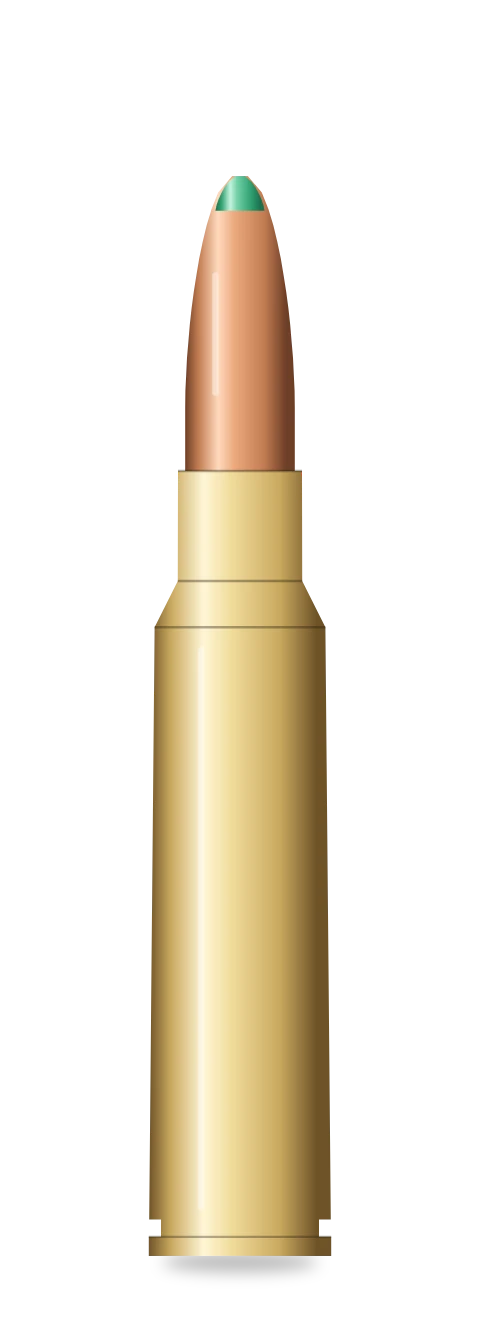
01 / At a glance
The basics
- Origin
- United States
- Introduced
- 1980
- Ignition
- Centerfire
- Case form
- Rimless, bottleneck
- Diameter
- 7.2 mm
- Case length
- 51.7 mm
Rounded values to help you identify the cartridge, not manufacturing drawings. See the cited standard for exact dimensions and tolerances.
Do not mix it up
The 7mm-08 Remington is not the same as the 7mm Remington Magnum. The cartridges are not interchangeable. Check the marking on the barrel.
The 7mm-08 Remington is a medium-bore rifle cartridge that fires a .284 inch bullet, usually 120 to 160 grains, at about 2,700 to 3,000 ft/s. It is the .308 Winchester case necked down to hold a 7mm bullet. The result is a cartridge with mild to moderate recoil, a flat path, and enough power for deer, pronghorn and larger game at sensible range.
This guide explains what the 7mm-08 is, how it performs out to 500 yards, how to choose ammunition and a rifle, and how it compares with the .308 Winchester, the .243 Winchester, the 6.5 Creedmoor, the .270 Winchester and the 7mm Remington Magnum. It is a reference page, not a loading manual, and it contains no handloading data.
A short history
The idea of necking the .308 Winchester case down to 7mm is older than the factory cartridge. Hunters and silhouette shooters had made the wildcat 7mm-08 for years, and its reputation was good. Remington standardized it in 1980 and chambered it in the Model 700.
The sales were slow at first. Hunters already had the .270 Winchester and the .30-06, and many saw no reason to change. Over time, as light rifles and lower recoil became more important, the 7mm-08 built a loyal following. It became a favorite for youth and women hunters, and for anyone who wanted a light rifle that was pleasant to shoot.
In the 2000s it gained attention again with the success of short-action cartridges, and it is now offered by nearly every rifle maker. It sits between the .243 Winchester and the .308 Winchester in recoil, and it is one of the best all-round deer cartridges in a short action.
Why it is popular
The first reason is the bullet. A 7mm bullet has a high ballistic coefficient for its weight, which means it keeps its speed and resists wind better than a .308 bullet of similar weight. A 140 grain 7mm bullet shoots flatter than a 150 grain .308 bullet and carries more energy downrange.
The second reason is recoil. The 7mm-08 kicks noticeably less than a .308 Winchester or a .30-06, and a light rifle is comfortable. Many shooters report that they shoot better with it, and that matters more than a small gain in power.
There is also a practical point about bullets. The 7mm bore has a wide range of bullets, from light 120 grain varmint and antelope loads to long 175 grain hunting bullets, and almost every maker offers several in .284 inch. A hunter can match the bullet to the animal without changing rifles.
The third reason is the short action. The case is the same length as the .308 Winchester, so a short, light, stiff action works. Rifles chambered for it are easy to carry, and brass is simple to make from .308 cases.
Specifications at a glance
| Specification | Value |
|---|---|
| Bullet diameter | .284 in (7.2 mm) |
| Case length | 2.035 in (51.7 mm) |
| Overall length (SAAMI) | 2.800 in (71.1 mm) |
| Case type | Rimless, bottleneck |
| Primer | Large rifle |
| Maximum average pressure (SAAMI) | 61,000 psi |
| Typical bullet weights | 120 to 175 grains; 139 to 150 grains are the most common |
| Typical muzzle velocity | About 2,860 ft/s with a 139 grain bullet |
| Typical rifling twist | 1 in 9.5 to 1 in 10 inches |
Values are rounded for reference. Exact dimensions and tolerances are in the SAAMI standard cited at the end of this page.
Strengths and limits
The 7mm-08 is a balanced cartridge. It does many things well and nothing at the extreme.
| Advantage | Limitation |
|---|---|
| Mild recoil in a light rifle | Less energy than a .30-06 or a magnum at long range |
| Flat path and good wind resistance | Fewer factory loads than the .308 Winchester or the .270 Winchester |
| Short, light, stiff action | Not the first choice for the largest game |
| Accurate with many bullets | Rifles in 7mm-08 can be harder to find in some stores |
For deer, pronghorn, sheep and black bear out to 400 yards, it is more than enough. For elk it works with a heavy, well-built bullet and a careful shot. For the largest game, a larger cartridge is a better tool.
Its main limit is practical rather than ballistic. Factory ammunition is easy to find, but store shelves usually carry fewer 7mm-08 boxes than .308 Winchester or .270 Winchester, so many owners buy a few boxes of a load that shoots well and stock up.
Relationship to the .308 Winchester
The two share a case, so a rifle built on the .308 action is also a 7mm-08 action. The 7mm-08 has the smaller bullet, a bit more speed with light bullets and much better ballistic coefficient. The .308 is cheaper and has more bullet choices, especially in heavy weights.
Ballistics
The tables and charts below show one common modern factory load, a 139 grain SST bullet at 2,860 ft/s, with the rifle zeroed at 200 yards.
| Range (yd) | Velocity (ft/s) | Energy (ft-lb) | Drop (in) | Wind drift, 10 mph (in) |
|---|---|---|---|---|
| 100 | 2659 | 2182 | 1.7 | 0.7 |
| 200 | 2467 | 1878 | 0 | 2.8 |
| 300 | 2283 | 1609 | -7.4 | 6.6 |
| 400 | 2107 | 1370 | -21.6 | 12.2 |
| 500 | 1939 | 1160 | -43.5 | 19.9 |
Reading the numbers
With a 200-yard zero the bullet rises about 2 inches above the line of sight at 100 yards, returns to the line at 200 and falls about 7 inches at 300, 22 at 400 and 44 at 500. A 10 mph crosswind moves it about 7 inches at 300 yards, 12 at 400 and 20 at 500. Velocity drops from 2,860 ft/s at the muzzle to about 1,940 ft/s at 500 yards, and energy from about 2,520 to about 1,160 foot-pounds.
Most hunters will keep shots inside 400 yards, where the bullet still carries more than 1,300 foot-pounds. That is enough for deer-sized game. Past 400 yards the drop and the wind drift grow quickly, and range estimation and practice matter more than the cartridge.
How these figures were made: the muzzle velocity (2,860 ft/s), weight (139 grains) and the published velocities at 100 to 500 yards (2,639, 2,456, 2,280, 2,112 and 1,951 ft/s) are Hornady figures for its American Whitetail 139 grain SST load. The ballistic coefficient (G1 0.466) was fitted to match those published velocities, and the computed velocities are within about 20 ft/s of them. Drop, velocity, energy and wind drift are computed with a standard point-mass model, a 200-yard zero, a 1.5 inch sight height and standard atmosphere. They are estimates. Different bullets and barrel lengths change the results.
Recoil and shooter comfort
Recoil is moderate and manageable. In a 7 to 8 pound rifle, the 7mm-08 gives a firm push, less than the .308 Winchester and clearly less than the .30-06. It is a little more than a .243 Winchester. Most adults shoot it well, and many young shooters can with a good stock fit and a recoil pad.
A muzzle brake cuts recoil and increases noise. It is rarely needed on this cartridge. Good form, a good stock fit and hearing protection matter more.
How to choose ammunition
Choose by purpose first, then by weight. The market has a wide range of 7mm-08 loads.
| Bullet type | Best for | Notes |
|---|---|---|
| Cup-and-core soft point, 139 to 150 grains | Deer and pronghorn | Reliable and economical |
| Bonded or partition, 140 to 160 grains | Elk, black bear and tough game | Deeper penetration |
| Polymer tip, 139 to 154 grains | Deer at longer range | Flatter path and fast expansion |
| Copper solid, 120 to 140 grains | Areas that require non-lead ammunition | Deep penetration; check expansion at low speed |
| Match boat-tail, 140 to 162 grains | Target shooting and long range | High ballistic coefficient |
Bullet weight
A 139 to 150 grain bullet is the best all-round choice for deer. A 120 to 130 grain bullet is faster and flatter, and suits pronghorn and varmints. A 154 to 175 grain bullet is slower, penetrates deeper, and suits elk and black bear.
Factory loads are sold for most purposes, from budget soft points to premium bonded bullets. If you plan to hunt larger animals, buy a load built for deep penetration, and test it on paper before the season.
Do not mix cartridges
A 7mm-08 has the same case length and a similar shoulder as the .308 Winchester, but the neck is smaller. Never load a 7mm-08 in a .308 chamber, or a .308 in a 7mm-08 chamber. Read the marking on the barrel.
How to choose a rifle
The right rifle depends on how you hunt. These are the points that matter most.
- Action. Bolt-action rifles dominate and are the most accurate for the price. Short-action single-shots and some semi-autos are also made.
- Weight. A light rifle of 6.5 to 7.5 pounds is easy to carry. A heavier rifle is steadier and kicks less.
- Barrel length. 20 to 24 inches is usual. A shorter barrel is handy and loses some velocity.
- Twist rate. A 1 in 9.5 or 1 in 10 twist stabilizes most bullets, including long, heavy ones.
- Optic. A variable scope of 3-9x or 4-12x is a good fit. Choose a clear one and mount it solidly.
- Fit. Try the length of pull before you buy. A rifle that fits shoots better.
Zeroing and practice
A 200-yard zero suits most hunting. It keeps the bullet within about 3 inches of the line of sight out to 250 yards, and it gives a drop of about 7 inches at 300. A 100-yard zero is simpler to check and easier on a short range. In that case the bullet falls about 3 inches at 200 and 12 at 300.
Practice at the distances you expect to hunt, from field positions. A rifle that groups well at the bench but is never fired from a rest in the field gives false confidence. Confirm your zero with the load you hunt with, and check it again when you change loads.
Practical uses
Deer and pronghorn
This is the core use. The 7mm-08 is a proven cartridge for whitetail, mule deer and pronghorn, with flat flight and enough energy at 400 yards.
Black bear, sheep and goat
It works well with a bonded or partition bullet and a good shot. The light rifle is a benefit in steep country.
Elk
It can be used with a heavy, tough bullet of 150 to 175 grains and a shot inside 300 yards with careful placement. A larger cartridge gives more margin.
Target and silhouette
The cartridge began as a silhouette round, and it is accurate. It is also a pleasant rifle for the range, with modest recoil.
Youth and recoil-sensitive hunters
With a reduced-recoil load and a good stock fit, it is a rifle a young hunter can grow into. It is a step up from the .243 Winchester for larger game.
7mm-08 Remington vs similar cartridges
The table lists the cartridges most often compared with the 7mm-08 Remington. Figures are rounded and use SAAMI maximum average pressures.
| Cartridge | Bullet diameter | Case length | Max pressure | Typical use |
|---|---|---|---|---|
| 7mm-08 Remington | .284 in | 2.035 in | 61,000 psi | All-round deer and pronghorn |
| .243 Winchester | .243 in | 2.045 in | 60,000 psi | Deer and varmints |
| 6.5 Creedmoor | .264 in | 1.920 in | 62,000 psi | Target and hunting |
| .308 Winchester | .308 in | 2.015 in | 62,000 psi | Hunting and target |
| .270 Winchester | .277 in | 2.540 in | 65,000 psi | Deer and elk at range |
| 7mm Remington Magnum | .284 in | 2.500 in | 61,000 psi | Long-range big game |
Against the .243 Winchester, the 7mm-08 has a heavier bullet and more energy, with a little more recoil. Against the 6.5 Creedmoor, the two are close in recoil and flight, and the 6.5 has more match bullets while the 7mm-08 has a larger bullet. Against the .308 Winchester, it shoots flatter with less recoil. Against the .270 Winchester, it is shorter and gentler and gives up some velocity. Against the 7mm Remington Magnum, it is much milder and lighter.
Care and storage
Clean the bore after each session and after a hunt in wet weather. Wipe the bolt, the chamber and the action, and use a light oil. Check the scope mounts and the stock screws from time to time. Store the rifle unloaded in a dry place, with a light film of oil on the metal. Keep firearms and ammunition locked and out of reach of children and unauthorized users.
Safety and common mistakes
- Do not confuse the 7mm-08 Remington with the .308 Winchester, the 7mm Remington Magnum or the 7x57 Mauser. Read the marking on the barrel and the headstamp before loading.
- Treat every firearm as loaded. Keep your finger off the trigger until your sights are on the target.
- Know your target and what is beyond it. A rifle bullet can travel more than a mile.
- Check that the bore is clear before shooting.
- Wear eye and ear protection at the range.
- Do not shoot at game beyond the range where you can place the bullet with confidence.
- If you reload, use only published data from a current manual and start low. This page does not contain loading data.
- Store firearms unloaded and locked, and keep the ammunition apart.
Frequently asked questions
Is the 7mm-08 good for deer?
Yes. It is one of the best all-round deer cartridges, with a flat path, mild recoil and enough energy at 400 yards.
Is the 7mm-08 good for elk?
It can be, with a heavy, well-built bullet and a shot inside 300 yards. A larger cartridge gives more margin.
How much recoil does the 7mm-08 have?
Moderate. It is less than the .308 Winchester and the .30-06, and a little more than the .243 Winchester.
What is the difference between the 7mm-08 and the .308?
They share a case. The 7mm-08 is necked down to a 7mm bullet, which shoots flatter, resists wind better and kicks less. The .308 is cheaper and has more bullet choices.
7mm-08 or 6.5 Creedmoor?
They are close. The 6.5 Creedmoor has more match bullets and factory loads. The 7mm-08 has a larger bullet and a longer history among hunters. Either works for deer.
What bullet weight is best?
A 139 to 150 grain bullet is the best all-round choice for deer. Use 154 to 175 grains for elk and tough game.
How far can I shoot with a 7mm-08?
Most hunters limit shots to 400 yards or less. The bullet still carries more than 1,300 foot-pounds at 400 yards with the load in this guide.
Can I reload 7mm-08 Remington?
Yes. The brass is widely reloaded and can be made from .308 Winchester cases. Use only published data from a current loading manual and follow its safety instructions.
Sources
Sources reviewed · 29 October 2026