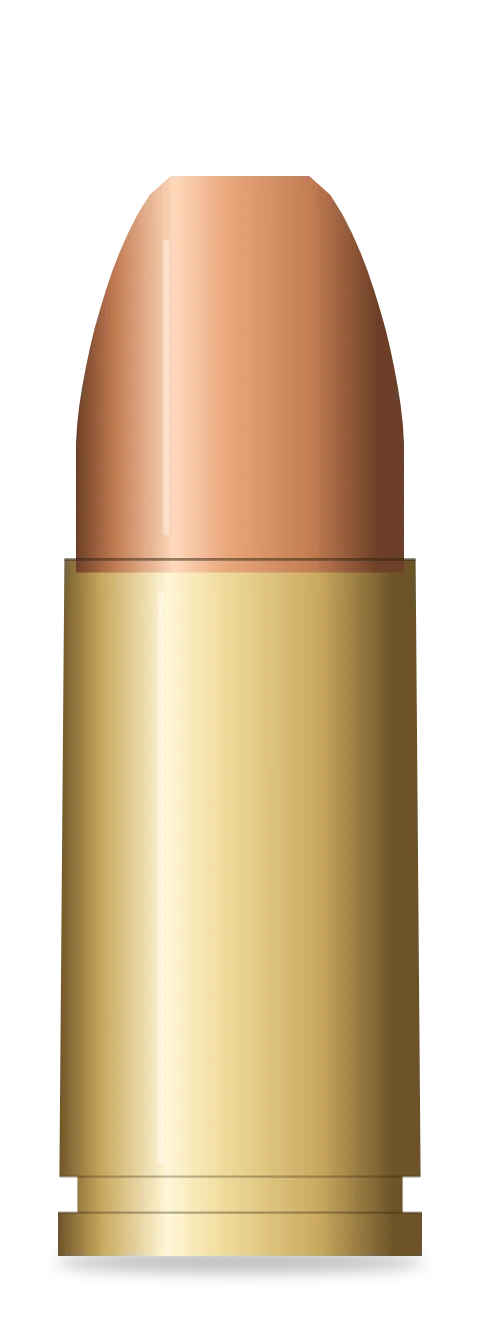
01 / At a glance
The basics
- Origin
- Germany
- Introduced
- 1902
- Ignition
- Centerfire
- Case form
- Rimless, tapered
- Diameter
- 9 mm
- Case length
- 19 mm
Rounded values to help you identify the cartridge, not manufacturing drawings. See the cited standard for exact dimensions and tolerances.
Do not mix it up
9mm Luger, 9×18 Makarov and 9mm Browning Short (.380 ACP) are different cartridges. Ammunition marked +P is loaded to a higher pressure, so use it only if your pistol's manual says it is approved.
The 9mm Luger, also called 9mm Parabellum or 9×19 mm, is one of the most widely used pistol cartridges in the world. It is the standard cartridge for many police and military forces, a staple of target and practical competition, and the most common chambering in modern semi-automatic pistols. It is also used in compact carbines and submachine guns.
This guide explains what the cartridge is, how it performs, how to choose ammunition and a pistol, and how it compares with the other handgun cartridges people weigh it against. It is a reference page, not a loading manual, and it contains no handloading data.
A short history
Georg Luger developed the 9×19 mm cartridge in the early 1900s for the pistol that carries his name, and it is usually dated to 1902. The German firm DWM sold the pistol as the Parabellum, from a Latin phrase meaning prepare for war, which is why the cartridge goes by both 9mm Luger and 9mm Parabellum.
The cartridge spread with the pistol, was adopted by many armies and police forces over the following decades, and later became a common NATO pistol round. It moved into civilian hands as a target and personal-use cartridge, and the arrival of lighter, high-capacity polymer pistols pushed it to the top of the market.
Why it is so popular
The 9mm Luger offers a balanced mix of recoil, capacity and cost. A full-size pistol can hold fifteen or more rounds. Recoil is manageable for most adults, so follow-up shots are fast. Ammunition is made in huge volume, which keeps practice rounds affordable, and a large choice of premium loads is available for other uses.
The cartridge is also supported by an enormous ecosystem. Holsters, magazines, sights, spare parts and training courses are easy to find for 9mm pistols, and many pistol-caliber carbines let a shooter use the same ammunition in a longer firearm.
Specifications at a glance
| Specification | Value |
|---|---|
| Bullet diameter | .355 in (9.02 mm) |
| Case length | 0.754 in (19.15 mm) |
| Maximum overall length (SAAMI) | 1.169 in (29.69 mm) |
| Case type | Rimless, tapered |
| Primer | Small pistol |
| Maximum average pressure (SAAMI) | 35,000 psi (+P: 38,500 psi) |
| Maximum pressure (C.I.P.) | 235 MPa (2,350 bar) |
| Common barrel twist | 1:10 inch |
| Typical bullet weights | 90 to 147 grains; most factory loads are 115, 124 or 147 grains |
Values are rounded for reference. Exact dimensions and tolerances are in the SAAMI and C.I.P. standards cited at the end of this page.
Strengths and limits
Every handgun cartridge is a compromise. The table shows where the 9mm Luger sits.
| Advantage | Limitation |
|---|---|
| Moderate recoil and fast follow-up shots | Smaller bullet than .40 S&W or .45 ACP |
| High magazine capacity | Short barrels lose velocity quickly |
| Widest choice of pistols and ammunition | Not suited to hunting larger game |
| Lower cost than larger pistol cartridges | Bullet performance varies a lot between loads |
Ballistics
Pistol ballistics are compressed into short distances. The tables and charts below show one common factory load, a 115 grain full metal jacket at 1,180 ft/s, fired from a pistol zeroed at 25 yards.
| Range (yd) | Velocity (ft/s) | Energy (ft-lb) | Drop (in) | Wind drift, 10 mph (in) |
|---|---|---|---|---|
| 25 | 1116 | 318 | 0 | 0.4 |
| 50 | 1063 | 289 | -0.9 | 1.4 |
| 75 | 1020 | 266 | -3.8 | 3 |
| 100 | 984 | 247 | -8.8 | 5.3 |
Reading the numbers
From a 25-yard zero the bullet is within about an inch of the point of aim at 50 yards and drops roughly 9 inches at 100 yards. At that distance a 10 mph crosswind moves it about 5 inches. Energy falls from about 356 foot-pounds at the muzzle to about 247 at 100 yards. For most pistol work inside 25 yards, the bullet simply goes where the sights point.
How these figures were made: the muzzle velocity (1,180 ft/s from a 4 inch barrel) and weight (115 grains) are Federal published figures for American Eagle FMJ. The ballistic coefficient (G1 0.145) is the published figure for a typical 115 grain 9mm bullet. Drop, velocity, energy and wind drift are computed with a standard point-mass model, a 25-yard zero, a 0.8 inch sight height and standard atmosphere. They are estimates. Pistol barrels, loads and sight heights vary, so confirm on your own range.
Recoil and shooter comfort
The 9mm Luger has less recoil than .40 S&W or .45 ACP in the same size of pistol. Felt recoil depends mostly on the weight of the pistol, the grip and the bullet weight. A heavier pistol and a good two-handed grip give the smoothest shooting.
New shooters should start with a full-size pistol and 115 or 124 grain target ammunition. Compact pistols are harder to shoot well because they are lighter and offer less to hold. Concentrate on a straight, steady press of the trigger and a firm, consistent grip, and keep sessions short enough that you stay focused.
How to choose ammunition
Choose by purpose first, then bullet weight. The same 9mm name covers very different products.
| Bullet type | Best for | Notes |
|---|---|---|
| Full metal jacket (FMJ) | Practice, target and training | Most affordable and reliable feeding |
| Jacketed hollow point (JHP) | Personal defense and law enforcement | Designed to expand; costs more |
| Lead round nose | Low-cost practice | Check your pistol allows lead bullets |
| Frangible | Indoor ranges and steel training | Breaks up on impact; cleaner but costs more |
| Subsonic 147 grain | Suppressed shooting | Heavy bullet at lower speed |
Bullet weight
A 115 grain bullet is fast and the most common weight for practice. A 124 grain bullet is a popular balance for general use. A 147 grain bullet is slower, heavier and often used for subsonic shooting. Heavier bullets usually recoil with a softer push, but the effect depends on the pistol.
+P ammunition
Ammunition marked +P is loaded to a higher pressure than standard. Use it only if your pistol manual says it is approved. Constant use of +P can increase wear, and some pistols are not designed for it. When in doubt, use standard pressure ammunition.
How to choose a pistol
The best pistol is the one you can shoot accurately and carry or store the way you need. These are the points that matter most.
- Size. A full-size pistol is easiest to shoot well. Compact pistols are easier to carry but are less forgiving.
- Grip fit. The pistol must fit your hand so you can reach the trigger and controls without shifting your grip.
- Action and safety. Striker-fired and hammer-fired pistols both work well. Learn the controls of the one you choose and practice until they are second nature.
- Sights and optics. Good iron sights are enough for most shooters. Many modern pistols accept a red-dot optic.
- Parts and support. Choose a model with a good record, available magazines and spare parts, and training resources.
Zeroing and practice
Most pistol sights are set to hit the point of aim at about 25 yards. Test your pistol at that distance, shoot a group from a rest, and adjust the sights if the group is off. Use the same ammunition you plan to use in practice, because different bullet weights hit at different points of impact.
Practice is more valuable than any equipment change. Start with slow fire at 7 to 10 yards, then add speed. Dry-fire at home with an unloaded pistol and a safe direction to build trigger control. A short, focused session once or twice a week beats a long session once a month.
Practical uses
Target and practical competition
The 9mm Luger is a standard cartridge for steel challenge, action pistol and many bullseye-style events. Low recoil and cheap practice ammunition help competitors shoot a lot, which makes them better.
Service and personal use
It is widely used by law enforcement and by civilians who carry a handgun for personal protection. Laws about carrying and using firearms for protection vary, so follow local laws and get proper training.
Pistol-caliber carbines
A carbine shooting 9mm Luger gains velocity from the longer barrel, shoots more accurately than a pistol and has less recoil. It is a popular choice for home use, ranges and some competitions.
9mm Luger vs similar handgun cartridges
The table lists the handgun cartridges most often compared with the 9mm Luger. Figures are rounded and use the SAAMI maximum average pressure where one exists.
| Cartridge | Bullet diameter | Case length | Max pressure | Typical use |
|---|---|---|---|---|
| 9mm Luger | .355 in | 0.754 in | 35,000 psi | All-round pistol and carbine |
| .380 ACP (9mm Short) | .355 in | 0.680 in | 21,500 psi | Small, light pistols |
| 9×18 Makarov | .363 in | 0.709 in | Different system, not SAAMI | Eastern European pistols |
| .40 S&W | .400 in | 0.850 in | 35,000 psi | Service pistols |
| .45 ACP | .452 in | 0.898 in | 21,000 psi | Large-bore pistols and competition |
| 10mm Auto | .400 in | 0.992 in | 37,500 psi | Power-oriented pistols |
| .38 Special | .357 in | 1.155 in | 17,000 psi | Revolvers |
Against the .45 ACP, the 9mm Luger gives up bullet size and gains capacity, lower recoil and lower cost. Against the .40 S&W, it recoils more softly and holds more rounds. The .380 ACP and 9mm Luger use the same bullet diameter but different cases, and they are not interchangeable.
Care and storage
Clean and lightly oil your pistol after each range session, and check the magazines and springs for wear. Store ammunition in a cool, dry place away from solvents and heat. Keep firearms and ammunition locked and out of reach of children and unauthorized users.
Safety and common mistakes
- Match the cartridge to the pistol. 9mm Luger, 9×18 Makarov and .380 ACP are different cartridges. Read the barrel marking and the headstamp.
- Use +P only if your manual allows it, and never use ammunition with unknown origin or reloads of uncertain quality.
- Treat every firearm as loaded. Keep your finger off the trigger until your sights are on the target.
- Know your target and what is beyond it. A 9mm bullet can pass through a target and travel far.
- Wear eye and ear protection at the range. Indoor ranges amplify noise.
- If you reload, use only published data from a current manual and start low. This page does not contain loading data.
Frequently asked questions
Are 9mm Luger, 9mm Parabellum and 9×19 the same?
Yes. They are three names for the same cartridge. Use the full name when you shop, because other cartridges also use a 9 mm bullet.
What is the difference between 9mm and .380 ACP?
They use the same bullet diameter, but the .380 ACP has a shorter case and lower pressure. They are different cartridges and are not interchangeable.
Is it safe to shoot +P ammunition?
Only if your pistol manual says it is approved. +P is loaded to a higher pressure than standard. Many modern pistols handle it, but constant use can increase wear.
What bullet weight is best for 9mm?
It depends on use. 115 grain is common for practice, 124 grain is a good general choice, and 147 grain is popular for subsonic shooting.
How far can a 9mm pistol shoot accurately?
Most defensive and practical shooting happens inside 25 yards. Good shooters can hit accurately at 50 yards and beyond, and bullets travel much farther than that, so always know your backstop.
Can I use 9mm in a carbine?
Yes, if the carbine is chambered for 9mm Luger. Pistol-caliber carbines gain velocity and accuracy from the longer barrel.
Can I reload 9mm Luger brass?
Yes. The brass is widely reloaded. Use only published data from a current loading manual and follow its safety instructions.
What distance should I zero a 9mm pistol?
Many pistols are set to hit the point of aim at about 25 yards. Check your own pistol with the ammunition you use and adjust if needed.
Sources
Sources reviewed · 29 October 2026