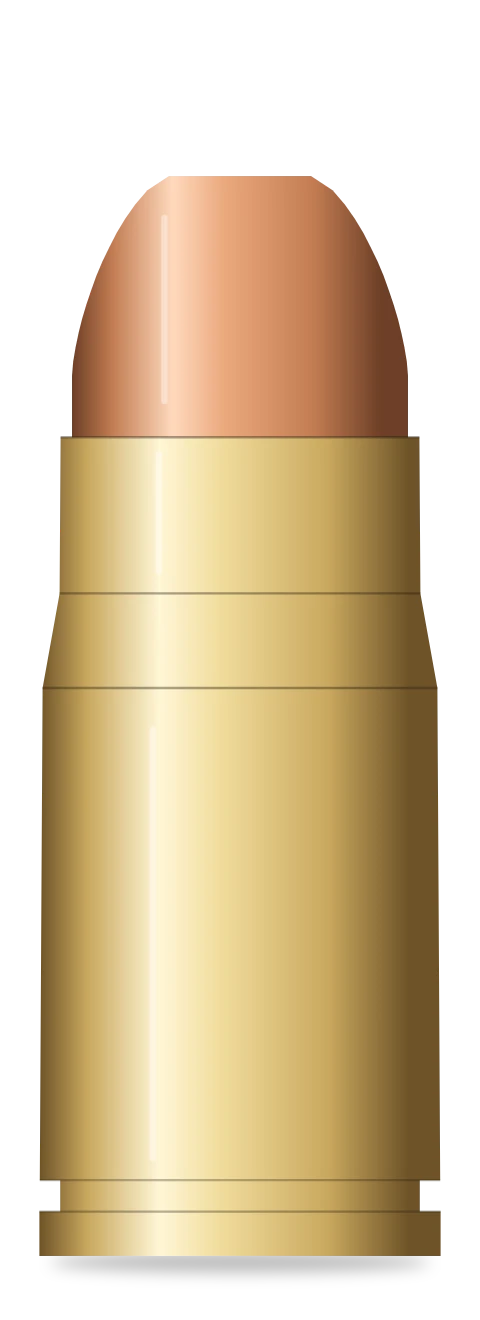
01 / At a glance
The basics
- Origin
- United States / Switzerland
- Introduced
- 1994
- Ignition
- Centerfire
- Case form
- Rimless, bottleneck
- Diameter
- 9.0 mm
- Case length
- 22.0 mm
Rounded values to help you identify the cartridge, not manufacturing drawings. See the cited standard for exact dimensions and tolerances.
Do not mix it up
The .357 SIG and the .357 Magnum are different cartridges. A .357 SIG cartridge does not fit a revolver, and a .357 Magnum cartridge does not fit a .357 SIG pistol.
The .357 SIG is a bottlenecked pistol cartridge that fires a .355 inch bullet, usually 115 to 150 grains, at about 1,200 to 1,450 ft/s. It was designed to give a semi-automatic pistol the speed of a .357 Magnum revolver load. The result is a flat-shooting, sharp-recoiling pistol cartridge with a loyal but small following.
This guide explains what the .357 SIG is, how it performs out to 100 yards, how to choose ammunition and a pistol, and how it compares with the 9mm Luger, the .40 S&W, the 10mm Auto and the .357 Magnum. It is a reference page, not a loading manual, and it contains no handloading data.
A short history
SIG Sauer and Federal Premium developed the .357 SIG and introduced it in 1994. The SIG P229 was the first production pistol chambered for it. The goal was to match the performance of a 125 grain .357 Magnum load, which law enforcement had long respected, in a standard-size semi-automatic pistol.
The designers used a bottlenecked case. The bottleneck helps feeding and lets the case hold a lot of powder behind a 9mm-diameter bullet. The cartridge shares its case head and basic dimensions with the .40 S&W and the 10mm Auto, so many .40 S&W pistols can be converted to .357 SIG with a new barrel.
A number of national and state law enforcement agencies adopted it in the years that followed. Over time many agencies moved to 9mm pistols, citing the cost and availability of ammunition and modern 9mm bullet designs. The .357 SIG remains in production, and it has kept a following among shooters who like its speed.
Why people choose it
The first reason is speed. A 125 grain bullet leaves a 4 inch barrel at about 1,350 ft/s, and a 115 grain bullet is faster still. That speed gives a flat path and fast expansion in hollow point bullets.
The second reason is penetration. The bullet has a lot of velocity and the bottleneck case holds a good load. Some shooters value that for shooting through barriers such as car doors and windshields, though results depend on the bullet and the barrier.
The third reason is the pistol. Because the cartridge shares dimensions with the .40 S&W, many pistols can be converted with a barrel swap, and magazines often interchange. A shooter who owns a .40 S&W can add a .357 SIG barrel at modest cost.
Specifications at a glance
| Specification | Value |
|---|---|
| Bullet diameter | .355 in (9.0 mm) |
| Case length | 0.865 in (22.0 mm) |
| Overall length | 1.141 in (29.0 mm) |
| Case type | Rimless, bottleneck |
| Primer | Small pistol |
| Maximum average pressure (SAAMI) | 40,000 psi |
| Maximum pressure (C.I.P.) | 44,240 psi |
| Typical bullet weights | 115 to 150 grains; 124 and 125 grains are the most common |
| Typical muzzle velocity | About 1,350 ft/s with a 125 grain bullet from a 4 inch barrel |
| Firearm types | Semi-automatic pistols |
Values are rounded for reference. Exact dimensions and tolerances are in the SAAMI and C.I.P. standards cited at the end of this page.
Strengths and limits
The .357 SIG is a fast pistol cartridge with a sharp report. It should be judged as one.
| Advantage | Limitation |
|---|---|
| Very flat path and high velocity for a pistol | Sharp recoil and loud report |
| Good barrier penetration | Ammunition costs more and is harder to find than 9mm |
| A barrel swap converts many .40 S&W pistols | Fewer pistol models than 9mm or .40 S&W |
| Fits a standard-size pistol | Parts can wear faster than with a gentler cartridge |
It is an effective cartridge, and many shooters who learn to handle it enjoy it. A shooter who wants cheap practice and a wide choice of pistols and ammunition will find the 9mm a more practical choice.
It helps to be honest about the trade. The .357 SIG gives more speed than a 9mm, and the 9mm gives better bullets for the money, easier shooting and a much wider choice of pistols. Modern 9mm defensive bullets have closed much of the gap in performance, which is one reason many agencies moved back to it. Choose the .357 SIG because you like what it does, not because you think it is a magic round.
Barrel and slide wear
Because the cartridge runs at higher pressure and speed than a 9mm, it can put more stress on a pistol, and some parts can wear faster. Use a pistol made for the cartridge, and follow the maker's guidance on recoil springs and maintenance.
Ballistics
The tables and charts below show one common factory load, a 125 grain full metal jacket bullet at 1,350 ft/s from a 4 inch barrel, with the pistol zeroed at 25 yards.
| Range (yd) | Velocity (ft/s) | Energy (ft-lb) | Drop (in) | Wind drift, 10 mph (in) |
|---|---|---|---|---|
| 25 | 1266 | 445 | 0 | 0.3 |
| 50 | 1193 | 395 | -0.5 | 1.3 |
| 75 | 1130 | 355 | -2.4 | 2.9 |
| 100 | 1078 | 323 | -6.1 | 5.1 |
For context, the same published table lists the load at 506 foot-pounds at the muzzle. Standard 9mm loads usually run at roughly 1,100 to 1,200 ft/s in a similar barrel, so the .357 SIG is faster, but the difference in energy is modest compared with the difference in recoil and cost.
Reading the numbers
With a 25-yard zero the bullet falls about half an inch at 50 yards, 2 inches at 75 and 6 at 100. A 10 mph crosswind moves it about 1 inch at 50 yards, 3 at 75 and 5 at 100. Velocity drops from 1,350 ft/s at the muzzle to about 1,080 ft/s at 100 yards, and energy from about 506 to about 323 foot-pounds.
These figures show why the cartridge is called flat-shooting for a pistol. Inside 50 yards the drop is small enough to ignore. Most defensive shooting happens at a few yards, where velocity and penetration matter more than path.
How these figures were made: the muzzle velocity (1,350 ft/s), weight (125 grains) and the published velocities at 25, 50, 75 and 100 yards (1,266, 1,192, 1,130 and 1,078 ft/s) are Federal figures for its American Eagle 125 grain FMJ load from a 4 inch test barrel. The ballistic coefficient (G1 0.154) was fitted to match those published velocities. Drop, velocity, energy and wind drift are computed with a standard point-mass model, a 25-yard zero, a 0.9 inch sight height and standard atmosphere. They are estimates. Velocity depends heavily on barrel length.
Recoil and shooter comfort
Recoil is sharp. In a full-size pistol of 28 to 30 ounces, the .357 SIG gives a snappy push, more than a 9mm and a little more than a .40 S&W. The muzzle blast and noise are also greater than for a 9mm.
It takes practice to shoot fast and accurately. A good grip and a firm stance help, and the cartridge rewards a shooter who trains. A new shooter may find a 9mm easier to learn on.
How to choose ammunition
Choose by purpose first. Ammunition for the .357 SIG is made by Federal, Speer, Hornady, Winchester and several others.
| Bullet type | Best for | Notes |
|---|---|---|
| Full metal jacket, 124 to 125 grains | Practice | The cheapest load; costs more than 9mm |
| Jacketed hollow point, 124 to 125 grains | Defense | Reliable expansion at high speed |
| Jacketed hollow point, 147 to 150 grains | Defense | Slower and heavier; more penetration |
| Lighter hollow point, 115 grains or less | Defense | Very fast; expands quickly |
Bullet weight matters. A 124 or 125 grain bullet is the most common and gives the speed the cartridge is known for. A 147 to 150 grain bullet is slower, with less sharp recoil and more penetration. A lighter 115 grain bullet is faster still. Try a few loads in your pistol, and choose the one that shoots accurately and feeds without trouble.
Use ammunition made for the cartridge
Buy factory ammunition from a known maker. Do not use a .357 Magnum cartridge in a .357 SIG pistol. The cartridges are not interchangeable, and the .357 Magnum is a longer, rimmed revolver cartridge.
Cost of practice
Practice ammunition costs more than 9mm, so many shooters fire fewer rounds. A shooter who wants a good number of practice rounds should plan the budget, and consider dry-fire practice, which costs nothing and builds the same trigger skills.
How to choose a pistol
The right pistol depends on how you will use it. These are the points that matter most.
- Size. A full-size or compact pistol handles the recoil well. A subcompact kicks harder.
- Weight. A heavier pistol with a metal frame soaks up recoil better than a light polymer pistol.
- Barrel conversion. Some pistols, such as many .40 S&W models, can take a .357 SIG barrel. Check with the maker first.
- Sights. Choose sights you can see clearly. Night sights suit defensive use.
- Reliability. Test the pistol with the ammunition you plan to use, and shoot enough rounds to be sure.
- Fit. Hold the grip, reach the trigger and check the magazine release before you buy.
Zeroing and practice
A 25-yard zero is common for pistol shooting, and for a defensive pistol many shooters use a 15 or 25 yard zero. The path is flat enough that you can hold at the target out to 50 yards with only a small hold-over.
Practice trigger control and grip. Dry-fire practice with an unloaded pistol improves your trigger press at no cost. At the range, shoot slowly at first, and add speed when your hits are good. Confirm your point of impact with your defensive load, since it can differ from practice ammunition.
Practical uses
The cartridge sits in an unusual place. It is neither the cheapest nor the most common, and it is not the most powerful. People who choose it usually do so for its feel and its history, and they accept the cost. That is a reasonable choice as long as the shooter practices enough to use it well.
Personal defense
This is the main use. The speed and penetration of a good hollow point suit a defensive pistol. Choose a load that expands reliably and practice with it.
Carry and storage matter as much as the cartridge. A pistol that is comfortable to carry gets carried, and one that is left at home does not help. Choose a good holster, practice the draw safely and keep the pistol secure when you are not carrying it.
Law enforcement
Several agencies adopted it, drawn by its penetration and speed. Many later changed to 9mm because of cost and availability.
Competition
Some competitors use it in practical shooting events. It is not as common there as the 9mm.
Field and outdoor carry
With a hard cast bullet, it can be used as a backup against animals at close range. For this a larger cartridge, such as the 10mm Auto or a revolver, gives more margin.
Target shooting
It is an accurate cartridge, and fun to shoot. Because of cost, most people shoot it less than they would a 9mm.
.357 SIG vs similar handgun cartridges
The table lists the cartridges most often compared with the .357 SIG. Figures are rounded and use SAAMI maximum average pressures.
| Cartridge | Bullet diameter | Case length | Max pressure | Typical use |
|---|---|---|---|---|
| .357 SIG | .355 in | 0.865 in | 40,000 psi | Defense and duty |
| 9mm Luger | .355 in | 0.754 in | 35,000 psi | All-round pistol and carbine |
| .40 S&W | .400 in | 0.850 in | 35,000 psi | Service pistols |
| 10mm Auto | .400 in | 0.992 in | 37,500 psi | Power-oriented pistols |
| .357 Magnum | .357 in | 1.290 in | 35,000 psi | Revolvers and lever-action carbines |
Against the 9mm Luger, the .357 SIG is faster and has a flatter path, with more recoil and cost. Against the .40 S&W, it shoots a lighter bullet at higher speed. Against the 10mm Auto, it is milder and smaller. Against the .357 Magnum, it matches the speed of the 125 grain load in a semi-automatic pistol.
Care and storage
Clean the barrel, the slide and the feed ramp after each session, and use a light oil on the rails. Replace recoil springs on the maker's schedule, since a high-pressure cartridge wears them faster. Check the magazines for wear. Store the pistol unloaded in a dry place. Keep firearms and ammunition locked and out of reach of children and unauthorized users.
Safety and common mistakes
- Do not confuse the .357 SIG with the .357 Magnum, the .40 S&W or the 9mm Luger. Read the marking on the barrel and the slide.
- Treat every firearm as loaded. Keep your finger off the trigger until your sights are on the target.
- Know your target and what is beyond it. A handgun bullet can travel more than a mile.
- Check that the barrel is clear and the chamber is empty before loading.
- Wear eye and ear protection at the range.
- Use only a barrel made for the cartridge when converting a pistol, and follow the maker's instructions.
- If you reload, use only published data from a current manual and start low. This page does not contain loading data.
- Store firearms unloaded and locked, and keep the ammunition apart.
Frequently asked questions
Is the .357 SIG better than the 9mm?
It is faster, with a flatter path and good barrier penetration. It also costs more, kicks harder and has fewer pistols and loads. Many shooters find the 9mm more practical.
What is the difference between .357 SIG and .357 Magnum?
They are different cartridges. The .357 SIG is a bottlenecked semi-automatic pistol round. The .357 Magnum is a longer, rimmed revolver cartridge. They are not interchangeable.
Can I convert a .40 S&W pistol to .357 SIG?
In many cases, yes, with a .357 SIG barrel, and sometimes a different recoil spring. Magazines often interchange. Check with the pistol maker first.
How much recoil does the .357 SIG have?
Sharp. It is more than a 9mm and a little more than a .40 S&W, with greater muzzle blast.
Is .357 SIG ammunition hard to find?
It is sold by several makers, but selection and price are worse than for 9mm.
How fast is a .357 SIG?
A 125 grain bullet leaves a 4 inch barrel at about 1,350 ft/s. Lighter bullets are faster.
Is the .357 SIG still used by police?
Some agencies still use it, but many have moved to 9mm because of cost and availability.
Can I reload .357 SIG?
Yes. The brass can be reloaded, though the bottleneck needs care in sizing. Use only published data from a current loading manual and follow its safety instructions.
Sources
Sources reviewed · 29 October 2026