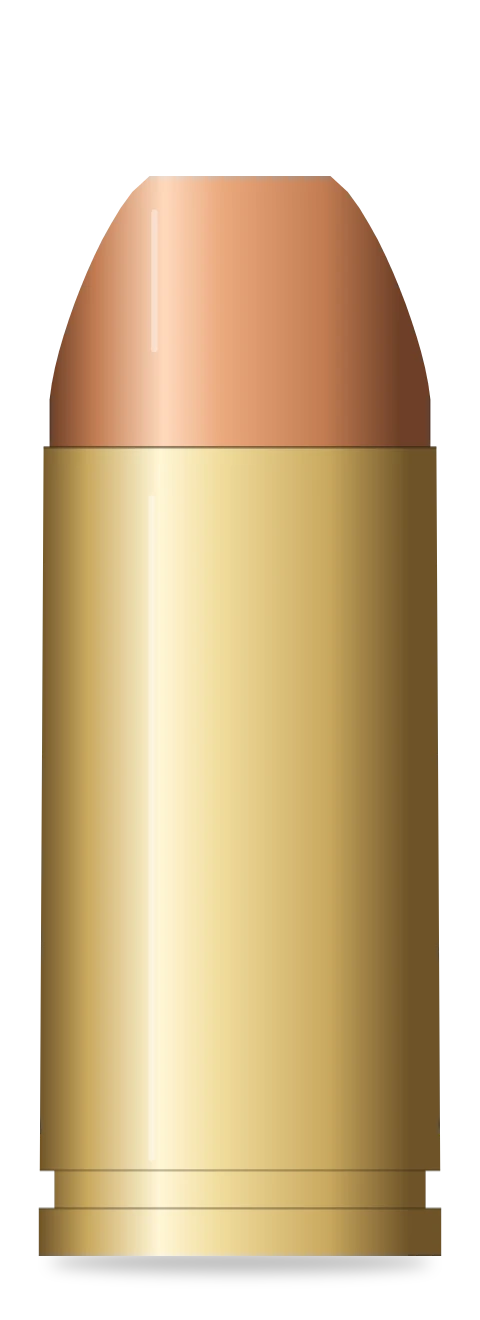
01 / At a glance
The basics
- Origin
- United States
- Introduced
- 1990
- Ignition
- Centerfire
- Case form
- Rimless, straight-walled
- Diameter
- 10.2 mm
- Case length
- 21.6 mm
Rounded values to help you identify the cartridge, not manufacturing drawings. See the cited standard for exact dimensions and tolerances.
Do not mix it up
The .40 S&W and the 10mm Auto use the same bullet diameter. The 10mm case is longer, and the two are not interchangeable. Never load one in a gun made for the other.
The .40 S&W is a mid-power pistol cartridge that fires a .400 inch bullet, usually 135 to 180 grains, at about 1,000 to 1,200 ft/s. It was introduced in 1990 and became the standard police cartridge in the United States for about twenty years. It sits between the 9mm Luger and the 10mm Auto in size and power, and it fits in pistols not much larger than a 9mm.
This guide explains what the cartridge is, how it performs, how to choose ammunition and a pistol, and how it compares with the 9mm, the 10mm Auto, the .45 ACP and other cartridges people weigh it against. It is a reference page, not a loading manual, and it contains no handloading data.
A short history
The story starts with the FBI. After a deadly shootout in Miami in 1986, the agency reviewed its handguns and ammunition, and in 1989 it chose a full-power 10mm Auto load. The cartridge worked, but many agents found it too sharp to shoot well, especially in pistols with small grips.
Winchester and Smith & Wesson answered with a reduced 10mm load that was easier to handle. It gave the same bullet weight at lower speed. The case was longer than it needed to be for those loads, so in 1990 the two companies shortened it and called the result the .40 Smith & Wesson. The same bullet diameter now fit in a pistol built for the 9mm.
It caught on fast. Glock introduced pistols for it in 1990, and many other makers followed. Police departments across the country adopted it through the 1990s and 2000s. Over the last decade, many agencies, including the FBI, have moved back to the 9mm, because modern 9mm bullets perform well and the cartridge is easier to shoot. The .40 S&W is still widely used and still widely sold.
Why it became so popular
The first reason is size. The .40 S&W fits in a frame close to a 9mm, so a pistol can be carried and shot like a 9mm and still fire a larger bullet. Many designs share a frame between the two cartridges.
The second reason is bullet weight. A 180 grain .40 bullet is clearly heavier than a typical 9mm bullet, and it hits with more energy at the muzzle. For many buyers in the 1990s, that was reason enough to choose it.
The third reason is police adoption. When a large part of American law enforcement carries a cartridge, ammunition is made in quantity, and the guns are sold used in large numbers after departments switch. That is why used police pistols in .40 S&W are common and cheap.
Specifications at a glance
| Specification | Value |
|---|---|
| Bullet diameter | .400 in (10.2 mm) |
| Case length | .850 in (21.6 mm) |
| Overall length (SAAMI) | 1.135 in (28.8 mm) |
| Case type | Rimless, straight-walled |
| Primer | Small pistol |
| Maximum average pressure (SAAMI) | 35,000 psi |
| Typical bullet weights | 135 to 180 grains; 165 and 180 grains are the most common |
| Typical muzzle velocity | About 1,000 ft/s with a 180 grain bullet from a 4 inch barrel |
Values are rounded for reference. Exact dimensions and tolerances are in the SAAMI and C.I.P. standards cited at the end of this page.
Strengths and limits
The .40 S&W is a solid, practical cartridge. It also has trade-offs that explain why police moved away from it.
| Advantage | Limitation |
|---|---|
| Heavier bullet than the 9mm in a similar pistol | Sharper recoil than the 9mm, and slower follow-up shots |
| Good energy for its size | Magazines hold fewer rounds than a 9mm of the same size |
| Many used police pistols and plenty of ammunition | Ammunition costs more than 9mm |
| Works well with a wide range of bullets | High pressure, so it wears pistols faster than the 9mm |
Modern 9mm defensive bullets close much of the gap in effect, and the 9mm has less recoil and more capacity. The .40 S&W still makes sense for a shooter who likes a heavier bullet and handles the recoil well.
Pressure and case support
The .40 S&W runs at high pressure for a short case. Some pistols leave a part of the case unsupported near the feed ramp. With damaged brass or an overloaded handload, the case can fail. Use quality factory ammunition, check your brass, and follow the maker's advice for your pistol.
Ballistics
Pistol ballistics are compressed into short distances. The tables and charts below show one common factory load, a 180 grain full metal jacket at 1,000 ft/s from a 4 inch barrel, with the pistol zeroed at 25 yards.
| Range (yd) | Velocity (ft/s) | Energy (ft-lb) | Drop (in) | Wind drift, 10 mph (in) |
|---|---|---|---|---|
| 25 | 972 | 377 | 0 | 0.2 |
| 50 | 946 | 358 | -1.4 | 0.8 |
| 75 | 923 | 340 | -5.2 | 1.7 |
| 100 | 901 | 324 | -11.6 | 3 |
Reading the numbers
From a 25-yard zero the bullet falls about 1.4 inches at 50 yards, about 5 inches at 75 yards and about 12 inches at 100 yards. A 10 mph crosswind moves it about 3 inches at 100 yards. Energy falls from about 400 foot-pounds at the muzzle to about 324 at 100 yards.
These numbers show a cartridge built for close range. Inside 25 yards the path is almost flat, and a defensive pistol is rarely fired farther. Out to 50 yards it is still accurate enough for competition and practice.
How these figures were made: the muzzle velocity (1,000 ft/s), weight (180 grains) and the published velocities at 25, 50, 75 and 100 yards (972, 946, 923 and 901 ft/s) are Federal figures for its American Eagle 180 grain FMJ load from a 4 inch test barrel. The ballistic coefficient (G1 0.175) was fitted to match those published velocities. Drop, velocity, energy and wind drift are computed with a standard point-mass model, a 25-yard zero, a 0.9 inch sight height and standard atmosphere. They are estimates. Velocity depends heavily on barrel length.
Recoil and shooter comfort
The .40 S&W has a snappy recoil. It is sharper than a 9mm and milder than a full-power 10mm. In a compact pistol with a short grip, it can be unpleasant to practice with, and beginners often shoot it less well than a 9mm.
Pistol weight matters. A full-size steel or polymer pistol absorbs more of the kick than a compact. A grip that fills your hand and a firm stance help. If recoil is slowing you down, a 9mm pistol of the same size is a fair alternative, and many shooters change for that reason.
How to choose ammunition
Choose by purpose first. Range ammunition and defensive ammunition are different products.
| Bullet type | Best for | Notes |
|---|---|---|
| Full metal jacket (FMJ) | Practice and training | Cheapest; feeds well |
| Jacketed hollow point (JHP) | Personal defense | Designed to expand; test feeding in your pistol |
| Lead round nose or flat nose | Cheap practice | Use only in barrels that allow lead |
| Frangible | Indoor ranges and steel | Breaks up on impact; reduces ricochet |
| Reduced recoil loads | Training and new shooters | Check that they cycle your pistol reliably |
Bullet weight
A 180 grain bullet is the traditional weight and gives the lowest speed and the softest push. A 165 grain bullet is a middle choice. A 135 to 155 grain bullet is fast and sharper to shoot. Pick a weight that your pistol feeds reliably and that you can control.
Defensive loads
Choose a name-brand jacketed hollow point from a major maker and fire a few magazines through your pistol to check feeding and accuracy. Keep the same load in the magazines that you practiced with. Do not use the cheapest hollow points you can find.
Check before you buy
Read the box. The .40 S&W, 10mm Auto and .357 SIG all have similar bullets or cases, and they are not interchangeable. A 9mm cartridge can chamber in a .40 S&W pistol and fire unsafely, so keep the boxes apart.
How to choose a pistol
The best pistol is the one you can shoot well and carry. These are the points that matter most.
- Size. A full-size pistol is the easiest to shoot well in .40 S&W. Compact and subcompact guns carry better and kick harder.
- Capacity. Full-size .40 pistols hold about 13 to 15 rounds. A 9mm of the same size holds two or three more.
- Frame and weight. A heavier frame absorbs more recoil. A light polymer frame is easier to carry and kicks more.
- Trigger and sights. Pick a trigger you can use cleanly and sights you can see. These matter more than the cartridge.
- Reliability. Pick a well-known design with a good record. Test the pistol with the ammunition you plan to use.
- Used police guns. Trade-ins are cheap and common. Check the slide, barrel and frame for wear, and ask for a function check.
Barrel swaps
Some pistols can change to 9mm with a different barrel, spring and magazine. This can cut practice costs, but the swap must use parts made for your gun. Check with the maker.
Zeroing and practice
Most defensive pistol practice happens at 3 to 15 yards, and a 25-yard zero is plenty. Sights are set at the factory for a typical load, and a heavier or lighter bullet can shift the point of impact a little. Fire a few groups at 15 and 25 yards before you rely on a new load.
Dry fire is free and builds trigger control. Live practice should include drawing from a holster if you carry, shooting from different positions, and reloading. Short, regular sessions beat one long session a year. Because the .40 kicks more than a 9mm, practice with a firm grip and watch for flinching.
Practical uses
Personal defense
The .40 S&W is a proven defensive cartridge with a long record. A quality hollow point from a major maker expands reliably and penetrates well. Many shooters now prefer the 9mm for the lower recoil and higher capacity, but the .40 remains a reasonable choice.
Law enforcement
The .40 S&W was the American police standard for twenty years, and many officers still carry it. Departments that changed to the 9mm did so mainly for lower recoil, better training results and more rounds per magazine.
Competition
It is used in practical shooting sports, particularly in divisions that score by power factor. Its pressure and bullet weight make it easy to reach the power needed for major scoring in some divisions. Many competitors now use the 9mm, but the .40 has a place.
Hunting
The .40 S&W is not a hunting cartridge. For handgun hunting, a 10mm Auto, .357 Magnum or larger cartridge is the better tool.
.40 S&W vs similar handgun cartridges
The table lists the cartridges most often compared with the .40 S&W. Figures are rounded and use SAAMI maximum average pressures.
| Cartridge | Bullet diameter | Case length | Max pressure | Typical use |
|---|---|---|---|---|
| 9mm Luger | .355 in | .754 in | 35,000 psi | Defense, duty and practice |
| .40 S&W | .400 in | .850 in | 35,000 psi | Defense and duty |
| 10mm Auto | .400 in | .992 in | 37,500 psi | Hunting and defense |
| .45 ACP | .452 in | .898 in | 21,000 psi | Defense, duty and target |
| .380 ACP | .355 in | .680 in | 21,500 psi | Pocket pistols |
Against the 9mm, the .40 S&W has a heavier bullet and more recoil, and the 9mm carries more rounds. Against the 10mm Auto, it has a shorter case and less power with the same bullet diameter. Against the .45 ACP, it is faster and lighter, and the .45 carries a wider, heavier bullet at lower pressure.
Care and storage
Clean the pistol after each range session, and oil the slide rails and barrel hood lightly. Check the recoil spring: .40 S&W springs wear faster because of the pressure, and many makers suggest replacing them every few thousand rounds. Inspect the barrel and the feed ramp for wear. Store ammunition in a cool, dry place. Keep firearms and ammunition locked and out of reach of children and unauthorized users.
Safety and common mistakes
- Never load a .40 S&W cartridge in a 9mm pistol, or a 9mm cartridge in a .40 S&W pistol. Check the marking on the barrel and the slide.
- Do not mix up .40 S&W with 10mm Auto. The bullets are the same diameter, and the cartridges look alike. The 10mm case is longer and will not fit a .40 chamber.
- Do not fire damaged or bulged cases. Inspect your ammunition.
- Use only factory ammunition or published data from a current manual. This page does not contain loading data.
- Treat every firearm as loaded. Keep your finger off the trigger until your sights are on the target.
- Know your target and what is beyond it. Pistol bullets can pass through walls.
- Wear eye and ear protection at the range.
- Store firearms unloaded and locked, and keep the ammunition apart.
Frequently asked questions
Is the .40 S&W still a good cartridge?
Yes. It is a proven defensive and duty cartridge. The 9mm has caught up in effect, and has less recoil and more capacity, but the .40 S&W is still a sound choice.
Why did police stop using the .40 S&W?
Mostly for lower recoil, better scores in training and more rounds per magazine with a modern 9mm. Modern 9mm bullets perform very well, so the case for a larger bullet weakened.
What is the difference between .40 S&W and 10mm?
They use the same .400 inch bullet. The 10mm case is longer (.992 in against .850 in), runs at higher pressure and has much more power. They are not interchangeable.
Is the .40 S&W more powerful than the 9mm?
Yes. A 180 grain .40 bullet carries more muzzle energy than a typical 124 grain 9mm bullet, at the cost of more recoil and fewer rounds in the magazine.
Can I shoot 9mm in a .40 S&W pistol?
No. A 9mm cartridge can slip into a .40 S&W chamber and fire unsafely. Only fire the cartridge marked on the barrel.
Can I convert a .40 S&W pistol to 9mm?
Some pistols can, with a barrel, recoil spring and magazine made for the conversion. Use parts made for your pistol and check with the maker.
What bullet weight is best?
A 165 or 180 grain jacketed hollow point is the usual choice for defense. A 180 grain FMJ is common for practice. Choose a weight your pistol feeds reliably.
Can I reload .40 S&W?
Yes. The brass is widely reloaded, but the cartridge runs at high pressure, so use only published data from a current manual, and inspect cases before each use.
Sources
Sources reviewed · 29 October 2026