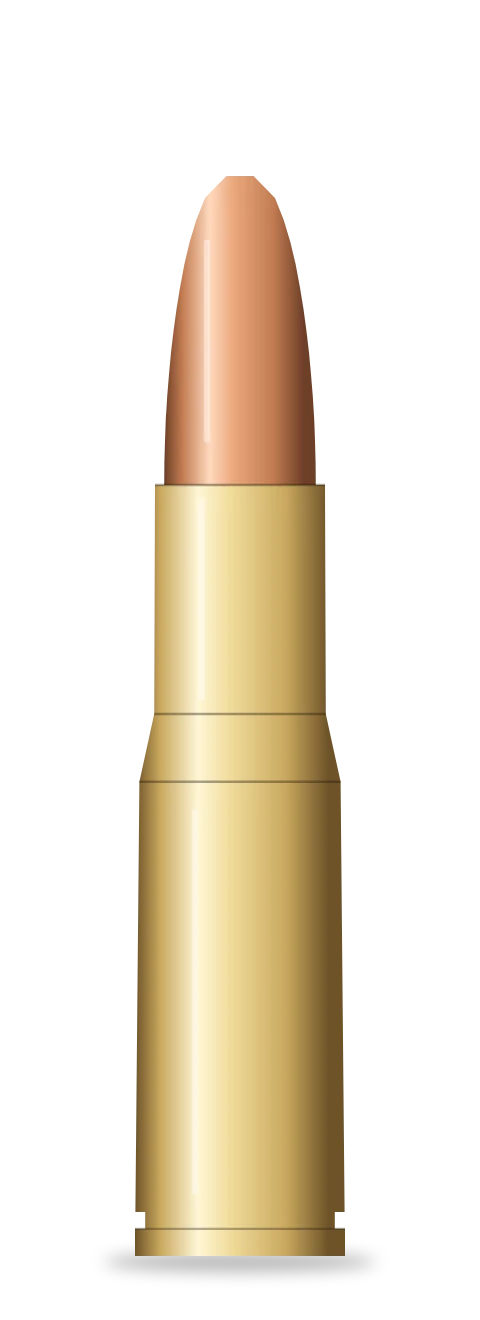
01 / At a glance
The basics
- Origin
- Belgium
- Introduced
- 1990
- Ignition
- Centerfire
- Case form
- Rimless, bottleneck
- Diameter
- 5.7 mm
- Case length
- 28.9 mm
Rounded values to help you identify the cartridge, not manufacturing drawings. See the cited standard for exact dimensions and tolerances.
Do not mix it up
The ATF classifies the military SS190 load as armor-piercing handgun ammunition, and FN sells it only to military and police. Civilian loads such as the SS195LF and SS197SR are not classified that way. Check the laws where you live.
The 5.7x28mm is a small, fast bottleneck cartridge from FN Herstal of Belgium. It fires a .224 inch bullet that weighs about 40 grains or less from a pistol-size case, with very light recoil and a flat trajectory for a handgun round. FN designed it for the P90 personal defense weapon and later for the Five-seveN pistol.
This guide explains what the 5.7x28mm is, how it performs out to 100 yards, how to choose ammunition and a pistol, and how it compares with the 9mm Luger, the .357 SIG and the .40 S&W. It is a reference page, not a loading manual, and it contains no loading data. Some 5.7x28mm loads are restricted by law, so check the rules where you live.
A short history
FN designed the 5.7x28mm in the late 1980s. Jean-Paul Denis and Marc Neuforge are credited with the early SS90 round, which FN introduced in 1990 for the P90, a compact personal defense weapon made to replace the pistol and submachine gun for troops who do not carry a full-size rifle. A U.S. patent for the SS90 projectile was granted in 1991. FN replaced the SS90 with the SS190 in the early 1990s.
The cartridge was developed from scratch, with no parent case. The idea was to give a compact weapon a small, light round with high velocity and enough penetration to defeat body armor, in an arm that is easy to control. The Five-seveN pistol went into production in 1998, which put the cartridge into a handgun.
NATO tested the 5.7x28mm against the 4.6x30mm in 2002 and 2003, and the group recommended the 5.7x28mm. Standardization stalled for years, and NATO adopted it as STANAG 4509 in 2021. By 2006 the P90 and Five-seveN were in service with military and police forces in more than 40 nations. The U.S. Secret Service also uses 5.7x28mm firearms.
In the civilian market, the 5.7x28mm stayed small for years because few firearms were made for it. That changed after 2019, when Ruger introduced the Ruger-5.7, and more makers followed, including Palmetto State Armory with the 5.7 Rock in 2022, Smith & Wesson with the M&P 5.7 in 2023 and Tisas with the PX-5.7 in 2024.
Why people shoot it
The first reason is recoil. The bullet is tiny and the push is very mild. A shooter can shoot fast and keep the sights on target, and a smaller or recoil-sensitive shooter finds it easy to control.
The second reason is the flat path. A 40 grain bullet leaves a pistol at about 1,650 ft/s, and at 100 yards it falls only about 3.7 inches with a 25 yard zero. A 9mm bullet drops more at the same range, and a shooter can hit a target out to 100 yards with a simple hold.
The third reason is capacity and the pistol itself. Five-seveN and similar pistols commonly hold 20 rounds, and carbines and the P90 use much larger magazines. The cartridge also appeals to enthusiasts of unusual firearms.
Specifications at a glance
| Specification | Value |
|---|---|
| Bullet diameter | .224 in (5.7 mm) |
| Case length | 1.138 in (28.9 mm) |
| Overall length | 1.594 in (40.5 mm) |
| Case type | Rimless, bottleneck |
| Case capacity | About 13.9 grains of water |
| Maximum pressure (C.I.P.) | 50,038 psi (345 MPa) |
| Typical rifling twist | 1 in 9 inches |
| Typical bullet weights | 27 to 40 grains for civilian loads |
| Typical muzzle velocity | About 1,650 ft/s from a pistol and 1,950 ft/s from a P90 with a 40 grain bullet |
Values are rounded for reference. Pressure is given as the C.I.P. figure. SAAMI standardized the cartridge in 2024 with a maximum average pressure of 48,500 psi. Exact dimensions and tolerances are in the standards cited at the end of this page.
Strengths and limits
The 5.7x28mm is a light-recoiling, flat-shooting handgun and carbine cartridge. It does not behave like a typical pistol round, so judge it on its own terms.
| Strength | Limit |
|---|---|
| Very light recoil and quick follow-up shots | Ammunition costs more than 9mm and is harder to find |
| Flat trajectory for a handgun cartridge | Light bullets carry little energy compared with a standard pistol round |
| High-capacity pistols and carbines | Fewer firearms and less choice than the 9mm |
| The military SS190 load is designed to penetrate body armor | Some loads are restricted, and laws are strict in some places |
Honest advice: for most people, a 9mm pistol is the more practical choice, with cheaper ammunition and many more firearms. The 5.7x28mm makes sense if you value its light recoil, flat path and high capacity, and if you accept the cost.
Energy and terminal performance
A 40 grain bullet from a pistol carries about 243 foot-pounds at the muzzle, much less than a typical 9mm or .357 SIG load, because the bullet is so light. The design relies on velocity, and results depend on the bullet and the target. Be wary of broad claims, and choose the load for how you plan to use it.
Ballistics
The table and charts below show one common factory load, a 40 grain full metal jacket bullet at 1,655 ft/s from a 4.8 inch test barrel, with the pistol zeroed at 25 yards.
| Range (yd) | Velocity (ft/s) | Energy (ft-lb) | Drop (in) | Wind drift, 10 mph (in) |
|---|---|---|---|---|
| 25 | 1515 | 204 | 0 | 0.4 |
| 50 | 1387 | 171 | 0 | 1.5 |
| 75 | 1274 | 144 | -1.2 | 3.5 |
| 100 | 1178 | 123 | -3.7 | 6.3 |
Reading the numbers
With a 25 yard zero the bullet is on the line at 25 and 50 yards, about 1.2 inches low at 75 and about 3.7 inches low at 100. A 10 mph crosswind moves it about 1.5 inches at 50 yards, 3.5 at 75 and 6.3 at 100. Velocity drops from 1,655 ft/s at the muzzle to about 1,180 ft/s at 100 yards, and energy from about 243 to about 123 foot-pounds.
The light bullet slows quickly, and the wind pushes it more than a heavier bullet. Out to 50 yards it shoots very flat. Beyond that, drift becomes the problem. For defensive and range distances, the trajectory is nearly flat.
How these figures were made: the muzzle velocity (1,655 ft/s), weight (40 grains) and the published velocities at 25, 50, 75 and 100 yards (1,514, 1,387, 1,275 and 1,179 ft/s) are Federal figures for its American Eagle 40 grain full metal jacket load from a 4.8 inch test barrel. The ballistic coefficient (G1 0.117) was fitted to match those published velocities. Drop, velocity, energy and wind drift are computed with a standard point-mass model, a 25 yard zero, a 0.9 inch sight height and standard atmosphere. They are estimates. Velocity depends a great deal on barrel length, and the P90 and PS90 reach higher speeds from longer barrels.
Recoil and shooter comfort
Recoil is very light. In a typical pistol, the 5.7x28mm gives a small, quick push, lighter than a 9mm. The muzzle blast and flash are sharper than the recoil suggests, especially in a short barrel, so wear hearing and eye protection.
Light recoil makes follow-up shots fast, and it helps a new shooter build good habits. It also makes the cartridge easy to shoot well, so spend your time on trigger control and sight picture.
How to choose ammunition
FN, Federal and Fiocchi sell the cartridge, and some loads use Hornady bullets. The selection is smaller than for 9mm. Choose a load made for civilian sale, and use it in a firearm made for the cartridge.
| Load | Muzzle velocity | Best for | Notes |
|---|---|---|---|
| SS197SR, 40 grain V-MAX | About 1,950 ft/s from a P90 | Sporting use and defense | Polymer-tip Hornady bullet; sold to civilians |
| SS195LF, 27 grain jacketed hollow point | About 2,550 ft/s from a P90 | Defense and range | Lead-free primer; sold to civilians |
| American Eagle AE5728A, 40 grain TMJ | About 1,655 ft/s from a 4.8 inch barrel | Range practice | The load in this guide; cheaper full metal jacket |
Test several loads in your firearm. Some pistols prefer one load and feed another poorly. A 40 grain bullet at lower velocity may work better in a short barrel than a light 27 grain at higher speed. Keep a label on the box so you know what you shot and how it fed.
Know the law on armor-piercing ammunition
The ATF classifies the military SS190 and the L191 tracer as armor-piercing handgun ammunition, and FN sells the SS190 only to military and police customers. The SS195, SS196 and SS197 types are classified as not armor-piercing, as are the sporting variants. Check the federal, state and local laws where you live before you buy or carry ammunition.
Cost and availability
Ammunition costs more than 9mm and is harder to find. Cases and bullets are scarce for handloaders, and most shooters use factory ammunition. Plan your practice with the cost in mind.
How to choose a pistol
The right firearm depends on what you want to do with it. These are the points that matter most.
- Type. The Five-seveN, Ruger-5.7, Smith & Wesson M&P 5.7, Palmetto State Armory 5.7 Rock and Tisas PX-5.7 are pistols. The PS90, KelTec P50 and AR-57 are carbine-size.
- Size and weight. A full-size pistol handles the cartridge easily. Smaller pistols make the muzzle flash and blast more noticeable.
- Capacity. Many pistols hold 20 rounds. Check magazine availability for the model you buy.
- Reliability. The bottleneck case needs a firearm designed for it. Test the pistol with the ammunition you plan to use and shoot enough rounds to be sure.
- Sights. Choose sights you see clearly. Red dot optics are common on newer models.
- Trigger. A smooth trigger helps accuracy. Test the reset and the pull.
- Cost. The firearms and magazines cost more than similar 9mm models, so plan the whole budget, not just the gun.
FN makes the P90, PS90 and Five-seveN. Other makers include Ruger, KelTec, Palmetto State Armory, Smith & Wesson and Tisas. Not every model is still in production, so check current catalogs.
Zeroing and practice
A 25 yard zero is common for pistols. With the load in this guide the bullet is on the line at 25 and 50 yards and about 4 inches low at 100. That means you can hold on the target out to 75 yards and hold a little high at 100.
Shoot a group at 25 yards from a rest, adjust the sights, and confirm at 50. Write down your own drops. The figures here are estimates from a model, and your pistol, load and barrel length will differ. Practice with the ammunition you will carry, since impact can differ from the practice load.
Dry fire is free and builds trigger control. Practice drawing, sight picture and safe handling, and take classes if the cartridge is new to you.
Practical uses
Range and recreation
The low recoil and flat path make it fun at the range. The ammunition cost is the main limit, so many shooters use it for fun and shoot cheaper cartridges for most practice.
Personal defense
Some people choose it for defense because of the light recoil and high capacity. Choose a load made for the purpose, test your firearm with it, and learn the laws where you live.
Law enforcement and military use
This is the original purpose. The P90 and Five-seveN serve military and police forces in many countries, and the cartridge is a NATO standard under STANAG 4509.
Small game and pests
Some shooters use carbines for pests at short range, though a .22 WMR or .17 HMR rifle is a more usual choice. Check the rules in your area before hunting with it.
5.7x28mm vs similar cartridges
The table compares the 5.7x28mm with the pistol cartridges it is usually weighed against. Figures are rounded. The 5.7x28mm pressure is the C.I.P. figure, and the others are SAAMI.
| Cartridge | Bullet diameter | Case length | Max pressure | Typical use |
|---|---|---|---|---|
| 5.7x28mm | .224 in | 1.138 in | 50,038 psi (C.I.P.) | Personal defense weapons and pistols |
| 9mm Luger | .355 in | 0.754 in | 35,000 psi | Pistol and carbine in general |
| .357 SIG | .355 in | 0.865 in | 40,000 psi | Defense and duty |
| .40 S&W | .400 in | 0.850 in | 35,000 psi | Duty pistols |
Against the 9mm Luger, the 5.7x28mm has less recoil, a flatter path and more capacity, and it costs more and carries a much lighter bullet. Against the .357 SIG, it is lighter, flatter and softer-recoiling, with less bullet weight and energy. Against the .40 S&W, it is a different idea altogether: small and fast against large and slow.
Care and storage
Clean the barrel, slide and feed ramp after each session, and oil the rails lightly. Bottleneck cases can leave carbon in the chamber, so inspect it. Check springs and magazines for wear. Store the firearm unloaded in a dry place, locked, with the ammunition kept separately and away from children.
Safety and common mistakes
- Do not confuse the 5.7x28mm with the .22 WMR, .22 LR or other small cartridges. Read the barrel marking and the headstamp.
- Treat every firearm as loaded. Keep your finger off the trigger until the sights are on the target.
- Know your target and what lies beyond it. A fast, small bullet can travel a long way.
- Check that the barrel is clear and the chamber empty before you load.
- Wear eye and ear protection. The muzzle blast is sharp.
- Follow the federal, state and local laws on ammunition types, including armor-piercing classifications.
- If you reload, use only published data from a current manual and start low. This page does not contain loading data.
- Store firearms unloaded and locked, and ammunition apart, away from children.
Frequently asked questions
What is the 5.7x28mm?
A small, fast bottleneck cartridge from FN with a .224 inch bullet, made for the P90 and the Five-seveN pistol. NATO adopted it as STANAG 4509 in 2021.
How fast is a 5.7x28mm?
A 40 grain bullet leaves a pistol at about 1,650 ft/s and a P90 at about 1,950 ft/s.
Is 5.7x28mm ammunition legal for civilians?
Civilian loads such as the SS195LF, SS197SR and Federal American Eagle are sold to civilians. The ATF classifies the military SS190 as armor-piercing handgun ammunition, and FN does not sell it to civilians. Check your local laws.
What is the maximum pressure of the 5.7x28mm?
The C.I.P. maximum is 50,038 psi.
Is the 5.7x28mm better than the 9mm?
It has less recoil, a flatter path and more capacity, but the ammunition costs more, the bullet is much lighter and there are fewer firearms. Most people find the 9mm more practical.
Which firearms use the 5.7x28mm?
The FN P90, PS90 and Five-seveN, plus the Ruger-5.7, Smith & Wesson M&P 5.7, Palmetto State Armory 5.7 Rock, Tisas PX-5.7 and KelTec P50 and others.
Can I reload 5.7x28mm?
It can be done, but cases and bullets are scarce. Most shooters use factory ammunition. If you reload, follow published data from a current manual.
Who designed the 5.7x28mm?
FN designed it in the late 1980s, with Jean-Paul Denis and Marc Neuforge credited for the early SS90 round introduced in 1990.
Sources
Sources reviewed · 29 October 2026