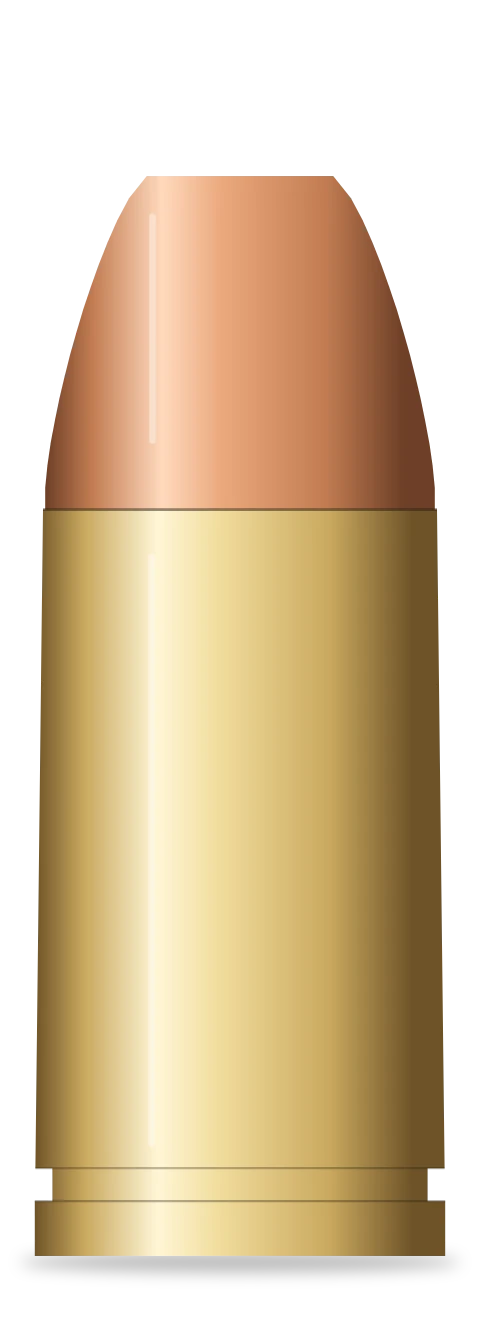
01 / At a glance
The basics
- Origin
- United States
- Introduced
- 1908
- Ignition
- Centerfire
- Case form
- Rimless, straight-walled
- Diameter
- 9.0 mm
- Case length
- 17.3 mm
Rounded values to help you identify the cartridge, not manufacturing drawings. See the cited standard for exact dimensions and tolerances.
Do not mix it up
The .380 ACP, 9mm Luger and .38 Special are different cartridges with almost the same bullet size. Never load one into a firearm made for another. Read the barrel marking and the headstamp.
The .380 ACP is a small, mild pistol cartridge that fires a .355 inch bullet, usually 85 to 100 grains, at about 900 to 1,000 ft/s. It was introduced in 1908 and became the standard cartridge for small, easy-to-carry pistols. Today it is one of the most popular concealed carry cartridges, and it is also known as the 9mm Kurz, 9mm Short and 9x17.
This guide explains what the cartridge is, how it performs, how to choose ammunition and a pistol, and how it compares with the 9mm Luger, .38 Special, .32 ACP and other cartridges people weigh it against. It is a reference page, not a loading manual, and it contains no handloading data.
A short history
John Browning designed the .380 ACP in 1908 for the Colt Model 1908 pocket pistol. The cartridge is in effect a 9mm Luger case shortened by about 0.07 inch, with a bullet of the same diameter. It was made for small pistols that work by simple blowback, in which the weight of the slide and the recoil spring hold the breech closed until pressure drops.
In Europe the same round is known as the 9mm Kurz, which means 9mm Short, and as the 9x17. It was adopted by police and military forces in Italy, Germany, Hungary and other countries. The Walther PPK, a famous pocket pistol, was made for it, and the cartridge became the standard for a great many small European pistols.
In the United States the .380 ACP faded behind the 9mm Luger for a time, but a boom in concealed carry from the 2000s brought it back. New, very small pistols in .380 ACP appeared, and today it is a leading cartridge for pocket-size guns.
Why it is so popular
The first reason is size. A .380 ACP pistol can be very small and light, easy to carry in a pocket or a small holster. A gun you actually carry is better than a stronger gun you leave at home.
The second reason is recoil. In a gun of the same size, the .380 ACP kicks less than a 9mm Luger. Many shooters, especially those with weak hands or arthritis, find a .380 ACP pistol easier to handle. It is an appealing choice for people who find stronger cartridges unpleasant.
The third reason is the choice of guns. Ruger, Glock, Smith & Wesson, Sig Sauer, Beretta, Walther and others make .380 ACP pistols, from tiny double-action guns to full-size ones, and ammunition is easy to find.
Specifications at a glance
| Specification | Value |
|---|---|
| Bullet diameter | .355 in (9.0 mm) |
| Case length | 0.680 in (17.3 mm) |
| Maximum overall length (SAAMI) | 0.984 in (25.0 mm) |
| Case type | Rimless, straight-walled |
| Primer | Small pistol |
| Maximum average pressure (SAAMI) | 21,500 psi |
| Typical bullet weights | 85 to 100 grains; 90 to 95 grains are most common |
| Typical muzzle velocity | About 900 to 1,000 ft/s |
| Common barrel twist | 1 in 16 inches |
Values are rounded for reference. Exact dimensions and tolerances are in the SAAMI and C.I.P. standards cited at the end of this page.
Strengths and limits
Every handgun cartridge is a compromise. The table shows where the .380 ACP sits.
| Advantage | Limitation |
|---|---|
| Very small and light guns | Less energy than a 9mm Luger |
| Mild recoil for the size of gun | Small pistols can be snappy and hard to shoot accurately |
| Good choice of modern pocket pistols | Ammunition costs more than 9mm and is a bit harder to find |
| Easy to carry and conceal | Some bullets expand but do not penetrate deeply |
Penetration matters. Bullets must reach vital organs to be effective, and a small, slow bullet may stop short if it expands too much or hits bone and heavy clothing. Some .380 ACP hollow points do not penetrate as deeply as larger cartridges. Choose a load that has been tested for both expansion and penetration.
Small guns are harder to shoot
A pocket pistol is easy to carry and not easy to shoot well. The sights are small, the grip is short and the trigger can be long. Practice matters more with a small gun than with a large one, and a slightly bigger pistol is often better if you can carry it.
Ballistics
Pistol ballistics are compressed into short distances. The tables and charts below show one common factory load, a 95 grain full metal jacket at 980 ft/s, fired from a pistol zeroed at 25 yards.
| Range (yd) | Velocity (ft/s) | Energy (ft-lb) | Drop (in) | Wind drift, 10 mph (in) |
|---|---|---|---|---|
| 25 | 937 | 185 | 0 | 0.3 |
| 50 | 899 | 171 | -1.6 | 1.2 |
| 75 | 866 | 158 | -5.8 | 2.7 |
| 100 | 835 | 147 | -13 | 4.8 |
Reading the numbers
From a 25-yard zero the bullet falls about 1.6 inches at 50 yards and about 13 inches at 100 yards. A 10 mph crosswind moves it about 5 inches at 100 yards. Energy falls from about 203 foot-pounds at the muzzle to about 147 at 100 yards. The bullet is light, so wind moves it more than a heavier bullet would.
These figures come from a test barrel. A small pistol with a short barrel of 2.5 to 3 inches will be slower by 50 ft/s or more. Expect the energy at the muzzle to be somewhat lower than the figure shown.
How these figures were made: the muzzle velocity (980 ft/s), weight (95 grains) and the published velocities at 50 and 100 yards (899 and 835 ft/s) are Federal figures for its American Eagle 95 grain FMJ load. The ballistic coefficient (G1 0.103) was fitted to match those published velocities. Drop, velocity, energy and wind drift are computed with a standard point-mass model, a 25-yard zero, a 0.9 inch sight height and standard atmosphere. They are estimates. Velocity depends heavily on barrel length.
Recoil and shooter comfort
The .380 ACP has mild recoil, but small, light guns can feel sharper than the cartridge suggests. A tiny pistol has little mass to absorb the push. A larger .380 ACP pistol is gentle and a pleasure to shoot.
Blowback pistols have a strong recoil spring, and a small gun can be hard to rack. If you have weak hands, look for a pistol designed to be easy to operate, such as models with easy-rack slides. Always use hearing protection and eye protection.
How to choose ammunition
Choose by purpose first, then bullet design. The same .380 ACP name covers very different products.
| Bullet type | Best for | Notes |
|---|---|---|
| Full metal jacket (FMJ), 90 to 100 grains | Practice and range use | Cheapest; deep penetration, no expansion |
| Jacketed hollow point (JHP), 80 to 95 grains | Personal defense | Designed to expand; check test results for penetration |
| Hard-cast lead or solid copper | Defense and field use | Deep penetration; check that your gun allows lead |
| Lighter bullets, 60 to 80 grains | High velocity | Fast and flashy; penetration may be less |
Bullet weight
A 90 to 95 grain bullet is the classic weight. Lighter bullets are faster but give up penetration. Heavier ones, around 100 grains, penetrate more. Choose a weight your pistol shoots and feeds reliably.
Feeding and reliability
Small pistols can be fussy about ammunition. Test any defensive load for reliable feeding and function. Fire at least a few magazines, and make sure it works in your gun before you carry it.
Testing a defensive load
Public gelatin test results are a useful guide. Look for a load that expands reliably and also reaches a depth of about 12 inches in calibrated gelatin, because depth is what lets a bullet reach vital organs through clothing and tissue. Many .380 ACP hollow points do one of these things well but not both. Buy a box, fire a few magazines through your own pistol to confirm that it feeds and fires without trouble, and then stay with that load.
Do not confuse it with other cartridges
The .380 ACP looks like a small 9mm Luger, and the two are not interchangeable. A 9mm Luger cartridge is longer and runs at a higher pressure. Never load one in a firearm made for the other.
How to choose a pistol
The best pistol is the one you can shoot accurately and carry every day. These are the points that matter most.
- Size and weight. Micro pistols such as the Ruger LCP are light and easy to conceal. Slightly larger models such as the Glock 42 or Smith & Wesson M&P380 Shield EZ are easier to shoot.
- Operation. Simple blowback pistols need a strong recoil spring and can be hard to rack. Locked-breech pistols such as the Sig P238 and Colt Mustang use a lighter spring, and easy-rack models are good for people with weak hands.
- Trigger. A smooth, short trigger helps accuracy. Some small pistols have long double-action triggers, which are safer to carry but harder to shoot well.
- Capacity. A micro pistol holds six to seven rounds. Larger ones hold ten or more.
- Sights and controls. Sights you can see and controls you can reach matter more than a long feature list.
Holster and carry
A good holster matters as much as the pistol. It must cover the trigger, hold the pistol securely and stay in place when you move. Pocket holsters and inside-the-waistband holsters are common for the .380 ACP.
Zeroing and practice
Many small pistols have fixed sights. Test your pistol at 7, 15 and 25 yards with the ammunition you plan to use, and check that it hits near the point of aim. If it does not, a different load or an aftermarket sight may help.
Practice often. A short, focused session once or twice a week beats a long session once a month. Dry-fire at home with an unloaded pistol and a safe direction to build smooth trigger control. Practice drawing from your holster slowly and safely.
Practical uses
Concealed carry
This is the .380 ACP's main job. A small pistol that fits a pocket is easy to carry every day. Laws about carrying firearms vary, so follow local laws and get proper training.
Home defense backup
Some people keep a .380 ACP pistol as a backup or a bedside gun. A larger cartridge is a better main tool, but a small pistol that is within reach beats a bigger one that is not.
Range shooting
Larger .380 ACP pistols are pleasant and inexpensive to shoot, and they are good for beginners and for shooters who want low recoil. Ammunition costs more than 9mm, so it is a little more expensive.
Pistol-caliber carbines
A few carbines are made in .380 ACP. They gain a little velocity from the longer barrel, but the cartridge stays modest.
.380 ACP vs similar handgun cartridges
The table lists the handgun cartridges most often compared with the .380 ACP. Figures are rounded and use the SAAMI maximum average pressure.
| Cartridge | Bullet diameter | Case length | Max pressure | Typical use |
|---|---|---|---|---|
| .380 ACP | .355 in | 0.680 in | 21,500 psi | Pocket pistols |
| 9mm Luger | .355 in | 0.754 in | 35,000 psi | All-round pistol and carbine |
| .38 Special | .357 in | 1.155 in | 17,000 psi | Revolvers |
| .32 ACP | .3125 in | 0.680 in | 20,500 psi | Small pocket pistols |
| .22 LR | .223 in | 0.613 in | 24,000 psi | Rimfire pistols and rifles |
| .45 ACP | .452 in | 0.898 in | 21,000 psi | Large-bore pistols and competition |
Against the 9mm Luger, the .380 ACP has less energy and less recoil, and its guns can be smaller. Against the .38 Special, it is similar in power and comes in an autoloader. Against the .32 ACP, it has a larger, heavier bullet. Against the .22 LR, it is far more powerful.
Care and storage
Clean the barrel, slide rails and feed ramp after each range session, and oil the moving parts. A pistol that is carried in a pocket collects lint, so clean it often and check that it still functions. Replace the recoil spring on the schedule the maker gives, because small pistols wear their springs quickly. Store ammunition in a cool, dry place. Keep firearms and ammunition locked and out of reach of children and unauthorized users.
Safety and common mistakes
- Never load 9mm Luger into a .380 ACP pistol, or .380 ACP into a 9mm pistol. The cartridges look similar. Read the barrel marking and the headstamp.
- Do not carry a pistol without a holster that covers the trigger guard. Do not carry loose in a pocket or bag.
- Treat every firearm as loaded. Keep your finger off the trigger until your sights are on the target.
- Know your target and what is beyond it. A .380 bullet can pass through a target and travel far.
- Test your defensive ammunition for reliable feeding before you carry it.
- Wear eye and ear protection at the range.
- If you reload, use only published data from a current manual and start low. This page does not contain loading data.
Frequently asked questions
Is .380 ACP the same as 9mm?
No. They use the same bullet diameter, but the .380 ACP case is shorter and runs at lower pressure. The cartridges are not interchangeable. The .380 ACP is also called 9mm Kurz or 9mm Short.
Is .380 ACP good for self-defense?
It is widely used, mostly because the guns are small and easy to carry. It has less energy than a 9mm Luger, so bullet choice matters. Choose a load tested for both expansion and penetration, and practice with it.
What is the effective range of a .380 ACP?
Most practical shooting is inside 25 yards. Good shooters hit at 50 yards. The bullet travels much farther, so always know your backstop.
Why is .380 ACP ammunition more expensive than 9mm?
It is made in smaller numbers than 9mm Luger, so the cost per round is higher. It is also less common in bulk packs.
Is .380 ACP good for beginners?
A larger .380 ACP pistol has mild recoil and is a good first pistol. Tiny pocket pistols are harder to shoot well, and a slightly larger gun is often better for learning.
Can I use +P ammunition in a .380 ACP?
Only if the pistol is rated for it. There is no official SAAMI +P for .380 ACP, and some small pistols are not designed for higher pressure. Check your manual.
What bullet weight is best for .380 ACP?
90 to 95 grains is the classic weight. Lighter bullets are faster but penetrate less. Choose one that feeds reliably in your pistol.
Can I reload .380 ACP brass?
Yes. The brass is widely reloaded. Use only published data from a current loading manual and follow its safety instructions.
Sources
Sources reviewed · 29 October 2026