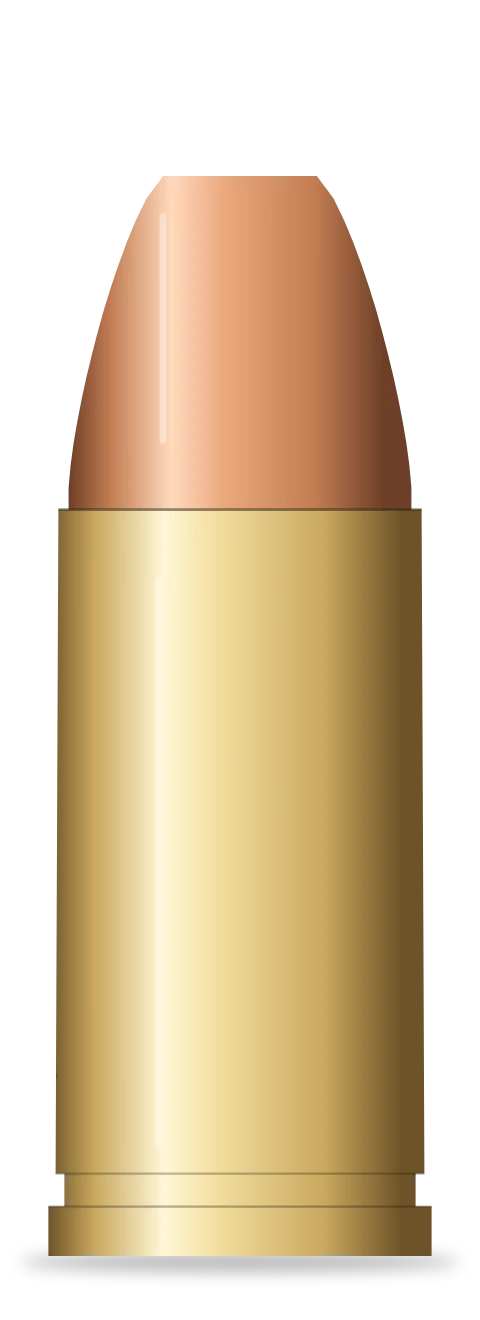
01 / At a glance
The basics
- Origin
- Belgium and United States
- Introduced
- 1899
- Ignition
- Centerfire
- Case form
- Semi-rimmed, straight
- Diameter
- 7.9 mm
- Case length
- 17.3 mm
Rounded values to help you identify the cartridge, not manufacturing drawings. See the cited standard for exact dimensions and tolerances.
Do not mix it up
The cartridge has low energy, so bullet choice and penetration matter. Check what your pistol feeds reliably, and keep in mind that it is a light cartridge.
The .32 ACP, also called the 7.65x17mm Browning SR, is a small semi-rimmed pistol cartridge designed by John Browning and introduced by Fabrique Nationale in 1899. It has very low recoil, and it was widely used in pocket pistols in Europe through much of the twentieth century. It remains in use today in small, light pistols that are easy to carry.
This guide explains what the .32 ACP is, how it performs, how to choose ammunition and a pistol, and how it compares with the .380 ACP, the 9mm Luger and the .45 ACP. It is a reference page, not a loading manual, and it contains no loading data. The cartridge is light, and an honest guide has to say what that means.
A short history
Fabrique Nationale introduced the cartridge in 1899 for the FN Model 1900 pistol, which John Browning designed. It spread quickly. The Colt Model 1903 Pocket Hammerless, the Savage Model 1907, the Browning Model 1910 and the Walther PP and PPK all used it, and dozens of countries and agencies adopted it for police and military use, in some cases in limited numbers.
The cartridge is semi-rimmed and straight-walled, with a case length of .680 inch (17.3 mm) and an overall length of .984 inch (25.0 mm). The bullet diameter is .3125 inch (7.94 mm). The SAAMI maximum average pressure is 20,500 psi, and the C.I.P. figure is about 23,000 psi.
Its fame grew in popular culture after the firearms expert Geoffrey Boothroyd recommended the cartridge for James Bond's Walther PPK. In the United States, its use has grown again with modern compact pistols made for concealed carry, such as the Kel-Tec P32 and the Seecamp LWS 32.
Why people carry it
The first reason is size. The cartridge is small and its pressure is low, so pistols in .32 ACP can be very small and light. A pistol the size of a deck of cards fits in a pocket and weighs little.
The second reason is recoil. The cartridge is easy on the hand, and people with weak hands or arthritis, or those who dislike heavy recoil, shoot it well. A shooter who can place every shot will do better with a gentle cartridge than a harsh one.
The third reason is history and variety. Many classic pistols were made in this caliber, and a collector can find a wide range. The cartridge also suits shooters who want a small backup pistol that is easy to carry in places where a larger pistol is awkward.
It is useful to put the energy in numbers. A typical 71 grain full metal jacket load carries about 129 foot-pounds at the muzzle, and a 75 grain +P load about 220 foot-pounds. A 95 grain .380 ACP load carries about 200 foot-pounds, and a standard 9mm Luger load much more. The .32 ACP is at the light end of the range of cartridges used in defensive pistols, and a shooter should choose it with that in mind.
Specifications at a glance
| Specification | Value |
|---|---|
| Bullet diameter | .3125 in (7.94 mm) |
| Case length | .680 in (17.3 mm) |
| Overall length | .984 in (25.0 mm) |
| Case type | Semi-rimmed, straight |
| Maximum average pressure (SAAMI) | 20,500 psi |
| Maximum pressure (C.I.P.) | About 23,000 psi (1,600 bar) |
| Typical bullet weights | 60 to 75 grains |
| Typical muzzle velocity | About 900 to 1,150 ft/s depending on the load |
| Typical muzzle energy | About 120 to 220 foot-pounds |
Values are rounded for reference. The figures come from test barrels, and a short pistol barrel gives lower velocity.
Strengths and limits
The .32 ACP is a light cartridge. These are the trade-offs to understand.
| Strength | Limit |
|---|---|
| Very low recoil and mild blast | Low energy compared with the .380 ACP and the 9mm |
| Small, light pistols that carry easily | Little margin if a bullet fails to penetrate or expand |
| Low pressure suits simple pistols | Fewer pistols and loads than the 9mm and .380 ACP |
| Long history and many classic pistols | Hollow points may not expand reliably at low speed |
Honest advice: the .32 ACP has less power than the .380 ACP and much less than the 9mm Luger. For self-defense, many shooters choose a larger cartridge when they can handle it. The .32 ACP makes sense if recoil is a real problem, if you want a very small pistol, or if you like the classic guns made for it.
Bullet and ammunition choice
Loads include a 60 grain jacketed hollow point at about 1,100 ft/s, a 65 grain hollow point at about 925 ft/s, a 71 grain full metal jacket at about 905 ft/s, a 73 grain full metal jacket at about 1,040 ft/s and a 75 grain lead +P at about 1,150 ft/s. Penetration is a big factor, so many shooters prefer a full metal jacket bullet that goes deep.
Ballistics
Pistol ballistics are compressed into short distances. The table and charts below show a typical factory load, a 71 grain full metal jacket at 905 ft/s, fired from a pistol zeroed at 25 yards.
| Range (yd) | Velocity (ft/s) | Energy (ft-lb) | Drop (in) | Wind drift, 10 mph (in) |
|---|---|---|---|---|
| 25 | 876 | 121 | 0 | 0.2 |
| 50 | 849 | 113 | -1.9 | 1 |
| 75 | 823 | 107 | -6.9 | 2.2 |
| 100 | 800 | 101 | -15 | 3.9 |
Reading the numbers
From a 25-yard zero the bullet falls about 2 inches at 50 yards and about 15 inches at 100 yards. A 10 mph crosswind moves it about 4 inches at 100 yards. Energy falls from about 129 foot-pounds at the muzzle to about 100 at 100 yards. The bullet is light, so the wind moves it noticeably.
These figures come from a test barrel. A small pistol with a barrel of about 2.7 to 3.8 inches gives lower speed. In gel tests of a 60 grain load, a Kel-Tec P32 with a 2.7 inch barrel recorded 833 to 893 ft/s, and a Beretta 81 with a 3.8 inch barrel recorded 946 to 1,001 ft/s, against a rated 1,000 ft/s.
How these figures were made: the muzzle velocity (905 ft/s) and the weight (71 grains) are a typical full metal jacket load listed for the cartridge. A published ballistic coefficient for this load was not found, so the G1 coefficient (0.120) is an estimate for a round-nose bullet of this shape. Drop, velocity, energy and wind drift are calculated with a standard point-mass model, a 25 yard zero, a sight height of 0.9 inch and standard atmosphere. They are estimates. Your pistol and conditions will differ.
Recoil and shooter comfort
Recoil is mild. Even in a very small pistol, the .32 ACP is gentle, and most shooters can fire it for a long session without fatigue. Tiny pistols have small grips, so hold them firmly.
Many small pistols are blowback designs with strong springs, and the slide can be hard to work. If you have weak hands, look for a pistol that is easy to operate. Always use hearing protection and eye protection.
How to choose ammunition
Match the load to the use and make sure the pistol feeds it reliably.
| Load | Muzzle velocity | Best for | Notes |
|---|---|---|---|
| 60 grain jacketed hollow point | About 1,000 to 1,100 ft/s | Carry | Fast, light bullet |
| 65 grain jacketed hollow point | About 925 ft/s | Carry | Check expansion and feeding |
| 71 grain full metal jacket | About 905 ft/s | Practice and carry | Deep penetration |
| 73 grain full metal jacket | About 1,040 ft/s | Practice | Higher velocity |
| 75 grain lead +P | About 1,150 ft/s | Carry in a pistol rated for it | Check that the pistol allows +P |
For carry, test the load in your pistol and make sure it feeds, fires and ejects with every magazine. For practice, full metal jacket ammunition costs less. Try more than one load, since a small pistol often prefers one.
Check the headstamp and the pistol
The .32 ACP is not the same as the .32 S&W, the .32 S&W Long or the .32 H&R Magnum. Those are different cartridges, and they are not interchangeable. Always read the slide marking and the headstamp.
Cost
The cartridge costs more than the 9mm, and stores stock fewer choices. Plan your practice with that in mind.
Penetration and expansion
The bullet is small and slow, so hollow points may not open reliably, and a pistol with a short barrel makes that worse. A full metal jacket bullet is the common choice for carry in this cartridge because it penetrates deeply and feeds reliably. If you choose a hollow point, test how it feeds, and look at independent test results for the exact load and barrel length.
How to choose a pistol
The right pistol depends on how you will carry and use it. These are the points that matter most.
- Size and weight. A smaller pistol is easier to carry and harder to shoot well. Try several.
- Reliability. Choose a pistol that feeds and ejects the load you will carry. Test it with many rounds.
- Sights. Tiny pistols may have very small sights, so check that you can see them.
- Operation. Check that you can rack the slide and use the magazine release.
- Safety. Learn the manual safety and the trigger of your model.
- Model. Examples include the Kel-Tec P32, the Seecamp LWS 32, the Beretta Tomcat, the Walther PP and PPK and the Browning Model 1910.
- Condition. For an old pistol, have a gunsmith check it before you shoot it.
Handle the pistol in a store before you buy it, and train with it. Check local rules before you carry any firearm.
Zeroing and practice
Pocket pistols are used at short range, usually inside 7 to 10 yards. Practice at those distances and learn to put every shot on the target. A 25-yard zero is a useful reference for the numbers in this guide, but most shooters practice at 7, 10 and 15 yards.
Start slowly and focus on grip, sight picture and trigger control. Practice drawing and firing if you carry, and practice reloading and clearing a stoppage. Dry fire at home, using a safe direction and an unloaded pistol that you have checked more than once.
Shoot from different positions and with both hands. Training with an instructor helps more than extra ammunition.
Pocket pistols reward practice because their short sight radius and small grip make them harder to shoot well than they look. A new owner should expect to spend time on grip and trigger control, and should confirm that the pistol feeds every load he or she plans to carry. Keep a record of how many rounds you fire without a stoppage, and replace magazines that cause problems.
Practical uses
Concealed carry
Small .32 ACP pistols are easy to carry, and some shooters choose them for that reason. Consider the limits of the cartridge when you choose.
Backup pistol
A very small pistol can serve as a backup, since it is light and easy to hide.
Plinking and collecting
Classic pistols in .32 ACP are collected and shot for fun. The mild recoil makes them pleasant to shoot.
Small game
It is not a hunting cartridge. Do not use it for game animals.
.32 ACP vs similar handgun cartridges
The table compares the .32 ACP with the cartridges it is usually weighed against. Figures are rounded and use SAAMI pressures.
| Cartridge | Bullet diameter | Case length | Max pressure | Typical use |
|---|---|---|---|---|
| .32 ACP | .3125 in | 0.680 in | 20,500 psi | Pocket pistols |
| .380 ACP | .355 in | 0.680 in | 21,500 psi | Pocket pistols |
| 9mm Luger | .355 in | 0.754 in | 35,000 psi | All-round pistol and carbine |
| .45 ACP | .452 in | 0.898 in | 21,000 psi | Service and defense pistols |
Against the .380 ACP, the .32 ACP has the same case length and a smaller, lighter bullet with less recoil and less energy. Against the 9mm Luger, it has much less energy and a smaller pistol. Against the .45 ACP, it is a very different cartridge with a much smaller bullet.
Care and storage
Clean the pistol after every session and lubricate it as the maker advises. Check the magazine springs and the extractor, and replace worn parts. Pocket pistols collect lint, so inspect the action. Store the pistol unloaded and locked, with the ammunition separate and away from children. If you carry the pistol in a pocket, use a holster that covers the trigger, and clean the pistol and the carry gear regularly, since lint and moisture build up quickly.
Safety and common mistakes
- Do not confuse .32 ACP ammunition with .32 S&W, .32 S&W Long or .32 H&R Magnum ammunition. Read the slide marking and the headstamp.
- Treat every pistol as loaded. Keep your finger off the trigger until the sights are on the target.
- Keep the muzzle in a safe direction at all times.
- Know your target and what lies beyond it.
- Wear eye and ear protection.
- Test the load you will carry for reliability.
- If you reload, use only published data from a current manual. This page does not contain loading data.
- Store firearms and ammunition locked and apart, away from children.
Frequently asked questions
What is the .32 ACP?
It is a small semi-rimmed pistol cartridge, also called the 7.65x17mm Browning SR, designed by John Browning and introduced by Fabrique Nationale in 1899.
What is the maximum pressure of the .32 ACP?
The SAAMI maximum average pressure is 20,500 psi, and the C.I.P. figure is about 23,000 psi.
How fast is the .32 ACP?
Typical loads shoot a 60 to 75 grain bullet at about 900 to 1,150 ft/s, with about 120 to 220 foot-pounds at the muzzle. Short pistol barrels give lower speeds.
Is the .32 ACP the same as the .32 S&W Long?
No. They are different cartridges and they are not interchangeable. Read the slide marking and the headstamp.
Which pistols use the .32 ACP?
They include the FN Model 1900, the Colt Model 1903, the Browning Model 1910, the Walther PP and PPK, the Beretta Tomcat, the Kel-Tec P32 and the Seecamp LWS 32.
Is the .32 ACP good for self-defense?
It has low energy compared with the .380 ACP and the 9mm Luger. Many shooters choose a larger cartridge when they can handle it. Choose a load that feeds reliably and penetrates well.
Is the .32 ACP better than the .380 ACP?
It has less recoil and less energy. The .380 ACP shoots a larger bullet and is more common today.
Can I reload the .32 ACP?
Yes. Brass, bullets, powder and primers are available. Use only published data from a current manual.
Sources
Sources reviewed · 29 October 2026