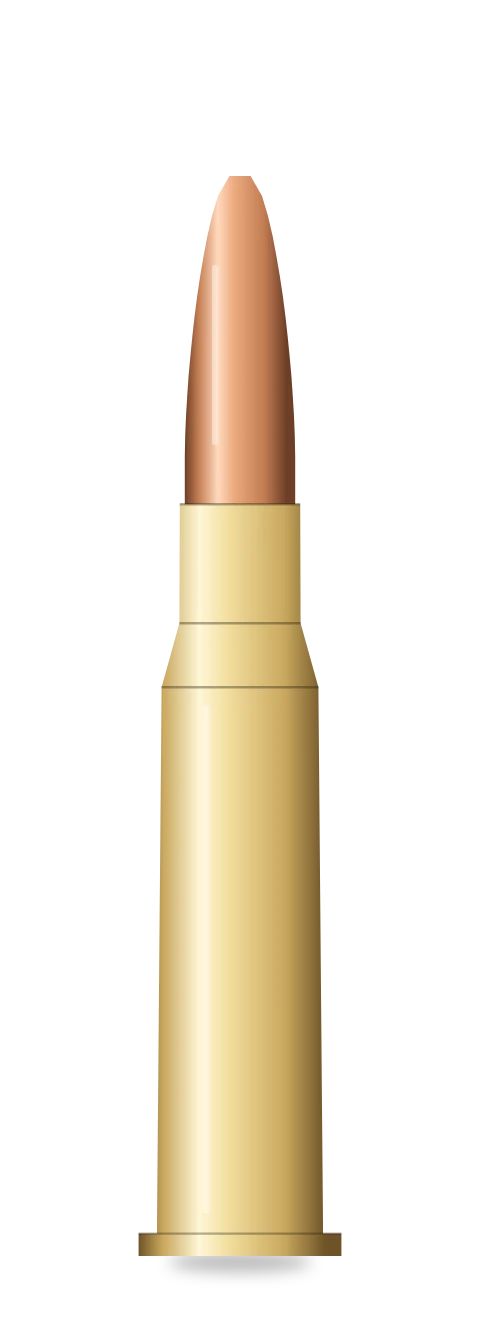
01 / At a glance
The basics
- Origin
- Russia
- Introduced
- 1891
- Ignition
- Centerfire
- Case form
- Rimmed, bottleneck
- Diameter
- 7.9 mm
- Case length
- 53.7 mm
Rounded values to help you identify the cartridge, not manufacturing drawings. See the cited standard for exact dimensions and tolerances.
Do not mix it up
Most surplus ammunition is steel-cased with Berdan primers, which makes handloading harder. Boxer-primed ammunition and brass are now available in the United States.
The 7.62x54mmR is a rimmed bottleneck rifle cartridge that the Russian Empire adopted in 1891 for the Mosin-Nagant rifle. It has been in service for more than 130 years, through the tsarist, Soviet and modern Russian armies, in bolt-action rifles, sniper rifles and machine guns. It is also one of the most common surplus cartridges in the United States.
This guide explains what the 7.62x54R is, how it performs out to 500 yards, how to choose ammunition and a rifle, and how it compares with the .308 Winchester, the .303 British, the 8mm Mauser and the .30-06 Springfield. It is a reference page, not a loading manual, and it contains no loading data. Many rifles that shoot it are old, so condition and inspection matter as much as the cartridge.
A short history
The Russian Empire introduced the cartridge as a service round in 1891 for the Mosin-Nagant bolt-action rifle. Colonel N. F. Rogovtsev is named as its designer. It has been used from the late tsarist era through the Soviet period to the present, and in 2021 it reached 130 years in service.
The case is rimmed and bottlenecked, with a rim of 14.48 mm (.570 inch) and a case length of 53.72 mm (2.115 inches). The overall length is 77.16 mm (3.038 inches). The R in the name stands for rimmed under C.I.P. standards. Some American shooters read it as Russian, and the name 7.62mm Russian is a misnomer.
After the Mosin-Nagant, the cartridge was used in the SVT-40 rifle and the Dragunov SVD and SV-98 sniper rifles, as well as the PKM and Pecheneg general-purpose machine guns. Surplus rifles and ammunition reached the United States in large numbers, and the Mosin-Nagant became one of the most affordable bolt-action rifles a shooter could buy.
The cartridge was designed around a rimmed case, which was normal for the 1890s. The rim lets the extractor grip the case and sets the headspace, and it suits a bolt-action rifle with a box magazine. The same rim makes the cartridge awkward in modern box magazines and automatic actions, so rifles and machine guns that use it are built around the rim. Keep that in mind if you plan to use modern magazines or accessories.
Over a century of production means the cartridge has appeared in many forms: ball, tracer, armor-piercing and sniper loads for the military, and soft point and match loads for civilians. This guide covers the common sporting and surplus loads and does not cover military special-purpose rounds.
Why people shoot it
The first reason is price. A surplus Mosin-Nagant and a case of surplus ammunition cost far less than a new hunting rifle, and the rifle is simple and rugged. For many shooters it was a first centerfire rifle.
The second reason is power. The cartridge sits in the class of the .308 Winchester and the .30-06 Springfield. A 150 grain full metal jacket load leaves at about 2,840 ft/s, a 174 grain boat-tail at about 2,610 ft/s and a 180 grain soft point at about 2,625 ft/s. That is real big game power.
The third reason is history. People collect and shoot the rifles that fought in the wars of the twentieth century, and the cartridge connects them to the Dragunov, the SVT-40 and the PKM. Commercial ammunition and boxer-primed brass are now available in the United States, which makes the cartridge easier to shoot and reload than it used to be.
There is a practical side as well. Results vary a great deal between rifles. A surplus rifle with a clean bore and sound ammunition can shoot acceptably at 100 yards, but the sights and the trigger are usually the limits, and the ammunition affects the result as much as the rifle. Test several loads and keep notes on what each one does in your rifle, since that tells you more than any published figure.
Specifications at a glance
| Specification | Value |
|---|---|
| Bullet diameter | .312 in groove (7.92 mm); .311 in bullets common |
| Land diameter | .300 in (7.62 mm) |
| Case length | 53.72 mm (2.115 in) |
| Overall length | 77.16 mm (3.038 in) |
| Rim diameter | 14.48 mm (.570 in) |
| Case type | Rimmed, bottleneck |
| Maximum pressure (C.I.P.) | 390 MPa (56,565 psi) |
| Typical bullet weights | 150 to 182 grains |
| Typical muzzle velocity | About 2,600 to 2,850 ft/s depending on the load |
Values are rounded for reference. The cartridge is governed by C.I.P., and no SAAMI pressure figure is used in this guide. Velocities are typical factory or test figures and vary with barrel length, and long military barrels give higher numbers than short carbines.
Strengths and limits
The 7.62x54R is a powerful, old military cartridge. These are the trade-offs to understand.
| Strength | Limit |
|---|---|
| Power in the class of the .308 Winchester | Rimmed case, so it feeds poorly in many modern magazine designs |
| Cheap surplus rifles and ammunition | Most surplus ammunition is steel-cased with Berdan primers |
| Long history and wide support in Russia and Eastern Europe | Old rifles vary in condition, and bores vary in size |
| Commercial hunting loads and boxer brass are available | Fewer modern sporting rifles and scope options |
Honest advice: for a modern hunting rifle, the .308 Winchester has more rifles, more ammunition and better scope mounts. The 7.62x54R makes sense if you own or want a Mosin-Nagant, a Dragunov-style rifle or an SVT, or if you collect and shoot military rifles.
Bullet and ammunition choice
Surplus ammunition uses full metal jacket bullets of about 148 to 182 grains. Commercial hunting loads use soft point bullets of 150 to 180 grains. Match-style loads use boat-tail bullets of about 174 to 182 grains.
Ballistics
The table and charts below show one factory load, a Sellier & Bellot 180 grain soft point at 2,625 ft/s, with the rifle zeroed at 100 yards, which suits the iron sights on most of the rifles that use this cartridge.
| Range (yd) | Velocity (ft/s) | Energy (ft-lb) | Drop (in) | Wind drift, 10 mph (in) |
|---|---|---|---|---|
| 100 | 2337 | 2183 | 0 | 1.2 |
| 200 | 2068 | 1708 | -4.9 | 5.1 |
| 300 | 1817 | 1320 | -18 | 12.2 |
| 400 | 1589 | 1009 | -41.7 | 23.2 |
| 500 | 1388 | 770 | -79.2 | 38.7 |
Reading the numbers
With a 100 yard zero the bullet falls about 5 inches at 200 yards, 18 at 300, 42 at 400 and 79 at 500. A 10 mph crosswind moves it about 12 inches at 300 yards, 23 at 400 and 39 at 500. Velocity drops from 2,625 ft/s at the muzzle to about 1,390 ft/s at 500 yards, and energy from about 2,750 to about 770 foot-pounds.
This is the profile of a round-nose or spitzer soft point with a modest ballistic coefficient. It is a good 200 to 300 yard cartridge, but the drop and the wind drift grow quickly past that. The bullet keeps more than 1,300 foot-pounds at 300 yards, which is enough for deer-size game at moderate range.
How these figures were made: the muzzle velocity (2,625 ft/s), the weight (180 grains) and the G1 ballistic coefficient (0.305) are the figures listed by a retailer for the Sellier & Bellot 180 grain soft point load. The barrel length is not stated. Drop, velocity, energy and wind drift are calculated with a standard point-mass model, a 100 yard zero, a sight height of 1.5 inches and standard atmosphere. Iron sights sit at a different height, so the drop will differ. They are estimates. Your rifle and conditions will differ.
Recoil and shooter comfort
Recoil is firm. A surplus Mosin-Nagant is long and fairly heavy, and the stock was not designed for comfort. A recoil pad helps, and many shooters find a few shots at a time enough.
Use good hearing protection, and consider both plugs and muffs on the range. The muzzle blast of a long-barreled rifle with this cartridge is loud. A new shooter will learn faster on a lighter cartridge.
How to choose ammunition
Match the load to the use, and check that it is suited to your rifle.
| Load | Muzzle velocity | Best for | Notes |
|---|---|---|---|
| 150 grain FMJ | About 2,840 ft/s | Range practice | Often steel-cased surplus |
| 174 grain boat-tail | About 2,610 ft/s | Target and long-range | Match-style bullet |
| 181 grain FMJ | About 2,580 ft/s | Range practice | Common commercial load |
| 180 grain soft point | About 2,625 ft/s | Deer and similar game | Expanding hunting bullet |
| 182 grain FMJ boat-tail | About 2,600 ft/s | Practice and target | Boxer-primed brass cases |
For hunting, choose a soft point or a bonded hunting bullet made for the speed. For practice, steel-cased surplus costs less but cannot be reloaded easily. Brass-cased ammunition with Boxer primers can be reloaded.
Check the bullet diameter and the rifle
Old rifles vary. Have a gunsmith check the headspace and the bore of an old military rifle before you shoot it. Use ammunition made for rifles and suited to the rifle.
Cost
Surplus ammunition is the cheapest way to shoot the cartridge, and commercial soft point ammunition costs more. Reloading with boxer brass can lower the cost.
How to choose a rifle
Most shooters buy a surplus rifle, so condition is the main question. These are the points that matter most.
- Condition. Check the bore for pitting and rust, the crown for damage and the stock for cracks.
- Headspace. Have a gunsmith check it, since old rifles can be worn.
- Matching numbers. Collectors value rifles with matching serial numbers, and shooters care more about the bore.
- Bore size. Bores vary between rifles, so ask a gunsmith to measure the bore and choose a bullet diameter to suit it.
- Sights and scope. Many rifles have only iron sights, and mounting a scope usually needs a mount made for the rifle.
- Model. Mosin-Nagant rifles, the SVT-40, the PSL and the Dragunov SVD are common examples.
Buy from a dealer who lets you inspect the rifle, and keep the original bayonet and accessories if the rifle has them. Check local rules, since some old rifles are collectibles.
Zeroing and range practice
A 100 yard zero is a good starting point for iron sights. With a 180 grain soft point the bullet falls about 5 inches at 200 yards and 18 at 300. The distance marks on old rear sights may not match your ammunition, so test them at the range.
Zero at 100 yards on paper first, then confirm at 200. Shoot at 300 and 400 to learn your own drops, and write them on a card. The numbers in this guide are estimates from a model, and your barrel, load and air density will move them. Wind is the main problem past 300 yards, so practice judging it.
Shoot from field positions as well as a bench. Practice at the distances you plan to take, and keep your shots within the range at which you can hit the target area reliably with iron sights.
Practical uses
Range shooting and collecting
Most 7.62x54R rifles are shot at the range and kept as part of a collection. The cartridge suits that use well.
Deer and similar game
With a soft point bullet at 2,625 ft/s the cartridge has the power for deer-size game at 200 to 300 yards, if the shooter can place the shot. Check local rules.
Boar
It handles boar at normal ranges with a soft point or hunting bullet.
Military and sniper history
The Dragunov SVD and SV-98 are modern sniper rifles in the cartridge, and the PKM is a general-purpose machine gun that uses it.
7.62x54R vs similar cartridges
The table compares the 7.62x54R with the cartridges it is usually weighed against. Figures are rounded. The 7.62x54R and the 8mm Mauser are shown by C.I.P. pressure, and the others by SAAMI.
| Cartridge | Bullet diameter | Case length | Max pressure | Typical use |
|---|---|---|---|---|
| 7.62x54R | .311 to .312 in | 2.115 in | 56,565 psi (C.I.P.) | Military surplus and hunting |
| .308 Winchester | .308 in | 2.015 in | 62,000 psi | All-round hunting and target |
| .303 British | .311 in | 2.222 in | 49,000 psi | Surplus rifles and hunting |
| .30-06 Springfield | .308 in | 2.494 in | 60,000 psi | All-round big game |
| 8mm Mauser | .323 in | 2.244 in | 56,560 psi (C.I.P.) | Surplus rifles and hunting |
Against the .308 Winchester, the 7.62x54R has similar power in a rimmed case, with fewer modern rifle options. Against the .303 British, it has a slightly shorter case and similar performance. Against the .30-06, it shoots a similar bullet with less case capacity. The 8mm Mauser shoots a larger bullet.
Care and storage
Clean the bore after every session, and clean it thoroughly after shooting surplus ammunition, since some surplus loads use primers that leave corrosive residue. Oil the bolt and the action, and inspect the stock for cracks. Store the rifle unloaded and locked, with the ammunition separate and away from children.
Safety and common mistakes
- Have an old military rifle checked by a gunsmith before you shoot it.
- Do not confuse 7.62x54R ammunition with 7.62x39mm, .308 Winchester or 7.62x51mm NATO ammunition. Read the headstamp.
- Treat every rifle as loaded. Keep your finger off the trigger until the sights are on the target.
- Know your target and what lies beyond it. A rifle bullet can travel several miles.
- Wear eye and ear protection.
- Check the bore for obstructions before you load.
- If you reload, use only published data from a current manual. This page does not contain loading data.
- Store firearms and ammunition locked and apart, away from children.
Frequently asked questions
What does the R in 7.62x54R mean?
It stands for rimmed under C.I.P. standards. It does not stand for Russian, although the cartridge is Russian in origin.
When was the 7.62x54R adopted?
The Russian Empire adopted it in 1891 for the Mosin-Nagant rifle.
What is the maximum pressure of the 7.62x54R?
The C.I.P. maximum pressure is 390 MPa, or 56,565 psi.
How fast is the 7.62x54R?
A 150 grain load leaves at about 2,840 ft/s, and a 180 grain soft point at about 2,625 ft/s. Long military barrels give higher numbers.
Is the 7.62x54R the same as the .308 Winchester?
No. They are different cartridges with different case designs, and the 7.62x54R is rimmed. Their power is similar.
Can I reload the 7.62x54R?
Yes, with boxer-primed brass. Most surplus ammunition is steel-cased with Berdan primers and is hard to reload. Use only published data from a current manual.
Which rifles use the 7.62x54R?
The Mosin-Nagant, the SVT-40, the PSL and the Dragunov SVD and SV-98 use it, as do the PKM and Pecheneg machine guns.
Is the 7.62x54R good for hunting?
Yes, with a soft point or hunting bullet it is suited to deer-size game at moderate range. Check local rules.
Sources
Sources reviewed · 29 October 2026