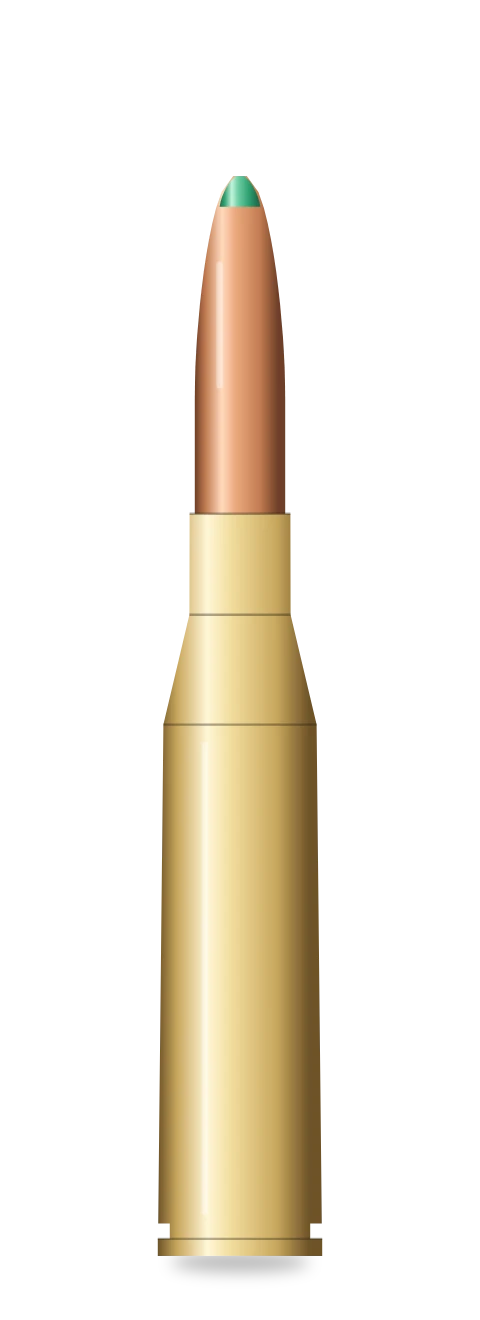
01 / At a glance
The basics
- Origin
- Sweden and Norway
- Introduced
- 1894
- Ignition
- Centerfire
- Case form
- Rimless, bottleneck
- Diameter
- 6.7 mm
- Case length
- 55.0 mm
Rounded values to help you identify the cartridge, not manufacturing drawings. See the cited standard for exact dimensions and tolerances.
Do not mix it up
Old military rifles are not built for the pressure that modern ammunition can reach. Have an old rifle checked by a gunsmith and use ammunition suited to it.
The 6.5x55 Swedish, also called the 6.5x55 SE, the 6.5 Swede and the 6.5x55mm Mauser, is a rimless 6.5 mm rifle cartridge that came out of a joint Norwegian and Swedish effort in the 1890s. It is more than 130 years old and still sold in every hunting country that uses metric cartridges. It fires long, slim bullets at moderate speed, with light recoil and good penetration, and that combination is why it has outlived the rifles it was made for.
This guide explains what the 6.5x55 is, how it performs out to 500 yards, how to choose ammunition and a rifle, and how it compares with the 6.5 Creedmoor, the .308 Winchester and the .30-06 Springfield. It is a reference page, not a loading manual, and it contains no loading data.
A short history
The cartridge was designed in 1891 and standardized in 1893 by a joint Norwegian and Swedish commission. No single person is named as its designer. It entered service in 1894 and stayed in military use until 1995. Norway chambered it in the Krag-Jørgensen M/1894 rifle, and Sweden chambered it in the Mauser m/1896, a rifle based on a Mauser design first made for the 7x57mm cartridge.
The original service load fired a 156 grain round-nosed bullet at about 725 m/s from a 739 mm barrel. From 1941 the Swedish army moved to a 140 grain spitzer boat-tail bullet at about 800 m/s. Denmark also issued two loadings in 1946, one for its Krag rifles and one for more modern rifles such as the Swedish Mauser. The cartridge was used in machine guns as well, including the Madsen, the Schwarzlose, the Browning BAR and the Swedish Kg/1940 and FN MAG. Swedish FN MAG guns were rechambered to 7.62x51mm NATO in the early 1970s.
After the armies moved on, civilians kept it. It was used in fullbore biathlon until 1975, and it became a standard for 1,000 yard target shooting, benchrest and metallic silhouette. Hunters in Scandinavia use it for moose. The cartridge is also the parent of wildcats such as the 6.5x55 Ackley Improved, and the SIG Sauer 200 STR is a modern target rifle made for it.
Why people shoot it
The first reason is the bullet. A 6.5 mm bullet is slim and long for its weight, so it keeps its speed well and resists wind. A 140 grain bullet in a 6.5x55 has a good sectional density, which helps it penetrate, and it does this at a speed that does not tear the bullet apart at close range. That is why it has a name for clean kills on moose and deer in Europe, where the shots are often short and the animal heavy.
The second reason is recoil. In a rifle of normal weight the cartridge is mild. A shooter who is new to centerfire rifles, a young hunter or a person who is sensitive to recoil can shoot it well. It is often described as a cartridge that lets a hunter place a shot rather than brace for one.
The third reason is the base of rifles. Millions of Swedish Mauser rifles were made, and many were sold on the civilian market. Modern sporting rifles are made for it too, so a shooter can pick a classic military surplus rifle, or a new bolt-action. There is also a link to the newer 6.5 Creedmoor. The two use the same bullet diameter and many of the same bullets, so the 6.5x55 is sometimes called the cartridge that showed what a 6.5 could do long before the Creedmoor appeared.
Specifications at a glance
| Specification | Value |
|---|---|
| Bullet diameter | .264 in (6.71 mm); land diameter .256 in (6.50 mm) |
| Case length | 2.165 in (55.0 mm) |
| Overall length | 3.150 in (80.0 mm) |
| Case type | Rimless, bottleneck |
| Case capacity | About 57.9 grains of water |
| Maximum pressure (C.I.P.) | 55,110 psi (380 MPa) |
| Maximum pressure (SAAMI) | 51,000 psi, or 46,000 CUP |
| Rifling twist | 1 in 7.87 in in Swedish Mauser rifles; 1 in 8.66 in is also common |
| Typical bullet weights | 100 to 156 grains |
The two pressure limits differ, and the difference matters. Vihtavuori warns that loads made to the C.I.P. maximum of 380 MPa are not recommended for old Krag-Jørgensen or Swedish Mauser rifles. Modern ammunition from a good maker is made with that in mind, but it is worth knowing before you shoot an old rifle. Values are rounded for reference.
Strengths and limits
The 6.5x55 is a moderate cartridge with a long record. These are the trade-offs to understand.
| Strength | Limit |
|---|---|
| Light recoil and a mild report | Slower than modern 6.5 cartridges with more case capacity |
| Good penetration with heavy-for-caliber bullets | Factory ammunition is less common in the United States |
| Accurate in target rifles | Old rifles may not suit modern high-pressure loads |
| Large base of surplus and sporting rifles | Fewer new rifle models than for the 6.5 Creedmoor |
Honest advice: if you only want a flat-shooting 6.5 and plan to buy new, the 6.5 Creedmoor has more rifles, more ammunition and more bullet choices. The 6.5x55 makes sense when you already own a rifle for it, when you value a classic cartridge, when you hunt in a place where it is standard, or when you shoot a target rifle built around it.
Old rifles and modern ammunition
A military rifle that is a century old is not built to the same standard as a new one. Check the action, the headspace and the bore, and have a gunsmith look at it. Use ammunition made for the rifle, and do not assume that every box sold for the cartridge suits every rifle. Maker information on a box is a better guide than a general rule.
Ballistics
The table and charts below show one factory load, a Federal Power-Shok 140 grain soft point at 2,650 ft/s, with the rifle zeroed at 100 yards. This is a basic hunting load, so the numbers describe a typical field cartridge and not the best the case can do.
| Range (yd) | Velocity (ft/s) | Energy (ft-lb) | Drop (in) | Wind drift, 10 mph (in) |
|---|---|---|---|---|
| 100 | 2449 | 1865 | 0 | 0.8 |
| 200 | 2258 | 1585 | -4.3 | 3.3 |
| 300 | 2075 | 1338 | -15.4 | 7.8 |
| 400 | 1900 | 1123 | -34.7 | 14.5 |
| 500 | 1736 | 937 | -63.6 | 23.6 |
Reading the numbers
With a 100 yard zero the bullet falls about 4 inches at 200 yards, about 15 at 300, about 35 at 400 and about 64 at 500. A 10 mph crosswind moves it about 8 inches at 300 yards, 15 at 400 and 24 at 500. Velocity drops from 2,650 ft/s at the muzzle to about 1,740 ft/s at 500 yards, and energy from about 2,180 to about 940 foot-pounds.
These figures show where the cartridge sits. Out to 300 yards it is a flat and gentle cartridge for deer and moose. At 500 yards the bullet is slower and drops more than a modern high-BC 6.5, and the energy is low for large game. Heavier match bullets with a higher ballistic coefficient do better, but the case size still limits the speed.
How these figures were made: the muzzle velocity (2,650 ft/s), weight (140 grains) and the published velocities at 100 to 500 yards (2,450, 2,258, 2,075, 1,900 and 1,736 ft/s) are Federal figures for its Power-Shok 140 grain Jacketed Soft Point. The ballistic coefficient (G1 0.445) was fitted to match those velocities. Federal publishes 0.438. Drop, velocity, energy and wind drift are calculated with a standard point-mass model, a 100 yard zero, a sight height of 1.5 inches and standard atmosphere. They are estimates. Your rifle and conditions will differ.
Recoil and shooter comfort
Recoil is light to moderate. In a rifle of 7 to 9 pounds, the 6.5x55 kicks less than a .308 Winchester or a .30-06 Springfield and about like a .243 Winchester or a 6.5 Creedmoor. Most adults shoot it well without a muzzle brake. Younger shooters and people who are sensitive to recoil do well with it.
The mild recoil is a real advantage in the field. A shooter who is not afraid of the rifle can hold steady, call the shot and follow through. That helps accuracy more than a small gain in speed does. Wear hearing protection anyway, since even a mild rifle is loud.
How to choose ammunition
Many makers load the cartridge, including Federal and Hornady. Match the bullet to the job, and test the load in your own rifle.
| Load | Muzzle velocity | Best for | Notes |
|---|---|---|---|
| 100 grain hollow point | About 3,200 ft/s | Small game and predators | Light, fast bullet; not for large game |
| 120 grain boat-tail | About 2,810 ft/s | Target and light hunting use | A balanced weight for many rifles |
| 140 grain soft point | About 2,650 ft/s | Deer and moose | The classic weight; Federal Power-Shok |
| 140 grain polymer-tip | About 2,900 ft/s | Deer and larger game | Faster and flatter than a plain soft point |
| 154 grain bullet | About 2,600 ft/s | Moose and heavier game | Heavy bullet for deep penetration |
For hunting, choose a bullet made to expand reliably at the speeds the cartridge produces. The 140 grain weight is the classic choice. For target work, a match bullet shoots with less variation. Try more than one load, since a rifle often prefers one.
Surplus and old ammunition
Military surplus ammunition can be corrosive or old, and the quality varies. Inspect it, and clean the rifle well after shooting any ammunition that may be corrosive. For an old rifle, new ammunition from a known maker is usually the safer and more accurate choice.
How to choose a rifle
The right rifle depends on how you hunt or shoot. These are the points that matter most.
- New or old. A modern bolt-action rifle takes modern ammunition without worry. A Swedish Mauser or Krag is a classic, but have it checked and use suitable loads.
- Condition. For an old rifle, check headspace, the bore and the bolt lugs before you shoot it.
- Barrel length and twist. A 22 to 24 inch barrel is usual for hunting. A 1 in 8 inch twist suits most bullets, and the Swedish Mauser uses about 1 in 7.9 inches.
- Weight. A lighter rifle is easier to carry and kicks harder. A heavier rifle is steadier.
- Trigger and stock. A crisp trigger and a stock that fits give better accuracy than a small gain in speed.
- Optic. A good scope with reliable adjustments suits it. Old rifles may need a mount made for them, and military rifles often keep iron sights.
- Target use. A rifle made for 1,000 yard or silhouette shooting has a heavier barrel and a tighter chamber.
Rifles in the chambering include the Swedish Mauser m/94, m/96 and m/38, Krag-Jørgensen rifles, the SIG Sauer 200 STR and many sporting bolt-action rifles. Not every model is still in production, so check current catalogs.
Zeroing and range practice
A 100 yard zero suits a cartridge of this speed for deer and moose. With a 140 grain soft point the bullet stays within a few inches of the line of sight out to 200 yards, and it drops about 15 inches at 300. That lets you hold on the vital area out to about 250 yards, and it asks for a hold-over beyond that.
Zero at 100 yards on paper first, then confirm at 200 and 300. Write the drops on a card, since the numbers in this guide are estimates from a model, and your barrel, load and air density will move them. Wind is the main problem past 300 yards, so practice judging it.
Shoot from field positions as well as a bench. A hunter rarely gets a bench, and the best group from a rest is not the group you will shoot from sticks or a sling. Practice at the distances you actually plan to take.
Practical uses
Moose and deer
This is its home use. In Scandinavia it is widely used for moose, and it is used for deer in Europe and North America. A good 140 grain bullet and a well-placed shot are the keys. Keep shots in the range where you can place the bullet reliably.
Target and F-Class shooting
The cartridge has a long history in 1,000 yard target shooting, in F-Class and in benchrest. Modern 6.5 mm match bullets with a high ballistic coefficient shoot well from it, though the newer cartridges with more case capacity have taken some of the field.
Metallic silhouette
The 6.5x55 has been used in metallic silhouette shooting, where a heavy bullet that knocks over a steel target is a plus and recoil has to stay low over a long match.
Predators
It works on coyotes, especially with a 100 grain or 120 grain bullet. It is a heavy choice for the job, and a smaller cartridge is more usual.
6.5x55 Swedish vs similar cartridges
The table compares the 6.5x55 with the cartridges it is usually weighed against. Figures are rounded and use SAAMI pressures, except where noted.
| Cartridge | Bullet diameter | Case length | Max pressure | Typical use |
|---|---|---|---|---|
| 6.5x55 Swedish | .264 in | 2.165 in | 51,000 psi | Moose, deer and target |
| 6.5 Creedmoor | .264 in | 1.920 in | 62,000 psi | Target and hunting |
| .308 Winchester | .308 in | 2.015 in | 62,000 psi | Hunting and target |
| .30-06 Springfield | .308 in | 2.494 in | 60,000 psi | All-round big game |
| 7mm-08 Remington | .284 in | 2.035 in | 61,000 psi | All-round deer and pronghorn |
Against the 6.5 Creedmoor, the 6.5x55 has a longer case and a lower pressure limit, and the Creedmoor is faster with modern bullets and has far more rifles and ammunition. Against the .308 Winchester and the .30-06, it kicks less and shoots flatter at similar weights, while the larger cartridges carry more energy. Against the 7mm-08, the choice is mostly about which rifle and ammunition you can find.
Care and storage
Clean the bore after a day of shooting, and take extra care with an old military rifle, which may have a worn bore or rust. Inspect the action, the magazine and the scope mounts for tightness. If you use surplus ammunition that may be corrosive, clean the bore the same day. Store the rifle unloaded and locked, with the ammunition separate and away from children.
Safety and common mistakes
- Do not shoot modern high-pressure ammunition in an old rifle unless a gunsmith says it is safe.
- Check headspace and the bore of any military surplus rifle before you shoot it.
- Treat every rifle as loaded. Keep your finger off the trigger until the sights are on the target.
- Know your target and what lies beyond it. A rifle bullet can travel several miles.
- Wear eye and ear protection.
- Check the bore for obstructions before you load.
- Do not confuse the 6.5x55 with the 6.5 Creedmoor, the 6.5 Grendel or the 6.5 PRC. Read the barrel marking and the headstamp.
- If you reload, use only published data from a current manual and start low. This page does not contain loading data.
- Store firearms and ammunition locked and apart, away from children.
Frequently asked questions
What is the 6.5x55 Swedish?
It is a rimless 6.5 mm rifle cartridge designed in 1891 and standardized in 1893 by a joint Norwegian and Swedish commission. It entered service in 1894 and is still used for hunting and target shooting.
What is the maximum pressure of the 6.5x55?
The C.I.P. maximum is 380 MPa, or 55,110 psi. The SAAMI figure is 51,000 psi, or 46,000 CUP.
Is the 6.5x55 the same as the 6.5 Creedmoor?
No. They use the same bullet diameter, but the cases are different. The 6.5x55 has a longer case of 2.165 inches against 1.920 inches, and a different head. They are not interchangeable.
Can I shoot modern ammunition in an old Swedish Mauser?
Take care. Vihtavuori warns that loads at the C.I.P. maximum are not recommended for old Krag-Jørgensen and Swedish Mauser rifles. Have the rifle checked and use ammunition made for it.
Is the 6.5x55 good for moose?
Yes. It is widely used for moose in Scandinavia, with a 140 grain or heavier bullet and a well-placed shot.
How far can you shoot a 6.5x55?
In target shooting it has been used out to 1,000 yards. For hunting, shoot only at distances where you can place the bullet reliably, which for most hunters is under 400 yards.
What twist rate does the 6.5x55 use?
Swedish Mauser rifles use a twist of 1 in 7.87 inches. Modern rifles often use about 1 in 8.66 inches, though makers vary.
Is the 6.5x55 still made?
Yes. Production continues, and several makers load it for hunting and target shooting.
Sources
Sources reviewed · 29 October 2026