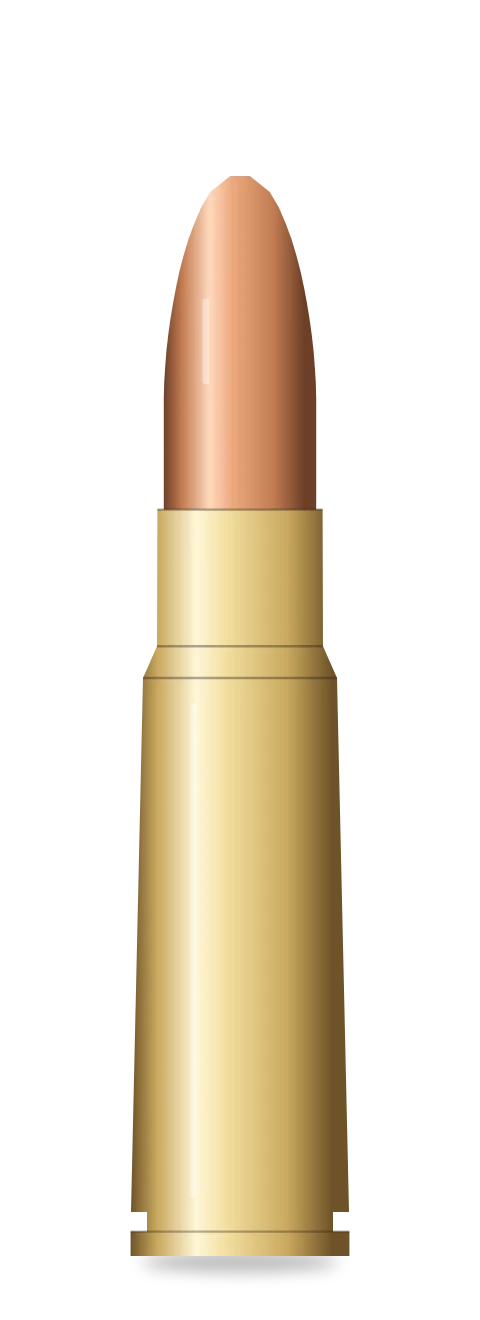
01 / At a glance
The basics
- Origin
- Soviet Union
- Introduced
- 1943
- Ignition
- Centerfire
- Case form
- Rimless, tapered bottleneck
- Diameter
- 7.9 mm
- Case length
- 38.7 mm
Rounded values to help you identify the cartridge, not manufacturing drawings. See the cited standard for exact dimensions and tolerances.
Do not mix it up
Bullet diameter varies between makers and rifles, from about .310 to .312 inch. Use ammunition made for your rifle, and check the marking on the barrel.
The 7.62x39mm is a short, tapered, intermediate rifle cartridge that fires a .311 inch bullet, usually 122 to 125 grains, at about 2,300 to 2,400 ft/s. The Soviet Union designed it in 1943, and it became famous as the cartridge of the AK-47 and the SKS. Today it is also a popular choice for hunting deer and hogs at short range, and a common cartridge for plinking.
This guide explains what the 7.62x39 is, how it performs out to 400 yards, how to choose ammunition and a rifle, and how it compares with the .30-30 Winchester, the 5.56 NATO, the .300 AAC Blackout and the .308 Winchester. It is a reference page, not a loading manual, and it contains no handloading data.
A short history
On 15 July 1943 the Soviet Technical Council decided to develop an intermediate cartridge. It was meant for a semi-automatic carbine, an assault rifle and a light machine gun. The first version was adopted after range trials in December 1943, and pilot production began in March 1944.
In 1947 the bullet was revised. It was given a boat tail and a steel core, and the case was shortened to 38.7 mm. That version, with the Soviet designation 57-N-231S, went into series production in mid-1947. Field tests of a prototype AK-47 followed from late 1947 to early 1948.
The cartridge was fired in the SKS carbine, the AK-47 and its later versions, and the RPD machine gun. It remained the Soviet standard until the 5.45x39mm replaced it in the 1970s. Since then it has stayed in service and in production in many countries.
In the United States it became a hunting and sporting cartridge in the 1990s, when inexpensive surplus ammunition and rifles became common. Ruger and other makers built sporting rifles for it, and AR-15 pattern rifles in this chambering followed.
Why people shoot it
The first reason is the rifle. The AK-47 pattern is one of the best-known rifle designs in the world, and many shooters like its simple, reliable action. The SKS is another long-lived rifle that is easy to find and inexpensive.
The second reason is price. For many years steel-case ammunition from Russia and other countries was among the cheapest centerfire rifle ammunition in the country. Even now, the cartridge is cheaper than most hunting cartridges of its power.
The third reason is that it works. The recoil is light to moderate, and the energy is enough for deer and hogs out to about 150 yards. It has a heavier bullet than the 5.56 NATO and it fits a short action, so the rifles are small and light.
Specifications at a glance
| Specification | Value |
|---|---|
| Bullet diameter | .311 in (7.9 mm), varying from about .310 to .312 in |
| Case length | 1.524 in (38.7 mm) |
| Overall length | 2.205 in (56.0 mm) |
| Case type | Rimless, tapered bottleneck |
| Primer | Varies by maker; many surplus rounds use Berdan primers |
| Maximum average pressure (SAAMI) | 45,010 psi |
| Maximum pressure (C.I.P.) | 51,490 psi |
| Typical bullet weights | 122 to 154 grains; 123 and 124 grains are the most common |
| Typical muzzle velocity | About 2,350 ft/s with a 123 grain bullet from a 20 inch barrel |
| Typical rifling twist | 1 in 9.5 to 1 in 10 inches |
Values are rounded for reference. Exact dimensions and tolerances are in the SAAMI and C.I.P. standards cited at the end of this page.
Strengths and limits
The 7.62x39 is a short-range cartridge with a heavy bullet. It should be judged as one.
| Advantage | Limitation |
|---|---|
| Light to moderate recoil and a compact rifle | The path is curved, and the range is limited to about 200 yards |
| Inexpensive, widely available ammunition | Bullets have a low ballistic coefficient, so wind drift is large |
| Enough energy for deer and hogs at short range | Not a long-range or large-game cartridge |
| A huge variety of rifles | Bullet diameter and quality vary between makers |
Inside 150 yards the cartridge is accurate and effective. Beyond 200 yards the bullet drops quickly and loses energy. A hunter who keeps shots short and uses a bullet made for hunting will find it a good choice.
The cartridge also has an unusual place among sporting rounds. It was designed as a military cartridge for automatic weapons, and its taper helps feed and extract in a rugged action. That same taper is why the cartridge looks stubby and curved. The hunting loads sold today use the same case with better bullets, which is how a service cartridge became a practical short-range hunting round.
Bullet diameter varies
The standards give the bullet a diameter of about .311 inch, but surplus ammunition and some rifles differ. SAAMI lists a range from .309 to .311 inch, and C.I.P. lists .312 inch. Use ammunition made for your rifle, and be careful with very old or unmarked ammunition.
Ballistics
The tables and charts below show one common factory load, a 123 grain SST polymer-tip bullet at 2,350 ft/s from a 20 inch barrel, with the rifle zeroed at 200 yards. A polymer-tip bullet has a better shape than a typical surplus bullet, so surplus ammunition will drop and drift more.
| Range (yd) | Velocity (ft/s) | Energy (ft-lb) | Drop (in) | Wind drift, 10 mph (in) |
|---|---|---|---|---|
| 100 | 2040 | 1137 | 3.5 | 1.6 |
| 200 | 1756 | 843 | 0 | 7.1 |
| 300 | 1503 | 617 | -14.8 | 17.1 |
| 400 | 1290 | 454 | -45.1 | 32.6 |
Reading the numbers
With a 200-yard zero the bullet rises about 3.5 inches above the line of sight at 100 yards, returns to the line at 200 and falls about 15 inches at 300 and 45 at 400. A 10 mph crosswind moves it about 2 inches at 100 yards, 7 at 200, 17 at 300 and 33 at 400. Velocity drops from 2,350 ft/s at the muzzle to about 1,290 ft/s at 400 yards, and energy from about 1,510 to about 450 foot-pounds.
The energy at 200 yards is about 840 foot-pounds, which is below what many hunters want for deer. For that reason most 7.62x39 hunting is done inside 150 yards, where the bullet still carries more than 980 foot-pounds.
How these figures were made: the muzzle velocity (2,350 ft/s), weight (123 grains) and the published velocities at 100 to 400 yards (2,040, 1,755, 1,502 and 1,289 ft/s) are Hornady figures for its BLACK 123 grain SST load from a 20 inch test barrel, and the ballistic coefficient (G1 0.265) is Hornady's published value. The computed velocities and drops match Hornady's published table. Drop, velocity, energy and wind drift are computed with a standard point-mass model, a 200-yard zero, a 1.5 inch sight height and standard atmosphere. They are estimates. Different bullets and barrel lengths change the results.
Recoil and shooter comfort
Recoil is light to moderate. In a 7 pound rifle the 7.62x39 gives a firm, quick push, more than a 5.56 NATO and less than a .308 Winchester. Most shooters handle it well, and young shooters can learn on it with a good stock fit.
Many rifles for this cartridge are semi-automatic, and the action absorbs part of the recoil. The report is sharp in a short barrel, so wear hearing protection.
How to choose ammunition
Choose by purpose first, and check the case material and primer type. Ammunition for the 7.62x39 comes in steel and brass cases.
| Bullet type | Best for | Notes |
|---|---|---|
| FMJ steel-core, 122 to 124 grains | Practice and plinking | Cheap; some ranges do not allow steel-core bullets |
| Soft point, 123 to 154 grains | Deer and hogs at short range | Expands on impact |
| Polymer tip, 123 grains | Deer at longer range | Flatter path and faster expansion |
| Hollow point, 123 to 125 grains | Hunting and defense | Reliable expansion |
| Subsonic, 200 grains or more | Suppressed shooting | Slow and heavy; check your rifle twist |
For hunting, buy a load built for it, with a soft point, a hollow point or a polymer tip. Test it on paper at the distance you expect to shoot. A bullet made for hunting expands on deer, while a military-style full metal jacket bullet often passes through without expanding and is a poor choice for game.
Steel and brass cases
Steel-case ammunition is cheaper. It does not usually work for reloading, and many surplus rounds use Berdan primers, which are difficult to reload. Brass-case ammunition costs more and can be reloaded. Some ranges do not allow steel-core or steel-case ammunition, so check the rules.
Do not mix cartridges
The 7.62x39 is not the same as the .30-30 Winchester, the .300 AAC Blackout or the 7.62x51mm NATO. Check the marking on the barrel before loading.
How to choose a rifle
The right rifle depends on how you will use it. These are the points that matter most.
- Action. AK pattern and SKS rifles are the classic choices. Ruger Mini-30 and AR-15 pattern rifles offer better sights and accuracy. Bolt-action rifles are the most accurate.
- Barrel length. 16 inches is the usual carbine length. A 20 inch barrel gives more velocity.
- Sights. Iron sights are fine inside 100 yards. A red dot or a low-power scope improves accuracy on deer and hogs.
- Condition. A used SKS or AK may have worn parts. Check the bore, the bolt and the headspace.
- Price. A used rifle can be a bargain, but a rifle of better quality shoots more accurately.
- Fit. Try the stock and the sights before you buy.
Zeroing and practice
A 100-yard zero is easy to check and suits most uses inside 150 yards. A 200-yard zero extends the point-blank range, with a rise of about 3.5 inches at 100 yards. Choose one and learn your own numbers.
Practice from field positions and at the distances you expect to hunt. Test your hunting load before the season, because different brands print to different points of aim. Do not assume a zero from steel-case ammunition holds for a polymer-tip hunting load.
Practical uses
Deer and hog hunting
With a bullet made for hunting and a shot inside 150 yards, the 7.62x39 is a capable deer and hog cartridge. Many people compare it to the .30-30 Winchester in power. Check your state rules for minimum caliber and energy.
Anyone who plans to use the cartridge on game should treat it as a close-range tool. Pick the stand or the blind so that the shot is short, wait for a broadside animal, and aim for the vitals. These habits matter more than any difference between brands of ammunition.
Plinking and recreational shooting
It is a fun cartridge to shoot, and affordable ammunition makes it easy to practice. It is popular for steel targets and informal competition.
Home and property protection
Some people keep a 7.62x39 rifle for this. The bullet can pass through walls, so the choice of load and the surroundings matter.
Collecting
Surplus rifles and ammunition have a collecting following, and many people enjoy shooting history.
Large game and long range
It is not a good choice. The bullet is too light and too slow for elk, and the path is too curved for long shots.
7.62x39mm vs similar cartridges
The table lists the cartridges most often compared with the 7.62x39. Figures are rounded, and pressures are from the standards named.
| Cartridge | Bullet diameter | Case length | Max pressure | Typical use |
|---|---|---|---|---|
| 7.62x39mm | .311 in | 1.524 in | 45,010 psi (SAAMI) | AK pattern rifles and deer at short range |
| .30-30 Winchester | .308 in | 2.039 in | 38,000 psi | Deer in brush and timber |
| .300 AAC Blackout | .308 in | 1.368 in | 55,000 psi | Short carbines and suppressed rifles |
| 5.56x45mm NATO | .224 in | 1.760 in | 62,400 psi (NATO EPVAT) | Military, AR-15 rifles, varmints |
| .308 Winchester | .308 in | 2.015 in | 62,000 psi | Hunting and target |
Against the .30-30 Winchester, the 7.62x39 has a similar bullet and a similar power, and it comes in semi-automatic rifles. Against the .300 AAC Blackout, it has a bit more range with supersonic loads, while the Blackout is made for short barrels. Against the 5.56 NATO, it has a heavier bullet and more recoil. Against the .308 Winchester, it has much less power and range.
Care and storage
Clean the bore and the action after each session. Corrosive surplus ammunition was once common, and rifles that fired it should be cleaned with water-based solvent and then oiled. Modern commercial ammunition is non-corrosive, but check the box. Store the rifle unloaded in a dry place. Keep firearms and ammunition locked and out of reach of children and unauthorized users.
Safety and common mistakes
- Do not confuse the 7.62x39 with the .30-30 Winchester, the .300 AAC Blackout or the 7.62x51mm NATO. Read the marking on the barrel.
- Treat every firearm as loaded. Keep your finger off the trigger until your sights are on the target.
- Know your target and what is beyond it. A rifle bullet can travel more than a mile.
- Check that the bore is clear before shooting.
- Wear eye and ear protection at the range.
- Be careful with old surplus ammunition, which can be corrosive or of uncertain quality.
- If you reload, use only published data from a current manual and start low. This page does not contain loading data.
- Store firearms unloaded and locked, and keep the ammunition apart.
Frequently asked questions
Is the 7.62x39 good for deer?
Yes, at short range. With a bullet made for hunting and a shot inside 150 yards, it is a capable deer cartridge. Its power is close to the .30-30 Winchester.
How far can a 7.62x39 shoot?
Most hunters keep shots inside 150 to 200 yards. Past that the bullet drops and drifts a lot and loses energy.
Is 7.62x39 the same as .308 or .30-30?
No. The 7.62x39 uses a .311 inch bullet in a short, tapered case. The .308 Winchester and .30-30 Winchester are different cartridges. They are not interchangeable.
What is the difference between steel and brass case ammunition?
Steel case ammunition is cheaper and usually cannot be reloaded. Brass case ammunition costs more and can be reloaded. Some ranges do not allow steel.
How much recoil does the 7.62x39 have?
Light to moderate. It is more than a 5.56 NATO and less than a .308 Winchester.
Why does bullet diameter vary?
The standards allow a range, from about .309 to .312 inch, and surplus ammunition and some rifles differ. Use ammunition made for your rifle.
Can I use a 7.62x39 for hogs?
Yes, with a hunting bullet and a careful shot at close range.
Can I reload 7.62x39?
Yes, with brass cases. Steel cases cannot normally be reloaded. Use only published data from a current loading manual and follow its safety instructions.
Sources
Sources reviewed · 29 October 2026