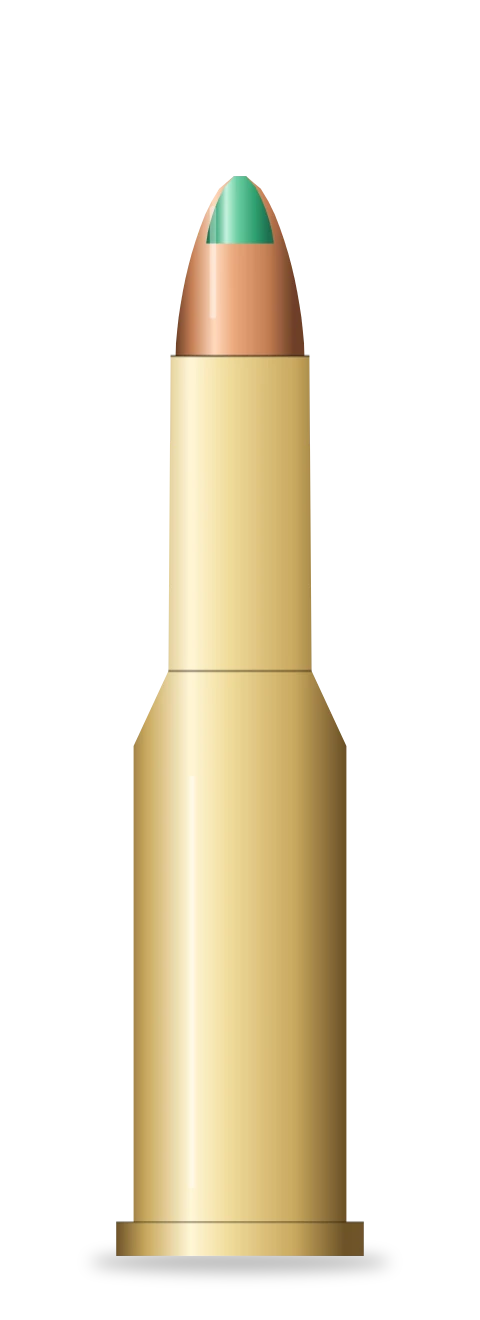
01 / At a glance
The basics
- Origin
- United States
- Introduced
- 2013
- Ignition
- Rimfire
- Case form
- Rimmed, bottleneck
- Diameter
- 4.4 mm
- Case length
- 30.5 mm
Rounded values to help you identify the cartridge, not manufacturing drawings. See the cited standard for exact dimensions and tolerances.
Do not mix it up
The .17 WSM is not interchangeable with the .17 HMR or the .22 WMR. The cartridges have different dimensions, and the .17 WSM runs at higher pressure.
The .17 WSM (.17 Winchester Super Magnum) is the fastest and hardest-hitting rimfire cartridge in common use. It fires a .172 inch bullet of 20 grains at about 3,000 ft/s. It reaches farther than the .17 HMR and is aimed at the same targets: ground squirrels, prairie dogs, rabbits and similar small pests.
This guide explains what the cartridge is, how it performs out to 200 yards, how to choose ammunition and a rifle, and how it compares with the .17 HMR, .22 WMR and .22 LR. It is a reference page, not a loading manual. Rimfire cases cannot be reloaded, so there is no loading data here.
A short history
Winchester and Savage introduced the .17 WSM at the SHOT Show in 2013, after the cartridge was designed in 2012. It was the second rimfire in the .17 family to reach the market in a major way, after the .17 HMR, and it was built to go faster and farther than that cartridge.
The parent of the case is a .27 caliber nail-gun blank, necked down to hold a .172 inch bullet. The result is a longer, larger case than the .17 HMR, with room for more powder. That larger case is the reason for the higher velocity.
Savage launched it with the B-Mag, a rimfire rifle built around the cartridge. Ruger, Winchester and other makers offered rifles in the new chambering as well. Since then the cartridge has found a steady, if smaller, following next to the very popular .17 HMR.
Why people shoot it
The first reason is velocity. A 20 grain load leaves the muzzle at about 3,000 ft/s. A standard .17 HMR load is slower, so the .17 WSM shoots flatter and carries more energy at every distance. At 100 yards the 20 grain bullet still has about 278 ft-lbf of energy in our model.
The second reason is range. A shooter who wants clean kills on small varmints past 150 yards will find the WSM gives more margin than the HMR. The bullet is less affected by wind because it spends less time in flight.
The third reason is that it is still a rimfire. The rifles are light, the report is modest compared with a centerfire, and there is no reloading. A shooter who wants more reach than the .17 HMR without moving to a centerfire like the .22 Hornet or .223 Remington can stay in the rimfire family.
Specifications at a glance
| Specification | Value |
|---|---|
| Bullet diameter | .172 in (4.4 mm) |
| Case length | 1.200 in (30.5 mm) |
| Overall length | About 1.440 to 1.590 in, depending on the load |
| Case type | Rimmed, rimfire, necked |
| Maximum pressure | 33,000 psi |
| Typical bullet weights | 15 to 25 grains; 20 grain is the most common |
| Typical muzzle velocity | About 3,000 ft/s with a 20 grain bullet |
| Reloadable | No. Rimfire case. |
Values are rounded for reference. Factory figures vary by load and barrel length. See the sources at the bottom of this page.
Strengths and limits
The .17 WSM is a fast, flat-shooting small-game and varmint round. It is not a general-purpose cartridge. These are the trade-offs to know.
| Strength | Limit |
|---|---|
| Very flat trajectory for a rimfire | Ammunition costs more than .17 HMR or .22 LR |
| High velocity and energy for its size | Fewer rifles and fewer load choices than the HMR |
| Effective on small varmints at 150 to 200 yards | Too light for anything larger than small pests |
| Light rifles and low recoil | Rimfire ammunition cannot be reloaded |
Honest advice: if a .17 HMR already does what you need, the WSM may not be worth the extra cost. The case for it is longer shots on small targets in open country, where the extra velocity matters.
A heavier case and higher pressure
The .17 WSM works at a maximum pressure of 33,000 psi, compared with 26,000 psi for the .17 HMR. The brass is also about 50 percent thicker. That is the reason the WSM cannot be fired in an HMR rifle, and the reverse is also unsafe. Always use a rifle made for the cartridge.
Ballistics
The table and charts below show a common factory load, a 20 grain V-MAX at 3,000 ft/s, zeroed at 100 yards.
| Range (yd) | Velocity (ft/s) | Energy (ft-lb) | Drop (in) | Wind drift, 10 mph (in) |
|---|---|---|---|---|
| 50 | 2745 | 335 | -0.2 | 0.4 |
| 100 | 2503 | 278 | 0 | 1.7 |
| 150 | 2275 | 230 | -1.2 | 3.9 |
| 200 | 2058 | 188 | -4.1 | 7.3 |
How to read the numbers
With a 100 yard zero, the bullet drops about 1.2 inches at 150 yards and about 4.1 inches at 200 yards. At 50 yards it is a fraction of an inch below the line of sight. A 10 mph crosswind moves the bullet about 1.7 inches at 100 yards and about 7.3 inches at 200 yards. Velocity falls from about 3,000 ft/s at the muzzle to about 2,060 ft/s at 200 yards, and energy from about 400 to about 190 ft-lbf.
These numbers show the shape of the cartridge. It is nearly flat out to 150 yards, and the wind becomes the main problem past that. A light bullet that is fast at the muzzle slows quickly, so wind drift grows faster than drop.
How these figures were made: the muzzle velocity (3,000 ft/s), weight (20 grains) and the published velocities at 100 and 200 yards (2,504 and 2,060 ft/s) come from Hornady for its Varmint Express 20 grain V-MAX load. The ballistic coefficient (G1 0.188) was fitted to match those published figures. Drop, velocity, energy and wind drift are calculated with a standard point-mass model, a 100 yard zero, a 1.5 inch sight height and standard atmosphere. They are estimates. Your rifle may differ.
Recoil and shooter comfort
Recoil is very light. A 20 grain bullet is tiny, and the rifles weigh several pounds. The shooter feels a small push, much less than a centerfire .223 Remington. The report is louder than a .22 LR and sharper than a .17 HMR, so hearing protection is a good idea.
Shot placement matters more than cartridge power in this class, and light recoil helps you see the bullet strike through the scope. Spotting your own hits lets you correct for wind on the next shot, which is how most long varmint shots are made.
Light recoil makes the cartridge easy to shoot well. A beginner can learn on it, and a shooter who fires many rounds in a day will not get tired. This is one reason it suits long sessions on a prairie dog town.
How to choose ammunition
Ammunition for the .17 WSM comes from Hornady and Winchester. The choice is smaller than for the .17 HMR, so there is less to decide.
| Load | Muzzle velocity | Energy | Best for |
|---|---|---|---|
| 15 grain polymer tip | About 3,300 ft/s | High | Small varmints at medium range; very fast |
| 20 grain polymer tip | About 3,000 ft/s | About 400 ft-lbf | General varmint load; the most common |
| 25 grain polymer tip | About 2,600 ft/s | About 375 ft-lbf | Heavier bullet; more penetration and wind resistance |
The 20 grain load is the one to start with. It is the most widely sold, and the ballistics in this guide are for it. A 15 grain bullet is faster and flatter at short and medium range. A 25 grain bullet starts slower but keeps its energy and resists wind better.
Match the ammunition to the rifle
Rimfire rifles can be picky. Buy a few boxes of different loads and shoot groups at 100 yards. Most rifles favor one load. Use that load for the field and keep a few boxes of it.
Bullet weight and wind
Light bullets lose speed quickly and are pushed around by wind more than heavy ones. If most of your shooting is under 125 yards, the 20 grain load is fine. If you often shoot in strong wind or at the edge of your range, try the 25 grain load and compare how it groups and how much it moves in a crosswind. Check the drop at the distances you actually shoot, since the heavier bullet shoots lower at the same zero.
Cost per shot
A box of .17 WSM costs noticeably more than .17 HMR and far more than .22 LR. If you shoot hundreds of rounds in a day on a prairie dog town, the cost adds up. Many shooters use the WSM only for the longer shots and carry a cheaper rifle for the rest.
Use only .17 WSM ammunition
Do not put .17 HMR or .22 WMR ammunition in a .17 WSM rifle, or the reverse. The cases are different. The WSM is a higher pressure cartridge, and a mismatch can cause damage and injury.
How to choose a rifle
Rifles are made in bolt-action, lever-action and semi-automatic form. These are the things to look at.
- Action. Bolt-action rifles are the most common and tend to be the most accurate. Semi-automatic and lever-action rifles are available for the cartridge too.
- Barrel length. A barrel of 20 to 24 inches is common. A longer barrel gets a little more velocity from the cartridge.
- Weight. A light rifle is easy to carry in the field. A heavier barrel is steadier on a bench or shooting sticks.
- Trigger. A clean, light trigger matters a lot with a small target. Many rifles have an adjustable trigger.
- Optic. A scope in the 3 to 9 power range is a common choice. Small targets at 150 yards need a clear sight picture.
- Magazine. Check that the magazine feeds the cartridge reliably. Rimfire magazines can be sensitive.
Rifles for the .17 WSM include the Savage B-Mag, the Ruger 77/17, the Winchester 1885 Low Wall, and a few semi-automatic designs such as the Franklin Armory F17 and the Jard J71 and J72. Not every model is still in production, so check what is available when you shop.
Zeroing and range practice
A 100 yard zero suits most field use. At that zero the bullet is within about 2 inches of the line of sight out to 150 yards, and about 4 inches low at 200. That is close enough to hold on the target out to 150 yards, and to hold over a little at 200.
Shoot a group at 100 yards from a rest, and adjust the scope to bring the group to the point of aim. Then check the drop at 150 and 200 yards, and write down your own numbers. The ones in this guide are estimates from a model, and your rifle and load will differ a little.
Wind is the main problem at longer range. Practice judging it with flags or grass, and take note of how the bullet moves. A wind of 10 mph moves the bullet more than 7 inches at 200 yards, which is more than the size of a prairie dog.
Practical uses
Varmint and pest control
This is the main use. Ground squirrels, prairie dogs, rabbits and similar small animals are the usual targets. The flat trajectory and speed allow clean shots to 150 yards and beyond for a skilled shooter.
Small game
The cartridge can take rabbits and squirrels, but it can damage the meat at close range. Many hunters prefer a .22 LR or a .17 HMR for small game that will be eaten.
Predator control
It is too small for coyotes and other larger predators. For these, use a centerfire such as the .223 Remington or .22-250 Remington. Check local rules, since many places set a minimum for predator hunting.
Target shooting
It is a fun cartridge on the range, and its low recoil helps with accuracy. The ammunition cost is higher than .22 LR, so most people save it for field use.
.17 WSM vs similar rimfire cartridges
The table compares the .17 WSM with the rimfire cartridges it is usually weighed against. Figures are typical factory values and are rounded.
| Cartridge | Bullet diameter | Typical bullet | Typical velocity | Best for |
|---|---|---|---|---|
| .17 WSM | .172 in | 20 gr | About 3,000 ft/s | Varmints to 200 yards |
| .17 HMR | .172 in | 17 gr | About 2,550 ft/s | Varmints to 150 yards |
| .22 WMR | .224 in | 30 to 40 gr | About 1,900 to 2,200 ft/s | Small game and varmints |
| .22 LR | .223 in | 36 to 40 gr | About 1,200 to 1,250 ft/s | Plinking and small game |
Compared with the .17 HMR, the WSM is faster and reaches farther, and it costs more. Compared with the .22 WMR, it is flatter and faster, though the .22 WMR bullet is heavier. Compared with the .22 LR, it is in another class for range, and it costs much more per round.
Care and storage
Clean the bore after a day of shooting, and wipe the action and chamber. Rimfire rifles collect residue and wax from the ammunition, and a dirty chamber can cause feeding trouble. Store the rifle in a dry place, unloaded and locked, with the ammunition kept separately.
Safety and common mistakes
- Do not mix .17 WSM, .17 HMR and .22 WMR ammunition. Read the headstamp and the rifle marking.
- A rimfire bullet can travel more than a mile. Know your target and what is behind it.
- Treat every rifle as loaded. Keep your finger off the trigger until the sights are on target.
- Wear eye and ear protection.
- Do not shoot at hard surfaces such as rocks or water. Fast, light bullets break up and ricochet.
- Keep the bore clear. Check it before you load.
- Store firearms and ammunition locked and apart, away from children.
Frequently asked questions
How fast is the .17 WSM?
A 20 grain bullet leaves the muzzle at about 3,000 ft/s. A 15 grain load is faster, near 3,300 ft/s, and a 25 grain load is slower, near 2,600 ft/s.
Is the .17 WSM better than the .17 HMR?
It is faster, flatter and reaches farther, but costs more and has fewer rifles and loads. For shots inside 150 yards the HMR is often enough.
How far can you shoot a .17 WSM?
It is an effective varmint cartridge out to about 200 yards for a skilled shooter. Wind becomes the main limit past 150 yards.
Can I shoot .17 HMR ammunition in a .17 WSM rifle?
No. The cases are different and the pressures are different. Use only the ammunition the rifle is marked for.
Can the .17 WSM be reloaded?
No. It is a rimfire cartridge, and the case cannot be reloaded.
What is the maximum pressure of the .17 WSM?
The maximum is 33,000 psi, compared with 26,000 psi for the .17 HMR. The case brass is also thicker.
Is the .17 WSM good for coyotes?
No. It is too light. Use a centerfire cartridge such as the .223 Remington or .22-250 Remington for coyotes.
Which rifles are chambered for the .17 WSM?
Examples include the Savage B-Mag, Ruger 77/17, Winchester 1885 Low Wall and some semi-automatic designs. Availability changes, so check current catalogs.
Sources
Sources reviewed · 29 October 2026