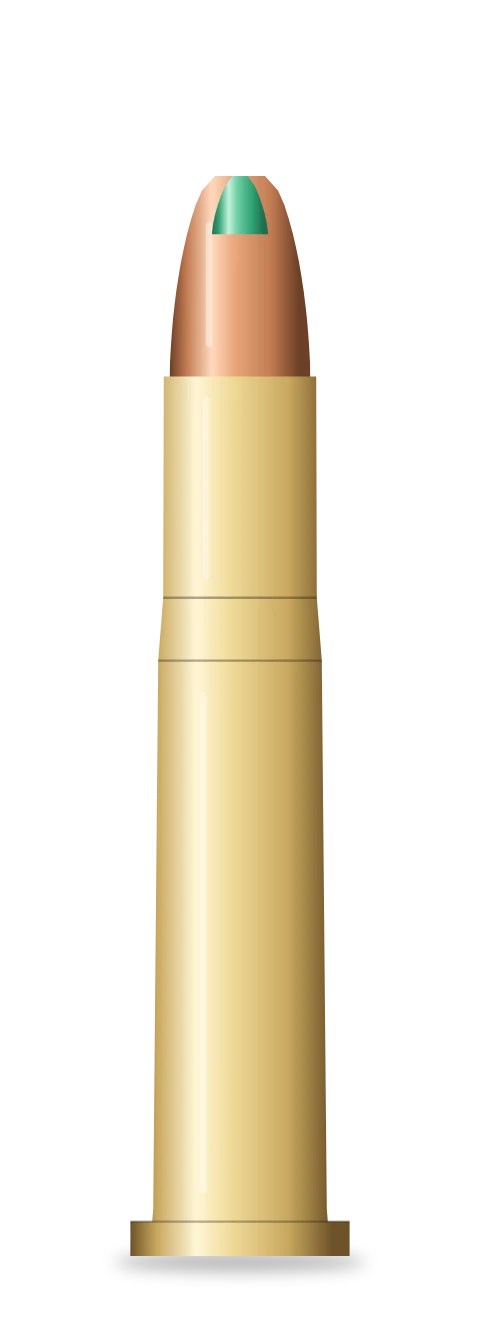
01 / At a glance
The basics
- Origin
- United States
- Introduced
- 1930
- Ignition
- Centerfire
- Case form
- Rimmed, bottleneck
- Diameter
- 5.7 mm
- Case length
- 35.6 mm
Rounded values to help you identify the cartridge, not manufacturing drawings. See the cited standard for exact dimensions and tolerances.
Do not mix it up
The .22 Hornet is not interchangeable with the .223 Remington or other .22 centerfire cartridges. Older rifles may have a .223 inch bore and a slower twist.
The .22 Hornet is a small, mild centerfire rifle cartridge from 1930. It fires a .224 inch bullet of 30 to 46 grains at about 2,500 to 3,100 ft/s, with light recoil and a modest report. It is a classic cartridge for varmints and small game at moderate range, and it is still chosen by shooters who want a quiet, light, easy-to-shoot centerfire.
This guide explains what the .22 Hornet is, how it performs out to 300 yards, how to choose ammunition and a rifle, and how it compares with the .223 Remington, the .22-250 Remington, the .17 HMR and the .22 WMR. It is a reference page, not a loading manual, and it contains no loading data.
A short history
The .22 Hornet was introduced commercially in 1930. Its roots go back to experiments in the 1920s with the old black powder .22 WCF cartridge at Springfield Armory. Townsend Whelen and G. L. Wotkyns are credited with the design, and Winchester made the ammunition.
Winchester adopted the cartridge in 1930 before any commercial rifles existed for it. Rifle makers began to sell guns in 1932, and the Hornet became the first widely available small centerfire for varmints. For many shooters it was the step up from the .22 LR to a cartridge that reached farther and hit harder.
During World War II the U.S. military developed and issued aircrew survival rifles in .22 Hornet, including the M4, a bolt-action with a collapsible stock, the M6, an over-under rifle and shotgun, and the AR-5, a takedown bolt-action. The ammunition used soft-point bullets, and the boxes were labeled for game hunting. After the war, the larger .222 Remington and .223 Remington took much of the market, but the Hornet kept a following for its low noise and low recoil.
Why people still shoot it
The first reason is the report and the recoil. The Hornet is quiet for a centerfire and kicks very little. A shooter can fire many rounds without fatigue, and a young or recoil-sensitive shooter can learn on it. Muzzle blast is modest enough that it is often used near homes and farms where a loud rifle is a problem.
The second reason is the rifle. Hornet rifles are small, light and handy. They suit walking a fence line or carrying in a vehicle, and a 6 pound rifle is common. Ruger, CZ and New England Firearms offer bolt-action and single-shot rifles, and Thompson Center made single-shot pistols for the cartridge.
The third reason is the economy. The cartridge uses little powder, and a handloader can get a lot of shooting from a pound of it, though this guide gives no loading data. Brass lasts well at the cartridge's mild pressure. Factory ammunition is more expensive than .22 LR, but the performance is much greater.
Specifications at a glance
| Specification | Value |
|---|---|
| Bullet diameter | .224 in (5.7 mm); some older rifles use .223 in |
| Case length | 1.403 in (35.6 mm) |
| Overall length | 1.723 in (43.8 mm) |
| Case type | Rimmed, bottleneck |
| Maximum pressure (SAAMI) | 49,000 psi |
| Maximum pressure (C.I.P.) | 43,000 psi |
| Typical rifling twist | 1 in 14 inches (newer rifles); 1 in 16 inches (older rifles) |
| Typical bullet weights | 34 to 46 grains; 35 and 45 grains are the most common |
| Typical muzzle velocity | About 2,500 to 3,100 ft/s |
| Typical muzzle energy | Just over 700 ft-lbf from a rifle |
Values are rounded for reference. Velocities and energies are lower from short-barreled firearms. Exact dimensions and tolerances are in the SAAMI and C.I.P. standards cited at the end of this page.
Strengths and limits
The .22 Hornet is a small-game and varmint cartridge for short and moderate range. It is not a deer cartridge.
| Strength | Limit |
|---|---|
| Very light recoil and modest noise for a centerfire | Bullet slows quickly, with strong wind drift past 150 yards |
| Light, handy rifles | Little energy left past 200 yards |
| Effective on varmints and small game to about 150 yards | Underpowered for deer; illegal for deer in some places |
| Mild on barrels and brass | Fewer rifles and loads than the .223 Remington |
Honest advice: if you shoot varmints past 200 yards in open country, a .223 Remington or .22-250 Remington has more reach and energy and more ammunition choice. The Hornet earns its place at short range, in populated areas, and where you want a light rifle that does not cost much to shoot.
Check the bore and the twist
Some older Hornet rifles have a .223 inch bore and a slow 1 in 16 inch twist, and newer rifles use a .224 inch bore with a 1 in 14 inch twist. Use bullets of the right diameter for your rifle, and test what shoots well. Heavier bullets may not stabilize in a slow twist.
Ballistics
The table and charts below show one factory load, a 35 grain V-MAX bullet at 3,100 ft/s, with the rifle zeroed at 100 yards. A 100 yard zero fits the cartridge, since it is used mostly at short and moderate range.
| Range (yd) | Velocity (ft/s) | Energy (ft-lb) | Drop (in) | Wind drift, 10 mph (in) |
|---|---|---|---|---|
| 50 | 2667 | 553 | -0.1 | 0.7 |
| 100 | 2273 | 401 | 0 | 2.9 |
| 150 | 1913 | 284 | -1.6 | 7 |
| 200 | 1593 | 197 | -5.5 | 13.6 |
| 250 | 1324 | 136 | -13 | 23.3 |
| 300 | 1126 | 99 | -25.4 | 36.5 |
Reading the numbers
With a 100 yard zero the bullet falls about 1.6 inches at 150 yards, 5.5 at 200, 13 at 250 and 25 at 300. A 10 mph crosswind moves it about 3 inches at 100 yards, 14 at 200 and 36 at 300. Velocity drops from 3,100 ft/s at the muzzle to about 2,270 ft/s at 100 yards and 1,590 ft/s at 200, and energy from about 750 to 400 and 200 foot-pounds.
These numbers explain the cartridge. The bullet is light and has a low ballistic coefficient, so it sheds speed and gets pushed by wind. At 100 yards it is a flat, fast varmint round. At 200 yards the wind moves it more than a foot, and at 300 yards it carries under 100 foot-pounds.
How these figures were made: the muzzle velocity (3,100 ft/s), weight (35 grains) and the published velocities at 100, 200 and 300 yards (2,271, 1,590 and 1,126 ft/s) are Hornady figures for its Varmint Express 35 grain V-MAX load as listed by a retailer. The ballistic coefficient (G1 0.111) was fitted to match those published velocities. Drop, velocity, energy and wind drift are computed with a standard point-mass model, a 100 yard zero, a 1.5 inch sight height and standard atmosphere. They are estimates. The retailer's table is printed for a 200 yard zero, and the drop figures here are recomputed for a 100 yard zero.
Recoil and shooter comfort
Recoil is very light. A 35 grain bullet at 3,100 ft/s in a 6 pound rifle gives a small push, less than a .223 Remington and far less than a deer cartridge. The report is sharper than a .22 LR but milder than most centerfires. Use hearing protection anyway.
That makes it a good cartridge to learn on, and a good one for long days. A shooter who flinches with a bigger rifle can recover accuracy with a Hornet, and a lighter rifle is easier to hold steady off sticks.
How to choose ammunition
Hornady, Federal and Winchester load the .22 Hornet. The selection is smaller than for the .223, and many stores stock only a few boxes. Choose the bullet for the job.
| Load | Muzzle velocity | Best for | Notes |
|---|---|---|---|
| 35 grain V-MAX | About 3,060 to 3,100 ft/s | Varmints | Fast, polymer-tip bullet; the load in this guide |
| 45 grain soft point | Below 3,000 ft/s | Small game and varmints | Heavier bullet; tougher on small game |
| 55 grain soft point | About 2,650 ft/s | Small game | Heavier; check twist and fit |
A light 35 grain bullet gives the flattest path, but it breaks up on impact and is easily moved by wind. A 45 grain bullet holds up better on small game and keeps more energy. Test several loads in your rifle, since Hornet rifles are often particular about what they shoot well.
Use ammunition made for the cartridge
Do not use .22 WMR or .223 Remington ammunition in a .22 Hornet rifle, or the reverse. Read the barrel marking and the headstamp. Hornet cases are small and look alike when loose, so keep them in labeled boxes.
Cost
Factory ammunition costs more than .22 LR and often more than .223 Remington, since fewer rounds are made. Handloaders can lower the cost, and brass is long-lived at the cartridge's mild pressure. This page gives no loading data.
How to choose a rifle
The right rifle depends on how you shoot. These are the points that matter most.
- Action. Bolt-action rifles are the most common. Single-shots such as the New England Firearms and Thompson Center designs are light and accurate.
- Weight. A rifle of 5 to 7 pounds is common. A heavier barrel is steadier for varmint shooting.
- Barrel and twist. Check the bore diameter and the twist. A 1 in 14 inch twist handles a wider range of bullets than a 1 in 16 inch twist.
- Magazine. A good detachable magazine feeds the rimmed case smoothly. Rimmed cartridges can catch in a magazine, so test feeding.
- Optic. A low- to medium-power scope suits the range. A 4 to 12 power scope is a common choice for varmints.
- Trigger. A clean, light trigger helps with small targets.
- Used rifles. Older rifles can have worn bores or odd dimensions, so have them checked.
Ruger, CZ, New England Firearms and other makers offer Hornet rifles, and Thompson Center made single-shot pistols for it. Taurus and Magnum Research have made revolvers in the chambering. Availability changes, so check current catalogs.
Zeroing and range practice
A 100 yard zero suits the cartridge. With a 35 grain V-MAX the bullet is on the line of sight at 100 yards, about 1.6 inches low at 150 and about 5.5 inches low at 200. That makes it a good choice for shots out to 150 yards with no holdover and a small holdover at 200.
Zero at 100 yards from a rest, then check your drop at 150 and 200. Wind is the main problem, since a 10 mph crosswind moves the bullet more than a foot at 200 yards. Practice judging wind with flags or grass, and keep shots inside your wind and range limits.
Write down your own drops for your load. The figures in this guide are estimates from a model, and your rifle, barrel length and bullet will differ.
Practical uses
Varmints
This is the main use. Ground squirrels, prairie dogs, rabbits and similar animals are the usual targets. The cartridge is effective to about 150 yards with good shot placement.
Small game
It is used on rabbits, squirrels and turkeys by some hunters, though it can damage the meat at close range. Check the rules in your area before using it on game.
Deer
It is considered underpowered for deer, and some places prohibit it for that use, including the United Kingdom, the Netherlands and some U.S. states. Use a larger cartridge for deer.
Survival rifles and silhouette
The Hornet has a history as a survival cartridge, and light survival rifles have been made for it. It is also used in IHMSA and NRA metallic silhouette shooting.
.22 Hornet vs similar cartridges
The table compares the .22 Hornet with the cartridges it is usually weighed against. Figures are rounded and use SAAMI pressures.
| Cartridge | Bullet diameter | Case length | Max pressure | Typical use |
|---|---|---|---|---|
| .22 Hornet | .224 in | 1.403 in | 49,000 psi | Small varmints at short range |
| .223 Remington | .224 in | 1.760 in | 55,000 psi | Varmints and general use |
| .22-250 Remington | .224 in | 1.912 in | 65,000 psi | Long-range varmints |
Against the .223 Remington, the Hornet has less recoil, less noise and less range. Against the .22-250 Remington, it is much milder and much slower. Against the .17 HMR and .22 WMR rimfires, it hits harder and reaches farther, with rifles that are about as light. Against the .22 LR, it is another class of cartridge for range and energy.
Care and storage
Clean the bore after a day of shooting, and wipe the action and chamber. Small necked cases leave carbon in the chamber, so inspect it from time to time. Check scope mounts and stock screws. Store the rifle unloaded and locked, with the ammunition separate and away from children.
Safety and common mistakes
- Do not confuse the .22 Hornet with the .22 WMR, .223 Remington or other .22 cartridges. Read the barrel marking and the headstamp.
- Treat every rifle as loaded. Keep your finger off the trigger until the sights are on the target.
- Know your target and what lies beyond it. A rifle bullet can travel more than a mile.
- Wear eye and ear protection.
- Do not shoot at hard surfaces such as rocks or water. Light, fast bullets break up and ricochet.
- Check the bore for obstructions before you load.
- If you reload, use only published data from a current manual and start low. This page does not contain loading data.
- Store firearms and ammunition locked and apart, away from children.
Frequently asked questions
What is the .22 Hornet used for?
Mainly varmints and small game at short to moderate range. It is also used in silhouette shooting and as a survival cartridge.
How far can you shoot a .22 Hornet?
It is effective on varmints to about 150 yards. With a 100 yard zero the bullet falls about 5.5 inches at 200 yards and 25 inches at 300, and wind moves it a lot.
Is the .22 Hornet good for deer?
No. It is considered underpowered, and some places prohibit it for deer. Use a larger cartridge.
What is the maximum pressure of the .22 Hornet?
The SAAMI maximum is 49,000 psi, and the C.I.P. maximum is 43,000 psi.
Is the .22 Hornet louder than a .22 LR?
Yes. It is a centerfire cartridge with more powder and a sharper report, but it is milder than most centerfires.
What twist rate does the .22 Hornet use?
Newer rifles are commonly 1 in 14 inches, and older rifles used 1 in 16 inches. Check your rifle before choosing bullets.
Is the .22 Hornet the same as the .223 Remington?
No. The .22 Hornet is a smaller, rimmed, lower-pressure cartridge. They are not interchangeable.
When was the .22 Hornet introduced?
It was introduced commercially in 1930, based on 1920s work with the .22 WCF at Springfield Armory.
Sources
Sources reviewed · 29 October 2026