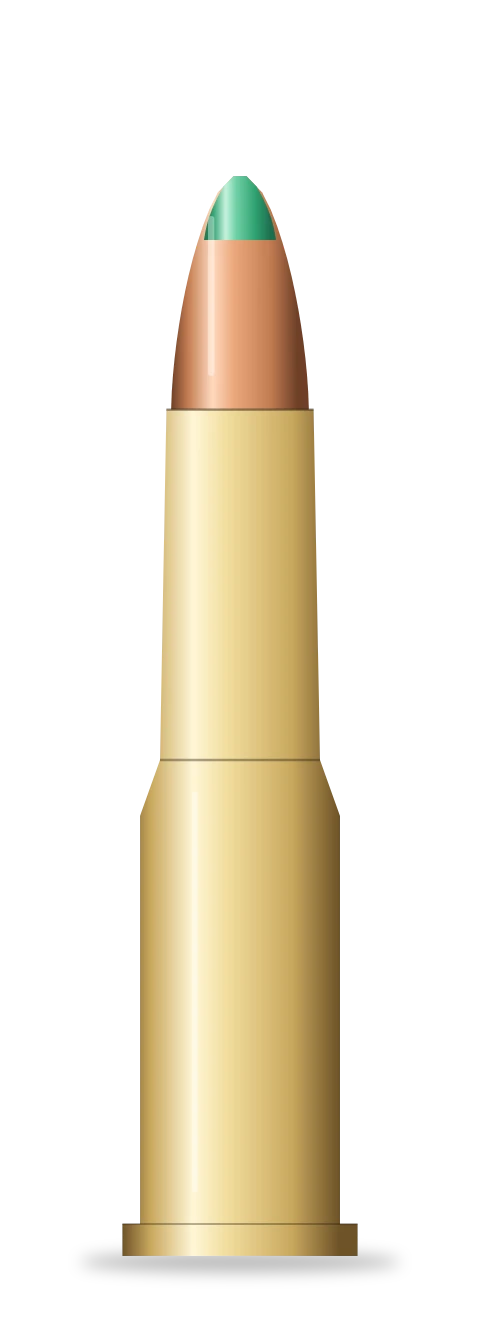
01 / At a glance
The basics
- Origin
- United States
- Introduced
- 2002
- Ignition
- Rimfire
- Case form
- Rimmed, bottleneck
- Diameter
- 4.4 mm
- Case length
- 26.9 mm
Rounded values to help you identify the cartridge, not manufacturing drawings. See the cited standard for exact dimensions and tolerances.
Do not mix it up
.17 HMR is not the same as .17 HM2, .17 WSM or .22 WMR. They look alike, but they are different cartridges. Check the marking on your rifle before you buy ammunition.
The .17 HMR is a small, fast rimfire cartridge. It fires a bullet that weighs less than a paperclip, at speeds that used to belong to centerfire rifles. Since 2002 it has become one of the most popular rimfire choices for ground squirrels, prairie dogs, rabbits and other small pests.
This guide explains what the cartridge is, how it performs, how to choose ammunition and a rifle, and how it compares with the .22 LR, .22 WMR and other .17 rimfire rounds. It is a reference page, not a loading manual. Rimfire cases cannot be reloaded, so there is no loading data here.
A short history
Hornady introduced the .17 HMR in 2002. The name stands for Hornady Magnum Rimfire. The company had been looking for a way to give rimfire shooters a flatter, faster option, and the answer was to neck the .22 WMR case down to hold a .17 inch bullet.
Rifle makers were ready. Marlin, Ruger and Savage all had .17 HMR rifles on the market within a short time. Sales were strong because the cartridge filled a real gap between the cheap, mild .22 LR and the centerfire .22 cartridges used on larger varmints.
Hornady later added the .17 HM2 (2004), a necked-down .22 LR case with a lower velocity, and the .17 WSM (2012), a faster cartridge on a larger case. The HMR remains the most common of the .17 rimfire family.
Why it is so popular
The .17 HMR shoots flat. With a 100 yard zero, a standard 17 grain load stays within a few inches of the line of sight out to 125 yards. That means less guessing about holdover, which is the main reason ground squirrel and prairie dog shooters like it.
It is also pleasant to shoot. Recoil is very light, the report is sharp but not extreme, and the rifles are accurate. A decent .17 HMR rifle can shoot groups of about an inch at 100 yards with good ammunition.
Finally, it is available. Most rifle makers offer at least one model, and ammunition is stocked at most sporting goods stores, although it costs more than .22 LR.
Specifications at a glance
| Specification | Value |
|---|---|
| Bullet diameter | .172 in (4.4 mm) |
| Case length | About 1.06 in (26.9 mm) |
| Overall length | About 1.35 in (34 mm) |
| Case type | Rimmed, bottleneck |
| Ignition | Rimfire |
| Maximum average pressure (SAAMI) | 26,000 psi |
| Typical bullet weights | 15.5 to 20 grains |
| Typical muzzle velocity | About 2,375 to 2,650 ft/s |
| Common barrel twist | 1 in 9 inches |
Values are rounded for reference. Exact dimensions and tolerances are in the SAAMI standards cited at the end of this page.
Strengths and limits
The .17 HMR is a specialist. It does a narrow job very well, and it is not a general-purpose cartridge.
| Advantage | Limitation |
|---|---|
| Very flat trajectory to 125 yards | The light bullet is pushed around by wind |
| Light recoil and good accuracy | Ammunition costs more than .22 LR |
| Quick, clean results on small pests | Not suited to larger game, and rules often forbid it for deer |
| Wide choice of rifles | Bullets can fragment or ricochet on hard surfaces |
Ballistics
The tables and charts below show the CCI 17 grain V-MAX load, which leaves the muzzle at 2,550 ft/s. It is the most common .17 HMR load and a good picture of what the cartridge does.
| Range (yd) | Velocity (ft/s) | Energy (ft-lb) | Drop (in) | Wind drift, 10 mph (in) |
|---|---|---|---|---|
| 25 | 2379 | 214 | -0.5 | 0.2 |
| 50 | 2215 | 185 | 0.1 | 0.8 |
| 75 | 2057 | 160 | 0.3 | 1.8 |
| 100 | 1906 | 137 | 0 | 3.3 |
| 125 | 1762 | 117 | -0.9 | 5.3 |
| 150 | 1627 | 100 | -2.6 | 7.9 |
Reading the numbers
From a 100 yard zero, the bullet is a tenth of an inch high at 50 yards, a third of an inch high at 75 yards and about 2.6 inches low at 150 yards. That is a very small change, which is why you rarely need to adjust for range inside 125 yards. Wind is a bigger problem. A 10 mph crosswind moves the bullet about 3 inches at 100 yards and 8 inches at 150, which is enough to miss a small target.
Energy is about 245 foot-pounds at the muzzle and 137 foot-pounds at 100 yards. That is enough for ground squirrels, rabbits and similar animals, and it falls quickly beyond that. The .17 HMR is a short-range varmint cartridge, not a long-range one.
How these figures were made: muzzle velocity (2,550 ft/s), weight (17 grains) and ballistic coefficient (G1 0.128) are the published figures for the CCI 17 grain V-MAX load. Drop, velocity, energy and wind drift are computed with a standard point-mass model, a 100 yard zero, a 1.5 inch sight height and standard atmosphere. At 50 and 100 yards the model is within a few feet per second of the maker's table. They are estimates. Your rifle and your lot of ammunition will differ.
Recoil and shooter comfort
Recoil is nearly nothing. Rifles in this cartridge barely move when fired, much less than a .243 or a 12 gauge. New shooters and youth can use a .17 HMR without trouble.
The report is a sharp crack, louder than a .22 LR. Hearing protection is important, and a suppressor can make long sessions on a prairie dog town more comfortable where suppressors are legal.
How to choose ammunition
There are only a few bullet weights, so the choice is simpler than for centerfire cartridges. What matters is the bullet type and your intended use.
| Load | Bullet weight | Typical velocity | Best for |
|---|---|---|---|
| V-MAX / polymer tip | 17 grains | About 2,550 ft/s | General varmint shooting |
| Jacketed hollow point | 17 to 20 grains | About 2,375 to 2,550 ft/s | Varmints and small game |
| XTP jacketed | 20 grains | About 2,375 ft/s | More controlled expansion, a little less speed |
| Lead-free (NTX type) | 15.5 grains | About 2,550 to 2,650 ft/s | Areas where lead is restricted |
| Full metal jacket | 20 grains | About 2,375 ft/s | Practice and less meat damage |
Try more than one brand
Rimfire rifles are fussy. One brand and bullet may shoot half-inch groups while another opens up to an inch and a half. Buy a few boxes of different loads and test them from a rest. When you find one that works, buy several boxes from the same lot.
Handle ammunition with care
The bullets are thin-jacketed, and rough handling can bend the case or damage the bullet tip. Keep ammunition dry and out of the heat, and do not carry it loose in a pocket.
How to choose a rifle
Most .17 HMR rifles are bolt-actions, with a few semi-automatics and lever-actions. Choose based on how you plan to use it.
- Action type. Bolt-actions are accurate and affordable. Semi-automatics give fast follow-up shots but cost more, and the .17 HMR can be hard on blowback actions. Lever-actions are fun and handy for walking hunts.
- Barrel. A heavier barrel holds accuracy over a long session. A lighter barrel is easier to carry. Many shooters prefer 18 to 22 inches.
- Trigger. A good, light trigger matters more than any other feature at the small targets this cartridge is used on.
- Magazine and ammunition feeding. Check that the rifle feeds the loads you want to use. Some magazines are fussy with certain bullet shapes.
- Optics. A fixed 4x to 9x scope is a common choice. Mount it solidly, and use good rings.
- Twist rate. Most rifles use 1 in 9 inches, which works well with the common 17 and 20 grain bullets.
Zeroing and range practice
A 100 yard zero is the usual choice because it keeps the bullet within about an inch of the line of sight for most of its effective range. A zero at 75 yards makes sense if most of your shots are closer.
Shoot from a rest, allow the barrel to cool between groups, and shoot a group of five to confirm. Then check how the bullet behaves at 50 and 150 yards, and write the numbers on a card. Learn to estimate wind by watching grass and mirage, because that is what usually causes a miss.
Practical uses
Ground squirrels and prairie dogs
This is the classic use. Shots are often 75 to 150 yards, the target is small, and the flat trajectory is a big help. Many shooters in the West use a .17 HMR for ground squirrel control on farms and ranches.
Rabbits, hares and small game
The bullet is effective on rabbits and similar animals, but expect more meat damage than with a .22 LR. A head or neck shot, or a jacketed load that expands less, helps.
Predators and larger animals
Some hunters use it on foxes or coyotes, but its energy is limited, and bullet performance depends on the exact load and range. In many places the law requires a larger cartridge, so check local rules. For coyotes, a centerfire such as a .223 Remington is the more reliable choice.
Target shooting
The .17 HMR is accurate and fun on paper or steel at 100 yards. It is not common in formal competition, but it is a pleasant plinking cartridge.
.17 HMR vs similar cartridges
The table lists the rimfire cartridges most often compared with the .17 HMR. Figures are rounded and are typical factory values.
| Cartridge | Bullet diameter | Typical bullet | Typical velocity | Max pressure (SAAMI) |
|---|---|---|---|---|
| .22 LR | .222 in | 40 grains | 1,000 to 1,750 ft/s | 24,000 psi |
| .17 HM2 | .172 in | 17 grains | About 2,100 ft/s | See maker data |
| .17 HMR | .172 in | 17 to 20 grains | 2,375 to 2,650 ft/s | 26,000 psi |
| .22 WMR | .224 in | 30 to 40 grains | 1,875 to 2,200 ft/s | 24,000 psi |
| .17 WSM | .172 in | 20 to 25 grains | About 2,600 to 3,000 ft/s | 33,000 psi |
Against the .22 WMR, the .17 HMR is flatter and has less recoil, while the .22 WMR has a heavier bullet that carries more energy and holds up better in wind. The .22 WMR is often the better choice for small predators and slightly larger game. Against the .22 LR, the .17 HMR shoots much flatter and reaches farther, but it costs more per round, often two to three times as much.
Care and storage
The .17 HMR fouls a barrel quickly because of its high speed and thin jackets. Clean the bore regularly with a bore guide and a good copper solvent, and follow the rifle maker's instructions. Avoid cleaning from the muzzle with a rough rod, because damage to the crown ruins accuracy. Store ammunition in a cool, dry place, and keep it locked away from children.
Safety and common mistakes
- Do not mix up rimfire cartridges. .17 HMR, .17 HM2, .17 WSM, .22 WMR and .22 LR can look alike. Read the barrel marking and the headstamp, and do not guess.
- Mind the backstop. The bullet is light, fast and can fragment or ricochet on rocks and hard ground. Know what is behind your target.
- Do not use it on game that needs more power. Check local law on legal calibers for deer and other large game.
- Know your range. A shot beyond 150 yards means large wind drift and little energy.
- Keep the muzzle pointed in a safe direction, and keep your finger off the trigger until you are ready to fire.
- Wear eye and ear protection every time. Rimfire cases cannot be reloaded, so do not try.
Frequently asked questions
What does .17 HMR stand for?
It stands for Hornady Magnum Rimfire. Hornady introduced it in 2002.
How far can a .17 HMR shoot accurately?
Most shooters use it out to about 125 to 150 yards. The trajectory is very flat, but the light bullet is pushed by wind and carries little energy beyond that.
Is the .17 HMR better than the .22 LR?
For longer shots and flatter flight, yes. For close range, cost, quiet loads and general plinking, the .22 LR is more practical. Many hunters own both.
Is the .17 HMR better than the .22 WMR?
It is flatter and has less recoil. The .22 WMR has a heavier bullet that hits harder and handles wind better. Which is better depends on the animal and the range.
Can I hunt deer with a .17 HMR?
No. It does not have enough energy for deer, and in most places it is illegal for that purpose. Use a centerfire cartridge.
Can I reload .17 HMR brass?
No. It is a rimfire cartridge, and the priming compound is inside the rim of the case, so the case cannot be reloaded.
Why does my .17 HMR rifle shoot different groups with different brands?
Rimfire rifles are sensitive to the exact bullet and powder. Try several brands and buy more from the lot that groups best.
Why is .17 HMR ammunition more expensive than .22 LR?
It uses a more complex case and a jacketed bullet, and it is made in smaller volumes. Prices also change with demand.
Sources
Sources reviewed · 29 October 2026