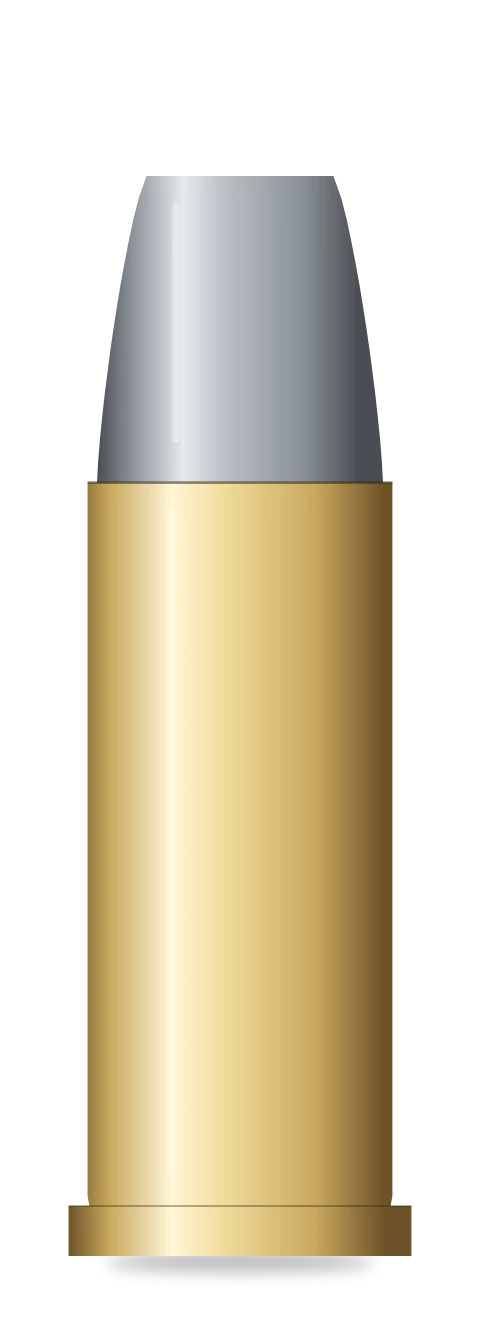
01 / At a glance
The basics
- Origin
- United States
- Introduced
- 1907
- Ignition
- Centerfire
- Case form
- Rimmed, straight-walled
- Diameter
- 10.9 mm
- Case length
- 29.5 mm
Rounded values to help you identify the cartridge, not manufacturing drawings. See the cited standard for exact dimensions and tolerances.
Do not mix it up
A .44 Magnum revolver can fire .44 Special, but a .44 Special revolver must never be loaded with .44 Magnum. Check the marking on the barrel or cylinder.
The .44 Special is a straight-walled revolver cartridge that fires a .429 inch bullet, usually 200 to 250 grains, at about 750 to 900 ft/s from factory ammunition. Smith & Wesson introduced it in 1907. It is a big, heavy bullet at modest speed, which means a firm but friendly push and a lot of authority on target. It is also the cartridge that led directly to the .44 Magnum.
This guide explains what the .44 Special is, how it performs out to 100 yards, how to choose ammunition and a revolver, and how it compares with the .44 Magnum, the .45 Colt, the .357 Magnum and the .38 Special. It is a reference page, not a loading manual, and it contains no handloading data.
A short history
Smith & Wesson introduced the .44 Special in 1907 for its .44 Hand Ejector revolver. It was a lengthened version of the older .44 Russian, with more room for powder. The original load was black powder, and smokeless loads followed.
The .44 Special was never as common as the .38 Special, which was cheaper and lighter, but it found a home with shooters who wanted something bigger. Elmer Keith, a well-known Western writer and shooter, loaded it far above factory strength in the 1920s and 1930s, in strong revolvers. That experiment led to the .44 Magnum in 1955, built on a longer case so that it could not be fired in older guns by mistake.
After the .44 Magnum arrived, the .44 Special faded for a time. It came back in the later decades of the 20th century, as shooters discovered that it was pleasant to shoot, accurate, and deadly enough for most work. Today it is sold in a good range of revolvers, including small carry guns, and in lever-action carbines.
Why it is popular
The first reason is the bullet. A .429 inch bullet of 200 to 250 grains makes a large hole and carries a lot of mass. Even at modest speed it hits harder than the smaller handgun bullets of the same era, and it penetrates well.
The second reason is recoil. A .44 Special in a medium-frame revolver is much gentler than a .44 Magnum and about like a full-power .357 Magnum or a little softer. Most shooters can learn to shoot it well, and they can shoot it for a whole session without fatigue.
The third reason is the revolver itself. The cartridge is a favorite of people who like classic double-action and single-action guns, and it is a joy in a well-made revolver with good sights and a good trigger.
Specifications at a glance
| Specification | Value |
|---|---|
| Bullet diameter | .429 in (10.9 mm) |
| Case length | 1.160 in (29.5 mm) |
| Case type | Rimmed, straight-walled |
| Primer | Large pistol |
| Maximum average pressure (SAAMI) | 15,500 psi |
| Typical bullet weights | 165 to 250 grains; 200 and 240 to 246 grains are the most common |
| Typical muzzle velocity | About 750 to 900 ft/s from a revolver |
| Firearm types | Revolvers and lever-action carbines |
Values are rounded for reference. Exact dimensions and tolerances are in the SAAMI standard cited at the end of this page.
Strengths and limits
The .44 Special is a close-range cartridge for a heavy bullet. It should be judged as one.
| Advantage | Limitation |
|---|---|
| Large, heavy bullet with good penetration | The path is curved, and range is limited to about 50 yards for most shooters |
| Moderate recoil and pleasant to shoot | Fewer factory loads than the .38 Special or .357 Magnum |
| Accurate in a good revolver | Ammunition costs more than for smaller calibers |
| Works in small carry revolvers | Not a hunting cartridge for large game at range |
A shooter who stays inside 50 yards and places the bullet well will find the .44 Special more than enough for defense and for small to medium game at close range. A shooter who wants flat flight and long reach should look at a rifle or a magnum.
The cartridge also rewards the shooter who likes to learn a revolver well. A medium-frame .44 Special is a gun many people keep for decades, passing it down with the holster and the loading notes. It is not a fashion cartridge, and that suits the people who shoot it.
The relationship to the .44 Magnum
The two cartridges use the same bullet diameter. The .44 Magnum case is about one-eighth of an inch longer, and its pressure is more than twice as high. A .44 Magnum revolver can fire .44 Special cartridges, and it is a pleasant way to practice. A revolver made only for the .44 Special must never be loaded with .44 Magnum cartridges. Check the marking on the barrel or the cylinder.
Ballistics
The tables and charts below show one common factory load, a 200 grain semi-wadcutter hollow point at 870 ft/s, with the revolver zeroed at 25 yards.
| Range (yd) | Velocity (ft/s) | Energy (ft-lb) | Drop (in) | Wind drift, 10 mph (in) |
|---|---|---|---|---|
| 25 | 848 | 319 | 0 | 0.2 |
| 50 | 826 | 303 | -2.1 | 0.8 |
| 75 | 806 | 289 | -7.4 | 1.8 |
| 100 | 787 | 275 | -16.1 | 3.2 |
Reading the numbers
With a 25-yard zero the bullet falls about 2 inches at 50 yards, 7 at 75 and 16 at 100. A 10 mph crosswind moves it about 3 inches at 100 yards. Velocity drops from 870 ft/s at the muzzle to about 790 ft/s at 100 yards, and energy from about 336 to about 275 foot-pounds.
Within 50 yards the drop is small enough to ignore in most shooting. Past 75 yards the bullet falls quickly, and a rifle or a magnum is a better tool.
How these figures were made: the muzzle velocity (870 ft/s), weight (200 grains) and the published velocities at 25, 50, 75 and 100 yards (848, 826, 806 and 787 ft/s) are Federal figures for its Champion 200 grain semi-wadcutter hollow point load. The ballistic coefficient (G1 0.143) was fitted to match those published velocities. Drop, velocity, energy and wind drift are computed with a standard point-mass model, a 25-yard zero, a 0.9 inch sight height and standard atmosphere. They are estimates. Velocity depends heavily on barrel length.
Recoil and shooter comfort
Recoil is moderate. In a medium-frame revolver of 35 to 40 ounces, standard loads give a firm push rather than a sharp jolt. It is more than a .38 Special and about like a .357 Magnum, and far less than a .44 Magnum. A small carry revolver of 20 ounces or so kicks harder, and practice with that gun should be done in short sessions.
Good grips matter. A rubber grip spreads the shock across the hand, and a wooden grip can feel sharp with heavy loads. Hearing protection is needed at the range, because the report from a short barrel is sharp.
How to choose ammunition
Choose by purpose first. Most .44 Special loads use a heavy lead or jacketed bullet at modest speed.
| Bullet type | Best for | Notes |
|---|---|---|
| Lead round-nose or flat-nose, 240 to 246 grains | Practice and classic loads | The traditional load; good penetration |
| Lead semi-wadcutter, 200 to 250 grains | Practice and general use | Cuts a clean hole in paper |
| Semi-wadcutter hollow point, 200 grains | Defense | Expands at modest speed |
| Jacketed hollow point, 200 to 210 grains | Defense and hunting small game | Reliable expansion |
| Hard cast, 240 to 250 grains | Heavy game at close range | Deep penetration |
Use ammunition made for the cartridge
Factory .44 Special ammunition is loaded to a modest pressure, suitable for all modern revolvers in good condition. Some hot loads are sold for strong modern guns only. Read the box, and use hot loads only in a revolver made for them.
Buy a few different boxes and see which one your revolver likes. Different bullet shapes and weights often print to different points of aim, and one load may group much better than another in the same gun. Note the best load, and keep a log of its point of impact at 25 yards.
Do not mix cartridges
The .44 Special is not the same as the .44 Magnum, the .44-40 Winchester or the .44 Russian. Check the marking on the barrel or the cylinder before you load.
How to choose a revolver
The right revolver depends on how you will use it. These are the points that matter most.
- Frame size. A medium frame is the classic choice and balances recoil and weight. A large frame is heavier and gentler. A small frame is light to carry and kicks hard.
- Barrel length. 3 to 4 inches is handy for carry. 5 to 6 inches gives more velocity and a longer sight radius.
- Action. Single-action revolvers are traditional and simple. Double-action revolvers are faster and more versatile.
- Sights. Adjustable sights suit range and hunting use. Fixed sights are simple and strong on a carry gun.
- Condition. With a used revolver, check the lockup, the timing and the barrel. Many older guns are in excellent shape, and some are worn.
- Fit. Try the grip and the reach to the trigger before you buy. A revolver that fits shoots better.
Zeroing and practice
A 25-yard zero is convenient for most handgun shooting. Past 25 yards the bullet falls below the line of sight, as the table shows, so a hold-over of a few inches is needed at 75 and 100 yards. Test your load at 25 and 50 yards, and note where it prints.
Practice slowly. Dry-fire practice with an unloaded revolver improves trigger control at no cost. At the range, shoot from a rest at first to confirm the sights, and then shoot standing with two hands. Revolver shooting rewards a smooth trigger press and a steady grip.
Practical uses
Personal defense
A .44 Special revolver is a serious defensive tool. The heavy bullet penetrates well. Choose a load that expands reliably at modest speed, and practice enough to shoot it well.
Backcountry carry
A medium-frame .44 Special is a pleasant gun to carry in the woods. With a hard cast bullet, it is a reasonable choice against wild animals at close range, though a larger cartridge gives more margin.
Hunting small and medium game
It works on small game and on deer at close range with a good bullet and a careful shot. A lever-action carbine gives more velocity and sights for longer shots.
Target shooting and plinking
It is an accurate and pleasant revolver to shoot at the range, and a good choice for steel and paper. Ammunition costs more than for the .38 Special.
Revolver cartridges like this one are also a good way to learn handgun fundamentals. The simple mechanism shows the shooter exactly what happens at each step, and the moderate recoil makes it easier to concentrate on the sights and the trigger than with a hard-kicking magnum.
Collecting and classic shooting
The cartridge has a long history and many classic revolvers are chambered for it. Many owners enjoy it for the history as much as the performance.
.44 Special vs similar handgun cartridges
The table lists the cartridges most often compared with the .44 Special. Figures are rounded and use SAAMI maximum average pressures.
| Cartridge | Bullet diameter | Case length | Max pressure | Typical use |
|---|---|---|---|---|
| .44 Special | .429 in | 1.160 in | 15,500 psi | Defense and revolver shooting |
| .44 Magnum | .429 in | 1.285 in | 36,000 psi | Hunting and heavy loads |
| .45 Colt | .452 in | 1.285 in | 14,000 psi | Revolvers and lever carbines |
| .357 Magnum | .357 in | 1.290 in | 35,000 psi | Defense and hunting |
| .38 Special | .357 in | 1.155 in | 17,000 psi | Defense and target |
Against the .44 Magnum, the .44 Special is far gentler and cheaper to shoot, and it gives up speed and range. Against the .45 Colt, the two are close in power and style. Against the .357 Magnum, it fires a heavier, wider bullet at lower speed. Against the .38 Special, it hits harder and kicks more.
Care and storage
Clean the barrel and the cylinder chambers after each session. Wipe the frame and the area behind the cylinder, where powder residue collects, and use a light oil. Check that the cylinder turns freely and locks up tight. Store the revolver unloaded in a dry place. Keep firearms and ammunition locked and out of reach of children and unauthorized users.
Safety and common mistakes
- Never load .44 Magnum cartridges in a revolver made only for the .44 Special. Read the marking on the barrel or the cylinder.
- Do not confuse the .44 Special with the .44-40 Winchester or the .44 Russian.
- Treat every firearm as loaded. Keep your finger off the trigger until your sights are on the target.
- Know your target and what is beyond it. A handgun bullet can travel more than a mile.
- Check that the barrel is clear and the chambers are empty before loading.
- Wear eye and ear protection at the range.
- Use hot loads only in a revolver made for them.
- If you reload, use only published data from a current manual and start low. This page does not contain loading data.
- Store firearms unloaded and locked, and keep the ammunition apart.
Frequently asked questions
Is the .44 Special good for self-defense?
Yes. It fires a heavy, wide bullet that penetrates well. Choose a load that expands reliably and practice until you shoot it well.
What is the difference between the .44 Special and the .44 Magnum?
They use the same bullet diameter. The .44 Magnum has a longer case and more than twice the pressure, with much more speed and recoil. The .44 Special is gentler and cheaper.
Can I fire .44 Special in a .44 Magnum revolver?
Yes. The shorter cartridge fits and fires safely. It is a pleasant way to practice.
Can I fire .44 Magnum in a .44 Special revolver?
No. The longer cartridge may not fit, and the pressure is far beyond what the gun was made for. Never do it.
How much recoil does the .44 Special have?
Moderate. It is more than a .38 Special, about like a .357 Magnum, and far less than a .44 Magnum.
Is the .44 Special good for hunting?
For small game and deer at close range, yes, with a good bullet and a careful shot. A rifle or a magnum is better for longer shots and larger game.
How far can I shoot a .44 Special?
Most shooters keep shots inside 50 yards. The bullet drops about 16 inches at 100 yards with a 25-yard zero.
Can I reload .44 Special?
Yes. The brass is widely reloaded. Use only published data from a current loading manual and follow its safety instructions.
Sources
Sources reviewed · 29 October 2026