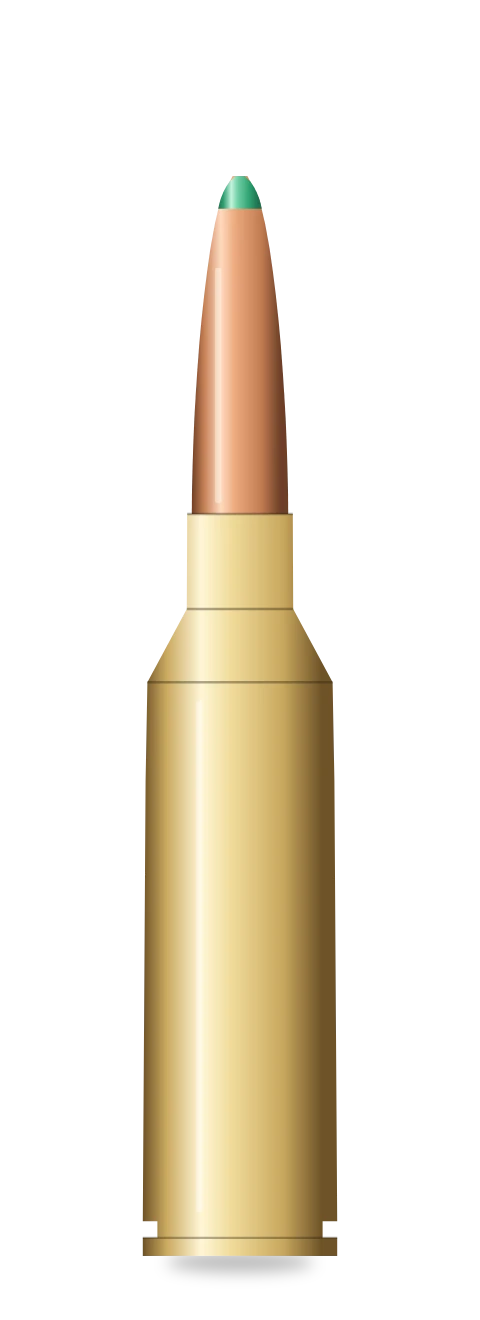
01 / At a glance
The basics
- Origin
- United States
- Introduced
- 2017
- Ignition
- Centerfire
- Case form
- Rimless, bottleneck
- Diameter
- 6.7 mm
- Case length
- 51.6 mm
Rounded values to help you identify the cartridge, not manufacturing drawings. See the cited standard for exact dimensions and tolerances.
Do not mix it up
Many rifles made for the 6.5 Creedmoor will not take the 6.5 PRC, because the cartridge is longer and has a larger case head. Check that the action and magazine are made for it.
The 6.5 PRC (Precision Rifle Cartridge) is a short-action 6.5 mm cartridge from Hornady. It fires the same slim, high-ballistic-coefficient bullets as the 6.5 Creedmoor, but from a larger case that adds roughly 200 to 300 ft/s. That extra speed flattens the trajectory, cuts wind drift and keeps more energy at long range, in a rifle that is still a short action.
This guide explains what the 6.5 PRC is, how it performs out to 500 yards, how to choose ammunition and a rifle, and how it compares with the 6.5 Creedmoor, the 7mm-08 Remington, the .308 Winchester and the .300 PRC. It is a reference page, not a loading manual, and it contains no loading data.
A short history
Hornady announced the 6.5 PRC in 2017, and SAAMI formally adopted it at its June 2018 meeting. The goal, as Hornady described it, was a large velocity gain over the 6.5 Creedmoor while staying inside a short action. The idea owes something to George Gardner of G.A. Precision, whose earlier 6.5 GAP 4S was a .300 SAUM necked down to 6.5 mm.
The case is based on the .375 Ruger, which is itself a .300 RCM case. Hornady necked it down to 6.5 mm, gave it a 30 degree shoulder and set the maximum pressure at 65,000 psi. The result holds about 67.7 grains of water, against about 53.3 grains for a Creedmoor case.
It arrived in the same period as the .300 PRC, and the two share the name and the idea. One is a fast 6.5 for a short action. The other is a heavy-bullet .30 caliber for a long action. Rifle makers including Christensen Arms, Gunwerks, Savage, Seekins Precision and Sauer have chambered the 6.5 PRC.
Why people shoot it
The first reason is velocity with the bullets that already work. A 143 grain ELD-X leaves a 24 inch barrel at about 2,960 ft/s, while the same weight in a 6.5 Creedmoor leaves at about 2,700 ft/s. That is an advantage of about 260 ft/s, and the difference grows with range.
The second reason is wind. In Hornady's comparison with a 147 grain ELD Match bullet, the PRC arrives at 1,000 yards at 1,737 ft/s, against 1,574 ft/s for the Creedmoor, with 53.7 inches of drift in a 10 mph wind against 60.7 inches. Hornady lists the 147 grain load as supersonic to 1,675 yards.
The third reason is that it stays a short-action cartridge. Hunters who want more reach than a 6.5 Creedmoor, but not the recoil or weight of a magnum, find the 6.5 PRC a middle path. It is not a small gain for the price. It is a real step, with a real cost in recoil, barrel life and ammunition price.
Specifications at a glance
| Specification | Value |
|---|---|
| Bullet diameter | .264 in (6.7 mm) |
| Case length | 2.030 in (51.6 mm) |
| Overall length | 2.955 in (75.1 mm) |
| Case type | Rimless, bottleneck, 30 degree shoulder |
| Case head diameter | 0.532 in |
| Case capacity | About 67.7 grains of water |
| Maximum average pressure (SAAMI) | 65,000 psi |
| Typical bullet weights | 140 to 147 grains for most uses |
| Typical muzzle velocity | About 2,900 to 2,960 ft/s with 143 to 147 grain bullets |
Values are rounded for reference. Exact dimensions and tolerances are in the SAAMI standard cited at the end of this page. The overall length is longer than many factory short-action magazines were made for.
Strengths and limits
The 6.5 PRC is a long-range hunting and target cartridge in a short action. These are the trade-offs to understand.
| Strength | Limit |
|---|---|
| About 260 ft/s faster than the 6.5 Creedmoor with the same bullet | More recoil and muzzle blast than the Creedmoor |
| Flatter trajectory and less wind drift | Ammunition costs more and has fewer choices |
| Fits a short action | Needs a rifle and magazine made for the longer overall length |
| Good bullet choice, with high-BC hunting and match bullets | Higher pressure and speed wear a barrel faster |
Honest advice: if your shots stay inside 400 yards, a 6.5 Creedmoor or a 7mm-08 Remington is easier on the shoulder and the wallet. The 6.5 PRC makes sense when you shoot at 500 yards or more, in strong wind, or at animals the Creedmoor takes only at its limit.
Magazine and action fit
The cartridge is longer than a Creedmoor, with an overall length of 2.955 inches. A short-action Remington 700 needs an aftermarket internal box magazine to hold it, since the factory short-action magazine is too short. Rifles made for the cartridge are built around this, so buy a rifle chambered for the PRC and do not try to rechamber a Creedmoor rifle without checking the action and magazine.
Ballistics
The table and charts below show one factory load, a 143 grain ELD-X Precision Hunter bullet at 2,960 ft/s from a 24 inch test barrel, with the rifle zeroed at 200 yards. This is a hunting load with a high-BC bullet.
| Range (yd) | Velocity (ft/s) | Energy (ft-lb) | Drop (in) | Wind drift, 10 mph (in) |
|---|---|---|---|---|
| 100 | 2808 | 2503 | 1.5 | 0.5 |
| 200 | 2661 | 2248 | 0 | 2 |
| 300 | 2519 | 2014 | -6.4 | 4.5 |
| 400 | 2381 | 1800 | -18.2 | 8.2 |
| 500 | 2247 | 1603 | -36.2 | 13.2 |
Reading the numbers
With a 200 yard zero the bullet rises about 1.5 inches above the line of sight at 100 yards, returns to the line at 200 and falls about 6 inches at 300, 18 at 400 and 36 at 500. A 10 mph crosswind moves it about 4.5 inches at 300 yards, 8 at 400 and 13 at 500. Velocity drops from 2,960 ft/s at the muzzle to about 2,250 ft/s at 500 yards, and energy from about 2,780 to about 1,600 foot-pounds.
The energy figure is worth noting. At 500 yards the bullet still carries about 1,600 foot-pounds, a number many hunters use as a rough guide for deer-size game, though bullet construction and shot placement matter more than any single number. For elk, check the minimum energy and caliber rules in your area, and consider a heavier bullet or a larger cartridge.
How these figures were made: the muzzle velocity (2,960 ft/s), weight (143 grains) and the published velocities at 100 to 500 yards (2,808, 2,661, 2,519, 2,381 and 2,248 ft/s) are Hornady figures for its Precision Hunter 143 grain ELD-X load from a 24 inch test barrel. The ballistic coefficient (G1 0.633) was fitted to match those published velocities. Drop, velocity, energy and wind drift are computed with a standard point-mass model, a 200 yard zero, a 1.5 inch sight height and standard atmosphere. They are estimates. Your rifle and conditions will differ.
Recoil and shooter comfort
Recoil is moderate. In a rifle of 8 to 10 pounds, the 6.5 PRC kicks harder than a 6.5 Creedmoor or a .308 Winchester and less than a .300 Winchester Magnum. Most adults shoot it well with a proper stock fit and a recoil pad. Lighter hunting rifles kick harder, and a muzzle brake cuts recoil while raising the noise for everyone nearby.
A new shooter will learn faster on a lighter cartridge. Move up when you can place shots well, since a flinch costs more accuracy than the extra velocity gains. Use good hearing protection, and consider both plugs and muffs on the range.
How to choose ammunition
Hornady makes the most common loads for the cartridge. Match the bullet to the job, and test the load in your own rifle.
| Load | Muzzle velocity | Best for | Notes |
|---|---|---|---|
| 143 grain ELD-X Precision Hunter | About 2,960 ft/s | Deer, pronghorn and elk-size game | Polymer-tip hunting bullet with high BC |
| 147 grain ELD Match | About 2,910 ft/s | Target and long-range practice | Match bullet; supersonic to about 1,675 yards |
For hunting, choose a bullet made to expand reliably at the speeds the cartridge produces. The 143 grain ELD-X is a common choice. For practice and target work, a match bullet shoots with less variation. Try more than one load, since rifles often prefer one.
Check the headstamp and the rifle
Do not put 6.5 PRC ammunition in a 6.5 Creedmoor rifle, or the reverse. The cases differ in length and in head size. A cartridge that chambers in the wrong rifle can be dangerous. Always read the barrel marking and the headstamp.
Cost
Factory ammunition for the 6.5 PRC costs more than for the 6.5 Creedmoor, and stores stock fewer choices. Plan your practice with that in mind. Many shooters practice with a cheaper rifle and use the PRC for the field and for the shots that need it.
How to choose a rifle
The right rifle depends on how you hunt or shoot. These are the points that matter most.
- Chambering and magazine. Buy a rifle made for the 6.5 PRC. Its overall length of 2.955 inches needs a magazine made for it.
- Barrel length. 22 to 24 inches is common for hunting, and 24 to 26 inches for target use. Longer barrels give more velocity.
- Twist rate. Long, high-BC 6.5 mm bullets need a fast twist. Check the rate the maker uses and match it to the bullets you plan to shoot.
- Weight. A lighter rifle is easier to carry and kicks harder. A heavier rifle is steadier and kicks less.
- Trigger. A clean, crisp trigger improves accuracy at long range.
- Optic. A good variable-power scope with reliable adjustments suits the cartridge. Long-range shooters often use a first focal plane scope with a ballistic reticle.
- Barrel life. High velocity and pressure wear a barrel faster than a Creedmoor does, so shooters who put many rounds downrange should plan for it.
Makers who have offered rifles in 6.5 PRC include Christensen Arms, Fierce Firearms, G.A. Precision, Gunwerks, Hill Country Rifles, Horizon Firearms, McRee Precision, Montana Rifles, PROOF Research, Savage Arms, Sauer, Stuteville Precision and Trident Armory. Not every model is still in production, so check current catalogs.
Zeroing and range practice
A 200 yard zero is a good starting point for hunting. With a 143 grain ELD-X the bullet stays within about 1.5 inches of the line of sight out to 150 yards, and drops about 6 inches at 300 yards. That lets you hold on the vital area out to about 250 yards, and hold over only a little beyond that.
Zero at 100 yards on paper first, then confirm at 200. Shoot at 300, 400 and 500 to learn your own drops, and write them on a card. The numbers in this guide are estimates from a model, and your barrel, load and air density will move them. Wind is the main problem past 400 yards, so practice judging it.
Shoot from field positions as well as a bench. A hunter rarely gets a bench, and the best group from a rest is not the group you will shoot from a pack or sticks. Practice at the distances you actually plan to take.
Practical uses
Deer and pronghorn
The 6.5 PRC is effective on deer and pronghorn at long range with a good bullet. It shoots flat enough to allow clean shots at 300 to 400 yards for a skilled shooter, though closer is better.
Elk
With a tough, well-constructed bullet it is used for elk, and some hunters choose it for that. Many others prefer a larger cartridge, such as a .30 caliber, for the extra margin. Check your local rules on the minimum caliber and energy, and keep shots in the range you can place well.
Long-range target and competition
The name says it. The cartridge was made for precision rifle shooting and long-range target work. Match bullets with high BC and a fast case keep the bullet supersonic well beyond 1,000 yards.
Predators
It works on coyotes, though the recoil and cost make it a heavy choice for the job. A lighter cartridge like the .243 Winchester or .223 Remington is more usual.
6.5 PRC vs similar cartridges
The table compares the 6.5 PRC with the cartridges it is usually weighed against. Figures are rounded and use SAAMI pressures.
| Cartridge | Bullet diameter | Case length | Max pressure | Typical use |
|---|---|---|---|---|
| 6.5 PRC | .264 in | 2.030 in | 65,000 psi | Long-range hunting and target |
| 6.5 Creedmoor | .264 in | 1.920 in | 62,000 psi | Target and hunting |
| 7mm-08 Remington | .284 in | 2.035 in | 61,000 psi | All-round deer and pronghorn |
| .308 Winchester | .308 in | 2.015 in | 62,000 psi | Hunting and target |
| .300 PRC | .308 in | 2.580 in | 65,000 psi | Long-range hunting and target |
Against the 6.5 Creedmoor, the PRC is faster and flatter and costs more in recoil, barrel wear and ammunition. Against the 7mm-08 Remington, it shoots flatter but with a higher pressure and fewer rifles. Against the .308 Winchester, it has a clear advantage at long range, and the .308 has far more rifles and ammunition. Against the .300 PRC, it is lighter and gentler, while the .300 PRC carries more energy with heavy bullets.
Care and storage
Clean the bore after a day of shooting, and follow the barrel maker's advice on copper and carbon. High-velocity cartridges can leave more fouling, and a clean bore helps accuracy. Inspect the action, the magazine and the scope mounts for tightness. Store the rifle unloaded and locked, with the ammunition separate and away from children.
Safety and common mistakes
- Do not confuse the 6.5 PRC with the 6.5 Creedmoor. Read the barrel marking and the headstamp.
- Treat every rifle as loaded. Keep your finger off the trigger until the sights are on the target.
- Know your target and what lies beyond it. A rifle bullet can travel several miles.
- Wear eye and ear protection. A fast cartridge has a sharp report.
- Check the bore for obstructions before you load.
- Do not take shots beyond the range at which you can place bullets reliably. Distance is a skill that needs practice.
- If you reload, use only published data from a current manual and start low. This page does not contain loading data.
- Store firearms and ammunition locked and apart, away from children.
Frequently asked questions
How much faster is the 6.5 PRC than the 6.5 Creedmoor?
With a 143 grain bullet, about 2,960 ft/s against about 2,700 ft/s from factory loads, an advantage of about 260 ft/s. The difference grows with range.
Can I shoot 6.5 PRC in a 6.5 Creedmoor rifle?
No. The case is longer and has a larger head, and the cartridges are not interchangeable. Use only the ammunition the rifle is marked for.
What is the maximum pressure of the 6.5 PRC?
The SAAMI maximum average pressure is 65,000 psi, compared with 62,000 psi for the 6.5 Creedmoor.
Is the 6.5 PRC a short-action cartridge?
Yes. It is made for a short action, but its overall length of 2.955 inches needs a magazine made for it. A factory short-action Remington 700 magazine is too short.
Is the 6.5 PRC good for elk?
It is used for elk with a tough, well-constructed bullet and good shot placement, but many hunters prefer a larger cartridge for the extra margin. Check local rules.
How far can you shoot a 6.5 PRC?
Hornady lists its 147 grain ELD Match load as supersonic to 1,675 yards. For hunting, shoot only at the distances where you can place the bullet reliably.
Is the 6.5 PRC harder on barrels than the 6.5 Creedmoor?
Yes. Higher pressure and velocity wear a barrel faster. The difference matters mainly for shooters who fire many rounds.
Where did the 6.5 PRC come from?
Hornady announced it in 2017 and SAAMI adopted it in June 2018. The case is based on the .375 Ruger necked down to 6.5 mm.
Sources
Sources reviewed · 29 October 2026