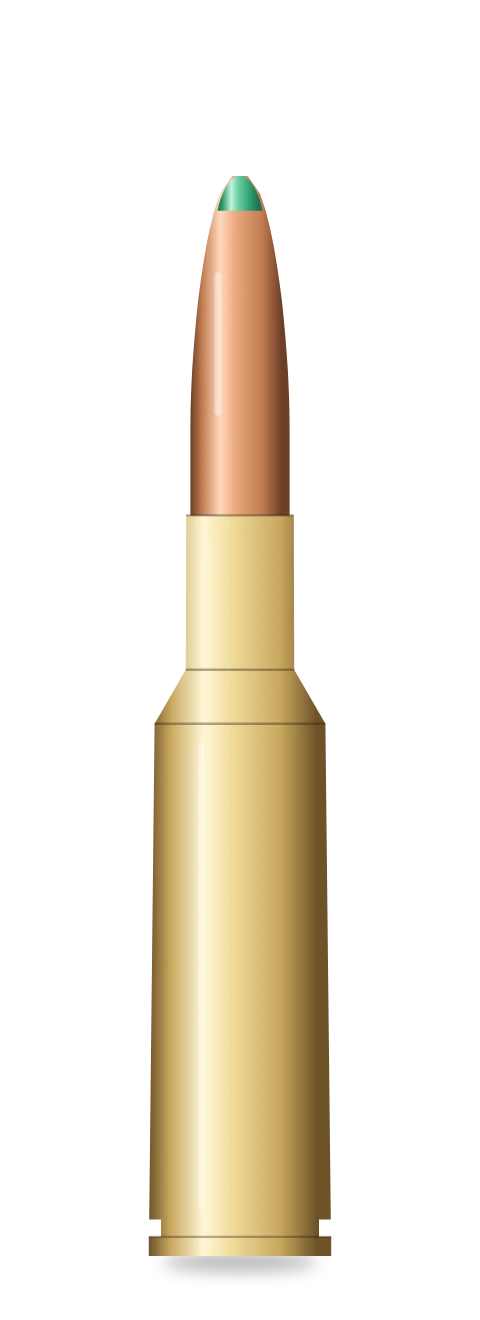
01 / At a glance
The basics
- Origin
- United States
- Introduced
- 2025
- Ignition
- Centerfire
- Case form
- Rimless, bottleneck
- Diameter
- 6.5 mm
- Case length
- 48.8 mm
Rounded values to help you identify the cartridge, not manufacturing drawings. See the cited standard for exact dimensions and tolerances.
Do not mix it up
It is a new cartridge, and rifle and ammunition choices are narrower than for the 6.5 Creedmoor. Use only the cartridge the rifle is marked for.
The .25 Creedmoor is a short-action .25 caliber rifle cartridge from Hornady. It is a 6.5 Creedmoor case necked down to hold a bullet of .257 inch, and it was brought to market in 2025. The aim is simple: a slightly lighter, slightly faster bullet than the 6.5 Creedmoor with less recoil, in a rifle and magazine that are the same size.
This guide explains what the .25 Creedmoor is, how it performs out to 500 yards, how to choose ammunition and a rifle, and how it compares with the 6.5 Creedmoor, the 6.5 PRC, the .243 Winchester and the 7mm-08 Remington. It is a reference page, not a loading manual, and it contains no loading data. The cartridge is new, and some details are still thin in public sources.
A short history
Hornady announced the .25 Creedmoor in 2025. A SAAMI public introduction document for the cartridge is dated January 2025, with Hornady listed as the supplier of support products,. Trade coverage in August 2025 described it as SAAMI-accepted and based on a necked-down 6.5 Creedmoor case.
The SAAMI drawing lists a maximum average pressure of 62,000 psi, the same figure as the 6.5 Creedmoor, with a bullet diameter of .2575 inch and an overall length that can run from 2.575 to 2.825 inches. The barrel shown is a 1 in 7.5 inch right-hand twist with six grooves. Hornady loads to an overall length of 2.800 inches, which lets the cartridge feed from AICS-style magazines and fit in a short action.
One design note stands out. The freebore is 0.150 inch long and 0.2575 inch in diameter, and the case head height allows long bullets to sit without being seated deep in the case. That helps keep the powder capacity up. Hornady also offers modified brass and a range of die sets.
Why people shoot it
The first reason is the bullet. A .257 bullet is slim, and Hornady made long, high-BC bullets for it, including a 134 grain ELD Match and a 128 grain ELD-X. A 134 grain ELD Match leaves a 24 inch barrel at about 2,800 ft/s, and a 128 grain ELD-X at about 2,850 ft/s. That is a flat-shooting load with moderate recoil.
The second reason is the familiar case. A shooter who owns brass, dies and a rifle for the 6.5 Creedmoor knows how that case behaves. The .25 Creedmoor builds on the same head size and the same action length, so there is little new to learn, and the magazines of many 6.5 Creedmoor rifles work.
The third reason is the field result. Shooters who have used the cartridge at long-range matches report that it shoots well, and one writer who shot it at the Hornady Precision Rifle Challenge saw an average of 2,863 ft/s with the 134 grain ELD Match at high elevation. The cartridge is new, so the track record is short. It has been described as a promising idea more than a proven standard.
Specifications at a glance
| Specification | Value |
|---|---|
| Bullet diameter | .2575 in (6.54 mm) |
| Case length | About 1.92 in, the length of the 6.5 Creedmoor case |
| Overall length | 2.800 in as loaded; SAAMI range 2.575 to 2.825 in |
| Case type | Rimless, bottleneck |
| Parent case | 6.5 Creedmoor, necked down |
| Maximum average pressure (SAAMI) | 62,000 psi |
| Rifling twist (SAAMI barrel) | 1 in 7.5 in, right-hand, 6 grooves |
| Typical bullet weights | 117 to 138 grains |
| Typical muzzle velocity | About 2,800 to 2,850 ft/s with 128 to 134 grain bullets |
Values are rounded for reference. The case length shown is that of the 6.5 Creedmoor parent case, and the sources used did not state it for the .25 Creedmoor, so confirm it in the SAAMI drawing. Velocities are Hornady figures from a 24 inch barrel.
Strengths and limits
The .25 Creedmoor is a mid-bore, short-action cartridge. These are the trade-offs to understand.
| Strength | Limit |
|---|---|
| Flat trajectory and low wind drift with high-BC bullets | New cartridge with a short track record |
| Familiar case and action length | Few rifle models and a narrow ammunition choice so far |
| Moderate recoil | Little published load data and few bullet choices in .257 |
| Fits AICS-style magazines | Barrel and brass choices are limited |
Honest advice: the 6.5 Creedmoor has far more rifles, ammunition and bullets, and it already shoots very well. The .25 Creedmoor makes sense if you like the bullet weights, want a little less recoil or more speed than a 6.5 Creedmoor gives with similar bullets, or enjoy a new cartridge. It is not an upgrade for most hunters who already own a good 6.5.
Bullet and ammunition choice
Hornady began with a 128 grain ELD-X for hunting and a 134 grain ELD Match for target use, and has pointed to a 138 grain A-Tip and a 117 grain InterLock as other weights. The range of .257 bullets from other makers is much wider for older .25 caliber cartridges, but it is smaller than for 6.5 mm.
Ballistics
The table and charts below show one factory load, a Hornady Match 134 grain ELD Match at 2,800 ft/s from a 24 inch barrel, with the rifle zeroed at 200 yards. It is a match bullet with a high ballistic coefficient.
| Range (yd) | Velocity (ft/s) | Energy (ft-lb) | Drop (in) | Wind drift, 10 mph (in) |
|---|---|---|---|---|
| 100 | 2659 | 2103 | 1.7 | 0.5 |
| 200 | 2521 | 1892 | 0 | 2 |
| 300 | 2389 | 1697 | -7.2 | 4.7 |
| 400 | 2260 | 1519 | -20.5 | 8.6 |
| 500 | 2134 | 1355 | -40.6 | 13.7 |
Reading the numbers
With a 200 yard zero the bullet rises about 2 inches above the line of sight at 100 yards, returns to the line at 200 and falls about 7 inches at 300, 21 at 400 and 41 at 500. A 10 mph crosswind moves it about 5 inches at 300 yards, 9 at 400 and 14 at 500. Velocity drops from 2,800 ft/s at the muzzle to about 2,130 ft/s at 500 yards, and energy from about 2,330 to about 1,360 foot-pounds.
This is the profile of a 6.5 Creedmoor-class cartridge, with a flat arc and a modest drift in the wind. At 500 yards the bullet still carries about 1,350 foot-pounds, which is enough for deer-size game with a bullet that expands at that speed. For elk, check local rules and consider a heavier cartridge.
How these figures were made: the muzzle velocity (2,800 ft/s), weight (134 grains) and the published velocities at 100 to 500 yards (2,658, 2,521, 2,389, 2,260 and 2,135 ft/s) are Hornady figures for its Match 134 grain ELD Match load from a 24 inch barrel, as listed by a retailer. The ballistic coefficient (G1 0.657) was fitted to match those velocities. Hornady does not publish a numeric BC in the sources used. Drop, velocity, energy and wind drift are calculated with a standard point-mass model, a 200 yard zero, a sight height of 1.5 inches and standard atmosphere. The published table appears to assume a 300 yard zero, so the drop figures here differ. They are estimates. Your rifle and conditions will differ.
Recoil and shooter comfort
Recoil is moderate. In a rifle of 8 to 10 pounds, the .25 Creedmoor kicks about like a 6.5 Creedmoor, and a little less with the lighter bullet weights, and well below a .300 Winchester Magnum. Most adults shoot it well with a proper stock fit.
A new shooter will learn faster on a lighter cartridge. Use good hearing protection, and consider both plugs and muffs on the range. A muzzle brake cuts recoil while raising the noise for everyone nearby.
How to choose ammunition
Hornady makes the first factory loads. Match the bullet to the job, and test the load in your own rifle.
| Load | Muzzle velocity | Best for | Notes |
|---|---|---|---|
| 128 grain ELD-X Precision Hunter | About 2,850 ft/s | Deer and pronghorn | Polymer-tip hunting bullet |
| 134 grain ELD Match | About 2,800 ft/s | Target and long-range practice | Match bullet with a Heat Shield tip |
| 138 grain A-Tip | Check the maker | Target and hunting | Mentioned by Hornady as another weight |
For hunting, choose a bullet made to expand reliably at the speeds the cartridge produces. For practice and target work, a match bullet shoots with less variation. Try more than one load, since a rifle often prefers one.
Check the headstamp and the rifle
Do not confuse .25 Creedmoor ammunition with 6.5 Creedmoor or .243 Winchester ammunition. The bullet diameters differ. Always read the barrel marking and the headstamp.
Cost
A new cartridge costs more than a common one, and stores stock fewer choices. Plan your practice with that in mind.
How to choose a rifle
The right rifle depends on how you hunt or shoot. These are the points that matter most.
- Chambering and magazine. Buy a rifle made for the .25 Creedmoor. The overall length of 2.800 inches suits AICS-style magazines.
- Barrel length. 22 to 24 inches is common for hunting, and 24 to 26 inches for target use. Longer barrels give more velocity.
- Twist rate. The SAAMI test barrel uses 1 in 7.5 inches. Check the rate the maker uses and match it to the bullets you plan to shoot.
- Weight. A lighter rifle is easier to carry and kicks harder. A heavier rifle is steadier.
- Trigger. A clean, crisp trigger improves accuracy at long range.
- Optic. A good variable-power scope with reliable adjustments suits the cartridge.
- Rifle choice. Models are limited, since the cartridge is new, so check current catalogs and custom builders.
Short-action bolt-action rifles, including custom and precision builds, are made for the cartridge. Check current catalogs, since availability is changing.
Zeroing and range practice
A 200 yard zero is a good starting point for hunting. With a 134 grain ELD Match the bullet stays within about 2 inches of the line of sight out to 150 yards, and drops about 7 inches at 300 yards. That lets you hold on the vital area out to about 300 yards.
Zero at 100 yards on paper first, then confirm at 200. Shoot at 300, 400 and 500 to learn your own drops, and write them on a card. The numbers in this guide are estimates from a model, and your barrel, load and air density will move them. Wind is the main problem past 400 yards, so practice judging it.
Shoot from field positions as well as a bench. Practice at the distances you plan to take.
Practical uses
Deer and pronghorn
The .25 Creedmoor is made for deer and pronghorn at long range with a good bullet. It shoots flat enough to allow clean shots at 300 to 400 yards for a skilled shooter, though closer is better.
Long-range target and competition
Shooters in the Hornady Precision Rifle Challenge used it, and the 134 grain ELD Match is a match-grade weight. It is a candidate for precision rifle shooting, though 6.5 Creedmoor remains the standard.
Elk
It is a lighter choice for elk, and many hunters prefer a larger cartridge for the extra margin. Check your local rules on the minimum caliber and energy.
Predators
It works on coyotes, though it is a heavy choice for the job. A lighter cartridge is more usual.
.25 Creedmoor vs similar cartridges
The table compares the .25 Creedmoor with the cartridges it is usually weighed against. Figures are rounded and use SAAMI pressures. The .25 Creedmoor case length is that of its parent case.
| Cartridge | Bullet diameter | Case length | Max pressure | Typical use |
|---|---|---|---|---|
| .25 Creedmoor | .2575 in | About 1.92 in | 62,000 psi | Long-range hunting and target |
| 6.5 Creedmoor | .264 in | 1.920 in | 62,000 psi | Target and hunting |
| 6.5 PRC | .264 in | 2.030 in | 65,000 psi | Long-range hunting and target |
| .243 Winchester | .243 in | 2.045 in | 60,000 psi | Deer, pronghorn and varmints |
| 7mm-08 Remington | .284 in | 2.035 in | 61,000 psi | All-round deer and pronghorn |
Against the 6.5 Creedmoor, the .25 Creedmoor uses the same case and similar pressure with a slightly smaller bullet, and the 6.5 Creedmoor has far more rifles, ammunition and bullets. Against the 6.5 PRC, it is a smaller case with less speed and less recoil. Against the .243 Winchester, it uses a heavier bullet. Against the 7mm-08, the choice is mostly about which rifle and ammunition you can find.
Care and storage
Clean the bore after a day of shooting, and follow the barrel maker's advice on copper and carbon. Inspect the action, the magazine and the scope mounts for tightness. Store the rifle unloaded and locked, with the ammunition separate and away from children.
Safety and common mistakes
- Do not confuse the .25 Creedmoor with the 6.5 Creedmoor. Read the barrel marking and the headstamp.
- Treat every rifle as loaded. Keep your finger off the trigger until the sights are on the target.
- Know your target and what lies beyond it. A rifle bullet can travel several miles.
- Wear eye and ear protection.
- Check the bore for obstructions before you load.
- Do not take shots beyond the range at which you can place bullets reliably.
- If you reload, use only published data from a current manual and start low. This page does not contain loading data.
- Store firearms and ammunition locked and apart, away from children.
Frequently asked questions
What is the .25 Creedmoor?
It is a short-action .25 caliber cartridge from Hornady, made by necking the 6.5 Creedmoor case down to hold a .257 inch bullet. It came to market in 2025.
What is the maximum pressure of the .25 Creedmoor?
The SAAMI maximum average pressure is 62,000 psi, the same as the 6.5 Creedmoor.
Is the .25 Creedmoor a SAAMI cartridge?
Yes. SAAMI published a public introduction document for it in January 2025, and trade coverage describes it as SAAMI-accepted.
How fast is the .25 Creedmoor?
The 134 grain ELD Match leaves a 24 inch barrel at about 2,800 ft/s, and the 128 grain ELD-X at about 2,850 ft/s.
What twist rate does the .25 Creedmoor use?
The SAAMI test barrel uses 1 in 7.5 inches. Check the rate the rifle maker uses.
Is the .25 Creedmoor better than the 6.5 Creedmoor?
Not for most shooters. It offers a slightly smaller bullet and similar performance, and the 6.5 Creedmoor has far more rifles, ammunition and bullets.
Can I use 6.5 Creedmoor brass for the .25 Creedmoor?
The cartridge is a necked-down 6.5 Creedmoor case, but follow the maker information and use brass made for it. Use only data from a current published manual if you reload.
Is the .25 Creedmoor good for deer?
Yes. A 128 grain ELD-X is made for deer and pronghorn at long range. Check local rules for caliber and energy.
Sources
Sources reviewed · 29 October 2026