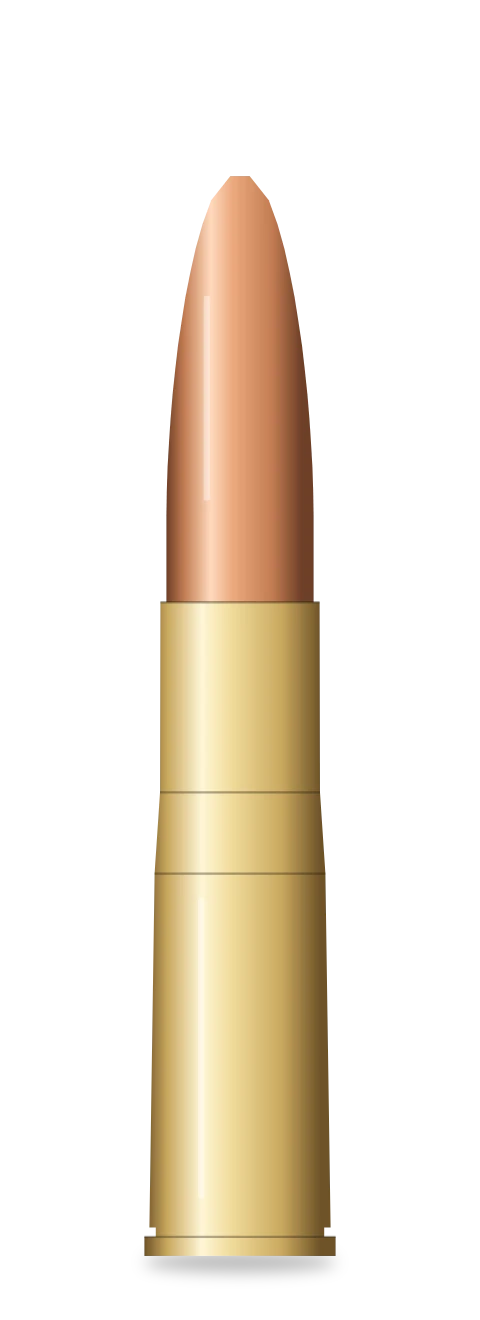
01 / At a glance
The basics
- Origin
- United States
- Introduced
- 2011
- Ignition
- Centerfire
- Case form
- Rimless, bottleneck
- Diameter
- 7.8 mm
- Case length
- 34.7 mm
Rounded values to help you identify the cartridge, not manufacturing drawings. See the cited standard for exact dimensions and tolerances.
Do not mix it up
A .223 Remington or 5.56 NATO cartridge can be chambered in a .300 Blackout rifle, and firing it is dangerous. Mark your magazines and keep the two cartridges apart.
The .300 AAC Blackout, usually written .300 BLK, is a short .30 caliber rifle cartridge built to run in an AR-15 with nothing more than a new barrel. It uses the same bolt, the same magazines and the same lower receiver as a 5.56 rifle, and it fires a bullet more than twice as heavy as a .223 Remington. It was introduced in 2011 and has become the standard choice for suppressed rifles and short-barreled carbines.
This guide explains what the cartridge is, how supersonic and subsonic loads differ, how it performs at 100 to 300 yards, how to choose ammunition and a rifle, and how it compares with the .223 Remington, 7.62x39 and .308 Winchester. It is a reference page, not a loading manual, and it contains no handloading data.
A short history
The idea of a .30 caliber round for the AR-15 is older than the cartridge itself. Wildcatters had been necking the .223 Remington case up to .30 caliber for years, and the best known of these was the .300 Whisper from J.D. Jones, which was designed around subsonic bullets and suppressors. The Whisper was a niche cartridge, and it was never standardized.
Advanced Armament Corporation, a suppressor maker, worked with Remington to turn the idea into a commercial product. The goal was a cartridge that would feed from an unmodified STANAG AR-15 magazine, work with the standard bolt, and give a short-barreled rifle better performance than a 5.56 could. The result was submitted to SAAMI and published as the .300 AAC Blackout in 2011.
The cartridge grew quickly in the civilian market. Dozens of makers now sell rifles, pistols and barrels in .300 BLK, and several ammunition companies load it. Military and law enforcement units have tested it, mainly for use with suppressors, but it has not replaced the 5.56 anywhere on a large scale.
Why it is so popular
The first reason is convenience. Changing from .223 to .300 BLK is a barrel swap and nothing else. The upper receiver, bolt carrier, magazine and lower stay the same. For an owner of an AR-15 it is the cheapest way to try a different caliber.
The second reason is the suppressor. A subsonic .300 BLK load has no supersonic crack, so a suppressed rifle is much quieter than almost any other rifle option. A heavy .30 caliber bullet also keeps enough energy at the low speed to be useful at short range. No common 5.56 load can do that.
The third reason is short barrels. A .223 loses a lot of velocity and makes a great deal of flash in a 7 or 9 inch barrel. The .300 BLK burns its powder charge in a much shorter distance and keeps its performance in barrels of 8 to 10 inches, which is why it is popular in pistol-style AR firearms and compact carbines.
Specifications at a glance
| Specification | Value |
|---|---|
| Bullet diameter | .308 in (7.82 mm) |
| Case length | 1.368 in (34.7 mm) |
| Maximum overall length (SAAMI) | 2.260 in (57.4 mm) |
| Case type | Rimless, bottleneck |
| Primer | Small rifle |
| Maximum average pressure (SAAMI) | 55,000 psi |
| Typical bullet weights | 110 to 125 grains supersonic; 190 to 220 grains subsonic |
| Typical muzzle velocity | About 2,175 ft/s with a 125 grain bullet from a 16 inch barrel |
| Common barrel twist | 1 in 7 or 1 in 8 inches |
Values are rounded for reference. Exact dimensions and tolerances are in the SAAMI standard cited at the end of this page.
Strengths and limits
The .300 BLK is a specialist. It does a few things better than any alternative, and it gives up range to do them.
| Advantage | Limitation |
|---|---|
| Works in an AR-15 with only a barrel change | A 5.56 round can be chambered in a .300 BLK rifle by mistake |
| Excellent with suppressors, with true subsonic loads | Subsonic bullets drop quickly beyond about 150 yards |
| Good performance from very short barrels | Supersonic loads run out of energy past 300 yards |
| Heavy .30 caliber bullets hit hard at short range | Ammunition costs more than 5.56 and is harder to find |
| Mild recoil, even in a short rifle | Not a long-range or large-game cartridge |
It is a short-range cartridge
Out to 150 or 200 yards the .300 BLK is easy to shoot and effective. Past 300 yards the bullet drops and drifts a lot, and its energy is falling. A shooter who wants a rifle for longer shots will be better served by a .308 Winchester, a 6.5 Creedmoor or a .223 Remington with a heavy bullet.
Ballistics
The tables and charts below show one common factory load, a 125 grain open-tip match or hollow point bullet at 2,175 ft/s from a 16 inch barrel, with the rifle zeroed at 200 yards.
| Range (yd) | Velocity (ft/s) | Energy (ft-lb) | Drop (in) | Wind drift, 10 mph (in) |
|---|---|---|---|---|
| 100 | 1933 | 1037 | 3.9 | 1.5 |
| 200 | 1708 | 810 | 0 | 6.3 |
| 300 | 1505 | 628 | -15.9 | 15 |
Reading the numbers
With a 200-yard zero, the bullet rises about 4 inches above the line of sight at 100 yards and is back on the line at 200. At 300 yards it has dropped about 16 inches. A 10 mph crosswind moves it about 6 inches at 200 yards and about 15 inches at 300. Velocity falls from 2,175 ft/s at the muzzle to about 1,500 ft/s at 300 yards, and energy falls from about 1,313 to about 600 foot-pounds.
These figures are for a supersonic load. A subsonic load starts at about 1,000 ft/s with a 200 to 220 grain bullet, drops much faster than a supersonic load and carries roughly 450 to 500 foot-pounds at the muzzle. It is a very quiet load, and a very short-range one.
How these figures were made: the muzzle velocity (2,175 ft/s), the weight (125 grains) and the published velocities at 100, 200 and 300 yards (1,932, 1,708 and 1,505 ft/s) are Hornady figures for its 125 grain American Gunner load from a 16 inch test barrel. The ballistic coefficient was fitted to match those published velocities. Drop, velocity, energy and wind drift are computed with a standard point-mass model, a 200-yard zero, a 1.5 inch sight height and standard atmosphere. They are estimates. Velocity changes with barrel length: a 9 inch barrel loses roughly 200 to 300 ft/s.
Recoil and shooter comfort
The .300 BLK produces more recoil than a .223 Remington, but it is still a light-recoiling cartridge. In a normal AR-15 the push is mild and easy to control, and most shooters will not find it tiring. Subsonic loads in a heavy carbine or a suppressed rifle are even softer.
Short-barreled rifles and pistols can be loud and snappy with supersonic loads, especially without a muzzle device. A suppressor or a good brake changes this a lot. As with any firearm, wear hearing protection. A subsonic load is not silent, even with a suppressor, and a suppressor does not make a rifle safe to shoot without ear protection.
How to choose ammunition
The first choice is between supersonic and subsonic. They are two different tools that share a name, and they behave differently in the rifle.
| Load type | Best for | Notes |
|---|---|---|
| Supersonic, 110 to 125 grains | Defense, hunting at short range, general use | About 2,100 to 2,300 ft/s; flatter path; cycles reliably in most rifles |
| Supersonic, 135 to 150 grains | Hunting and heavier bullets | Slower, with more penetration; fewer choices |
| Subsonic, 190 to 220 grains | Suppressed shooting | About 1,000 ft/s; low energy and a steep trajectory |
| Full metal jacket | Practice and range use | Cheapest; not for hunting |
| Open-tip match and hollow point | Accuracy and defense | Designed to expand; costs more |
Subsonic ammunition
Subsonic loads are built to stay under the speed of sound, about 1,125 ft/s at sea level and normal temperature. Because the bullets are slow, they are designed to expand reliably at low speed. Most subsonic ammunition has a heavy bullet of 190 to 220 grains. Many rifles will not cycle subsonic loads reliably without a suppressor and a suitable gas setup, so test a few magazines before you rely on it.
Supersonic ammunition
Supersonic loads with a 110 to 125 grain bullet are the most common and the most useful for general use. They have enough power to cycle any normal AR-15 and a flatter path than a subsonic load. For hunting, choose a bullet designed to expand at the velocity you will have at the target.
How to choose a rifle
Most .300 BLK rifles are AR-15 style carbines or pistols. The details below matter most.
- Barrel length. Eight to ten inches is the usual choice for a suppressed rifle or pistol. Sixteen inches gives the best velocity from supersonic loads. Pick the length for the way you plan to use the rifle.
- Twist rate. A 1 in 7 or 1 in 8 twist stabilizes the heavy subsonic bullets and also works with supersonic loads.
- Gas system. A short rifle can be over-gassed, which is unpleasant with a suppressor. An adjustable gas block helps.
- Suppressor-ready muzzle. If you plan to use a suppressor, a threaded muzzle with a standard thread pitch saves trouble later.
- Clear markings. Choose a barrel that is clearly marked .300 BLK or .300 AAC Blackout, and a magazine that is clearly marked as well.
Converting an AR-15
An AR-15 owner needs a .300 BLK barrel and, if the gas system is different, a matching gas block and tube. The bolt carrier group, magazines and lower can remain the same, although many shooters fit a .300 BLK-specific bolt and use magazines marked clearly for the new caliber. Local laws about short barrels, pistols and suppressors differ, so check them before building a rifle.
Zeroing and practice
For supersonic loads a 100 or 200-yard zero is practical. A 100-yard zero keeps the path simple, and a 200-yard zero, as in the table above, gives a flatter path out to 250 yards. Subsonic loads need a different zero because the path is so curved, and many shooters zero at 50 yards and keep a separate note of the hold-over for 100 yards. Supersonic and subsonic ammunition hit at different points, so do not mix them without checking.
Practice with the exact load you plan to use. Shoot groups from a rest, then shoot at the distances you expect in the field. Subsonic ammunition is the harder of the two to use well, and a few range sessions will show how much hold-over you need.
Practical uses
Suppressed shooting
This is the cartridge's best use. Subsonic loads in a suppressed rifle are quiet and have no sonic crack, which is useful for pest control, for training and for shooting with less disturbance to neighbors. Suppressor ownership is regulated and rules vary by country and state.
Home and property defense
A short, light .300 BLK carbine is easy to handle indoors, and supersonic expanding bullets have good performance at short range. As with all rifle cartridges, over-penetration in buildings is a real concern. Train with the exact load you intend to use.
Hunting
With a good expanding bullet, supersonic .300 BLK is used on feral hogs, coyotes and deer at short range, usually inside 150 yards. It is not a long-range hunting cartridge. Check local regulations for minimum caliber and energy before using it on deer.
Sport and training
The cartridge is fun on the range. The rifles are light and the recoil is gentle, and steel targets ring well even at 200 yards.
.300 BLK vs similar cartridges
The table lists the cartridges most often compared with the .300 BLK. Figures are rounded and use the SAAMI maximum average pressure.
| Cartridge | Bullet diameter | Case length | Max pressure | Typical use |
|---|---|---|---|---|
| .300 AAC Blackout | .308 in | 1.368 in | 55,000 psi | Short carbines and suppressed rifles |
| .223 Remington | .224 in | 1.760 in | 55,000 psi | Varmints, target and general AR use |
| 7.62x39 | .311 in | 1.524 in | 45,010 psi | AK rifles and carbines |
| .308 Winchester | .308 in | 2.015 in | 62,000 psi | Hunting and long-range rifles |
| 9mm Luger | .355 in | 0.754 in | 35,000 psi | Pistol and pistol-caliber carbines |
Against the .223 Remington, the .300 BLK has a much heavier bullet and a better subsonic option, but a much shorter effective range. Against the 7.62x39, the two are similar in power at 100 yards, and the .300 BLK has the advantage in an AR-15 and with a suppressor. Against the .308 Winchester, the .308 has far more range and energy.
Care and storage
Clean the rifle after each range session. Suppressed rifles collect more carbon in the action, so pay attention to the bolt and carrier. Check the gas tube and gas block for build-up. Store ammunition in a cool, dry place, in labeled boxes, away from .223 or 5.56 ammunition. Keep firearms and ammunition locked and out of reach of children and unauthorized users.
Safety and common mistakes
- Never mix .223 Remington or 5.56 NATO with .300 BLK. A 5.56 cartridge will chamber in a .300 BLK rifle, and firing it can burst the case and wreck the rifle. Mark every .300 BLK magazine clearly, and never keep both cartridges in the same bag or box.
- Do not use a .300 BLK cartridge in a .223 Remington rifle. It will not chamber properly, and forcing it is dangerous.
- Check the barrel marking before every range session, especially when you own more than one AR-15 upper.
- Treat every firearm as loaded. Keep your finger off the trigger until your sights are on the target.
- Know your target and what is beyond it. Supersonic rifle bullets travel far.
- Wear eye and ear protection. A suppressor does not remove the need for hearing protection.
- If you reload, use only published data from a current manual and start low. This page does not contain loading data.
Frequently asked questions
Can I shoot .223 or 5.56 in a .300 Blackout rifle?
No. A .223 or 5.56 cartridge will chamber in a .300 BLK rifle, but firing it is dangerous and can destroy the rifle. Mark your .300 BLK magazines and keep the ammunition separate.
Do I need a new bolt and magazines for .300 BLK?
Normally no. The .300 BLK uses the same bolt face and fits standard AR-15 magazines. You need a .300 BLK barrel and, in some builds, a different gas setup.
What is the difference between supersonic and subsonic .300 BLK?
Supersonic loads use light bullets of 110 to 125 grains at about 2,200 ft/s. Subsonic loads use heavy bullets of 190 to 220 grains at about 1,000 ft/s. Subsonic is for suppressors and short range; supersonic is for general use.
Is .300 Blackout good for deer hunting?
At short range, with a good expanding bullet and a well-placed shot, it works, and many hunters use it inside about 150 yards. It is not a long-range deer cartridge. Check local rules for minimum caliber and energy.
How far can a .300 Blackout shoot?
Supersonic loads are accurate to 300 yards or more, but the bullet drops about 16 inches at 300 yards from a 200-yard zero, and energy is low. Most practical use is inside 200 yards.
Why does .300 BLK need a suppressor to be useful in subsonic form?
It does not need one, but a subsonic load is only quiet in a suppressed rifle. Without a suppressor the powder blast is still loud. The low velocity is the point, because the bullet makes no sonic crack.
What barrel length is best for .300 BLK?
Eight to ten inches is common for suppressed builds. Sixteen inches gives the most velocity from supersonic loads. Choose the length for your use and for local law.
Can I reload .300 BLK brass?
Yes. Brass is widely reloaded, and many shooters make it from .223 Remington cases. Use only published data from a current loading manual and follow its safety instructions.
Sources
Sources reviewed · 29 October 2026