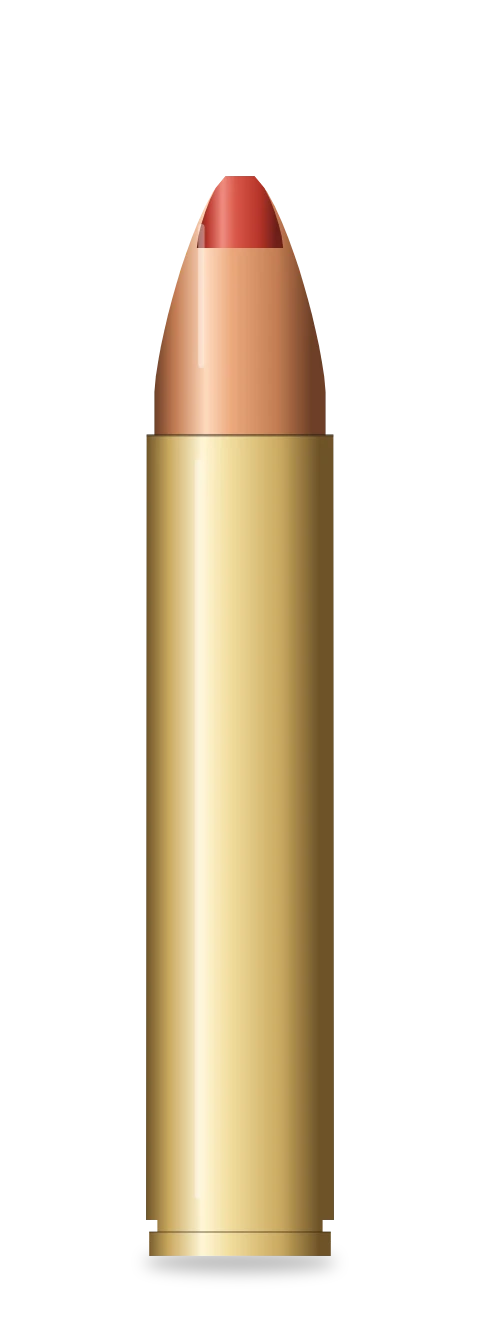
01 / At a glance
The basics
- Origin
- United States
- Introduced
- 2019
- Ignition
- Centerfire
- Case form
- Rebated rim, straight wall
- Diameter
- 9.0 mm
- Case length
- 43.4 mm
Rounded values to help you identify the cartridge, not manufacturing drawings. See the cited standard for exact dimensions and tolerances.
Do not mix it up
The .350 Legend is not interchangeable with the .223 Remington even though the rim and overall length match. Use only the cartridge the rifle is marked for.
The .350 Legend is a straight-wall rifle cartridge from Winchester, made for deer hunters in states and counties that limit them to straight-wall cases. A 150 grain bullet leaves at about 2,325 ft/s, the recoil is lighter than a .243 Winchester, and the cartridge works in bolt-action rifles, single-shots and AR-15 pattern rifles.
This guide explains what the .350 Legend is, how it performs out to 300 yards, how to choose ammunition and a rifle, and how it compares with the .30-30 Winchester, the .300 Blackout, the 7.62x39 and the .243 Winchester. It is a reference page, not a loading manual, and it contains no loading data. Hunting rules change, so check your state's current regulations.
A short history
Winchester introduced the .350 Legend at the 2019 SHOT Show, and SAAMI accepted the cartridge and chamber standard on January 31, 2019. Winchester designed it from scratch. It has no parent case, though its rim diameter and overall length match the .223 Remington.
The reason for the cartridge is regulatory. Several states, including Ohio, Iowa in the past and the southern Lower Peninsula of Michigan, have limited deer hunters with rifles to straight-wall cartridges, usually to keep rifle range short in populated areas. Hunters there had choices such as the .444 Marlin, .45-70 and .450 Bushmaster, which kick hard and drop fast. The .350 Legend was meant to give them a flatter, lighter-recoiling option.
At introduction Winchester called it the fastest production straight-wall hunting cartridge. That claim did not last long. Some .450 Bushmaster, .444 Marlin and .458 Winchester Magnum loads are faster and carry more energy, and the .360 Buckhammer, introduced in 2023, surpassed it on speed. Its appeal is in the mix of flat trajectory, modest recoil and low cost for the class.
Why people shoot it
The first reason is recoil. The .350 Legend is reported to kick less than a .243 Winchester, and it is easy to shoot well. A new hunter, a smaller shooter or a youth hunter can learn on it without the flinch that big straight-wall rounds cause.
The second reason is range for a straight-wall round. A 150 grain bullet starts at about 2,325 ft/s and drops about 7.6 inches at 200 yards with a 100 yard zero. Winchester describes the cartridge as built for lethal effect on large deer out to about 200 yards, and published summaries put the longest practical deer range at about 250 yards. That is farther than most straight-wall hunters need.
The third reason is the platform. It runs in AR-15 pattern rifles with the right barrel and bolt, in bolt-action rifles such as the Winchester XPR and the Ruger American, and in single-shots. A shooter who already owns an AR-15 lower can add a .350 Legend upper.
Specifications at a glance
| Specification | Value |
|---|---|
| Bullet diameter | .355 to .357 in (9.0 mm) |
| Case length | 1.71 in (43 mm) |
| Overall length | About 2.25 in (57 mm) |
| Case type | Rebated rim, straight wall |
| Primer | Small rifle |
| Case capacity | About 36.5 grains of water |
| Maximum average pressure (SAAMI) | 55,000 psi |
| Typical rifling twist | 1 in 16 inches |
| Typical bullet weights | 145 to 180 grains; 255 grain subsonic loads also exist |
| Typical muzzle velocity | About 2,100 to 2,350 ft/s, depending on bullet weight |
Values are rounded for reference. Sources give the bullet diameter as .355 to .357 inch, and the barrel bore is .355 inch. Exact dimensions and tolerances are in the SAAMI standard cited at the end of this page.
Strengths and limits
The .350 Legend is a short- to medium-range deer cartridge. It is not an all-round big-game round.
| Strength | Limit |
|---|---|
| Light recoil, less than a .243 Winchester | Bullets shed velocity and energy quickly past 200 yards |
| Straight-wall case legal in more restricted areas | Rules vary by state and change, so check them every season |
| Works in bolt-action rifles, single-shots and AR-15 pattern rifles | Not made for elk, moose or other large game |
| Low cost for the class and a good choice of bullets | Not interchangeable with the .223 Remington even with matching rim and length |
Honest advice: if your state allows a bottleneck cartridge and you want range, a .243 Winchester or a 6.5 Creedmoor shoots flatter. The .350 Legend earns its place where straight-wall rules apply, and where you want light recoil and a short-range deer rifle.
Pay attention to the rules
Straight-wall regulations differ from state to state and change from year to year. Some states have loosened them. For example, Iowa now accepts cartridges with a bullet diameter of at least .350 inch and at least 500 foot-pounds of muzzle energy, and Indiana now allows centerfire rifle cartridges with bullets of at least .219 inch on public and private land starting with the 2025-26 season. Others require a minimum bullet diameter or a minimum case length. Read the current regulations for your area before you buy a rifle, since they may not match what you find in an article.
Ballistics
The table and charts below show one factory load, a 150 grain Extreme Point bullet at 2,325 ft/s, with the rifle zeroed at 100 yards. Zero at 100 yards suits a cartridge that is mostly used inside 200 yards.
| Range (yd) | Velocity (ft/s) | Energy (ft-lb) | Drop (in) | Wind drift, 10 mph (in) |
|---|---|---|---|---|
| 50 | 2142 | 1529 | 0.2 | 0.5 |
| 100 | 1968 | 1290 | 0 | 2 |
| 150 | 1803 | 1083 | -2.4 | 4.6 |
| 200 | 1648 | 904 | -7.6 | 8.6 |
| 250 | 1504 | 754 | -15.9 | 14 |
| 300 | 1374 | 629 | -28.1 | 21 |
Reading the numbers
With a 100 yard zero the bullet falls about 2.4 inches at 150 yards, 7.6 at 200, 16 at 250 and 28 at 300. A 10 mph crosswind moves it about 2 inches at 100 yards, 8.6 at 200 and 21 at 300. Velocity drops from 2,325 ft/s at the muzzle to about 1,650 ft/s at 200 yards and 1,370 ft/s at 300, and energy from about 1,800 to 900 and 630 foot-pounds.
The numbers show why 200 yards is a practical limit. Out to 150 yards the bullet is easy to place. Past 200 the drop and drift grow quickly, and the energy falls below what many hunters want for a deer. Know your distance and keep the shot inside your range.
How these figures were made: the muzzle velocity (2,325 ft/s), weight (150 grains) and the published velocities at 100, 200 and 300 yards (1,968, 1,647 and 1,373 ft/s) are Winchester figures for its Deer Season XP 150 grain Extreme Point load as listed by a retailer. The ballistic coefficient (G1 0.227) was fitted to match those published velocities. Drop, velocity, energy and wind drift are computed with a standard point-mass model, a 100 yard zero, a 1.5 inch sight height and standard atmosphere. They are estimates. Your rifle and conditions will differ.
Recoil and shooter comfort
Recoil is light to moderate. In a bolt-action rifle of 7 pounds, the .350 Legend kicks about like a .243 Winchester, and some sources report less. In a heavier AR-15 pattern rifle with a gas system, it feels softer still. Most hunters, including youths, shoot it well.
Light recoil means you can practice more and flinch less. Wear hearing protection, since the report is sharp. A suppressor is an option where it is legal, and Winchester offers a subsonic 255 grain load made for suppressed rifles.
How to choose ammunition
Winchester, Federal, Hornady, Barnes, Browning and Underwood load the cartridge. Pick the bullet for the job, and test it in your rifle.
| Load | Muzzle velocity | Best for | Notes |
|---|---|---|---|
| 150 grain Deer Season XP | About 2,325 ft/s | Deer | Polymer-tip hunting bullet; the load in this guide |
| 160 grain Fusion | About 2,300 ft/s | Deer and hogs | Bonded bullet that holds together on bone |
| 165 grain FTX | About 2,200 ft/s | Deer | Polymer-tip bullet with a higher BC |
| 180 grain Power Point | About 2,100 ft/s | Deer at close range | Heavier bullet; more drop |
| 145 grain FMJ | About 2,350 ft/s | Range practice | Cheaper; not for hunting |
| 255 grain Super Suppressed | About 1,060 ft/s | Suppressed shooting | Subsonic; use in a rifle with the right twist |
For deer, a bonded or controlled-expansion bullet is a good choice, since the cartridge runs at moderate speed and the bullet must open reliably at 200 yards. Check that the bullet you choose is rated for the speeds you will see at your range.
Do not mix it up with the .223 Remington
The .350 Legend and the .223 Remington share a rim diameter and an overall length, so they can look alike in a magazine. They are not interchangeable. A .223 round will not fire safely in a .350 Legend chamber, and a .350 Legend round will not work in a .223 rifle. Read the barrel marking and the headstamp every time.
How to choose a rifle
The right rifle depends on where you hunt. These are the points that matter most.
- Legal rules. Confirm that the cartridge and rifle type are legal for deer where you hunt.
- Action. Bolt-actions are accurate and simple. Single-shots are light. AR-15 pattern rifles cycle the cartridge with the right bolt and magazine.
- Barrel length. 16 to 22 inches is common. Short barrels are handy in brush and cost a little velocity.
- Twist rate. Rifles are commonly 1 in 16. A faster twist helps with heavier bullets.
- Weight. A light rifle suits a hunter who walks a lot. A heavier rifle shoots softer.
- Optic. A low-power scope or a red dot works at the ranges the cartridge is made for. A 1 to 6 or 2 to 7 power scope is a good choice.
- Magazine. For an AR-15 pattern rifle, use magazines made for the cartridge.
Zeroing and range practice
A 100 yard zero fits the cartridge. With a 150 grain load the bullet is on the line of sight at 100 yards, about 2 inches low at 150 and nearly 8 inches low at 200. That means you hold on the vitals out to 150 yards and hold a little high at 200.
Shoot a group at 100 yards from a rest, adjust the scope, and confirm at 200. Write down your own drops. The figures in this guide are estimates from a model, and different bullets and barrel lengths change them. Practice from the positions you will hunt from, such as sitting, kneeling or on sticks.
Most deer are shot inside 150 yards, so a cartridge like this suits the way people hunt. Practice judging distance, and pass on a shot that is beyond your ability or the cartridge.
Practical uses
Deer hunting
This is the reason for the cartridge. Winchester developed it for effect on large deer out to 200 yards, and a well-placed bullet from a good load does the job. It is a short- to medium-range rifle, not a mountain rifle.
Hogs and small game
It works on feral hogs with a bonded bullet and good shot placement. For small game, it is more than needed.
Home and ranch use
Because it runs in AR-15 pattern rifles, some shooters use it for ranch work and general-purpose rifles. It is not a long-range cartridge, so match the use to the range.
Suppressed shooting
Subsonic loads at 255 grains run at about 1,060 ft/s and are made for suppressed rifles. Check your local laws on suppressors.
.350 Legend vs similar cartridges
The table compares the .350 Legend with cartridges it is often weighed against. Figures are rounded and use SAAMI pressures.
| Cartridge | Bullet diameter | Case length | Max pressure | Typical use |
|---|---|---|---|---|
| .350 Legend | .357 in | 1.71 in | 55,000 psi | Deer in straight-wall areas |
| .30-30 Winchester | .308 in | 2.039 in | 38,000 psi | Deer in brush and timber |
| .300 Blackout | .308 in | 1.368 in | 55,000 psi | AR-15 pattern rifles and suppressed use |
| 7.62x39mm | .311 in | 1.524 in | 45,010 psi (SAAMI) | AK pattern rifles and short-range deer |
| .243 Winchester | .243 in | 2.045 in | 60,000 psi | Deer and varmints |
Against the .30-30 Winchester, the .350 Legend is faster with a flatter trajectory and works in more platforms, while the .30-30 has a long history and many lever-action rifles. Against the .300 Blackout, it carries a heavier bullet at higher speed and has more energy for deer. Against the 7.62x39, it shoots flatter and carries more energy. Against the .243 Winchester, it has similar recoil but a shorter useful range, and the .243 is not a straight-wall case.
Care and storage
Clean the bore and the action after a day of shooting. Gas-operated rifles need the gas system and bolt cleaned. Inspect the magazine and the scope mounts. Store the rifle unloaded and locked, with the ammunition separate and away from children.
Safety and common mistakes
- Do not confuse the .350 Legend with the .223 Remington. Read the barrel marking and the headstamp.
- Treat every rifle as loaded. Keep your finger off the trigger until the sights are on the target.
- Know your target and what lies beyond it. A rifle bullet can travel more than a mile.
- Wear eye and ear protection.
- Check the bore for obstructions before you load.
- Follow the current hunting regulations for your area, including legal cartridges and rifle types.
- If you reload, use only published data from a current manual and start low. This page does not contain loading data.
- Store firearms and ammunition locked and apart, away from children.
Frequently asked questions
What is the .350 Legend used for?
Mainly deer hunting in states that require straight-wall cartridges. It also works for hogs and for general short-range use.
How far can you shoot a .350 Legend?
Winchester describes it as built for large deer out to about 200 yards. With a 100 yard zero the bullet falls about 7.6 inches at 200 yards and 28 inches at 300.
Is the .350 Legend the same as the .223 Remington?
No. They share a rim diameter and overall length, but the cartridges are different and not interchangeable.
Does the .350 Legend kick hard?
No. It is reported to kick less than a .243 Winchester, and it is comfortable for most hunters, including youths.
What is the maximum pressure of the .350 Legend?
The SAAMI maximum average pressure is 55,000 psi.
Can I shoot .350 Legend in an AR-15?
Yes, with an upper, barrel, bolt and magazine made for the cartridge. A standard .223 Remington upper will not work.
Is the .350 Legend legal in my state?
It depends on the state and the year. Straight-wall rules change, so check the current regulations before you hunt.
Is the .350 Legend good for elk?
No. It is made for deer-size game at short to medium range. For elk, use a larger cartridge with more energy.
Sources
Sources reviewed · 29 October 2026