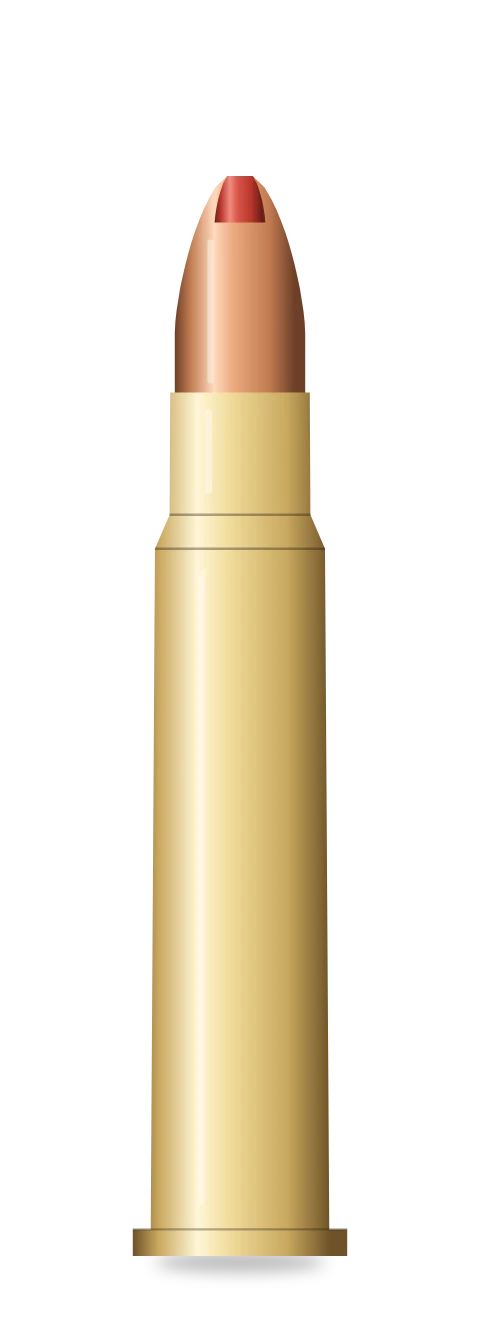
01 / At a glance
The basics
- Origin
- United States
- Introduced
- 1895
- Ignition
- Centerfire
- Case form
- Rimmed, bottleneck
- Diameter
- 7.8 mm
- Case length
- 51.8 mm
Rounded values to help you identify the cartridge, not manufacturing drawings. See the cited standard for exact dimensions and tolerances.
Do not mix it up
The .30-30 is not the same as the .30-06 or the .300 Blackout, and the cartridges are not interchangeable. Pointed bullets should not be used in tube-magazine rifles unless they have a soft tip made for it.
The .30-30 Winchester is a rimmed, mild-recoiling rifle cartridge that fires a .308 inch bullet, usually 150 to 170 grains, at about 2,200 to 2,400 ft/s. It was introduced in 1895 for the Winchester Model 1894 lever-action rifle and has been a deer hunter's standard in North America for well over a century. It is not fast or flat-shooting, but it is accurate, gentle and very good at the ranges where most deer are shot.
This guide explains what the cartridge is, how it performs out to 300 yards, how to choose ammunition and a rifle, and how it compares with the .308 Winchester, the .30-06 Springfield, the .45-70 Government and other cartridges people weigh it against. It is a reference page, not a loading manual, and it contains no handloading data.
A short history
Winchester introduced the .30-30 in 1895 for its Model 1894 lever-action rifle, designed by John Browning. It was one of the first American sporting cartridges loaded with smokeless powder, and that was a selling point. Smokeless powder gave more speed than black powder with less smoke and less fouling.
The name comes from the original load: a .30 caliber bullet over 30 grains of powder. Winchester also called it the .30 WCF, for Winchester Center Fire. Marlin brought out its own lever gun for the cartridge, and it spread across the country. It became the cartridge of choice for farmers, ranchers and deer hunters in the East and Midwest.
Over the decades the cartridge outlived the black-powder era, two world wars and the arrival of the bolt-action hunting rifle. Rifle makers kept building lever guns for it because buyers kept asking, and ammunition makers kept improving the loads. Today it is chambered in classic Winchester and Marlin rifles as well as in newer lever guns from Henry, Mossberg and others, which is rare for a cartridge of its age.
Its reputation rests on a simple record. It has taken more deer than almost any other cartridge in the country, and it has done so with mild recoil and light, handy rifles. Newer cartridges are faster and flatter, but the .30-30 has never gone out of fashion, and modern bullets have given it a second life.
Why it is still popular
The first reason is the rifle. A lever-action .30-30 is light, quick and easy to carry through brush and timber. It balances well, it handles quickly and it holds five to six rounds. For a hunter who walks a lot, that matters more than a flatter path.
The second reason is the recoil. A .30-30 kicks a little more than a .243 Winchester and far less than a .30-06 or a .308 Winchester. New shooters and young hunters can handle it, and most adults shoot it well.
The third reason is cost and availability. Ammunition is sold in nearly every store that sells ammunition, and it costs less than most centerfire hunting rounds. Rifles from Winchester, Marlin, Henry and others are common, new and used.
Specifications at a glance
| Specification | Value |
|---|---|
| Bullet diameter | .308 in (7.8 mm) |
| Case length | 2.039 in (51.8 mm) |
| Overall length (SAAMI) | 2.550 in (64.8 mm) |
| Case type | Rimmed, bottleneck |
| Primer | Large rifle |
| Maximum average pressure (SAAMI) | 38,000 psi |
| Typical bullet weights | 125 to 170 grains; 150 and 170 grains are the most common |
| Typical muzzle velocity | About 2,400 ft/s with a 160 grain bullet from a 24 inch barrel |
| Typical rifling twist | 1 in 12 inches |
Values are rounded for reference. Exact dimensions and tolerances are in the SAAMI standard cited at the end of this page.
Strengths and limits
The .30-30 is a close-range deer cartridge, and it should be judged as one.
| Advantage | Limitation |
|---|---|
| Mild recoil and a light, handy rifle | The path is curved, and range is limited to about 200 yards |
| Cheap and widely available ammunition | Pressure is modest, so heavy game takes careful shots |
| Accurate enough for deer, hogs and black bears | Not a long-range or elk cartridge |
| Works well in thick cover | Pointed bullets are unsafe in tube magazines unless made for them |
A hunter who takes shots inside 150 yards and places the bullet well will find the .30-30 more than enough for deer. A hunter who wants to shoot across open fields or canyons should look at a flatter cartridge.
Tube magazines and bullet shape
Most .30-30 lever guns carry cartridges nose to tail in a tube under the barrel. A hard pointed bullet could, in theory, press on the primer of the next cartridge when the rifle recoils. That is why traditional loads use round or flat-nose bullets. Modern polymer-tip bullets, such as the FTX, have a soft tip that is safe in a tube magazine and gives a flatter path. Do not put ordinary pointed bullets in a tube magazine.
Ballistics
The tables and charts below show one common modern factory load, a 160 grain FTX bullet at 2,400 ft/s from a 24 inch barrel, with the rifle zeroed at 200 yards.
| Range (yd) | Velocity (ft/s) | Energy (ft-lb) | Drop (in) | Wind drift, 10 mph (in) |
|---|---|---|---|---|
| 50 | 2274 | 1836 | 1.6 | 0.3 |
| 100 | 2151 | 1643 | 3 | 1.2 |
| 150 | 2032 | 1467 | 2.6 | 2.9 |
| 200 | 1917 | 1305 | 0 | 5.2 |
| 250 | 1806 | 1159 | -4.9 | 8.4 |
| 300 | 1700 | 1027 | -12.5 | 12.5 |
Reading the numbers
With a 200-yard zero the bullet rises about 3 inches above the line of sight at 100 yards, returns to the line at 200 and falls about 12 inches at 300. A 10 mph crosswind moves it about 1 inch at 100 yards, 5 at 200 and 12 at 300. Velocity drops from 2,400 ft/s at the muzzle to about 1,700 ft/s at 300 yards, and energy from about 2,050 to about 1,030 foot-pounds.
Older round-nose loads at 2,200 ft/s drop faster. Most .30-30 hunters shoot inside 150 yards, where the numbers above are comfortable. A 100-yard zero is common, and the bullet then falls roughly 2 inches at 150 and 6 at 200, but check your own load.
How these figures were made: the muzzle velocity (2,400 ft/s), weight (160 grains) and the published velocities at 100, 200 and 300 yards (2,151, 1,917 and 1,700 ft/s) are Hornady figures for its 30-30 Win 160 grain FTX LEVERevolution load from a 24 inch test barrel. The ballistic coefficient (G1 0.336) was fitted to match those published velocities, and the computed drop matches Hornady's published trajectory (+3.0, 0 and -12.5 inches at 100, 200 and 300 yards). Drop, velocity, energy and wind drift are computed with a standard point-mass model, a 200-yard zero, a 1.5 inch sight height and standard atmosphere. They are estimates. Different bullets and barrel lengths change the results.
Recoil and shooter comfort
The .30-30 has light to moderate recoil. In a lever gun of six to seven pounds it is a gentle push, about like a .243 Winchester or a little more. Most shooters see their hits, and new shooters learn on it easily.
The curved steel butt plate on some lever guns can be hard on the shoulder, and a rubber pad helps. Keep your face off the stock in a rifle with a scope mounted high, because the lever and the scope can get close to your face.
How to choose ammunition
Choose by rifle first, then by purpose. Because of the tube magazine, the bullet shape matters.
| Bullet type | Best for | Notes |
|---|---|---|
| Round-nose soft point, 150 to 170 grains | Deer in brush and timber | The traditional load; safe in tube magazines |
| Flat-nose soft point | Deer and hogs | Safe in tube magazines; more weight forward |
| Polymer tip (FTX) | Deer at longer range | Flatter path; safe in tube magazines |
| Copper solid (MonoFlex) | Areas that require non-lead ammunition | Deep penetration; made for lever guns |
| Light soft point, 125 to 130 grains | Small deer, varmints and light recoil | Faster and flatter, with less weight |
Bullet weight
A 150 grain bullet is a good all-round weight and shoots a little flatter. A 170 grain bullet is the traditional weight with more penetration, and it suits black bear and hogs. A 125 to 140 grain bullet is faster, with less recoil, and it suits small deer.
Check the box
The .30-30 Winchester is not the same as the .30-06 Springfield, the .308 Winchester or the .300 Blackout. The cartridges are not interchangeable. Read the marking on the barrel before you load.
How to choose a rifle
The right rifle depends on how you hunt. These are the points that matter most.
- Action. A lever-action is the classic, with models from Winchester, Marlin, Henry and others. Single-shot and bolt-action rifles exist, and they are stronger and more accurate.
- Weight. A light lever gun of 6 to 7 pounds is easy to carry. A heavier rifle is steadier.
- Barrel length. 20 to 24 inches is usual. A 16 to 18 inch carbine is handy in thick cover, and it loses some velocity.
- Sights. Open sights are traditional and work well inside 100 yards. A low-power scope of 1-4x or 2-7x is a good upgrade, and some rifles have a side-ejecting port that makes scope mounting easy.
- Fit. A rifle that fits you shoots better. Try the stock length and the lever reach before you buy.
- Condition. With a used rifle, check the bore, the action and the lever. Many old guns are in excellent shape, and some are worn.
Zeroing and practice
A 100-yard zero is the most common and the easiest to check. A 150-yard zero keeps the bullet within about 3 inches of the line of sight out to 200 yards, which suits thick cover where shots are close. A 200-yard zero is for open country, where the bullet rises a few inches at midrange.
Practice from field positions: standing, kneeling and sitting. Most shots at deer happen at 50 to 100 yards, so shooting quickly and accurately at those ranges is the most useful skill. Confirm your zero with the load you hunt with.
Practical uses
Deer
This is the core use. With a good bullet and a shot inside 200 yards, the .30-30 is a proven deer cartridge for whitetails and mule deer. It has taken millions of them.
Black bear and hogs
It works on black bear and hogs at close range with a heavier, tough bullet and careful shot placement. Choose a 170 grain bullet and keep the shot close.
Brush and timber hunting
The handy rifle and moderate recoil make it a good choice for hunting in cover, where shots are short and quick. A light carbine is easy to swing through brush.
Plinking and general use
It is a pleasant rifle for the range, though ammunition costs more than for .22 Long Rifle. Many people keep a .30-30 as a general-purpose farm and truck gun.
Elk and large game
It is not a good choice. Bullets are too light and too slow for reliable penetration on elk. A larger cartridge is a better tool.
.30-30 Winchester vs similar cartridges
The table lists the cartridges most often compared with the .30-30 Winchester. Figures are rounded and use SAAMI maximum average pressures.
| Cartridge | Bullet diameter | Case length | Max pressure | Typical use |
|---|---|---|---|---|
| .30-30 Winchester | .308 in | 2.039 in | 38,000 psi | Deer in brush and timber |
| .308 Winchester | .308 in | 2.015 in | 62,000 psi | Hunting and target |
| .30-06 Springfield | .308 in | 2.494 in | 60,000 psi | All-round big game |
| .45-70 Government | .458 in | 2.105 in | 28,000 psi | Close-range big game |
| .357 Magnum | .357 in | 1.290 in | 35,000 psi | Revolvers and lever carbines |
Against the .308 Winchester, the .30-30 has far less speed and range, with less recoil and a lighter rifle. Against the .30-06, it is a much smaller cartridge. Against the .45-70, it has a flatter path and a lighter bullet, while the .45-70 hits harder up close. Against the .357 Magnum carbine, it has much more range and energy.
Care and storage
Clean the bore after each session and after a hunt in wet weather. Wipe the action, the lever and the inside of the magazine tube, and use a light oil. Check the screws on the stock and the scope mounts from time to time. Store the rifle unloaded in a dry place, with a light film of oil on the metal. Keep firearms and ammunition locked and out of reach of children and unauthorized users.
Safety and common mistakes
- Do not put ordinary pointed bullets in a tube magazine. Use round-nose, flat-nose or polymer-tip loads made for lever guns.
- Do not confuse the .30-30 Winchester with the .30-06 Springfield, the .308 Winchester or the .300 Blackout. Read the marking on the barrel and the headstamp before loading.
- Treat every firearm as loaded. Keep your finger off the trigger until your sights are on the target.
- Know your target and what is beyond it. A rifle bullet can travel more than a mile.
- Unload a lever gun by working the lever, and check the chamber and magazine.
- Wear eye and ear protection at the range.
- If you reload, use only published data from a current manual and start low. This page does not contain loading data.
- Store firearms unloaded and locked, and keep the ammunition apart.
Frequently asked questions
Is the .30-30 still good for deer?
Yes. With a good bullet and a shot inside 200 yards, it is a proven deer cartridge. It has taken millions of deer.
How far can a .30-30 shoot?
Most hunters keep shots inside 150 to 200 yards. With modern bullets and a good zero, 250 yards is possible, but the path is curved.
Is the .30-30 good for elk?
No. The bullets are too light and slow for reliable penetration on elk. Use a larger cartridge.
How much recoil does a .30-30 have?
Light to moderate. It is about like a .243 Winchester or a little more, and far less than a .30-06.
Why are .30-30 bullets round or flat-nosed?
Most lever guns have a tube magazine, where the nose of one cartridge sits against the primer of the next. A hard pointed bullet could set off a primer under recoil. Soft-tip bullets such as the FTX are made to be safe.
What is the difference between the .30-30 and the .308?
The .308 Winchester is a much more powerful cartridge, with far more speed and range. The .30-30 has less recoil and is made for lever guns.
What bullet weight is best?
A 150 grain bullet is a good all-round weight. A 170 grain bullet is the traditional weight with more penetration. Choose a load made for lever guns.
Can I reload .30-30 Winchester?
Yes. The brass is widely reloaded. Use only published data from a current loading manual and follow its safety instructions.
Sources
Sources reviewed · 29 October 2026