01 / At a glance
The basics
- Origin
- United States
- Introduced
- 2022
- Ignition
- Centerfire
- Case form
- Rimless, bottleneck
- Diameter
- 8.6 mm
- Case length
- 42.8 mm
Rounded values to help you identify the cartridge, not manufacturing drawings. See the cited standard for exact dimensions and tolerances.
Do not mix it up
Load data and chambers for this cartridge are not set by SAAMI. Use ammunition from a maker that states it is for 8.6 Blackout, in a rifle marked for it.
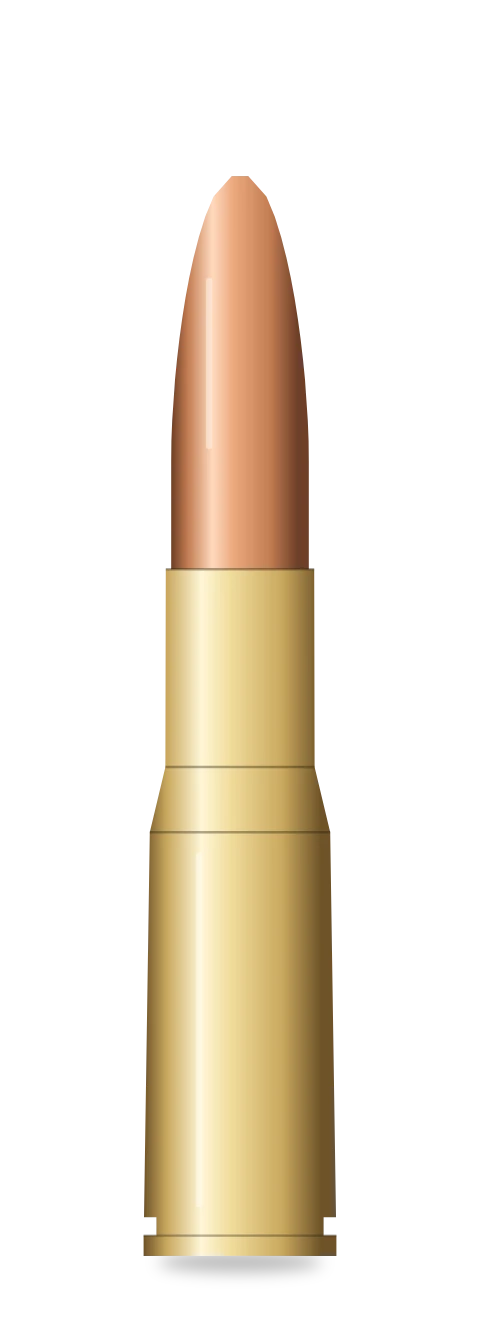
The 8.6 Blackout is a .338 caliber rifle cartridge from Q, LLC. It is made by cutting a 6.5 Creedmoor case down to 1.685 inches and necking it up to hold a bullet of .338 inch. The point is to fire very heavy bullets at subsonic speed from a short action, usually through a suppressor, and to offer a supersonic option for use as a short-range hunting round.
This guide explains what the 8.6 Blackout is, how it performs out to 200 yards in subsonic and supersonic form, how to choose ammunition and a rifle, and how it compares with the .300 Blackout, the 7.62x39 and the .308 Winchester. It is a reference page, not a loading manual, and it contains no loading data.
A short history
Q, LLC is the designer, and the cartridge has been in production since 2022. It is built on the 6.5 Creedmoor case, shortened to 42.8 mm (1.685 inches) so that it fits in a short action, and with the neck opened to take a .338 inch (8.58 mm) bullet. The overall length can run from 2.490 to 2.825 inches, which allows for very long heavy bullets that sit well down in the case.
The cartridge was made for a purpose: shooting subsonic loads from a suppressed rifle. In that role a heavy bullet is the main way to get useful energy at a speed below the speed of sound, which is about 1,125 ft/s at sea level in standard air. A bullet of 285 to 350 grains moving at 1,000 to 1,200 ft/s carries far more energy than a light bullet of the same speed, and it holds that energy over distance.
It has no SAAMI standard. A number of small makers chamber rifles for it, which is typical of a young and specialized cartridge. If you plan to buy one, read the maker information on the rifle and on the ammunition before you shoot.
Why people shoot it
The first reason is subsonic energy. A subsonic 285 grain bullet leaves the muzzle at about 1,050 ft/s with about 700 foot-pounds of energy. A heavier 350 grain bullet at about 1,200 ft/s carries about 1,140. These numbers are not those of a magnum, but they are far above those of a light .30 caliber subsonic load, and they come without the crack of a bullet that breaks the sound barrier.
The second reason is the suppressor. A suppressed rifle that shoots subsonic ammunition makes much less noise than one that shoots supersonic ammunition. Hunters use that for hogs and for pest control, where the shooting is at short range and a quiet shot matters. Suppressors are regulated, so know and follow the law where you live.
The third reason is flexibility. The same rifle can shoot a supersonic hunting load as well. A 210 grain Barnes TSX load leaves a 16 inch barrel at about 1,970 ft/s, and 160 to 225 grain bullets are the design range for supersonic ammunition. That makes it a short-range hunting rifle with a quiet option.
Specifications at a glance
| Specification | Value |
|---|---|
| Bullet diameter | .338 in (8.58 mm) |
| Case length | 1.685 in (42.8 mm) |
| Overall length | 2.490 to 2.825 in (63.25 to 71.75 mm) |
| Case type | Rimless, bottleneck |
| Parent case | 6.5 Creedmoor |
| Designer | Q, LLC (2022) |
| Subsonic bullet weights | 285 to 350 grains |
| Supersonic bullet weights | 160 to 225 grains |
| Standardization | No SAAMI standard |
Values are rounded for reference. There is no SAAMI drawing, so chamber and ammunition details come from the makers. This page does not state a maximum pressure, since none is published in the sources used.
Strengths and limits
The 8.6 Blackout is a specialist cartridge. These are the trade-offs to understand.
| Strength | Limit |
|---|---|
| Heavy .338 bullets with real subsonic energy | Very steep drop at 150 to 200 yards in subsonic form |
| Quiet when suppressed | Needs a suppressor to get the benefit, and these are regulated |
| Short action, short barrel | No SAAMI standard and a small number of rifle makers |
| Also works as a supersonic round | The supersonic load is not a long-range load |
Honest advice: if you want a quiet, short-range round and you already own a .300 Blackout, check whether the extra weight and cost of the 8.6 are worth it. The cartridge makes sense for people who want the largest subsonic bullet in a compact rifle and accept its short reach.
The drop problem
Subsonic bullets are slow. The 285 grain load in this guide drops about 12 inches at 150 yards and about 32 inches at 200 yards from a 100 yard zero. That is steep. It is a cartridge for short shots, or for shooters who know their holdovers well and range every target.
Ballistics
The tables and charts below compare two loads from a 16 inch barrel with the rifle zeroed at 100 yards: a Gorilla 285 grain subsonic load at 1,050 ft/s, and a Gorilla 210 grain Barnes TSX supersonic load at 1,970 ft/s. They show the two ways the cartridge is used.
| Range (yd) | Velocity (ft/s) | Energy (ft-lb) | Drop (in) | Wind drift, 10 mph (in) |
|---|---|---|---|---|
| 50 | 1033 | 676 | 3.3 | 0.2 |
| 100 | 1018 | 656 | 0 | 0.8 |
| 150 | 1003 | 637 | -11.7 | 1.8 |
| 200 | 990 | 620 | -32 | 3.1 |
| Range (yd) | Velocity (ft/s) | Energy (ft-lb) | Drop (in) | Wind drift, 10 mph (in) |
|---|---|---|---|---|
| 50 | 1878 | 1644 | 0.5 | 0.3 |
| 100 | 1788 | 1491 | 0 | 1.3 |
| 150 | 1702 | 1351 | -3.2 | 3.1 |
| 200 | 1619 | 1222 | -9.4 | 5.6 |
Reading the numbers
The subsonic load falls from 1,050 ft/s at the muzzle to about 990 ft/s at 200 yards, so it stays subsonic, with about 620 foot-pounds left. Its drop from the 100 yard zero is about 12 inches at 150 yards and 32 inches at 200. A 10 mph crosswind moves it about 3 inches at 200 yards. The supersonic load falls from about 1,970 ft/s to about 1,620 ft/s at 200 yards, with about 1,220 foot-pounds left, a drop of about 9 inches and a 10 mph wind drift of about 6 inches.
The two loads shoot to different points of aim at the same range. Anyone who uses both should zero for one and learn the other, and should not assume that a single zero covers both.
How these figures were made: the muzzle velocities (1,050 and 1,970 ft/s), weights (285 and 210 grains) and the published velocities at 100 and 200 yards (1,018 and 990 ft/s for the 285 grain load, 1,788 and 1,619 ft/s for the 210 grain load) are Gorilla Ammunition figures from a 16 inch barrel, as listed in a published ballistic chart. The ballistic coefficients (G1 0.754 and 0.412) were fitted to those velocities, and the subsonic value is a modeling convenience rather than a measured number. Drop, energy and wind drift are calculated with a standard point-mass model, a 100 yard zero, a sight height of 1.5 inches and standard atmosphere. They are estimates. Your rifle and conditions will differ.
Recoil and shooter comfort
Recoil depends on the load. Subsonic loads are slow and heavy, and they push rather than snap. In a rifle of normal weight with a suppressor attached, which adds weight at the muzzle, they are mild. Supersonic loads kick more, though the cartridge is a short one. Most adults shoot either without trouble.
A suppressor cuts the report and some of the felt recoil. Wear hearing protection anyway, since a suppressed rifle is quieter but not silent, and the range may be loud. Eye protection matters too.
How to choose ammunition
Gorilla Ammunition and Fort Scott are among the makers listed in published load charts. Match the bullet to the job, and test the load in your own rifle and with your own suppressor.
| Load | Muzzle velocity | Best for | Notes |
|---|---|---|---|
| 285 grain subsonic | About 1,000 to 1,050 ft/s | Suppressed shooting at short range | Heavy bullet; steep drop past 100 yards |
| 342 to 350 grain subsonic | About 1,000 to 1,200 ft/s | Suppressed hunting at short range | Heaviest loads; most energy |
| 210 grain Barnes TSX | About 2,000 ft/s | Hunting at short range | Supersonic copper bullet |
| 190 grain hollow point | About 2,200 ft/s from 16 in | General short-range use | Supersonic; lighter bullet |
For hunting, choose a bullet made to expand at the speed it will have on the animal. Subsonic bullets need a design made for low velocity, and a supersonic bullet may not open properly at subsonic speed. Do not swap one for the other without checking what the maker says.
Check the headstamp and the rifle
Because there is no SAAMI standard, buy ammunition from a maker who states it is for the 8.6 Blackout, and use it in a rifle marked for it. Do not assume that a similar-looking .338 round will fit.
Cost
The cartridge is new, and ammunition costs more than for common cartridges. Plan your practice around that. Many shooters keep a small amount of subsonic ammunition for the field and practice with the supersonic load.
How to choose a rifle
The right rifle depends on how you plan to use it. These are the points that matter most.
- Action type. Rifles are made as bolt-action, semi-automatic and single-shot designs. Choose the one that suits your use and your suppressor.
- Barrel length. A 16 inch barrel is common for a suppressed rifle. Barrel length changes velocity, and shorter barrels cut it noticeably.
- Twist rate. A heavy .338 bullet needs a twist made for it. Match the twist to the bullet weights you will shoot.
- Suppressor mount. Check that the muzzle thread suits your suppressor and that the suppressor is rated for the cartridge.
- Magazines. Check that the magazines are made for the cartridge and feed reliably.
- Weight. A short rifle with a suppressor is easy to carry, though the muzzle weight changes the balance.
- Optic. A low-power scope or a red dot suits short-range use.
Makers who have offered rifles in 8.6 Blackout include Q, Chattahoochee Munitions, Faxon Firearms, Gorilla Ammunition, Bear Creek Arsenal, Robinson Armament and Rossi. Not every model is still in production, so check current catalogs.
Zeroing and range practice
A 100 yard zero is a sensible default for a suppressed rifle. With the subsonic 285 grain load the bullet is on target at 100 yards, a few inches high at 50, and well below the line of sight past 150 yards. Learn the holdover at 150 and 200 yards and write it on a card.
Zero at 50 yards if you shoot mainly at close range, and check at 100. Shoot the subsonic load at the distances you plan to use it, since its drop is steep. The numbers in this guide are estimates from a model, and your barrel, load and suppressor will move them.
Check the zero with the suppressor on and off. Some suppressors shift the point of impact. If you use both subsonic and supersonic loads, zero for the one you use most and learn the offset of the other.
Practical uses
Hog and pest control
The heavy subsonic bullet is used for hogs and for pest control at short range with a suppressor, where a quiet shot matters. Use a bullet made for the animal and keep shots close.
Deer at short range
With a supersonic expanding bullet, the cartridge can be used on deer at short range where the law permits. Check local rules for caliber and energy, and keep shots in the range where you can place the bullet well.
Suppressed range shooting
It is a fun cartridge to shoot at a range with a suppressor, where the heavy bullet makes a clear impact on steel. Check your range rules first, since not every range allows heavy bullets on steel.
Not a long-range cartridge
It is not made for long range. A shooter who wants reach is better served by a cartridge with a faster, flatter bullet.
8.6 Blackout vs similar cartridges
The table compares the 8.6 Blackout with the cartridges it is usually weighed against. Figures are rounded, and the 8.6 Blackout has no SAAMI pressure.
| Cartridge | Bullet diameter | Case length | Max pressure | Typical use |
|---|---|---|---|---|
| 8.6 Blackout | .338 in | 1.685 in | No SAAMI standard | Suppressed short-range use |
| .300 Blackout | .308 in | 1.368 in | 55,000 psi | Suppressed use and short-range hunting |
| 7.62x39 | .311 in | 1.524 in | 45,010 psi | Short-range hunting and sporting |
| .308 Winchester | .308 in | 2.015 in | 62,000 psi | Hunting and target |
| 6.5 Creedmoor | .264 in | 1.920 in | 62,000 psi | Target and hunting |
Against the .300 Blackout, the 8.6 fires heavier bullets and offers more subsonic energy, while the .300 Blackout has far more rifles, magazines and ammunition. Against the 7.62x39, it is a quiet-use cartridge and the 7.62x39 is a cheap supersonic one. Against the .308 Winchester, it is shorter and slower with a short reach, and the .308 is the better long-range and general-purpose cartridge.
Care and storage
Clean the bore after a day of shooting, and follow the suppressor maker's instructions for its care, since suppressors collect carbon and need attention. Inspect the action, the magazine and the mounts for tightness. Store the rifle unloaded and locked, with the ammunition separate and away from children.
Safety and common mistakes
- Use ammunition made for the 8.6 Blackout, in a rifle marked for it. There is no SAAMI standard to rely on.
- Treat every rifle as loaded. Keep your finger off the trigger until the sights are on the target.
- Know your target and what lies beyond it. A .338 bullet can travel a long way, even a subsonic one.
- Wear eye and ear protection, even with a suppressor.
- Check the bore for obstructions before you load.
- Make sure the suppressor is made for the cartridge and mounted correctly, and follow the law about owning it.
- Do not use subsonic bullets for hunting beyond the range at which they expand and hit the target.
- If you reload, use only published data from a current manual and start low. This page does not contain loading data.
- Store firearms and ammunition locked and apart, away from children.
Frequently asked questions
What is the 8.6 Blackout?
It is a .338 caliber rifle cartridge from Q, LLC, built on a shortened 6.5 Creedmoor case. It is made for heavy subsonic bullets and suppressed use, and it also has supersonic loads.
Is the 8.6 Blackout a SAAMI cartridge?
No. The sources used for this page do not list a SAAMI standard. Use ammunition and rifles made by makers who state they are for the cartridge.
What bullet weights does the 8.6 Blackout use?
The design range is about 285 to 350 grains for subsonic loads and 160 to 225 grains for supersonic loads.
How fast is a subsonic 8.6 Blackout?
Subsonic loads run at about 1,000 to 1,200 ft/s. A 285 grain load leaves at about 1,050 ft/s from a 16 inch barrel.
How far can you shoot the 8.6 Blackout?
It is a short-range cartridge. The subsonic 285 grain load in this guide falls about 32 inches at 200 yards from a 100 yard zero.
Is the 8.6 Blackout better than the .300 Blackout?
It depends. It fires heavier bullets and offers more subsonic energy, while the .300 Blackout has more rifles and ammunition and is cheaper to shoot.
Do I need a suppressor for the 8.6 Blackout?
No, but the cartridge is made for suppressed use, and it makes the most sense with one. Suppressors are regulated, so follow the law where you live.
What case is the 8.6 Blackout based on?
It is based on the 6.5 Creedmoor case, cut to 1.685 inches and necked to hold a .338 inch bullet.
Sources
Sources reviewed · 29 October 2026