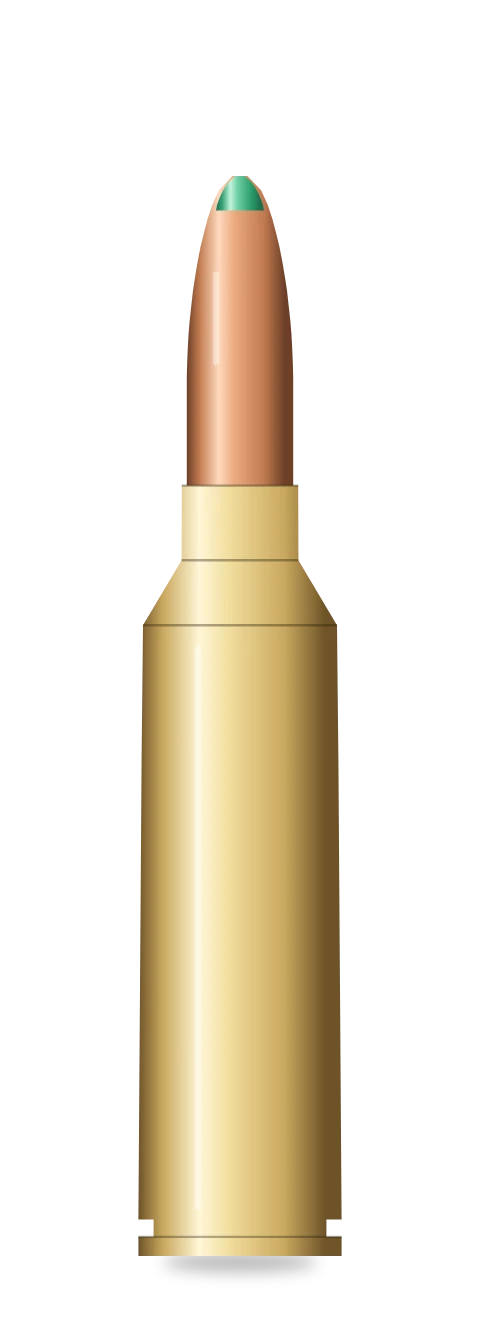
01 / At a glance
The basics
- Origin
- United States
- Introduced
- 2019
- Ignition
- Centerfire
- Case form
- Rimless, bottleneck, hybrid
- Diameter
- 7.1 mm
- Case length
- 51.2 mm
Rounded values to help you identify the cartridge, not manufacturing drawings. See the cited standard for exact dimensions and tolerances.
Do not mix it up
The hybrid case and the very high pressure mean this ammunition must only be used in a rifle marked for .277 Fury. Do not try to use or reload it in any other chamber.
The .277 Fury, also called the 6.8x51mm, is a rifle cartridge developed by SIG Sauer for the US Army's Next Generation Squad Weapon program. It uses a hybrid case with a steel head and a brass body, and it runs at a pressure far above any traditional rifle cartridge. That pressure is the point: it lets a .277 inch bullet leave the muzzle near 3,000 ft/s from a rifle with a battle-rifle sized action.
This guide explains what the .277 Fury is, how it performs out to 500 yards, how to choose ammunition and a rifle, and how it compares with the .308 Winchester, the 6.5 Creedmoor, the 6.5 PRC and the 6.8 SPC. It is a reference page, not a loading manual, and it contains no loading data. The cartridge is built around a special case, so reloading is a different matter from reloading a brass cartridge.
A short history
SIG Sauer designed the cartridge in 2019 for the Army's Next Generation Squad Weapon program, which aimed to replace the 5.56 NATO M4 carbine and the M249 squad automatic weapon. SIG announced a commercial version in late 2019, and the cartridge was accepted by SAAMI in 2020, with a drawing dated September 2020. In April 2022 the Army selected SIG Sauer's entries for the program: the XM5 rifle (later the M7) and the XM250 automatic rifle (later the M250), both chambered for the cartridge under the military name 6.8 common cartridge.
The commercial name .277 Fury and the military name 6.8x51mm describe the same family. The military load is the XM1186 general-purpose cartridge. SIG sells the cartridge to civilians, with the SIG CROSS bolt-action rifle announced in late 2019 and the MCX Spear semi-automatic rifle as the best-known firearms.
The design solves a specific problem. Rifle makers wanted a faster, flatter, harder-hitting bullet than 5.56 or 7.62 NATO, in a rifle not much larger than a standard one. The answer was a very high chamber pressure, which a conventional brass case cannot hold at that level. SIG's case therefore joins a steel head to a brass body with an aluminum locking washer.
A practical point for owners: the cartridge was built to survive military handling, and its pressure is the highest of any common rifle round. That is why the SAAMI drawing carries a note that pressure above 65,000 psi calls for a different case and firearm design. If you buy a rifle for it, treat the rifle and ammunition as one system, keep the ammunition in its original box, and do not mix it with other .277 inch ammunition.
It also helps to remember what the cartridge is not. It is not a replacement for a good deer rifle that you already own, and it is not a long-range match cartridge, since its bullet has a modest ballistic coefficient. It is a fast, flat-shooting, high-pressure cartridge for people who want exactly that.
Why people are interested
The first reason is the military adoption. A cartridge chosen to replace the 5.56 in a major army draws attention from shooters, and the MCX Spear and the CROSS put it in civilian hands.
The second reason is the speed. A 150 grain AccuBond load leaves a 24 inch barrel at about 3,120 ft/s, and a 16 inch barrel at about 3,240 ft/s in SIG data, with 2,830 foot-pounds at the muzzle. For a .277 inch bullet of that weight, that is a very fast load and the reason the cartridge attracts hunters.
The third reason is the novelty. A hybrid case is unusual, and shooters like to see how it works. The cost of that novelty is a narrow choice of ammunition, rifles and reloading components.
Specifications at a glance
| Specification | Value |
|---|---|
| Bullet diameter | .2780 in (7.06 mm) |
| Case length | 2.015 in (51.2 mm) |
| Overall length | 2.825 in (71.8 mm) |
| Case type | Rimless, bottleneck, hybrid (steel head, brass body, aluminum locking washer) |
| Maximum average pressure (SAAMI) | 80,000 psi |
| Rifling twist | 1 in 7 in |
| Military designation | 6.8x51mm, 6.8 common cartridge |
| Typical bullet weights | 113 to 155 grains |
| Typical muzzle velocity | About 2,750 to 3,200 ft/s depending on the load |
Values are rounded for reference. Pressure and dimensions are from the SAAMI cartridge drawing, which also states that a pressure above 65,000 psi requires a different case and firearm design. Velocities are SIG Sauer figures.
Strengths and limits
The .277 Fury is a very high-pressure cartridge. These are the trade-offs to understand.
| Strength | Limit |
|---|---|
| Very high velocity for the bullet weight | Pressure of 80,000 psi demands rifles built for it |
| Flat trajectory and good energy at 500 yards | Few rifle models and a narrow ammunition choice |
| Fits a compact action | Hybrid case, so reloading is not like reloading brass |
| Proven interest from the military | Ammunition costs more than for common cartridges |
Honest advice: for most hunters and target shooters, the .308 Winchester, the 6.5 Creedmoor or the 6.5 PRC do the same work with cheaper, more available ammunition and many more rifles. The .277 Fury makes sense if you want the cartridge itself, or the rifles chambered for it.
Bullet and ammunition choice
SIG Sauer offers several loads, including a 113 grain hybrid ball, a 135 grain brass elite load, a 155 grain match load and a 150 grain AccuBond hunting load. Some of its earlier loads, including a 135 grain hybrid match and a 140 grain hunting load, have been listed as discontinued.
Note that some SIG ammunition is loaded in the hybrid case and some in a brass case. Check the box, because hybrid cases need the matching rifle.
Ballistics
The table and charts below show one factory load, a SIG Sauer 150 grain AccuBond hybrid load at 3,120 ft/s from a 24 inch barrel, with the rifle zeroed at 200 yards.
| Range (yd) | Velocity (ft/s) | Energy (ft-lb) | Drop (in) | Wind drift, 10 mph (in) |
|---|---|---|---|---|
| 100 | 2921 | 2842 | 1.3 | 0.6 |
| 200 | 2731 | 2484 | 0 | 2.3 |
| 300 | 2549 | 2164 | -6 | 5.4 |
| 400 | 2374 | 1877 | -17.3 | 10 |
| 500 | 2206 | 1621 | -34.8 | 16.1 |
Reading the numbers
With a 200 yard zero the bullet rises about 1 inch above the line of sight at 100 yards, returns to the line at 200 and falls about 6 inches at 300, 17 at 400 and 35 at 500. A 10 mph crosswind moves it about 5 inches at 300 yards, 10 at 400 and 16 at 500. Velocity drops from 3,120 ft/s at the muzzle to about 2,210 ft/s at 500 yards, and energy from about 3,240 to about 1,620 foot-pounds.
The trajectory is flat for a rifle cartridge of this size, and the bullet keeps real energy at 500 yards. The wind drift is similar to a 6.5 Creedmoor, since the ballistic coefficient is modest. Use a bullet that expands at the speeds you expect, and check local rules for caliber and energy minimums.
How these figures were made: the muzzle velocity (3,120 ft/s from a 24 inch barrel), the bullet weight (150 grains) and the G1 ballistic coefficient (0.500) are SIG Sauer figures for its 150 grain AccuBond hybrid load. Drop, velocity, energy and wind drift are calculated with a standard point-mass model, a 200 yard zero, a sight height of 1.5 inches and standard atmosphere. The muzzle energy in SIG data (2,830 foot-pounds) uses a different basis from the 3,240 shown here, so treat both as approximate. They are estimates. Your rifle and conditions will differ.
Recoil and shooter comfort
Recoil is moderate to firm. The high velocity of the bullet gives the cartridge more recoil than a 6.5 Creedmoor in the same rifle weight, though less than a .300 Winchester Magnum. A suppressor and a muzzle device are common on rifles built for it.
Use good hearing protection, and consider both plugs and muffs on the range. The high pressure also means a loud report, so protect your hearing.
How to choose ammunition
SIG Sauer makes most of the commercial ammunition. Match the bullet to the job and test the load in your own rifle.
| Load | Muzzle velocity | Best for | Notes |
|---|---|---|---|
| 113 grain hybrid ball | About 3,200 ft/s | Range practice | Hybrid case |
| 135 grain brass elite | About 2,750 ft/s | Practice and target | Brass case |
| 155 grain match | About 3,000 ft/s | Target | Match bullet |
| 150 grain AccuBond hybrid | About 3,120 ft/s from 24 in | Hunting | Bonded hunting bullet |
For hunting, choose a bonded or controlled-expansion bullet suited to the speed. For practice, ball and match loads cost less. Try more than one load, since a rifle often prefers one.
Check the headstamp and the rifle
Do not confuse .277 Fury ammunition with other .277 inch cartridges such as the 6.8 SPC. They are not interchangeable and the pressure of the Fury is much higher. Always read the barrel marking and the headstamp.
Cost
The hybrid case costs more than brass, and so does the ammunition. Plan your practice with that in mind.
How to choose a rifle
The right rifle depends on how you hunt or shoot. These are the points that matter most.
- Chambering and pressure. Buy only a rifle made for the .277 Fury. Its 80,000 psi is far above what a rifle for a brass-case cartridge is built for.
- Action. Semi-automatic and bolt-action rifles exist. The SIG MCX Spear is a semi-automatic and the SIG CROSS is a bolt-action.
- Barrel length. 16 inches gives a compact rifle with a loss of speed, and 24 inches gives more velocity.
- Twist rate. The cartridge uses 1 in 7 inches. Check the rate the maker uses.
- Weight. A lighter rifle is easier to carry and kicks harder. A heavier rifle is steadier.
- Suppressor. Check that the muzzle and the local rules allow one.
- Optic. A good variable-power scope with reliable adjustments suits the cartridge.
The SIG MCX Spear is the best-known semi-automatic, and SIG also made the CROSS bolt-action rifle. Check current catalogs, since the range is small and changing.
Zeroing and range practice
A 200 yard zero is a good starting point. With a 150 grain AccuBond the bullet stays within about 1.5 inches of the line of sight out to 150 yards and drops about 6 inches at 300 yards. That lets you hold on the vital area out to about 300 yards.
Zero at 100 yards on paper first, then confirm at 200. Shoot at 300, 400 and 500 to learn your own drops, and write them on a card. The numbers in this guide are estimates from a model, and your barrel, load and air density will move them. Wind is the main problem past 400 yards, so practice judging it.
Shoot from field positions as well as a bench. Practice at the distances you plan to take.
Practical uses
Deer and similar game
The 150 grain AccuBond load is made for deer-size game. It shoots flat and carries energy to 400 yards or more, though closer shots are better. Check local rules on minimum caliber and energy.
Hogs
It handles hogs well with a bonded bullet, and the semi-automatic rifles give quick follow-up shots.
Elk
It is a light choice for elk, and many hunters prefer a larger cartridge for the extra margin. Check your local rules.
Range and tactical use
The cartridge was designed for military use, and the MCX Spear is popular as a range rifle. Cost is the main limit on volume practice.
.277 Fury vs similar cartridges
The table compares the .277 Fury with the cartridges it is usually weighed against. Figures are rounded and use SAAMI pressures.
| Cartridge | Bullet diameter | Case length | Max pressure | Typical use |
|---|---|---|---|---|
| .277 Fury | .278 in | 2.015 in | 80,000 psi | Military, hunting and range |
| .308 Winchester | .308 in | 2.015 in | 62,000 psi | All-round hunting and target |
| 6.5 Creedmoor | .264 in | 1.920 in | 62,000 psi | Target and hunting |
| 6.5 PRC | .264 in | 2.030 in | 65,000 psi | Long-range hunting and target |
| 6.8 SPC | .277 in | 1.687 in | 55,000 psi | Short-range hunting and carbine |
Against the .308 Winchester, the Fury has the same case length and much higher pressure, with a smaller bullet at higher speed. Against the 6.5 Creedmoor and 6.5 PRC, it offers more speed and less choice. Against the 6.8 SPC, it is a much larger and faster cartridge. The shared .277 inch diameter does not make them interchangeable.
Care and storage
Clean the bore after a day of shooting, and follow the barrel maker's advice. Inspect the action, the magazine and the scope mounts for tightness. Rifles for this cartridge see high pressure, so follow the maker's inspection schedule. Store the rifle unloaded and locked, with the ammunition separate and away from children.
Safety and common mistakes
- Never fire .277 Fury ammunition in a rifle not chambered for it, and never fire another cartridge in a .277 Fury rifle.
- Do not confuse it with the 6.8 SPC or other .277 inch cartridges. Read the barrel marking and the headstamp.
- Treat every rifle as loaded. Keep your finger off the trigger until the sights are on the target.
- Know your target and what lies beyond it. A rifle bullet can travel several miles.
- Wear eye and ear protection.
- Check the bore for obstructions before you load.
- If you reload, use only data and components made for the cartridge. This page does not contain loading data.
- Store firearms and ammunition locked and apart, away from children.
Frequently asked questions
What is the .277 Fury?
It is a rifle cartridge developed by SIG Sauer for the US Army, also known as the 6.8x51mm. It uses a hybrid case with a steel head and a brass body.
What is the maximum pressure of the .277 Fury?
The SAAMI maximum average pressure is 80,000 psi, far above most rifle cartridges.
Is the .277 Fury a SAAMI cartridge?
Yes. SAAMI accepted it in 2020.
How fast is the .277 Fury?
A 150 grain AccuBond load leaves a 24 inch barrel at about 3,120 ft/s, and a 16 inch barrel at about 3,240 ft/s in SIG data.
What twist rate does the .277 Fury use?
The cartridge uses 1 in 7 inches.
Is the .277 Fury better than the .308 Winchester?
It is faster with a smaller bullet, but the .308 has far more rifles, ammunition and reloading support. For most shooters the .308 is the practical choice.
Can I reload the .277 Fury?
The hybrid case is not like a brass case, so reloading needs components and data made for it. Use only published data from the maker.
Is the .277 Fury the same as the 6.8 SPC?
No. Both use a .277 inch bullet, but the Fury is a much larger, faster, higher-pressure cartridge, and the two are not interchangeable.
Sources
Sources reviewed · 29 October 2026